 QA
It’s 4:40 on a Thursday. A hiring manager has 31 applications for one SDET role and a meeting at five. She opens your CV, sees a GitHub link, and clicks it. You have about 90 seconds.
What she finds in those 90 seconds decides whether your QA portfolio 2027 gets you an interview or gets you closed. I’ve been on both sides of that screen many times over 11+ years in QA, and the pattern is surprisingly consistent.
The short answer: a strong QA portfolio in 2027 is two or three focused repositories, not twenty. Each one solves a realistic testing problem, runs green in CI, explains its decisions in a README, and shows you can judge AI-generated tests rather than just produce them. A pinned profile and a one-page case study tie it together.
Reading time: about 12 minutes. Written for QA engineers, SDETs and career-switchers getting ready for 2027 job applications. Last updated November 25, 2026.
What a QA Portfolio 2027 Is (and What It Isn’t)
A QA portfolio is public evidence that you can find risk, build reliable checks for it, and explain your decisions. That’s it. Everything in it should serve one of those three jobs.
People get this wrong in predictable ways, so let’s clear it up:
| A strong portfolio is… | It isn’t… |
|---|---|
| 2–3 repositories you’d defend line by line | 25 forked tutorials with your name on them |
| Tests against a realistic app, with real edge cases | A login test against a demo site and nothing else |
| A pipeline that runs on every push and stays green | Code that only ever ran on your laptop |
| A README explaining why, not just how | A README that says “run npm test” |
| Proof you can review and fix AI-generated tests | A folder of tests an AI wrote that you never read |
| A short case study of a bug you found and why it mattered | A list of tools under “Skills” |
The 2027 twist is the AI row. When anyone can produce 200 tests in an afternoon, volume proves nothing. What proves something is judgement: which tests you kept, which you deleted, and why. If you want the full skill picture behind that, I broke it down in SDET Skills 2027.
The 90-Second Review: What Gets Opened, in Order
Reviewers rarely read a portfolio. They scan it, in roughly the same order every time. Here’s that order, and what each stop needs to show.
0–10 seconds: your GitHub profile. The first impression is your pinned repositories and profile README. GitHub shows a profile README when you create a public repository with the same name as your username (GitHub Docs). Pin your best QA work so it’s the first thing on the page. If the top of your profile is a 2019 tutorial fork, the scan often ends here.
10–30 seconds: the top of one README. The reviewer wants three answers fast: what this tests, why it’s interesting, and whether it runs. A one-line problem statement, a CI badge and a screenshot of the report answer all three before they scroll.
30–50 seconds: the CI run. A green badge is a claim. The Actions tab is the proof. Reviewers click into the latest run to check it actually executes tests, not just a lint step, and to see how long it takes.
50–75 seconds: one test file. This is where most portfolios win or lose. Reviewers open a spec at random and look for clear names, meaningful assertions, no hard-coded sleeps and no copy-paste blocks.
75–90 seconds: the commit history. One giant “initial commit” suggests the code was dumped in. A steady trail of small, well-described commits suggests someone who works like an engineer.
Notice what’s missing: nobody counts your tests. A 40-test suite with sharp assertions beats a 400-test suite of noise every time.
[Image prompt for Gemini: “Clean flat infographic, 16:9, dark navy background with teal and amber accents. A horizontal timeline bar with five evenly spaced circular stops, each holding a simple icon: a user profile card with pinned tiles, a document page, a pipeline with a green check, a code file under a magnifying glass, and a branching commit graph. A small stopwatch sits at the start of the bar and a checkered flag at the end. Minimal, modern, no text or numbers.” Alt text: the five stops a hiring manager checks when reviewing a QA portfolio 2027]
6 QA Portfolio Projects That Get Interviews in 2027
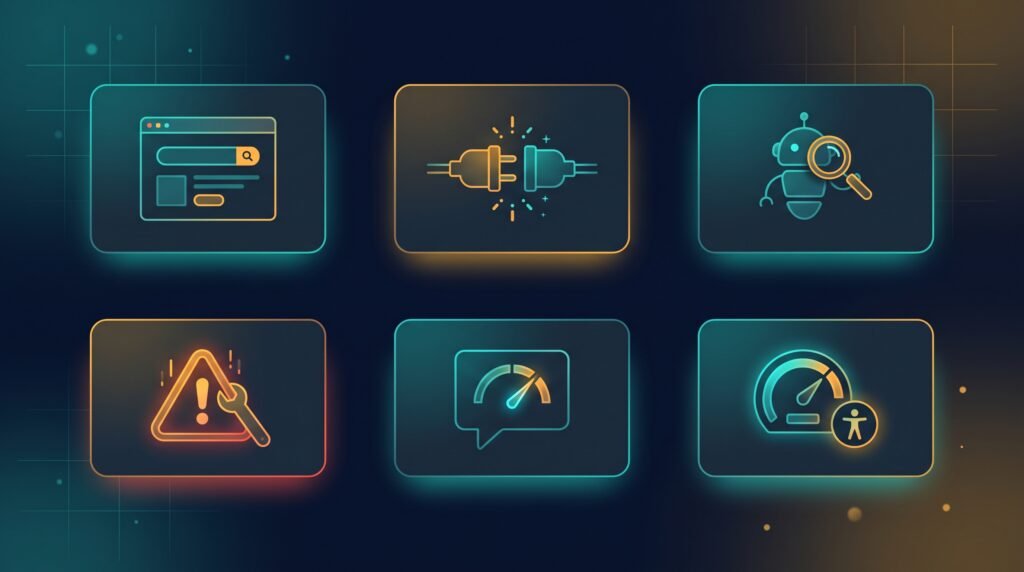
Don’t build all six. Pick two or three that match the role you want, and build them well. Each card shows what the project covers, a sensible stack, what it proves, and a stretch goal that turns a good project into a memorable one.
1. The production-style E2E suite
- Scope: 30–50 browser tests against a realistic open-source app with logins, forms, search and payments-like flows, not a one-page demo.
- Stack: Playwright with TypeScript, typed fixtures, GitHub Actions with sharding.
- Proves: you can structure a suite that stays fast and readable as it grows.
- Stretch goal: a short “why I didn’t test this in the UI” section that moves checks down to the API.
- Time: 2–3 weekends.
2. The API and contract test suite
- Scope: functional, negative and schema tests for a public or self-hosted REST API, plus one consumer-driven contract.
- Stack: pytest with httpx, or Playwright’s API testing; JSON Schema validation; Pact for the contract (Pact docs).
- Proves: you test where the business logic lives, at a speed CI can afford.
- Stretch goal: run the suite against a throwaway database with Testcontainers; see Testcontainers in Python.
- Time: 2 weekends.
3. The AI test review log
- Scope: let an AI agent generate tests for a feature, then review every one in a public pull request. Keep, rewrite or delete each test, and say why.
- Stack: Playwright Test Agents or any AI coding assistant; a pull request with line comments.
- Proves: the single most valuable 2027 skill, judging AI output instead of trusting it.
- Stretch goal: a summary table in the README, such as “24 generated, 9 kept, 11 rewritten, 4 deleted”, with the most common failure patterns.
- Time: 1 weekend.
4. The flaky test lab
- Scope: a small repo with deliberately flaky tests, one for each common cause, and the fix for each, with before-and-after pass rates from repeated runs.
- Stack: Playwright,
--repeat-each, a small script that records pass rates. - Proves: you can diagnose instability, not just rerun it. My Playwright flaky tests guide lists the causes to cover.
- Stretch goal: a CI job that fails on any test needing a retry to pass.
- Time: 1–2 weekends.
5. The LLM feature eval suite
- Scope: an evaluation suite for a small chatbot or summariser: a golden dataset of 30–50 cases, a scoring rubric, and a pass-rate threshold enforced in CI.
- Stack: Python, pytest, your choice of model API; a human review step for borderline scores, as in LangGraph human in the loop testing.
- Proves: you can test non-deterministic features, which more teams need every quarter.
- Stretch goal: track the score across two prompt versions and explain which one you’d ship.
- Time: 2 weekends.
6. The non-functional smoke pack
- Scope: a light load test on two key endpoints and automated accessibility checks on five key pages, both running in CI.
- Stack: k6 for load; axe-core with Playwright for accessibility.
- Proves: you think beyond “does the button work”, to speed and to users with assistive technology.
- Stretch goal: set performance budgets and accessibility rules as pass/fail gates, not just reports.
- Time: 1 weekend.
Which ones to pick:
- Aiming for an SDET role: projects 1, 2 and 3.
- Aiming for an AI-focused QA role: projects 3, 5 and either 1 or 2.
- Switching from manual QA: start with 2 (API tests teach the fundamentals fastest), then add 1.
A README Template That Survives the 90-Second Scan
The README does more selling than the code, because it’s the only file everyone reads. Copy this structure into each portfolio repo and fill it in. Keep the top section short enough to read without scrolling.
# Checkout API Test Suite

**What this tests:** the cart, pricing and checkout endpoints of <app>,
including discounts, stock limits and failed payments.
**Why it's interesting:** 14 of 52 tests cover edge cases the app's own
suite misses; two of them found real bugs (see Findings).
**Run it:** `docker compose up -d && pytest -n auto` (about 40 seconds).
## Approach
- Why API-first: business rules live here; the UI suite stays thin.
- Test data: each test creates its own user and cart, so tests run in parallel.
- Contract: one Pact contract between the web client and the pricing service.
## Findings
| Bug | Impact | Status |
| --- | --- | --- |
| Discount applied twice on retry | Revenue loss on flaky networks | Reported upstream (#123) |
## AI usage
I used an AI assistant to draft 20 tests. I kept 7, rewrote 9 and deleted 4.
The review notes are in PR #4.
## What I'd do next
- Add load tests for checkout with k6.
- Move the remaining UI-only checks down to the API.Three sections do most of the work. Findings shows impact, not activity. AI usage shows judgement, and it’s honest, which reviewers notice. What I’d do next shows you can prioritise, which is what seniors get hired for.
Score Your QA Portfolio 2027 in Five Minutes
Grade each repository against this table. Count the “strong” column: 7 or more means it’s ready to pin, 4–6 means one more weekend, and under 4 means start with the README and the CI run.
| Area | Weak | Strong |
|---|---|---|
| First screen | No README, or a default template | Problem, CI badge and report screenshot above the fold |
| Realism | Tests a demo login page | Tests a multi-feature app with real edge cases |
| CI | Runs only locally | Runs on every push, green, under 10 minutes |
| Assertions | Checks that elements exist | Checks outcomes, persisted data and error states |
| Test data | Shared accounts and hard-coded IDs | Each test creates and cleans up its own data |
| Layering | Everything through the UI | API and contract tests carry the logic; the UI stays thin |
| AI use | Hidden, or unreviewed generated code | Disclosed, with a review trail of kept, rewritten and deleted tests |
| Findings | None listed | At least one real bug or risk, with impact explained |
| History | One “initial commit” | Small commits with clear messages over several weeks |
| Next steps | Missing | 2–3 prioritised improvements |
Be honest with yourself here. A reviewer will be, and you won’t be in the room to explain.
7 Mistakes That Quietly Sink a QA Portfolio
None of these feel serious while you’re building. Each one is enough to end the 90-second scan.
1. Tutorial clones. The reviewer has seen the same course project a dozen times this month. Instead: take the course idea and point it at a different, messier app.
2. A red or missing CI badge. A failing badge says “abandoned”. Instead: fix it, or remove the badge until it’s green.
3. Secrets in the repo. One committed password or API key and the conversation is over, because it signals how you’d treat a client’s credentials. Instead: use environment variables and CI secrets, and check your history with a secret scanner.
4. Unreviewed AI code. Generated tests full of waitForTimeout and assertions that check nothing are easy to spot. Instead: show the review, as in project 3.
5. Testing someone’s live production site. Hammering a real company’s site with load tests or bots can break their terms of service. Instead: use a self-hosted open-source app or a public practice API.
6. No story. Code without context makes the reviewer guess why it matters. Instead: lead with the problem and one finding.
7. Hiding the portfolio. A great repo that isn’t linked from your CV or LinkedIn doesn’t exist. Instead: link the two best repos by name in your CV, not just your GitHub username.
If you’d like a second pair of eyes on yours, the SDET learning track covers each stage of building one.
External Sources
- Customizing your profile, GitHub Docs
- Introduction to contract testing, Pact documentation
- Playwright Test Agents, Playwright documentation
Internal Links
- The Future QA Engineer (2025–2030): Part Developer, Part Prompt Engineer, Part Data Curator
- SDET Skills 2027: What Actually Matters in Modern QA Engineering
- QA Engineer Portfolio: 7 Powerful Projects That Get Interviews in 2026
- QA Engineer vs SDET vs Quality Engineer: What’s the Difference?
Internal Series Links
- Learn Python – Zero to Hero
- Playwright Forge — Modern Web Automation
- Agentic QA & LLMs — AI Driven Quality Engineering
- API & Performance Testing
- Enterprise SDET Architect — Frameworks, CI/CD & Leadership
- LangGraph: Complete Zero to Hero
- Claude Code Tutorial: Complete Zero to Hero
- Learn MCP – Zero to Hero
- Cursor AI: Complete Zero to Hero
- OpenAI Codex: Complete Zero to Hero
- AutoGen: Complete Zero to Hero Guide
- AI Agents for QA: Zero to Hero
- Python for Data Science: Complete Zero to Hero
- Learn Playwright – Zero to Hero
- Learn Cypress Testing – Zero to Hero
- Learn Selenium WebDriver – Zero to Hero
- Postman AI: Complete Zero to Hero
- XCUITest iOS Testing: Complete Zero to Hero
- Appium: Complete Zero to Hero
- Detox React Native Testing: Complete Zero to Hero
- EarlGrey: Complete Zero to Hero
- Espresso Android Testing: Complete Zero to Hero
- Flutter Integration Testing: Complete Zero to Hero
- Maestro Mobile Testing: Complete Zero to Hero
- Robot Framework Appium: Complete Zero to Hero
- UI Automator: Complete Zero to Hero
- WebdriverIO Mobile: Complete Zero to Hero
- SQL Mastery: From Basics to Advanced
- TencentDB Agent Memory: Complete Zero to Hero
- DataRobot: Complete Zero to Hero
- Deepnote AI: Complete Zero to Hero
- Jupyter AI: Complete Zero to Hero
- AWS Q Developer: Complete Zero to Hero
- Azure AI DevOps: Complete Zero to Hero
- Docker AI: Complete Zero to Hero
- GitHub Actions AI: Complete Zero to Hero
- Google Cloud AI: Complete Zero to Hero
- Kubernetes AI: Complete Zero to Hero
- Terraform AI: Complete Zero to Hero
- Free QA Resources Built From Real Experience
- QA Glossary: Test Automation Terms Every Engineer Should Know
Questions People Ask About QA Portfolios
Do QA engineers really need a portfolio in 2027?
Not always, but it helps most when your CV can’t speak for you: career switchers, people coming from manual QA, and anyone whose best work sits behind an employer’s firewall. A small public portfolio is the fastest way to prove skills you can’t otherwise show.
How many projects should a QA portfolio have?
Two or three finished projects beat ten half-built ones. Reviewers open one or two repositories at most, so put your effort where they’ll look, and pin only your best work to the top of your GitHub profile.
Can I use AI to build my QA portfolio?
Yes, and you should say so. Hiding AI use is the risk, not using it. Disclose it in the README, and show what you changed: which generated tests you kept, rewrote or deleted, and why. That review trail is often the most impressive part of the portfolio.
What if I can’t share work from my current job?
Don’t share it. Rebuild the idea instead: the same kind of problem, against an open-source app, with no client code, data or names. Then describe the original impact on your CV in general terms, such as “cut suite time from 40 to 12 minutes”.
Should a QA portfolio be a website or a GitHub profile?
Start with GitHub, because that’s where reviewers click first. A personal site helps later for case studies and writing, but it should link straight back to the repositories, not replace them.
Your Next Weekend
Back to that Thursday afternoon. The candidates who get the call aren’t the ones with the most repositories. They’re the ones whose first screen answers “what, why and does it work” before the reviewer has to ask.
So here’s a plan for this weekend. Pick one project from the list, write the README first, get the CI badge green, and pin it. Next weekend, add the AI review log. In a month your QA portfolio 2027 will say more than your CV can.
If you’re building the skills underneath it, the Playwright Zero to Hero series is a good place to start, and the free QA roadmap maps the rest.
About the author: Muhammad Shahnawaz Khan is an independent software engineer and applied ML researcher with 11+ years in SDET and SQA. He founded QAPulse by SK and writes about test automation, CI/CD and AI in testing. More about Shahnawaz
This guide was drafted and reviewed by the author. See our editorial policy.