 QA
Playwright release notes are where test suites quietly break or get faster. Between June and November 2026, Playwright shipped five minor versions, 1.61 to 1.65, plus four patch releases. Two of them changed behaviour that existing tests rely on. This page turns the official Playwright release notes into what testers actually need: what’s new, what breaks, and which version to run. These Playwright release notes are updated every week.
Current version: Playwright 1.65.1 (November 13, 2026). Version 1.65.0 shipped on November 5 with Bun support, a failures-only reporter, the
-exclusive-test lock and 11 breaking changes. Upgrade:npm i -D @playwright/test@latest, thennpx playwright install --with-deps. Node.js: 22, 24 or 26.
Playwright Release Notes in Brief
Short answer: The 2026 Playwright release notes cover versions 1.61 to 1.65. Highlights are passkey testing and a Web Storage API (1.61), isolated retries and AbortSignal support (1.62), test locks and visible-only locators (1.63), WebMCP and --shuffle (1.64), and Bun support with 11 breaking changes (1.65).
Key points for testers:
- Version 1.65 is the riskiest upgrade of the year: page objects, cookies, API request bodies and sharded runs can all behave differently.
- Test locks (1.63) and
retryStrategy: 'isolated'(1.62) are the two biggest new tools against flaky tests. - Node.js 20 is no longer tested from 1.65, so CI images need Node.js 22 or later.
Definition: Playwright is an open-source framework from Microsoft for end-to-end testing and browser automation across Chromium, Firefox and WebKit.

Which Playwright Version Do You Need?
Start here if you’re deciding whether to upgrade. Find the capability you want, and the table gives the minimum version from the Playwright release notes that adds it.
| You want to | Minimum version | Feature |
|---|---|---|
| Test passkey (WebAuthn) login | 1.61 | Credentials virtual authenticator |
| Read or write localStorage in a test | 1.61 | page.localStorage and page.sessionStorage |
| Cancel a hanging action or assertion | 1.62 | signal option with an AbortSignal |
| Retry flaky tests away from the main run | 1.62 | retryStrategy: ‘isolated’ |
| Store golden screenshots as WebP | 1.62 | toHaveScreenshot(‘name.webp’) |
| Stop tests clashing on a shared account | 1.63 | Test locks |
| Click inside any iframe without locating it first | 1.63 | frameLocator() with no selector |
| Match only visible elements | 1.63 | locator.visible() |
| Find tests that depend on run order | 1.64 | –shuffle |
| Test tools a page registers with WebMCP | 1.64 | page.webmcp |
| Run the test runner on Bun | 1.65 | –bun |
| Report only failures in CI logs | 1.65 | failures reporter, onlyFailures option |
Upgrade Risk by Version
The Playwright release notes list breaking changes for each version. This table counts them and flags what to check first.
| Version | Released (2026) | Breaking changes | Risk | Check first |
|---|---|---|---|---|
| 1.65 | Nov 5 (1.65.1: Nov 13) | 11 | High | Page object class fields, inert elements, cookies, API request params and JSON, sharded runs |
| 1.64 | Oct 7 (1.64.1: Oct 14) | 4 | Medium | Screen size emulation, JSX compilation, snapshot updates, hidden iframes |
| 1.63 | Sep 4 | 0 | Low | Experimental React and Vue component testing packages frozen; Ubuntu 20.04 dropped |
| 1.62 | Jul 24 (1.62.1: Jul 30) | 0 | Low | Clipboard isolated in headless mode; Debian 11 dropped |
| 1.61 | Jun 15 (1.61.1: Jun 23) | 0 | Low | None |
Playwright 1.65 Release Notes (November 5, 2026)
Headline: the test runner now runs under Bun. Pass the --bun flag, and Bun transpiles your TypeScript test files itself. The Playwright team runs its test-runner tests under Bun 1.4.3 on Linux. Some features work differently: there’s no watch mode, --tsconfig has no effect, stack traces lose async frames, and a test’s console output doesn’t reach the trace.
Also new:
- A
failuresreporter that prints only failures and successful retries, plus anonlyFailuresoption for the HTML, JSON and JUnit reporters. - A built-in
-exclusive-test lock that runs a test only when no other test is running. test.skip(),test.fixme(),test.fail()andtest.slow()now accept only a description, which is recorded in the test annotation.- A
PLAYWRIGHT_TRANSFORM_CACHE_DIRenvironment variable for the transpile cache, plustimeoutandsignaloptions onCDPSession.send().
What breaks:
- TypeScript class fields follow
useDefineForClassFieldsfrom yourtsconfig.json. Page objects that build locators in field initialisers from a constructor parameter now throw. - Actions such as
click(),fill()andcheck()wait for the element to be not inert, and time out if it stays inert. - A sharded run fails with “No tests found” when no shard has tests, unless you pass
--pass-with-no-tests. - Cookie matching follows RFC 6265, so subdomain and path matching is stricter.
- Proxy credentials are no longer sent to websites; use
httpCredentialsfor site authentication. - Text the browser doesn’t render is left out of accessible names and aria snapshots.
- In API requests,
paramsare appended to the URL’s existing query instead of replacing it, andapplication/json;charset=UTF-8content types now trigger JSON encoding of string data. - CSS imports in test files load as empty modules, the blob reporter clears its output folder again, and CommonJS test locations point to the start of the call.
Platform: Node.js 20 is no longer tested, and Docker images now ship Node.js 26. Browsers: Chromium 158.0.8127.18, Firefox 159.0 and WebKit 27.2, also tested against Chrome 157 and Edge 156.
Why testers care: the class-field change breaks one of the most common page object patterns. The fix is in the migration section below.
Playwright 1.64 Release Notes (October 7, 2026)
Headline: WebMCP. New page.webmcp and frame.webmcp give tests access to the tools a page registers through the WebMCP API, so you can test what an AI agent would see.
Also new:
- Better videos: a custom
fpsoption, VP9 encoding for smaller files, and action markers styled with CSS. --shuffleruns tests in random order to expose hidden dependencies between them.TestProject.defaultkeeps a project in the config without running it by default.lockintest.describe.configure()applies a test lock to a whole file or group.locator.within()combines two existing locators, andpage.getByRef()finds an element by its aria-snapshot ref.APIRequestContextgainsaddCookies(),cookies()andclearCookies().
What breaks:
- Device descriptors now pass the
screensize, sowindow.screenand media queries see the emulated size. - JSX in test files follows your
tsconfig.jsonsettings. --update-snapshots=missingnow passes the run when it only creates missing snapshots.- Elements inside a hidden iframe count as hidden for actions and
isVisible().
Browsers: Chromium 156.0.8078.4, Firefox 157.0 and WebKit 27.2.
Why testers care: of all this year’s Playwright release notes, this one hides a quiet layout change. If responsive tests suddenly pick a different layout after upgrading, the screen change is the likely cause.
Playwright 1.63 Release Notes (September 4, 2026)
Headline: test locks. Tests that share a lock name never run at the same time, across files, workers and projects, while everything else stays parallel. It’s the cleanest fix yet for tests that fight over one account or setting.
Also new:
frameLocator()with no selector searches every frame, so you don’t need to locate the iframe first.locator.visible()matches only visible elements and replaces the:visiblepseudo-class.- Steps carry structured params and subtitles for reporters, and traces can record aria and screen snapshots.
httpCredentialsaccepts an array, storage state can include OPFS, and newdialogClosedevents fire.ariaSnapshotJSON(), typedjson()responses on API requests, and standalonereducedMotion,forcedColorsandcontrastoptions.--add-reporter, anomitTagsreporter option, aperfettoreporter and a duration waterfall in the HTML report.
Announcements: the experimental React and Vue component testing packages are no longer updated, Ubuntu 20.04 is unsupported, and Linux arm64 now downloads Chrome for Testing.
Browsers: Chromium 153.0.8010.12, Firefox 155.0 and WebKit 26.6.
Why testers care: test locks and visible-only locators remove two common causes of flaky tests. See the Playwright flaky tests guide for the rest.
Deep dive: for the 1.63 features in detail, read Playwright 1.63: 5 Best Features for Test Automation.
Playwright 1.62 Release Notes (July 24, 2026)
Headline: isolated retries. The new retryStrategy option can run all retries at the end of the run, one by one in a single worker, so a flaky test gets a quiet second chance instead of retrying under full load.
Also new:
- A new component testing model built on stories, each wrapping a component in one specific scenario.
- Most actions and web-first assertions accept a
signaloption with anAbortSignal. toHaveScreenshot()stores golden files as lossless WebP when the name ends in.webp.- A
Reporter.preprocess()hook for custom test filtering. - Passkeys in storage state, a
scrolloption on actions,APIResponse.timing()andlocator.waitForFunction(). - Playwright MCP and
playwright-cliare bundled, runnable withnpx playwright mcp.
Announcements: the clipboard is isolated from the operating system in headless mode, and Debian 11 is unsupported.
Browsers: Chromium 151.0.7922.34, Firefox 153.0 and WebKit 26.5.
Why testers care: WebP golden screenshots shrink visual-regression baselines, and isolated retries make the “flaky” label more trustworthy.
Deep dive: the 1.62.1 patch fixed TypeScript and accessibility regressions. Full breakdown: Playwright 1.62.1 fixes for test automation teams.
Playwright 1.61 Release Notes (June 15, 2026)
Headline: passkey testing. A virtual WebAuthn authenticator through context.credentials lets tests register passkeys and answer navigator.credentials calls without hardware keys.
Also new:
- A Web Storage API:
page.localStorageandpage.sessionStorageread and write storage for the current origin. - Video recording supports the same modes as tracing, including
'retain-on-failure-and-retries'. expect.soft.poll(),FullConfig.argv,FullConfig.failOnFlakyTestsand a-Gshorthand for--grep-invert.- HAR files and traces now include WebSocket requests, and Ubuntu 26.04 is supported.
Browsers: Chromium 149.0.7827.55, Firefox 151.0 and WebKit 26.5.
Why testers care: in the Playwright release notes, this is the version that made passkey flows testable. They used to need workarounds or manual testing. From 1.61 they can be covered end to end.
Deep dive: the 1.61.1 patch is covered bug by bug in Playwright 1.61.1 Released: 5 Critical Bug Fixes.
Tested Examples From the Latest Playwright Release Notes
Every example below ran and passed on Playwright 1.65.1, with the browser test using installed Google Chrome. The config turns on isolated retries from 1.62 and fails CI on flaky tests.
// playwright.config.ts
import { defineConfig } from '@playwright/test';

export default defineConfig({
  testDir: './tests',
  fullyParallel: true,
  retries: process.env.CI ? 2 : 0,
  retryStrategy: 'isolated',        // 1.62+: run retries at the end, one by one
  failOnFlakyTests: !!process.env.CI,
});
Test locks from 1.63 and the -exclusive- lock from 1.65:
// tests/locks.spec.ts
import { test } from '@playwright/test';

// 1.63+: tests that share a lock name never run at the same time
test('update notification settings', { lock: 'user-settings' }, async () => {
  // call the shared settings API here
});

test('update privacy settings', { lock: 'user-settings' }, async () => {
  // call the shared settings API here
});

// 1.65+: '-exclusive-' waits until no other test is running
test('reset shared test data', { lock: '-exclusive-' }, async () => {
  // reseed the database here
});
The two new 1.63 locators in a real browser:
// tests/new-locators.spec.ts
import { test, expect } from '@playwright/test';

test.use({ channel: 'chrome' });

test('visible() and frameLocator() without a selector', async ({ page }) => {
  await page.setContent(`
    <button style="display:none">Save</button>
    <button>Save</button>
    <iframe srcdoc="<button>Pay now</button>"></iframe>
  `);

  // 1.63+: match only the visible button, replacing the :visible pseudo-class
  await expect(page.locator('button').visible()).toHaveCount(1);

  // 1.63+: frameLocator() with no selector searches every frame on the page
  await expect(page.frameLocator().getByRole('button', { name: 'Pay now' })).toBeVisible();
});
$ npx playwright test
5 passed (1.9s)Fixing the Playwright 1.65 Breaking Changes
Four fixes cover most suites. Each comes straight from the 1.65 entry in the official Playwright release notes.
1. Page objects that build locators in field initialisers. With useDefineForClassFields on, a field initialiser runs before the constructor’s parameter property is set, so this.page is still undefined. Move the locator into the constructor:
import { type Page, type Locator } from '@playwright/test';

// Before 1.65 this worked; now it throws "Cannot read properties of undefined"
// readonly submit = this.page.getByRole('button', { name: 'Submit' });

class LoginPage {
  readonly submit: Locator;

  constructor(private readonly page: Page) {
    this.submit = page.getByRole('button', { name: 'Submit' });
  }
}
If you can’t change many page objects at once, set "useDefineForClassFields": false in tsconfig.json as a stopgap.
2. Sharded runs with no matching tests. Add --pass-with-no-tests to jobs that filter with --grep and can legitimately match nothing.
3. Signed or exact API request bodies. If a string body must be sent byte for byte, pass data: Buffer.from(body, 'utf8') so it isn’t JSON-encoded.
4. Proxy authentication. Proxy credentials now answer only proxy challenges. Move website logins to the context’s httpCredentials option.
For a full CI set-up that runs these suites across browsers, see the GitHub Actions multi-browser matrix guide.
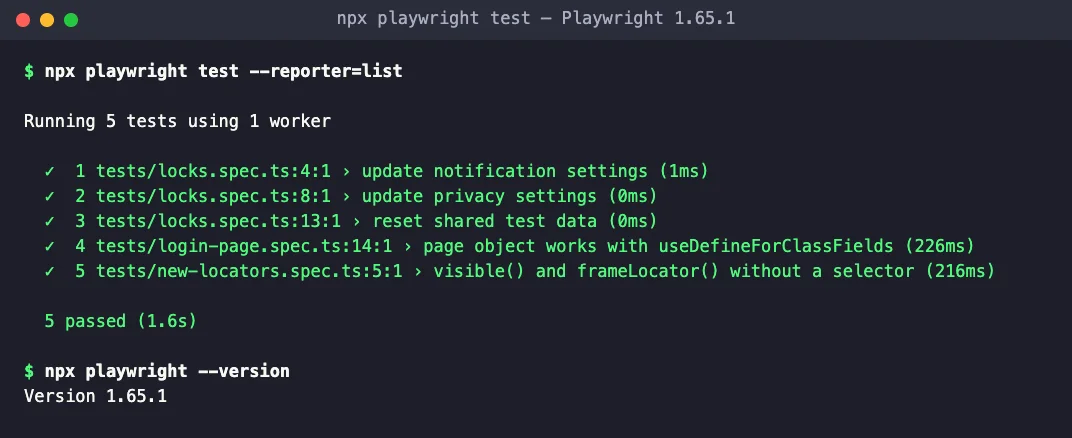
Proof it runs: the Playwright 1.65 suite
Every example on this page is part of a small suite I run against Playwright 1.65.1 before updating these Playwright release notes. Here is the latest run: the shared-data locks, the page object with useDefineForClassFields, and the new selector-less locator calls all pass.
External Sources
- Release notes, Playwright documentation
- Parallelism and test locks, Playwright documentation
- Playwright releases, GitHub
- @playwright/test version history, npm
Playwright Release Deep Dives
- Playwright 1.63: 5 Best Features for Test Automation
- Playwright 1.62.1: TypeScript and Accessibility Regression Fixes
- Playwright 1.61.1: 5 Critical Bug Fixes QA Engineers Must Know
- 50 Playwright Commands Every QA Engineer Should Know
- Playwright Parallel Execution: 6 Powerful Sharding Secrets
- Playwright Flaky Tests: How to Find and Fix Them in Production
Internal Series Links
- Learn Python – Zero to Hero
- Playwright Forge — Modern Web Automation
- Agentic QA & LLMs — AI Driven Quality Engineering
- API & Performance Testing
- Enterprise SDET Architect — Frameworks, CI/CD & Leadership
- LangGraph: Complete Zero to Hero
- Claude Code Tutorial: Complete Zero to Hero
- Learn MCP – Zero to Hero
- Cursor AI: Complete Zero to Hero
- OpenAI Codex: Complete Zero to Hero
- AutoGen: Complete Zero to Hero Guide
- AI Agents for QA: Zero to Hero
- Python for Data Science: Complete Zero to Hero
- Learn Playwright – Zero to Hero
- Learn Cypress Testing – Zero to Hero
- Learn Selenium WebDriver – Zero to Hero
- Postman AI: Complete Zero to Hero
- XCUITest iOS Testing: Complete Zero to Hero
- Appium: Complete Zero to Hero
- Detox React Native Testing: Complete Zero to Hero
- EarlGrey: Complete Zero to Hero
- Espresso Android Testing: Complete Zero to Hero
- Flutter Integration Testing: Complete Zero to Hero
- Maestro Mobile Testing: Complete Zero to Hero
- Robot Framework Appium: Complete Zero to Hero
- UI Automator: Complete Zero to Hero
- WebdriverIO Mobile: Complete Zero to Hero
- SQL Mastery: From Basics to Advanced
- TencentDB Agent Memory: Complete Zero to Hero
- DataRobot: Complete Zero to Hero
- Deepnote AI: Complete Zero to Hero
- Jupyter AI: Complete Zero to Hero
- AWS Q Developer: Complete Zero to Hero
- Azure AI DevOps: Complete Zero to Hero
- Docker AI: Complete Zero to Hero
- GitHub Actions AI: Complete Zero to Hero
- Google Cloud AI: Complete Zero to Hero
- Kubernetes AI: Complete Zero to Hero
- Terraform AI: Complete Zero to Hero
- Free QA Resources Built From Real Experience
- QA Glossary: Test Automation Terms Every Engineer Should Know
People Also Ask About Playwright Release Notes
What is the latest version of Playwright?
Playwright 1.65.1, released on November 13, 2026, a patch on top of 1.65.0 from November 5. These Playwright release notes are updated weekly, so check the “Current version” box at the top for the newest release.
Does Playwright 1.65 still support Node.js 20?
The Playwright release notes for 1.65 say Node.js 20 is no longer tested. Use Node.js 22, 24 or 26. The official Docker images now include Node.js 26.
Can Playwright run tests with Bun?
Yes, from 1.65. Run the test runner with the --bun flag. Watch mode, the --tsconfig option and async stack frames don’t work the same way under Bun, so try it on a branch before switching CI.
What are test locks in Playwright?
Test locks, added in 1.63, let tests declare a named lock such as { lock: 'user-settings' }. Tests that share a lock never run at the same time, even across workers, while the rest of the suite stays parallel. From 1.65, the built-in -exclusive- lock runs a test only when nothing else is running.
How do I upgrade Playwright safely?
Read the Playwright release notes for every version you’re skipping, using the upgrade risk table above. Upgrade on a branch with npm i -D @playwright/test@latest and npx playwright install --with-deps, then run the full suite in CI before merging.
How often does Playwright release a new version?
Roughly every four to six weeks. In 2026, minor versions shipped on June 15, July 24, September 4, October 7 and November 5, each usually followed by a patch release within about a week.
Where can I find the official Playwright release notes?
The official Playwright release notes are on playwright.dev, with separate pages for JavaScript, Python, Java and .NET. This page covers the JavaScript and TypeScript release, which is the one most test suites use.
New to the tool? Start with what Playwright is or the full Learn Playwright: Zero to Hero series. If your team needs help upgrading a large suite, see automation testing services.
About the author: Muhammad Shahnawaz Khan is an independent software engineer and applied ML researcher with 11+ years in SDET and SQA. He founded QAPulse by SK and writes about test automation, CI/CD and AI in testing. More about Shahnawaz
Every version, date and change on this page comes from Playwright’s official release notes and npm release dates. The code examples were run on Playwright 1.65.1. This page was drafted and reviewed by the author. See our editorial policy.