QA
QA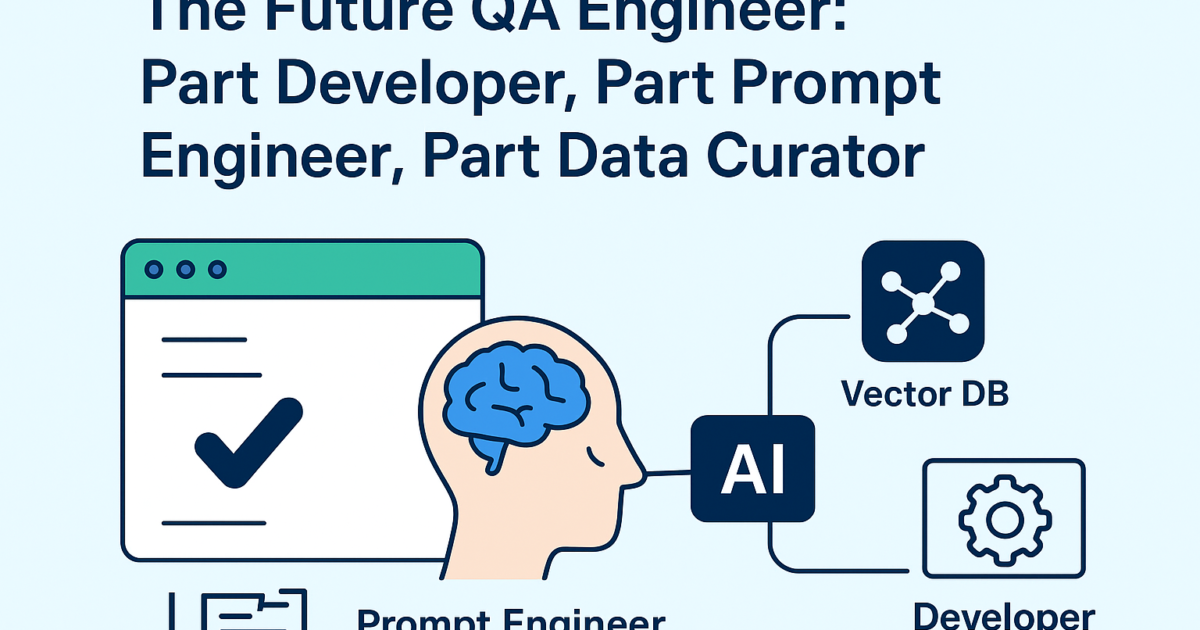
Future QA Engineer is no longer a buzzword—it represents one of the biggest career transformations happening in software engineering. Over the next five years, the role of the Future QA Engineer will evolve far beyond writing test cases or maintaining Selenium scripts. As Artificial Intelligence, autonomous testing agents, Large Language Models (LLMs), and data-driven engineering become mainstream, organizations will expect QA professionals to build intelligent testing systems instead of simply executing test scenarios.
If you still believe that Quality Assurance is only about writing Selenium or Playwright automation scripts, you are already preparing for yesterday’s job market.
The industry is not eliminating QA Engineers.
It is redefining what being a QA Engineer means.
Today’s organizations expect QA professionals to understand software architecture, cloud platforms, APIs, AI systems, CI/CD pipelines, data quality, observability, security, and business risk. The Future QA Engineer is becoming an engineering role that sits at the intersection of software development, artificial intelligence, automation, and product quality.
Why the QA Industry Is Changing
Software development has changed dramatically over the past decade.
Applications are no longer simple web portals deployed once every few months. Modern products consist of distributed microservices, cloud-native infrastructure, mobile applications, AI models, event-driven architectures, third-party integrations, and continuous deployments happening dozens or even hundreds of times per day.
Traditional testing approaches cannot keep pace with this level of complexity.
At the same time, Artificial Intelligence has fundamentally changed how engineers work. Tasks that once required hours of manual effort—such as generating test cases, creating automation scripts, analyzing logs, or summarizing defects—can now be completed within seconds using AI tools.
This shift has created a new reality.
The value of a QA Engineer is no longer measured by the number of test cases written or automated scripts maintained. Instead, it is measured by the ability to design intelligent quality systems that continuously evaluate product reliability throughout the software delivery lifecycle.
The Evolution of Quality Assurance
The QA profession has evolved through several major phases.
Manual Testing

↓

Automation Testing

↓

Continuous Testing

↓

AI-Assisted Testing

↓

AI-Augmented Quality Engineering

↓

Autonomous Quality Engineering
Each stage has required QA professionals to develop new technical skills.
The current transition is unlike any previous evolution because Artificial Intelligence is changing not only how testing is performed but also who performs repetitive testing activities.
Instead of manually executing regression suites, AI systems can now:
- Generate functional test cases
- Produce automation scripts
- Analyze application logs
- Detect visual regressions
- Identify flaky tests
- Recommend missing test coverage
- Explain failures
- Predict release risks
As these capabilities improve, the responsibilities of QA Engineers naturally move toward higher-value engineering work.
What Is a Future QA Engineer?
A Future QA Engineer is an engineer who combines traditional quality assurance knowledge with software engineering, AI, automation, and data intelligence to improve software quality across the entire development lifecycle.
Rather than acting only as a tester, this professional designs systems that help organizations prevent defects before they reach production.
A modern QA Engineer is expected to understand:
- Software architecture
- Automation frameworks
- APIs and backend systems
- Cloud platforms
- AI-assisted development
- Continuous Integration and Continuous Delivery (CI/CD)
- Observability platforms
- Production monitoring
- Test data management
- Risk analysis
Testing becomes only one responsibility among many.
The role expands into engineering, architecture, and intelligent automation.
Why Traditional QA Is No Longer Enough
For many years, QA teams focused primarily on executing predefined test cases.
A typical workflow looked like this:
Requirement

↓

Write Test Cases

↓

Execute Tests

↓

Report Bugs

↓

Release
While this process still exists, it no longer scales for modern software delivery.
Consider an organization deploying software twenty times every day.
Manual regression testing cannot keep up.
Even traditional automation frameworks require continuous maintenance, especially when applications evolve rapidly.
Modern engineering teams therefore expect QA professionals to contribute much earlier in the Software Development Life Cycle (SDLC).
Instead of validating software after development is complete, QA Engineers now participate in:
- Requirement analysis
- API contract reviews
- Architecture discussions
- Risk assessment
- Test strategy design
- CI/CD pipeline implementation
- AI-assisted quality analysis
Quality is no longer a final checkpoint.
It becomes a continuous engineering activity.
AI Is Changing Responsibilities, Not Replacing QA
One of the biggest misconceptions surrounding Artificial Intelligence is that it will replace QA Engineers.
In reality, AI is replacing repetitive activities—not engineering judgment.
AI can generate thousands of test cases in seconds.
It cannot reliably determine:
- Whether the right business problem is being solved.
- Which customer journeys are most critical.
- What level of risk is acceptable.
- Which production failures would cause the greatest business impact.
- How to balance quality, delivery speed, and customer expectations.
These decisions require technical expertise, product understanding, and human reasoning.
The Future QA Engineer works alongside AI rather than competing against it.
AI becomes an accelerator.
The engineer remains responsible for strategy, architecture, validation, governance, and decision-making.
The New Mission of Quality Engineering
Historically, QA teams answered a simple question:
Does the software work?
Modern organizations ask much larger questions.
- Is the software reliable?
- Is it secure?
- Can it scale?
- Can AI-generated features be trusted?
- Can deployments happen safely every day?
- Is customer data protected?
- Are AI models producing accurate responses?
- Can failures be detected before customers notice them?
These questions cannot be answered through traditional functional testing alone.
They require engineers capable of understanding complete software ecosystems.
That is why the title “QA Engineer” increasingly represents an engineering discipline rather than a testing discipline.
The Five New Pillars of the Future QA Engineer
Between 2025 and 2030, the role of the Future QA Engineer is expected to revolve around five major disciplines:
- Software Engineering
- Prompt Engineering
- Data Curation
- AI Orchestration
- Risk Engineering
Each discipline addresses a different aspect of software quality in AI-driven systems.
Together, they define the next generation of Quality Engineering.
The following sections of this guide explore each pillar in depth, explain why it matters, and demonstrate how modern QA professionals can build the technical expertise required to remain valuable in an AI-first software industry.
Pillar 1: The Future QA Engineer as a Software Developer
The first and arguably most important transformation is that the Future QA Engineer must think like a software developer.
For years, automation engineers were primarily evaluated by how many Selenium or Playwright scripts they could write. While automation remains an essential skill, enterprise organizations are now looking for engineers who can build complete testing solutions instead of isolated test scripts.
The shift is from automation scripting to software engineering.
A modern QA Engineer builds reusable systems, scalable frameworks, automation platforms, and intelligent services that continuously improve product quality.
Why Coding Alone Is No Longer Enough
Learning a programming language is only the starting point.
Many QA professionals know Java, Python, JavaScript, or TypeScript, yet struggle to design maintainable automation systems because they lack software engineering principles.
The Future QA Engineer should understand:
- Object-Oriented Programming (OOP)
- Design Patterns
- SOLID Principles
- Clean Code practices
- Modular architecture
- Dependency Injection
- Error handling
- Logging strategies
- Configuration management
Instead of asking:
“Can I automate this test?”
The better question becomes:
“Can I build a reusable solution that automates thousands of tests efficiently?”
That mindset separates automation engineers from software engineers.
Building Systems Instead of Scripts
Traditional automation often produces code like this:
Login Test

↓

Search Test

↓

Checkout Test

↓

Logout Test
Each script works independently.
However, enterprise automation frameworks are designed differently.
Framework

│

├── Configuration

├── Test Data

├── Page Objects

├── Utilities

├── API Layer

├── Reporting

├── CI/CD Integration

└── Test Suites
The framework becomes a software product that supports hundreds or thousands of automated tests.
This architectural thinking is a defining characteristic of the Future QA Engineer.
Understanding the Entire Technology Stack
Modern applications are built using dozens of technologies working together.
A QA Engineer who only understands browser automation has limited visibility into how the system actually behaves.
A modern engineer should understand every layer involved in a request.
Browser

↓

Frontend

↓

API Gateway

↓

Microservices

↓

Database

↓

Cache

↓

Cloud Infrastructure
Understanding these layers makes debugging significantly faster.
Instead of reporting:
“The login test failed.”
A skilled engineer can identify whether the issue originates from:
- API failures
- Database inconsistencies
- Authentication services
- Network latency
- Infrastructure outages
- Frontend rendering problems
This level of analysis dramatically increases the value of the QA role.
APIs Become First-Class Citizens
Modern software communicates primarily through APIs.
Every user action may trigger multiple backend requests.
For example:
User Login

↓

Authentication API

↓

Profile API

↓

Permissions API

↓

Notification Service

↓

Dashboard API
A Future QA Engineer must be comfortable validating these interactions independently of the user interface.
Essential API skills include:
- REST
- GraphQL
- HTTP methods
- Authentication mechanisms
- Status codes
- Request validation
- Response validation
- API performance analysis
Testing APIs often detects defects much earlier than UI automation.
Infrastructure Awareness
Cloud computing has changed how software is deployed.
Applications now run on distributed infrastructure rather than a single server.
QA Engineers should understand concepts such as:
- Docker containers
- Kubernetes
- Virtual machines
- Cloud environments
- Load balancers
- Reverse proxies
- Environment variables
You do not need to become a DevOps engineer, but understanding how applications are deployed helps explain many production issues.
CI/CD Is Part of Quality Engineering
Automation scripts have little value if they only run manually.
Modern organizations execute automated tests continuously.
Typical deployment workflow:
Developer Pushes Code

↓

Build Starts

↓

Static Analysis

↓

Unit Tests

↓

API Tests

↓

UI Automation

↓

Security Scans

↓

Deployment
The Future QA Engineer participates in designing and maintaining this pipeline.
Knowledge of tools such as GitHub Actions, Jenkins, Azure DevOps, or GitLab CI is becoming increasingly valuable.
Debugging Is an Engineering Skill
Enterprise teams value engineers who can investigate failures efficiently.
Suppose a regression test fails.
A traditional approach may simply reopen the defect.
A stronger engineering approach investigates:
- Application logs
- API responses
- Browser console errors
- Network requests
- Database records
- Infrastructure metrics
Finding the root cause is often more valuable than identifying the symptom.
Automation Is Becoming Platform Engineering
Leading organizations no longer treat automation frameworks as collections of test scripts.
Instead, they build internal quality platforms.
These platforms provide:
- Test execution services
- Test data generation
- Reporting dashboards
- AI-assisted defect analysis
- Environment management
- Observability integration
- Release quality metrics
QA Engineers contribute to building and improving these platforms alongside software developers.
Essential Technical Skills
Between 2025 and 2030, a Future QA Engineer should continuously strengthen skills in:
Programming
- Python
- TypeScript
- JavaScript
- Java
- C#
Version Control
- Git
- GitHub
- GitLab
- Bitbucket
API Technologies
- REST
- GraphQL
- WebSockets
Databases
- PostgreSQL
- MySQL
- MongoDB
- Redis
Cloud Platforms
- AWS
- Microsoft Azure
- Google Cloud Platform
Containers
- Docker
- Kubernetes
CI/CD
- GitHub Actions
- Jenkins
- GitLab CI
- Azure DevOps
Testing Frameworks
- Playwright
- Cypress
- Appium
- JUnit
- Pytest
The objective is not to master every tool but to understand how they fit together within modern software delivery.
Enterprise Example
Imagine an online banking platform.
A customer reports that money transfers occasionally fail.
A traditional automation engineer may rerun the UI test.
A Future QA Engineer investigates the complete workflow:
User Action

↓

Frontend

↓

Authentication API

↓

Payment Service

↓

Fraud Detection

↓

Transaction Database

↓

Notification Service
By tracing the entire request, the engineer identifies whether the issue originates from business logic, infrastructure, networking, authentication, or external integrations.
This systems-thinking approach transforms QA from a testing function into an engineering discipline.
The Mindset Shift
The Future QA Engineer is no longer measured by the number of automation scripts written.
Instead, success is measured by the ability to:
- Design scalable quality systems.
- Build maintainable automation platforms.
- Improve software delivery pipelines.
- Diagnose complex production issues.
- Collaborate across development, DevOps, AI, and product teams.
- Reduce business risk through engineering excellence.
This shift from script writing to software engineering forms the foundation for every other capability explored in this guide. Once this mindset is established, the next transformation is learning how QA Engineers collaborate with Artificial Intelligence through Prompt Engineering, where engineers guide AI systems to generate, validate, and continuously improve software quality.
Pillar 2: The Future QA Engineer as a Prompt Engineer
The second major transformation is that the Future QA Engineer must become an effective Prompt Engineer.
Many people misunderstand prompt engineering as simply asking ChatGPT a question. In enterprise software development, prompt engineering is a structured engineering discipline focused on communicating with AI systems to produce reliable, repeatable, and high-quality outputs.
For a Future QA Engineer, prompts become another form of automation.
Instead of writing every test manually, engineers design instructions that enable AI to generate, validate, analyze, and improve testing artifacts at scale.
The objective is not to replace automation frameworks.
The objective is to accelerate engineering work while maintaining human control over quality decisions.
What Is Prompt Engineering?
Prompt engineering is the practice of designing structured instructions that guide Large Language Models (LLMs) toward predictable and useful outcomes.
A prompt is no longer a simple question.
It becomes an engineering specification.
Instead of asking AI:
Write login test cases.
A Future QA Engineer provides context, constraints, expected output format, business rules, acceptance criteria, and validation requirements.
The difference in quality is enormous.
Why Prompt Engineering Matters in QA
Software teams are rapidly adopting AI-powered development tools.
These tools can generate:
- Test cases
- Automation scripts
- API validation
- SQL queries
- Bug summaries
- Test data
- Documentation
- Risk analysis
- Regression plans
- Release reports
However, AI only performs well when it receives high-quality instructions.
Poor prompts produce inconsistent and unreliable outputs.
Well-designed prompts generate reusable engineering assets that significantly reduce manual effort.
Prompt quality directly influences testing quality.
The Shift From Script Writing to Intent Engineering
Traditional automation focused on implementation.
Requirement

↓

Write Script

↓

Execute

↓

Verify Result
The Future QA Engineer follows a different workflow.
Requirement

↓

Define Intent

↓

Design Prompt

↓

AI Generates Assets

↓

Engineer Reviews

↓

Execute

↓

Improve Prompt
The engineer’s expertise moves from repetitive implementation toward designing intelligent workflows.
Characteristics of a High-Quality Prompt
Enterprise prompts are structured.
A strong prompt usually includes:
- Business objective
- Application context
- Functional requirements
- Acceptance criteria
- Edge cases
- Constraints
- Expected output format
- Validation rules
Example structure:
Role

Task

Application Context

Requirements

Constraints

Expected Output

Validation Rules
This approach produces much more reliable AI-generated results.
Real QA Example
Suppose an API accepts customer registrations.
A weak prompt might be:
Generate API test cases.
A stronger engineering prompt would describe:
- API endpoint
- Request schema
- Required fields
- Optional fields
- Authentication method
- Business rules
- Validation rules
- Boundary values
- Expected status codes
- Output format
The resulting test suite becomes significantly more complete.
The Future QA Engineer engineers the prompt instead of manually writing every scenario.
Prompt Engineering Across the Testing Lifecycle
Prompt engineering can improve nearly every testing activity.
Test Case Generation
AI can create:
- Positive scenarios
- Negative scenarios
- Boundary tests
- Exploratory ideas
- Regression suites
Automation Development
AI can assist with:
- Playwright scripts
- API automation
- Page Objects
- Test utilities
- Assertions
- Mock data
Bug Analysis
AI helps:
- Summarize logs
- Explain stack traces
- Identify probable root causes
- Group duplicate defects
Documentation
Prompt engineering can generate:
- Test plans
- Release reports
- QA documentation
- Technical summaries
- Risk assessments
The engineer validates every output before it becomes part of the delivery process.
Prompt Libraries Become Reusable Assets
Enterprise organizations rarely write prompts from scratch every day.
Instead, they build internal prompt libraries.
QA Prompt Library

│

├── API Testing

├── UI Testing

├── Accessibility

├── Security

├── Performance

├── Regression

├── Test Data

└── Bug Analysis
These prompt libraries become organizational knowledge that improves consistency across projects.
AI Does Not Replace Critical Thinking
One of the biggest misconceptions is that AI removes the need for engineering expertise.
The opposite is true.
The better the engineer understands:
- Software architecture
- Business workflows
- Testing principles
- Risk analysis
- Product behavior
the better prompts they can design.
Prompt engineering amplifies expertise.
It does not replace it.
Common Prompt Engineering Mistakes
Many beginners produce inconsistent AI results because they:
- Ask vague questions.
- Provide no application context.
- Ignore business rules.
- Omit acceptance criteria.
- Fail to define output format.
- Trust AI responses without verification.
- Treat AI as an authority instead of an assistant.
A Future QA Engineer avoids these mistakes by treating prompts as engineering artifacts.
Prompt Versioning
As prompts evolve, organizations should manage them similarly to source code.
Git Repository

│

├── Prompt Templates

├── Test Generation

├── Bug Analysis

├── API Validation

└── Release Notes
Version-controlled prompts provide:
- Repeatability
- Collaboration
- Continuous improvement
- Auditability
This practice becomes increasingly important as AI adoption grows.
Prompt Engineering and AI Agents
Prompt engineering is only the first step.
Modern AI systems increasingly consist of autonomous agents working together.
For example:
Requirement

↓

Planning Agent

↓

Test Generation Agent

↓

Automation Agent

↓

Execution Agent

↓

Analysis Agent

↓

Reporting Agent
Each agent receives carefully designed prompts describing its responsibilities.
The Future QA Engineer defines how these agents collaborate rather than performing every task manually.
This is the foundation of Agentic AI in Quality Engineering.
Essential Skills for Prompt Engineering
Every Future QA Engineer should gradually develop expertise in:
- Structured prompting
- Context engineering
- Chain-of-thought design
- Few-shot prompting
- Role-based prompting
- Constraint definition
- Output formatting
- Prompt evaluation
- AI validation
- Hallucination detection
These skills improve the reliability of AI-generated engineering work.
Enterprise Example
Imagine a financial application introducing a new loan approval workflow.
Instead of manually creating hundreds of regression scenarios, the QA Engineer designs a structured prompt that instructs AI to:
- Analyze business requirements.
- Generate positive scenarios.
- Produce negative scenarios.
- Identify boundary conditions.
- Suggest API validations.
- Recommend security tests.
- Highlight compliance risks.
The engineer reviews and refines the generated output before incorporating it into the automation framework.
The result is dramatically faster planning without sacrificing engineering quality.
Looking Beyond Prompt Engineering
Prompt engineering is only one capability required by the Future QA Engineer.
AI systems are only as effective as the information they receive.
In the next pillar, we move beyond prompting and explore why Data Curation is becoming one of the most valuable and least understood responsibilities in modern Quality Engineering. As AI-powered testing grows, managing high-quality data becomes just as important as writing automation code.
Pillar 3: The Future QA Engineer as a Data Curator, AI Orchestrator, and Risk Engineer
The final transformation of the Future QA Engineer extends beyond writing code and designing prompts. As organizations adopt AI-native software development, QA professionals become responsible for managing knowledge, coordinating intelligent systems, and making strategic quality decisions.
Artificial Intelligence is only as effective as the information it receives.
Poor-quality data produces poor-quality decisions.
Similarly, even the most advanced AI models cannot determine business priorities, regulatory impact, or customer risk without human guidance.
This is where the Future QA Engineer becomes indispensable.
Pillar 3: The Future QA Engineer as a Data Curator
Every modern software product continuously generates data.
Examples include:
- Test cases
- Defect reports
- Production incidents
- Application logs
- API requests and responses
- Performance metrics
- User analytics
- Customer feedback
- Security findings
- Release notes
Historically, much of this information was scattered across multiple tools and rarely reused effectively.
The Future QA Engineer treats this information as valuable engineering knowledge rather than historical records.
Why Data Quality Matters
Large Language Models and AI agents depend on high-quality context.
If the underlying information is outdated, duplicated, or incomplete, AI-generated outputs become unreliable.
Consider a simple example.
An AI system is asked to generate regression tests using defect history.
If the defect database contains:
- Duplicate bugs
- Incorrect classifications
- Missing root causes
- Incomplete reproduction steps
the generated regression suite will also be incomplete.
The quality of AI-assisted testing is directly proportional to the quality of engineering data.
Building Test Intelligence
Modern QA teams are moving beyond traditional test repositories.
Instead, they create centralized knowledge systems.
Requirements

↓

Test Cases

↓

Automation Results

↓

Production Logs

↓

Defect History

↓

Knowledge Repository

↓

AI Agents
Instead of treating every project as a new beginning, organizations continuously expand this knowledge base.
Every release makes future testing smarter.
Types of Data a Future QA Engineer Manages
High-performing engineering teams curate multiple categories of information.
Product Knowledge
- Business rules
- Functional requirements
- User stories
- Acceptance criteria
Testing Assets
- Manual test cases
- Automated scripts
- Test datasets
- Regression suites
Operational Data
- CI/CD results
- Test execution history
- Deployment records
- Infrastructure logs
Production Intelligence
- Customer issues
- Crash reports
- Monitoring alerts
- Performance metrics
Together, these datasets enable AI systems to make informed recommendations instead of generic assumptions.
Pillar 4: The Future QA Engineer as an AI Orchestrator
The next evolution of testing is not simply AI-assisted automation.
It is AI orchestration.
Instead of asking one AI model to perform every task, organizations are increasingly adopting multiple specialized AI agents that collaborate to complete complex engineering workflows.
A Future QA Engineer designs and supervises these workflows.
What Is AI Orchestration?
AI orchestration is the coordination of multiple AI systems, tools, and automation services to accomplish a larger objective.
A simplified testing workflow might look like this.
Business Requirement

↓

Planning Agent

↓

Test Case Generation Agent

↓

Automation Agent

↓

Execution Agent

↓

Failure Analysis Agent

↓

Reporting Agent

↓

Engineer Review
Each AI agent performs a specialized responsibility.
The engineer defines how information flows between them.
Example Enterprise Workflow
Imagine a payment feature is added to an e-commerce platform.
Instead of manually coordinating every activity, an orchestrated workflow could:
- Read the Jira story.
- Generate functional scenarios.
- Produce API test cases.
- Generate Playwright automation.
- Execute regression tests.
- Analyze failures.
- Compare results with previous releases.
- Generate a release quality report.
The QA Engineer supervises the process, validates outputs, and resolves exceptions rather than performing every repetitive task manually.
Human-in-the-Loop Engineering
One principle will remain critical throughout the AI era:
Humans remain responsible for quality decisions.
Enterprise AI systems increasingly follow a Human-in-the-Loop (HITL) model.
Engineer

↓

AI Planning

↓

AI Execution

↓

Human Validation

↓

Deployment
AI accelerates engineering.
Humans provide governance.
This combination delivers speed without sacrificing reliability.
Pillar 5: The Future QA Engineer as a Risk Engineer
Perhaps the most valuable responsibility of the Future QA Engineer is understanding business risk.
AI can generate thousands of test cases.
It cannot determine which ten scenarios are most important to the business.
Risk analysis remains a human responsibility.
Understanding Risk-Based Testing
Not every feature deserves equal testing effort.
Consider two failures.
Scenario A:
A user’s profile picture fails to update.
Scenario B:
A payment transaction is duplicated.
Both are defects.
Only one threatens customer trust and financial stability.
The Future QA Engineer identifies these priorities before testing begins.
Risk Categories
Modern engineering teams evaluate several dimensions of risk.
Business Risk
- Revenue impact
- Customer satisfaction
- Regulatory compliance
Technical Risk
- Architecture complexity
- Integration dependencies
- Infrastructure changes
Operational Risk
- Deployment frequency
- Environment stability
- Third-party services
AI Risk
- Hallucinated outputs
- Model drift
- Prompt failures
- Incorrect recommendations
Testing strategies should focus first on areas carrying the greatest overall risk.
The Skills That Will Define the Future QA Engineer
Between 2025 and 2030, successful QA professionals will combine expertise from multiple disciplines.
Software Engineering
Building scalable automation systems.
Prompt Engineering
Communicating effectively with AI systems.
Data Engineering
Managing high-quality engineering knowledge.
AI Orchestration
Designing collaborative AI workflows.
Risk Engineering
Making informed business decisions.
This combination creates engineers who contribute throughout the entire software delivery lifecycle rather than only during testing.
The Career Shift Already Underway
Many organizations have already begun changing job descriptions.
Increasingly common responsibilities include:
- AI-assisted testing
- Test strategy design
- Quality engineering
- Platform engineering
- Developer productivity
- AI governance
- Test intelligence
- Engineering analytics
The job title may still say “QA Engineer,” but the expectations have expanded significantly.
The engineers who adapt early will have a substantial competitive advantage.
The Roadmap for Becoming a Future QA Engineer
A practical learning path includes:
- Master one programming language such as Python or TypeScript.
- Build expertise in API and backend testing.
- Learn Playwright or another modern automation framework.
- Understand CI/CD and cloud deployment fundamentals.
- Develop prompt engineering and AI evaluation skills.
- Learn how Retrieval-Augmented Generation (RAG) and vector databases support AI applications.
- Build AI-powered testing projects using real-world scenarios.
- Study software architecture, observability, and distributed systems.
- Publish technical work through blogs, GitHub repositories, and open-source contributions.
- Continuously experiment with emerging AI engineering tools.
The goal is not to learn every technology immediately.
The goal is to build a mindset of continuous engineering growth.
Final Perspective
The Future QA Engineer is no longer defined by the ability to execute manual tests or maintain automation scripts.
Instead, this role combines software engineering, artificial intelligence, data management, automation architecture, and business strategy to ensure software quality at enterprise scale.
Artificial Intelligence will continue to automate repetitive activities, but it cannot replace engineering judgment, domain expertise, ethical decision-making, or risk assessment.
The most successful QA professionals between 2025 and 2030 will not compete against AI.
They will build, guide, evaluate, and govern AI-powered quality systems.
That is the future of Quality Engineering.
That future has already begun.
AI Search Optimized Section
What is a Future QA Engineer?
A Future QA Engineer is a software quality professional who combines software engineering, AI, automation, prompt engineering, data management, and business risk analysis to build intelligent quality systems rather than simply executing software tests.
Why Is the Future QA Engineer Role Changing?
The rise of AI-assisted software development, continuous delivery, cloud-native applications, and autonomous testing systems requires QA professionals to become engineering-focused rather than execution-focused.
Which Skills Should Every Future QA Engineer Learn?
Every Future QA Engineer should develop expertise in:
- Programming
- API Testing
- AI Testing
- Prompt Engineering
- CI/CD
- Cloud Computing
- Data Engineering
- Risk Analysis
- Software Architecture
- Automation Framework Design
Will AI Replace QA Engineers?
No.
Artificial Intelligence automates repetitive testing activities, but engineers remain responsible for business decisions, quality strategy, risk analysis, governance, and validating AI-generated outputs.
Career Roadmap
A recommended roadmap:
Programming

↓

Automation

↓

API Testing

↓

CI/CD

↓

Cloud

↓

Prompt Engineering

↓

AI Testing

↓

Agentic AI

↓

Quality Engineering

↓

Technical Leadership
Best Practices
- Learn software engineering instead of only automation scripting.
- Master one modern programming language.
- Build reusable automation frameworks.
- Learn AI prompting and evaluation.
- Understand software architecture.
- Practice API-first testing.
- Study cloud-native applications.
- Build AI-powered QA projects.
- Publish technical blogs and GitHub repositories.
- Continue learning emerging AI technologies.
Common Mistakes
- Thinking Selenium alone is enough.
- Ignoring backend systems.
- Avoiding programming.
- Depending entirely on AI-generated answers.
- Never learning prompt engineering.
- Ignoring business risk.
- Treating QA as only bug finding.
- Avoiding cloud and DevOps concepts.
Internal Blog Links
- The Future QA Engineer (2025–2030): Part Developer, Part Prompt Engineer, Part Data Curator
- QA Engineer Portfolio: 7 Best Projects to Land Top Jobs in 2026
- QA Engineer’s Handbook: Essential Software Testing Fundamentals
- QA Engineer vs SDET vs Quality Engineer: What’s the Difference?
- QA Engineer Portfolio: 7 Powerful Projects That Get Interviews in 2026
- What is QA Engineering? A Practical Guide to Modern Software Quality
Internal Links:
- Learn MCP – Zero to Hero
- Learn AI Agents for QA – Zero to Hero
- Playwright Automation – Zero to Hero
- Learn Python – Zero to Hero
- Free QA Resources Built From Real Experience
- QA Glossary: Test Automation Terms Every Engineer Should Know
External Links
- World Quality Report: https://www.capgemini.com/insights/research-library/world-quality-report
- OpenAI: https://openai.com
- Anthropic: https://www.anthropic.com
- Microsoft AI: https://learn.microsoft.com/ai
- Playwright Documentation: https://playwright.dev
Frequently Asked Questions
What is a Future QA Engineer?
A Future QA Engineer is a modern quality professional who combines software engineering, AI, automation, prompt engineering, data curation, and risk engineering to improve software quality across the development lifecycle.
Is QA still a good career in 2026?
Yes. The role is evolving rather than disappearing. Engineers with AI, automation, cloud, and software engineering skills are expected to remain in high demand.
Which programming language should a Future QA Engineer learn?
Python and TypeScript are excellent choices because they are widely used in AI, Playwright automation, backend development, and modern testing frameworks.
Do Future QA Engineers need AI skills?
Yes. Understanding prompt engineering, AI-assisted testing, LLM evaluation, and autonomous testing workflows is becoming increasingly valuable.
Can AI completely replace QA Engineers?
No. AI accelerates repetitive work, but human engineers remain responsible for business judgment, product quality, governance, and risk assessment.
Practical Assignment
Instead of writing code, perform a career gap analysis.
Create a table with three columns.
| Current Skill | Target Skill (2030) | Action Plan |
|---|---|---|
| Selenium | Playwright + Framework Design | Build one enterprise framework |
| Manual API Testing | API Automation | Automate 20 REST APIs |
| Basic Python | Advanced Python | Complete 5 backend projects |
| Test Cases | Prompt Engineering | Build a reusable QA prompt library |
| Regression Execution | AI-Orchestrated Testing | Create an AI testing workflow |
Then answer these questions:
- Which of the five Future QA Engineer pillars is your strongest?
- Which pillar needs the most improvement?
- What is one project you can build in the next 30 days to move toward becoming a Future QA Engineer?
Continue Learning
Explore more expert articles on Mobile Testing, Agentic QA, TencentDB, Backend & API, AI & Agentic, AI Tools, n8n, LangChain, CrewAI, MCP Servers, AI Agents, LlamaIndex, Docker, FastAPI, Playwright, Cypress, Test Automation, DevOps, and Software Engineering at www.skakarh.com.
QAPulse by SK delivers expert release analysis, AI engineering insights, enterprise automation strategies, migration guidance, DevOps best practices, and practical testing knowledge to help software professionals build scalable, intelligent, and production-ready software systems.