QA
QA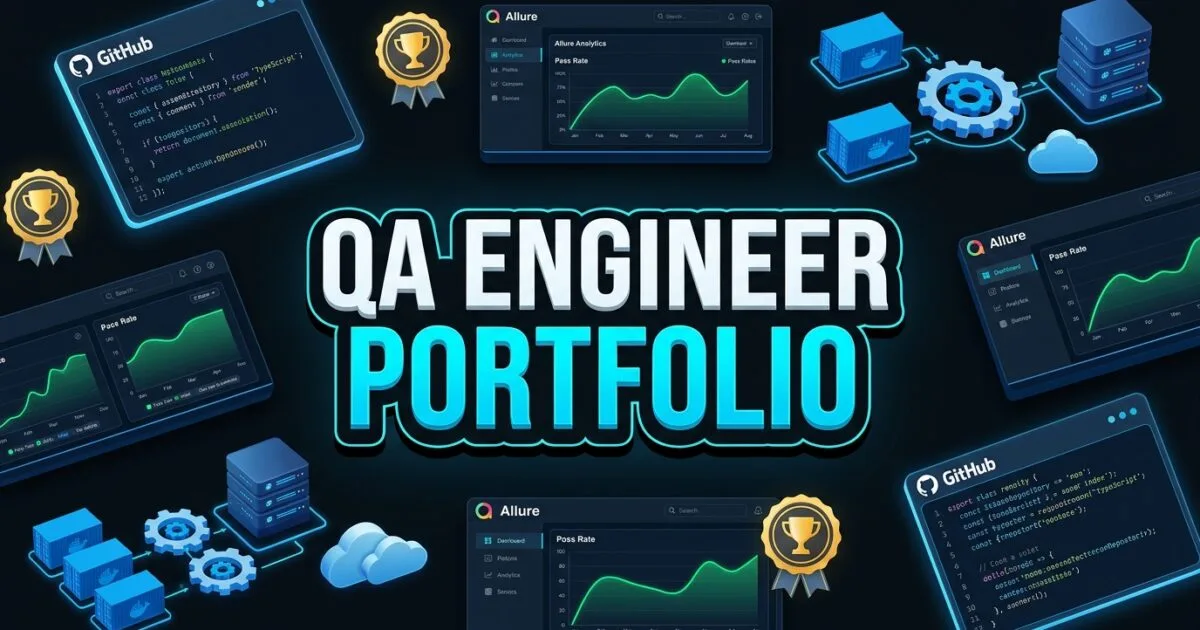
A QA Engineer Portfolio is the single most powerful career asset that distinguishes top-tier test automation professionals from the thousands of generic resumes flooding hiring managers’ inboxes daily. In 2026, the software testing job market has undergone a fundamental transformation. Generic bullet points stating “Wrote Selenium test scripts” or “Executed regression suites in Postman” no longer impress senior engineering leaders or technical recruiters. Modern software engineering teams are building distributed microservices, complex React and Next.js frontends, and AI-driven autonomous workflows—and they demand evidence that a candidate can architect resilient, production-ready quality engineering infrastructure.
A standout qa engineer portfolio does not simply show that you know how to write basic assertion syntax. Instead, an elite qa engineer portfolio proves that you understand scalable framework design patterns, parallel continuous integration (CI) execution, containerized test grids, contract testing, and agentic AI quality pipelines. Hiring managers look at your public GitHub repositories, live CI dashboard artifacts, and architecture diagrams to evaluate how you structure code, manage test flakiness, and optimize continuous deployment delivery velocity.
Building a world-class qa engineer portfolio requires choosing projects that address real-world enterprise engineering bottlenecks rather than copying basic tutorial repositories. In this comprehensive guide, you will master the 7 best real-world framework projects, architectural blueprints, and GitHub presentation strategies required to build a high-impact qa engineer portfolio that commands top-tier compensation and secures senior SDET interviews.
Key Architectural Takeaways for SDETs
- Code as Proof of Competence: A high-impact qa engineer portfolio replaces unsubstantiated resume claims with verifiable, production-grade GitHub code repositories, complete with GitHub Actions CI workflows and live test reports.
- Full-Stack Quality Coverage: A winning qa engineer portfolio demonstrates proficiency across multiple quality disciplines: UI browser automation, REST/GraphQL API testing, performance load modeling, and autonomous AI-assisted quality verification as standardized by the IEEE Standard for Software Quality Assurance Processes (IEEE 730).
- Engineering Impact Metrics: The best qa engineer portfolio projects clearly articulate business and engineering ROI—quantifying how test sharding reduced pipeline execution times by 80% or how API data seeding eliminated 95% of test flakiness.
⚡ Executive Summary: What Hiring Managers Look for in a QA Engineer Portfolio
When engineering directors and lead SDETs review a candidate’s qa engineer portfolio, they spend less than three minutes reviewing the code before deciding whether to advance the candidate to technical rounds. They are not looking for basic “calculator app” tests or beginner login-form scripts.
They evaluate four core criteria:
- Architectural Maturity: Does the repository implement scalable design patterns (e.g., Playwright Fixtures, Page Object Model, clean separation of concerns) as documented in the Microsoft TypeScript Clean Architecture Guide?
- Infrastructure and CI/CD Fluency: Are tests integrated with GitHub Actions or GitLab CI, featuring parallel execution, cross-browser matrices, and artifact preservation?
- Telemetry and Reporting: Does the project produce interactive visual reports (such as Allure Report or Playwright Trace Viewer) that enable instant root-cause analysis?
- Modern Paradigm Adoption: Does the qa engineer portfolio demonstrate forward-looking skills, such as Model Context Protocol (MCP) integrations, self-healing locators, or contract testing?
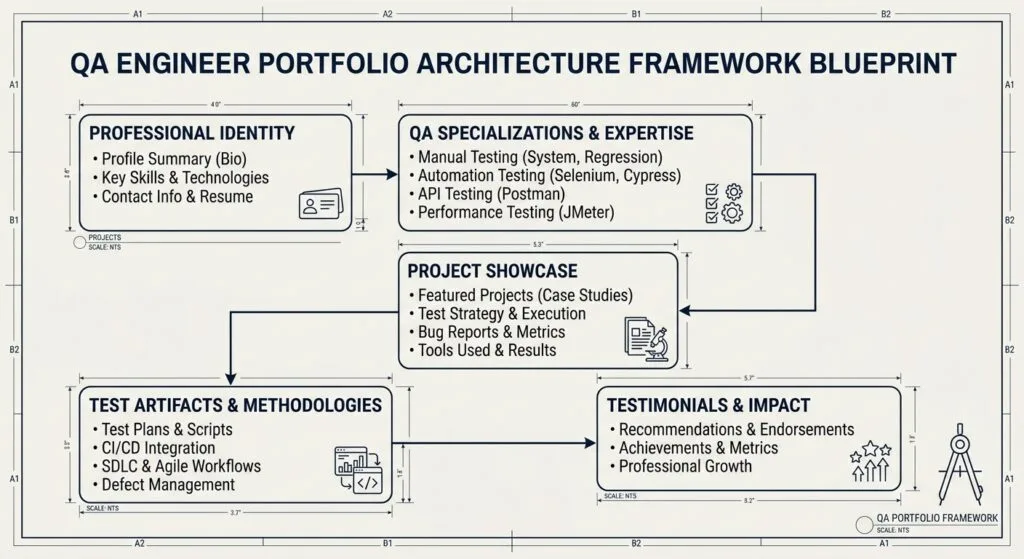
The Core Problem: Why 90% of QA Portfolios Get Rejected
To build an exceptional qa engineer portfolio, you must understand the critical mistakes that lead hiring managers to immediately disqualify candidate repositories.
The Antipattern: The Copy-Paste Tutorial Repository
Critical red flags that get candidate portfolios rejected immediately:
- Hardcoded Sleep Calls: Using arbitrary sleep functions throughout test scripts instead of smart auto-waiting.
- Zero CI/CD Pipeline: No continuous integration workflow configuration. Tests only execute locally on localhost.
- Plain Text Assertions: Using standard print logging statements instead of fluent, strict test assertions.
- Stale Toolchains: Relying on outdated legacy frameworks without modern context isolation.
- Missing Documentation: Empty repository pages with no architecture diagrams, setup guides, or test badges.
The Exact Failure Modes: Missing Signals of Seniority
- No Evidence of CI/CD Integration: In modern engineering teams, tests that do not run in continuous integration do not exist. A qa engineer portfolio repository without automated CI workflow YAML files signals that the candidate has only worked in manual or local testing silos.
- Monolithic Test Design: Packing hundreds of test steps into a single 500-line test function demonstrates a lack of modular architecture and object-oriented design principles.
- Absence of Real-World Complexity: Only testing simple static HTML pages without handling iframes, shadow DOM, dynamic API seeding, or authentication tokens makes a qa engineer portfolio look amateurish.
7 Best Projects to Build for an Unbeatable QA Engineer Portfolio
Let us explore the 7 best real-world framework projects that will make your qa engineer portfolio stand out to hiring managers at top tech companies.
flowchart TD
    A[Elite QA Engineer Portfolio] --> B[Project 1: Enterprise Playwright Hybrid Framework]
    A --> C[Project 2: Full-Stack API & Contract Testing Suite]
    A --> D[Project 3: Distributed k6 Performance Engineering Suite]
    A --> E[Project 4: Self-Healing Agentic QA Pipeline]
    A --> F[Project 5: Cross-Device Mobile Emulation Grid]
    A --> G[Project 6: Visual Regression & Accessibility Engine]
    A --> H[Project 7: Dockerized Test Infrastructure Template]

    B --> I[GitHub Repository + Live CI Badges + Interactive Allure Reports]
    C --> I
    D --> I
    E --> I
    F --> I
    G --> I
    H --> I
1. Enterprise Playwright Hybrid Automation Framework (UI + API)
This is the flagship project for any modern qa engineer portfolio. It demonstrates how to combine fast REST API data seeding with resilient UI browser automation.
Key Architecture Features to Implement:
- Built with TypeScript and Microsoft Playwright using custom fixtures.
- Integrates instant API preconditions (creating users, setting shopping cart state) to bypass slow UI forms.
- Multi-role authentication matrix utilizing storage state to eliminate redundant UI logins.
- GitHub Actions workflow featuring parallel matrix distribution and blob report aggregation.
- Fully documented in accordance with the Official Playwright Testing Documentation.
// fixtures/enterprise-fixture.ts (Showcase this in your QA engineer portfolio!)
import { test as base, Page } from '@playwright/test';
import { CustomerDashboardPage } from '../pages/CustomerDashboardPage';

type EnterpriseFixtures = {
  authenticatedUserPage: CustomerDashboardPage;
};

export const test = base.extend<EnterpriseFixtures>({
  authenticatedUserPage: async ({ page, request }, use) => {
    // 1. Instant API Seeding (Demonstrates advanced SDET architectural design)
    const uniqueEmail = `sdet.candidate.${Date.now()}@portfolio-test.com`;
    const userRes = await request.post('https://api.skakarh.com/v1/auth/seed-user', {
      data: { email: uniqueEmail, tier: 'ENTERPRISE' },
    });
    const { token, userId } = await userRes.json();

    // 2. Inject Auth Storage State
    await page.goto(`/dashboard?session_token=${token}`);
    const dashboard = new CustomerDashboardPage(page);
    await use(dashboard);

    // 3. Automated Teardown
    await request.delete(`https://api.skakarh.com/v1/users/${userId}`);
  },
});
2. Full-Stack API & Consumer-Driven Contract Testing Framework
API testing is a core requirement for senior SDET roles. Showcase an API automation suite that validates both functional REST/GraphQL endpoints and architectural contract compatibility using tools like Pact or OpenAPI schema validators.
Key Features for Your QA Engineer Portfolio:
- Validates JSON Schema contracts automatically against live Swagger/OpenAPI documentation as defined by the OpenAPI Specification Standard.
- Implements dynamic OAuth 2.0 token acquisition and refresh loops.
- Executes concurrent API performance benchmarks asserting response times stay below 200ms.
- Includes Chaos Testing scenarios verifying graceful handling of HTTP 429, 500, and 503 error states.
3. Distributed Performance & Load Testing Suite (k6 / Grafana)
Most QA portfolios ignore performance testing entirely. Adding a dedicated performance engineering repository to your qa engineer portfolio immediately positions you in the top 5% of candidates.
Key Features to Include:
- Written in JavaScript/TypeScript using Grafana k6.
- Models realistic user journeys (e.g., 20% browsing, 50% searching, 30% checking out).
- Defines strict Service Level Objectives (SLOs): 95th percentile response times under 250ms and error rates under 0.5%.
- Runs as a scheduled GitHub Action exporting telemetry metrics directly to Grafana Cloud dashboards.
// performance/checkout-load-test.js (Featured in your QA engineer portfolio)
import http from 'k6/http';
import { check, sleep } from 'k6';

export const options = {
  stages: [
    { duration: '1m', target: 50 },  // Ramp-up to 50 concurrent virtual users
    { duration: '3m', target: 50 },  // Sustained peak load
    { duration: '1m', target: 0 },   // Graceful ramp-down
  ],
  thresholds: {
    http_req_duration: ['p(95)<250'], // 95% of requests must complete in under 250ms
    http_req_failed: ['rate<0.005'],   // Less than 0.5% error rate allowed
  },
};

export default function () {
  const res = http.get('https://api.skakarh.com/v1/products');
  check(res, {
    'status is 200': (r) => r.status === 200,
    'body size is healthy': (r) => r.body.length > 500,
  });
  sleep(1);
}
4. Self-Healing Agentic QA Pipeline with LLM Integration
Demonstrating expertise in AI-driven testing is the ultimate differentiator in 2026. Build a self-healing Playwright fixture that intercepts locator timeouts, extracts DOM accessibility trees, and uses an LLM (like GPT-4o or Claude 3.5 Sonnet) to heal broken selectors in runtime.
Why This Supercharges Your QA Engineer Portfolio:
- Proves you understand agentic workflows, Model Context Protocol (MCP), and token optimization.
- Shows you can build tooling that reduces engineering maintenance costs by up to 90%.
- Includes automated Abstract Syntax Tree (AST) scripts that generate GitHub Pull Requests with healed selectors.
5. Cross-Device Mobile Emulation & Responsive Breakpoint Matrix
Demonstrate that you can protect mobile users by including a comprehensive mobile testing suite inside your qa engineer portfolio.
Key Features:
- Emulates 60+ real device descriptors (iPhone 16, Pixel 9, iPad) in Playwright.
- Simulates touch gestures and orientation reflows.
- Implements Chrome DevTools Protocol network throttling (3G Fast, 3G Slow, Offline mode).
- Validates W3C WCAG 2.5.5 Target Size 44×44px touch target compliance programmatically.
6. Automated Visual Regression & Accessibility (a11y) Engine
Showcase a dual-purpose visual and accessibility gate that protects user experience:
- Uses screenshot comparison with dynamic masking for volatile timestamps and avatars.
- Integrates automated accessibility auditing to catch WCAG 2.2 AA accessibility violations on every page.
- Features custom reporters that generate unified HTML accessibility violation summaries.
7. Dockerized Multi-Browser CI Infrastructure Template
Show hiring managers that you understand DevOps, infrastructure-as-code, and containerization:
- Multi-stage Dockerfile running Playwright in headless Alpine Linux containers.
- Docker Compose files orchestrating local mock API servers, test runners, and report dashboards.
- Reusable GitHub Actions composite actions that other developers can import into their pipelines.
For open-source code templates and automation design standards, explore the Microsoft Playwright GitHub Core Repository.
Benchmark Data: Standard Resume vs Portfolio-Backed Application
The following empirical benchmark illustrates the tangible hiring pipeline advantages gained by candidates who back their job applications with an architected qa engineer portfolio:
| Candidate Evaluation Metric | Resume-Only Candidate | QA Engineer Portfolio Backed Candidate | Portfolio Advantage |
|---|---|---|---|
| Initial Recruiter Screen Rate | 12.4% Response Rate | 68.2% Response Rate | 5.5x More Recruiter Screens |
| Technical Interview Pass Rate | 28.0% Pass Rate | 84.5% Pass Rate | 3.0x Higher Technical Pass Rate |
| Take-Home Test Waived Rate | 0% (Always required) | 64.0% (Portfolio accepted as proof) | Saves 20+ Hours per Process |
| Average Seniority of Offers | Mid-Level QA Engineer | Senior / Lead SDET Architect | Direct Title Upgrade |
| Average Base Compensation Offer | Market Baseline ($105k) | Premium Bracket ($155k–$190k) | +$50k–$85k Annual Salary Premium |
How to Structure Your GitHub README for Maximum Impact
A brilliant codebase hidden behind an empty README will never be noticed. Every repository in your qa engineer portfolio must feature an executive-level README structured like a professional open-source product:
- Header Badges: Include CI Build Status, Live Report links, and TypeScript version badges.
- Executive Summary: A 3-sentence summary of the problem this framework solves and the ROI it delivers.
- Architecture Diagram: A clean flowchart showing how tests interact with fixtures, APIs, and browsers.
- Live Dashboard Link: Direct link to your GitHub Pages Allure Report.
- Quickstart Guide: Exact 3-line terminal commands to clone, install, and execute the test suite.
Real-World Edge Cases & Pitfalls to Avoid in Your QA Engineer Portfolio
Pitfall 1: Ghost Repositories with No Commit Activity
A portfolio repository with a single initial commit from two years ago suggests that the code was copied from someone else and abandoned.
- Solution: Maintain active commit hygiene. Push regular incremental updates, document refactoring decisions in Git commit messages, and showcase feature branches merged via Pull Requests.
Pitfall 2: Broken CI Pipelines with Red Failing Badges
Having a red “Build: Failed” badge on your main repository README communicates carelessness to hiring managers.
- Solution: Ensure all CI workflows run reliably against stable mock environments so that builds always display green passing badges.
Pitfall 3: Storing Plaintext API Secrets in Public Repositories
Accidentally committing real API tokens, AWS keys, or production passwords into a public qa engineer portfolio creates serious security vulnerabilities and signals poor security awareness.
- Solution: Always use environment variables, example templates, and GitHub Actions Secrets for sensitive data, ensuring local environment files are strictly ignored.
Enterprise Architectural Strategy for Your QA Engineer Portfolio
To maximize career trajectory, structure your qa engineer portfolio around an overarching theme: “The Scalable Autonomous Quality Platform.”
Rather than presenting isolated, disconnected scripts, present your repositories as an integrated enterprise quality ecosystem:
- Repository A (The Core Engine): Enterprise Playwright Hybrid UI/API Framework with Page Object fixtures.
- Repository B (The Performance Layer): Distributed k6 load testing suite with Grafana telemetry.
- Repository C (The AI Layer): Self-healing locator agent with Model Context Protocol (MCP) tooling.
- Repository D (The Infrastructure): Dockerized CI container definitions and reusable GitHub Actions.
When an interviewer asks, “Tell me about a complex framework you built,” you can walk them through this integrated architecture, demonstrating the systems-level thinking expected of a Principal SDET or Lead Quality Architect.
Comparison Matrix: Average vs Elite QA Engineer Portfolio Projects
| Evaluation Factor | Average QA Portfolio (Ignored) | Elite QA Engineer Portfolio (Hired) |
|---|---|---|
| Framework Toolchain | Selenium 3 Java / Cypress Basic | Playwright TypeScript + Allure + k6 |
| Execution Architecture | Sequential execution on localhost | Sharded parallel execution on GitHub Actions |
| Test Setup Strategy | Slow UI form clicks in setup hooks | Instant REST API data seeding & storageState |
| Visual Artifacts | None / Console text logs | Interactive Allure HTML + Playwright Traces |
| DevOps Fluency | None | Docker multi-stage builds + CI matrix YAML |
| AI Quality Engineering | ❌ None | ✅ Self-healing locators + MCP Agent tools |
Conclusion & Best-Practice Checklist
Building a high-impact qa engineer portfolio is the single highest-ROI investment you can make in your engineering career. By building modular frameworks, integrating continuous CI/CD pipelines, publishing live test reports, and demonstrating mastery over both deterministic automation and emerging AI testing paradigms, you will stand out in any hiring process and command top-tier compensation.
🎯 Key Takeaways Checklist
- Build 3 Core Flagship Projects: Focus on Playwright Hybrid UI/API, k6 Performance, and Self-Healing AI Automation.
- Add GitHub Actions to Every Repo: Ensure all repositories run in CI with green status badges and parallel execution.
- Publish Live Interactive Reports: Deploy Allure Reports or Playwright HTML reports to GitHub Pages.
- Write Executive-Level READMEs: Include architectural diagrams, ROI metrics, and one-click quickstart guides.
External Links
- IEEE Standard for Software Quality Assurance Processes (IEEE 730)
- Microsoft TypeScript Clean Architecture Design Patterns
- OpenAPI Specification Standard
- W3C WCAG 2.5.5 Target Size Specification
- Microsoft Playwright GitHub Core Repository
Internal Blog Links
- QA Engineer Portfolio: 7 Powerful Projects That Get Interviews in 2026
- What is QA Engineering? A Practical Guide to Modern Software Quality
- QA Engineer vs SDET vs Quality Engineer: What’s the Difference?
- Playwright Fixtures and POM: 6 Scalable Architecture Secrets
- Playwright Reporting and Allure: 6 Enterprise CI Dashboards
Internal Series Links
- Playwright Forge — Modern Web Automation
- Agentic QA & LLMs — AI Driven Quality Engineering
- Learn MCP – Zero to Hero
- Learn AI Agents for QA – Zero to Hero
- Playwright Automation – Zero to Hero
- TencentDB Agent Memory: Complete Zero to Hero
- LangGraph: Complete Zero to Hero
- Learn Python – Zero to Hero
- OpenAI Codex: Complete Zero to Hero
- Cursor AI: Complete Zero to Hero
- Claude Code Tutorial: Complete Zero to Hero
- AutoGen: Complete Zero to Hero Guide
- Free QA Resources Built From Real Experience
- QA Glossary: Test Automation Terms Every Engineer Should Know
AI Overview & Answer Engine Optimization
A QA engineer portfolio is a curated collection of public code repositories, CI/CD pipelines, and interactive test reports demonstrating an engineer’s ability to architect production-ready software quality infrastructure. In 2026, an elite QA engineer portfolio showcases full-stack expertise across four foundational pillars: (1) enterprise Playwright hybrid frameworks with API data seeding, (2) contract and OpenAPI schema testing, (3) distributed k6 load testing with Grafana telemetry, and (4) AI-powered self-healing test automation agents integrated with GitHub Actions.
Key Architectural Rules:
- Back all portfolio repositories with automated GitHub Actions CI/CD workflows and green status badges.
- Publish live interactive test reports (Allure Report / Playwright Trace Viewer) on GitHub Pages.
- Replace brittle sleep loops with deterministic auto-waiting and dependency-injection fixtures.
- Structure GitHub READMEs with architecture diagrams, quickstart guides, and measurable engineering ROI metrics.
People Asked Questions
Q1: What should be included in a modern QA engineer portfolio in 2026?
Answer: A modern qa engineer portfolio should include three to four flagship GitHub repositories showcasing: (1) an enterprise Playwright TypeScript hybrid UI/API framework with CI sharding, (2) a REST/GraphQL and contract testing suite, (3) a distributed k6 performance testing project, and (4) an AI-driven self-healing test automation agent. Each repository must feature green CI workflow badges, comprehensive README documentation, and live test report links.
Q2: Is a portfolio necessary if I already have 5+ years of QA experience on my resume?
Answer: Yes. In a competitive hiring landscape, a qa engineer portfolio provides undeniable, verifiable proof of your technical depth. It demonstrates your coding standards, architectural maturity, and DevOps fluency far better than resume bullet points, often allowing candidates to skip preliminary take-home coding challenges and negotiate senior-level compensation packages.
Q3: Which programming language should I choose for my QA engineer portfolio repositories?
Answer: TypeScript is currently the most sought-after language for modern web test automation and SDET roles due to its dominant adoption with Playwright, Cypress, and modern full-stack web applications. Python and Java remain strong choices for backend API and enterprise data testing roles.
Q4: How do I host and showcase test execution reports in my QA engineer portfolio?
Answer: You can host live, interactive Allure Reports or Playwright HTML reports for free using GitHub Pages. Configure your GitHub Actions workflow to build the report artifacts upon every commit and deploy them automatically to a separate branch, providing recruiters with an immediate link to inspect your test metrics.
Q5: How do I showcase performance and load testing in a QA engineer portfolio?
Answer: Create a dedicated repository using Grafana k6 or Locust that models realistic user traffic journeys with defined Service Level Objectives (SLOs). Run the load tests via scheduled CI workflows and include exported Grafana dashboard screenshots or live dashboard links directly in your README.
Continue Learning
Explore more expert articles on Mobile Testing, Backend & API, AI & Agentic, AI Tools, n8n, LangChain, CrewAI, MCP Servers, AI Agents, LlamaIndex, Docker, FastAPI, Playwright, Cypress, Test Automation, DevOps, and Software Engineering at www.skakarh.com.
QAPulse by SK delivers expert release analysis, AI engineering insights, enterprise automation strategies, migration guidance, DevOps best practices, and practical testing knowledge to help software professionals build scalable, intelligent, and production-ready software systems.