 QA
QA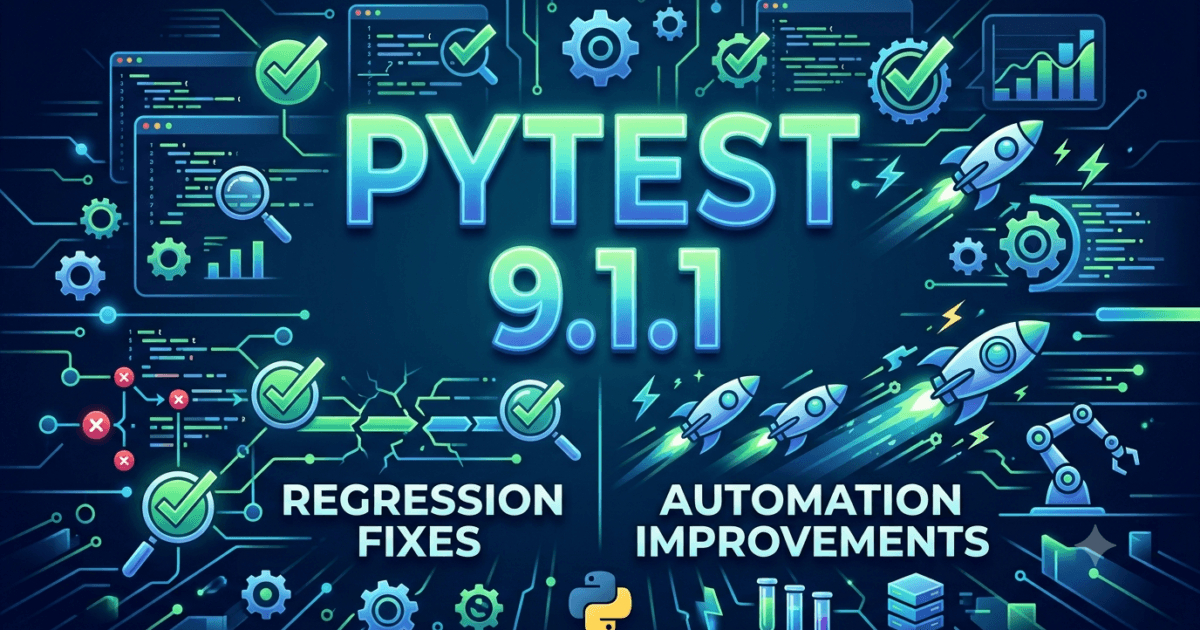
When a framework releases a patch version, many teams assume there is little value in upgrading immediately. In reality, patch releases often fix issues that directly affect developer productivity, CI/CD stability, and test reliability. PyTest 9.1.1 is a perfect example.
Although this release introduces no major features, it resolves several regressions introduced in PyTest 9.1.0, improves typing support, and restores expected behavior for common enterprise testing scenarios. If your organization depends on PyTest for unit testing, API testing, UI automation, or continuous integration, these fixes deserve your attention.
For QA engineers and SDETs, this release is less about new capabilities and more about eliminating friction that can silently disrupt large automation suites.
What is PyTest 9.1.1?
PyTest is one of the world’s most widely adopted Python testing frameworks. From startups to Fortune 500 enterprises, PyTest powers millions of automated tests across web applications, APIs, AI platforms, microservices, data engineering pipelines, and cloud-native systems.
Version 9.1.1, released on 19 June 2026, is a maintenance release focused on correcting regressions introduced in version 9.1.0. Rather than adding new APIs, it restores expected behavior in several areas that are heavily used in professional automation frameworks.
For organizations running thousands of automated tests every day, these seemingly “small” fixes can significantly reduce pipeline failures, developer confusion, and maintenance effort.
At a Glance
| Category | Details |
|---|---|
| Release | PyTest 9.1.1 |
| Release Date | 19 June 2026 |
| Release Type | Patch Release |
| Breaking Changes | None introduced in this release |
| Primary Focus | Bug fixes and regression corrections |
| Recommended Upgrade | Yes, especially for teams already using PyTest 9.1.0 |
Why This Release Matters More Than It Looks
Many engineering teams postpone patch upgrades because they expect minimal benefits. However, patch releases often resolve issues that affect day-to-day development more than major feature releases.
Imagine a CI pipeline that suddenly starts failing because fixture parametrization behaves differently after upgrading. Developers spend hours debugging their own code before discovering that the problem originates from the testing framework itself.
Similarly, if conftest.py is not loaded correctly, custom hooks, plugins, command-line options, and shared fixtures may silently stop working. Such issues can impact hundreds or even thousands of tests across an enterprise codebase.
PyTest 9.1.1 focuses precisely on these kinds of reliability improvements. Instead of introducing flashy features, it restores confidence that existing automation frameworks behave consistently across local development and CI environments.
This is why mature engineering organizations often prioritize stability releases over feature releases.
PyTest 9.1.1 vs PyTest 9.1.0
| Feature | PyTest 9.1.0 | PyTest 9.1.1 |
|---|---|---|
| Fixture Parametrization | Regression introduced | Fixed |
| RaisesGroup Messages | Could display misleading output | Corrected |
| conftest.py Loading | Regression in some directory structures | Fixed |
| mypy Typing | Minor typing issues | Improved |
| Enterprise CI Stability | Possible pipeline disruptions | More stable |
| Upgrade Recommendation | Evaluate carefully | Recommended |
For most organizations, PyTest 9.1.1 should be considered the practical replacement for 9.1.0.
Deep Dive into the Most Important Fixes
1. Parametrized Fixture Regression Has Been Resolved
Among all fixes in this release, this is arguably the most important for automation engineers.
Many modern PyTest frameworks rely heavily on indirect parametrization to create reusable test environments. Instead of hardcoding setup logic inside every test, fixtures dynamically create users, databases, browsers, APIs, or cloud environments.
A regression in PyTest 9.1.0 caused some indirect parametrization scenarios to fail with duplicate parametrization errors.
Large automation frameworks commonly use this pattern for:
- Cross-browser execution
- Environment-specific configuration
- API authentication
- Database initialization
- Dynamic test data generation
When these fixtures stop working correctly, entire regression suites may fail before the first assertion executes.
For enterprise QA teams, this fix removes unnecessary debugging time and restores confidence in reusable testing infrastructure.
2. conftest.py Loading Works Correctly Again
If your team has ever built a serious PyTest framework, you know how important conftest.py is.
This file usually contains:
- shared fixtures
- custom hooks
- command-line options
- logging configuration
- browser initialization
- authentication helpers
- reporting plugins
PyTest 9.1.0 introduced a regression where certain conftest.py files located inside /test* directories were no longer loaded correctly when invoked without arguments.
This sounds minor until you consider the impact.
Without loading these files correctly:
- custom CLI options may disappear
- fixtures become unavailable
- plugins stop registering
- reporting breaks
- setup hooks fail silently
From a QA perspective, this creates dangerous false negatives. Test failures appear to originate from application code even though the underlying issue is framework initialization.
PyTest 9.1.1 restores the expected discovery behavior, reducing unnecessary troubleshooting during CI runs.
3. Better Exception Group Diagnostics
Python’s Exception Groups introduced more powerful error handling, and PyTest has steadily improved support for these language features.
The fix to pytest.RaisesGroup ensures that diagnostic messages correctly identify matching exception types.
While this change may appear niche, it becomes valuable for:
- concurrent testing
- async applications
- distributed systems
- parallel execution
- AI pipelines
- event-driven architectures
Accurate diagnostic messages help developers identify the true root cause of failures instead of chasing misleading error reports.
In complex systems, better diagnostics often save more engineering time than new framework features.
What This Means for QA Engineers
From a QA engineering perspective, PyTest 9.1.1 is a reliability release rather than a feature release.
Its value lies in reducing unexpected behavior across automation frameworks.
If your organization recently upgraded to PyTest 9.1.0 and noticed unusual fixture behavior, inconsistent pipeline execution, or missing hooks, this release should be prioritized.
If you are still using PyTest 8.x or an earlier 9.x version without issues, there is no urgent pressure to upgrade immediately. However, teams planning future migrations should validate against 9.1.1 instead of 9.1.0 to avoid inheriting regressions that have already been resolved.
The release also reinforces an important lesson for QA leaders: regression testing should include the testing framework itself. Too often, teams validate only the application while assuming infrastructure upgrades are risk-free. In reality, a framework regression can affect hundreds of downstream tests, making disciplined upgrade validation an essential part of test engineering.
Enterprise Impact: Why Large QA Teams Should Upgrade
If you maintain a personal automation project with a few hundred tests, PyTest 9.1.1 may appear to be a routine maintenance release. However, for enterprise organizations running thousands of automated tests every day, the fixes in this release can significantly improve pipeline stability and developer productivity.
Large software teams often execute multiple categories of automated tests as part of every release:
- Unit Tests
- API Tests
- UI Automation
- Contract Testing
- Performance Validation
- Security Verification
- Smoke Suites
- Regression Suites
These tests are executed across numerous environments using CI/CD platforms such as GitHub Actions, Jenkins, Azure DevOps, GitLab CI, and CircleCI.
A regression in the testing framework itself can affect every stage of this pipeline.
For example, imagine a banking application with 8,000 automated tests. If indirect fixture parametrization stops working correctly after a framework upgrade, hundreds of tests may fail before the application code is even executed. Developers waste valuable engineering hours investigating false failures instead of building new features.
Similarly, missing conftest.py discovery can disable custom fixtures, authentication helpers, browser initialization, reporting hooks, and plugin registration across multiple repositories.
PyTest 9.1.1 restores predictable framework behavior, reducing the operational risk associated with automation infrastructure.
Impact on Popular Automation Frameworks
One of PyTest’s greatest strengths is its ecosystem. Most Python testing frameworks either integrate directly with PyTest or build upon its fixture system.
Playwright + PyTest
Playwright users frequently depend on fixtures to initialize browser contexts, authenticated sessions, test users, and reusable page objects.
Correct fixture discovery ensures:
- Browser contexts initialize consistently.
- Authentication helpers remain available.
- Parallel execution behaves as expected.
- Shared resources are cleaned up correctly.
Large Playwright projects should validate their custom fixtures after upgrading.
Selenium + PyTest
Selenium automation frameworks typically use fixtures for:
- WebDriver creation
- Browser configuration
- Grid execution
- Screenshot capture
- Logging
- Cleanup
The fixes in PyTest 9.1.1 reduce the likelihood of unexpected fixture-related failures after upgrading.
FastAPI and API Testing
FastAPI projects commonly use PyTest for endpoint validation, dependency injection testing, authentication flows, and database fixtures.
Reliable fixture loading ensures API test environments remain deterministic across local development and CI pipelines.
AI and Machine Learning Applications
Modern AI projects using LangChain, CrewAI, LlamaIndex, MCP Servers, or FastAPI increasingly rely on PyTest to validate agent workflows, RAG pipelines, prompt evaluation, vector database interactions, and model integrations.
These systems frequently use complex fixture hierarchies.
Stable fixture behavior directly improves confidence in AI regression testing.
Migration Guide
Upgrading to PyTest 9.1.1 is straightforward for most projects.
Upgrade Command
pip install --upgrade pytest
Verify the installed version:
pytest --versionRegression Testing Checklist After Upgrading
Never upgrade a testing framework without validating your automation framework.
Use the following checklist.
✅ Execute smoke tests
✅ Execute full regression suite
✅ Validate indirect parametrized fixtures
✅ Verify all conftest.py files load correctly
✅ Confirm custom plugins still initialize
✅ Test custom CLI options
✅ Verify HTML/XML reporting
✅ Validate Allure reporting if applicable
✅ Run tests in CI/CD
✅ Execute parallel runs
✅ Validate async tests
✅ Review flaky test statistics
Code Example
Suppose your automation framework relies on indirect parametrization.
import pytest

@pytest.fixture
def browser(request):
    return create_browser(request.param)

@pytest.mark.parametrize(
    "browser",
    ["chrome", "firefox"],
    indirect=True,
)
def test_login(browser):
    browser.open("/login")
PyTest 9.1.1 restores correct handling for regression scenarios affecting indirect parametrization introduced in version 9.1.0.
For teams heavily using reusable fixtures, this is one of the strongest reasons to upgrade.
Should You Upgrade?
| Team Type | Recommendation |
|---|---|
| Individual Developers | ✅ Yes |
| Small Startups | ✅ Yes |
| Enterprise QA Teams | ✅ Yes, after smoke and regression testing |
| Open Source Maintainers | ✅ Recommended |
| AI Engineering Teams | ✅ Recommended |
| Teams Remaining on PyTest 8.x | Test before migrating |
Unlike feature-heavy releases, PyTest 9.1.1 introduces very little migration risk while resolving real issues encountered by users of 9.1.0.
My Expert Verdict
PyTest 9.1.1 is exactly what a mature patch release should be.
Rather than introducing experimental capabilities, it restores stability, corrects regressions, and improves developer confidence. Those improvements rarely make headlines, but they have a measurable impact on engineering productivity.
For QA engineers, the biggest takeaway is not the individual fixes themselves but the reminder that testing frameworks are production dependencies. An unstable testing framework can generate false failures, delay releases, and consume significant debugging time.
If your team upgraded to PyTest 9.1.0, moving to PyTest 9.1.1 should be a priority.
If you are planning a future migration, skip 9.1.0 and adopt 9.1.1 as your baseline after validating your automation framework.
Overall Recommendation: ⭐⭐⭐⭐⭐ (5/5)
Frequently Asked Questions
Is PyTest 9.1.1 a major release?
No. It is a patch release focused on bug fixes and regression corrections.
Should I upgrade from PyTest 9.1.0?
Yes. If you are already using 9.1.0, upgrading to 9.1.1 is recommended because it resolves several regressions affecting fixtures, conftest.py discovery, typing, and exception diagnostics.
Are there breaking changes?
No new breaking changes are introduced in PyTest 9.1.1.
Does this release improve CI/CD stability?
Yes. The regression fixes reduce unnecessary pipeline failures caused by framework behavior rather than application defects.
Does PyTest 9.1.1 require changes to existing test code?
Most projects will not require code changes. However, teams should execute a complete regression suite after upgrading.
Relevant Articles
- What is Playwright and Why Everyone is Talking About It
- The Hidden Architecture Behind Scalable QA Platforms in 2026
- AI-Powered Test Automation Framework: Powerful Complete Guide for 2026
External Resources
- Official PyTest Documentation: https://docs.pytest.org/
- PyTest GitHub Repository: https://github.com/pytest-dev/pytest
- Official Release Notes: https://github.com/pytest-dev/pytest/releases/tag/9.1.1
- Python Documentation: https://docs.python.org/3/
- mypy Documentation: https://mypy.readthedocs.io/
Final Thoughts
Not every software release introduces groundbreaking capabilities, but every stable release contributes to the long-term health of your automation ecosystem.
PyTest 9.1.1 demonstrates why maintenance releases deserve attention. By correcting regressions in fixture handling, improving diagnostics, restoring conftest.py discovery, and strengthening typing support, it helps QA teams spend less time troubleshooting their testing framework and more time validating application quality.
If your automation strategy depends on PyTest—which is true for many Python, Playwright, Selenium, FastAPI, AI, and API testing projects—this release is a worthwhile upgrade.
Continue learning with QAPulse by SK
At www.skakarh.com, we publish in-depth guides on Software Testing, QA Engineering, Test Automation, Playwright, Selenium, Cypress, PyTest, FastAPI, AI Testing, Agentic AI, MCP, LangChain, CrewAI, and modern DevOps practices. If you found this release analysis useful, explore our latest tutorials and stay updated with practical insights designed for QA professionals and SDETs.