QA
QA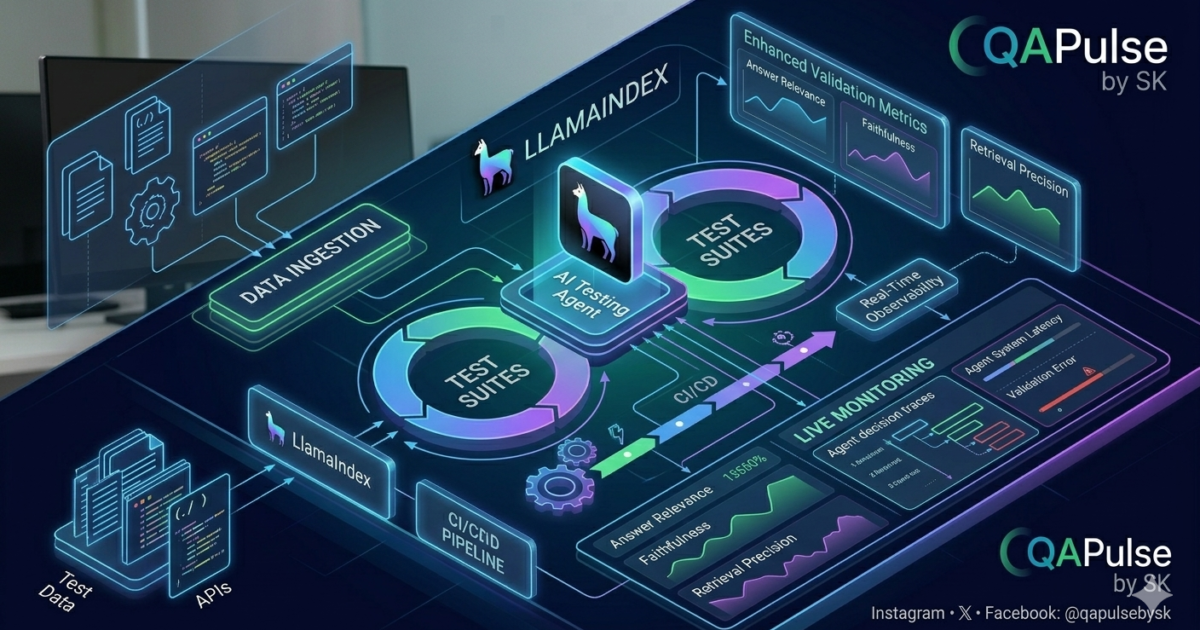
LlamaIndex 0.14.22 Released: Key Updates for QA Engineers in 2026
The AI engineering ecosystem continues to evolve rapidly, and keeping dependencies up to date is becoming an important responsibility for QA Engineers, SDETs, and AI Testing teams.
On May 14, 2026, LlamaIndex released version 0.14.22, introducing updates across multiple packages in the ecosystem. While this release is not packed with major end-user features, it contains dependency updates and package maintenance improvements that can impact stability, security, and future compatibility.
In this article, we’ll explore what changed in LlamaIndex 0.14.22, what it means for software testing teams, and whether you should upgrade immediately.
What is LlamaIndex?
LlamaIndex is one of the most widely adopted frameworks for building Retrieval-Augmented Generation (RAG) applications, AI agents, enterprise search systems, and knowledge-driven chatbots.
It helps developers connect Large Language Models (LLMs) with:
- Databases
- Documents
- APIs
- Knowledge Bases
- Enterprise Systems
As AI-powered applications become more common, QA engineers increasingly encounter LlamaIndex-based systems during testing activities.
What’s New in LlamaIndex 0.14.22?
According to the official release notes, the update primarily focuses on package maintenance and dependency management.
Updated Components:
llama-index-agent-agentmesh [0.2.0]
Changes:
- Mass dependency lock upgrades
- Package synchronization improvements
llama-index-callbacks-agentops [0.5.0]
Changes:
- Dependency upgrades across multiple directories
- Updated package locks
- Improved dependency consistency
llama-index-callbacks-aim [0.4.1]
Changes:
- Lock file updates
- Dependency refresh
llama-index-callbacks-argilla [0.5.0]
Changes:
- Dependency management improvements
- Package upgrade maintenance
At first glance, these may appear to be minor updates. However, experienced QA engineers know that dependency-related releases often introduce unexpected side effects.
Why Should QA Engineers Care About LlamaIndex 0.14.22?
Many teams only focus on feature releases.
In reality, dependency updates frequently introduce:
- Version conflicts
- Runtime regressions
- Security fixes
- Build failures
- Integration issues
For organizations running AI-powered systems, even a small package update can impact production stability.
Areas Worth Testing After Upgrading
If your application uses LlamaIndex, consider validating the following areas after upgrading.
1. Agent Workflows
Test:
- Multi-agent communication
- Tool invocation
- Context sharing
- Workflow orchestration
AgentMesh-related updates may indirectly affect these capabilities.
2. Callback Integrations
Many observability platforms rely on callback integrations.
Validate:
- Logging
- Metrics collection
- Tracing
- Telemetry
If your team uses AgentOps, AIM, or Argilla integrations, regression testing is recommended.
3. Retrieval-Augmented Generation (RAG)
Verify:
- Document indexing
- Embedding generation
- Retrieval quality
- Citation accuracy
Dependency changes occasionally impact underlying retrieval pipelines.
4. API Stability
Run automated tests against:
- REST endpoints
- Agent APIs
- Search endpoints
- Chat interfaces
Even maintenance releases can introduce unexpected behavior.
Potential Risks When Upgrading
Although no major breaking changes were announced, QA teams should remain cautious.
Common upgrade risks include:
| Risk Area | Testing Recommendation |
|---|---|
| Dependency Conflicts | Verify package compatibility |
| Agent Execution | Run workflow regression suites |
| Callback Systems | Validate telemetry integrations |
| Build Pipelines | Test CI/CD environments |
| RAG Pipelines | Execute retrieval quality checks |
A controlled rollout is usually safer than an immediate production deployment.
Recommended Upgrade Strategy
For enterprise teams, consider the following approach:
Step 1: Upgrade in a Non-Production Environment
Never deploy directly to production.
Use:
- Development
- QA
- Staging
environments first.
Step 2: Run Regression Tests
Execute:
- Functional tests
- API tests
- Integration tests
- AI evaluation tests
Step 3: Validate Observability
Ensure:
- Logs are generated correctly
- Metrics continue to flow
- Monitoring dashboards remain operational
Step 4: Monitor Production Carefully
After deployment:
- Track latency
- Monitor failures
- Review agent behavior
- Analyze retrieval quality
Should You Upgrade Immediately?
For most teams, the answer is:
Yes, but test first.
This release appears to focus primarily on dependency maintenance rather than introducing major functionality changes.
If your project relies heavily on:
- AgentMesh
- AgentOps
- AIM callbacks
- Argilla integrations
then a regression testing cycle is recommended before production deployment.
For teams actively building AI agents, RAG applications, or AI-powered testing frameworks, staying reasonably current with LlamaIndex releases helps reduce technical debt and future migration challenges.
What This Means for AI Testing Teams
The growing adoption of frameworks like LlamaIndex means QA engineers must expand beyond traditional software testing practices.
Modern AI testing now includes:
- Agent Testing
- RAG Testing
- Prompt Validation
- Hallucination Detection
- Tool Usage Validation
- Observability Verification
As frameworks continue evolving, release monitoring should become a regular part of the QA process.
Teams that proactively validate framework upgrades will experience fewer production incidents and more reliable AI systems.
Best Practices for Testing LlamaIndex Upgrades
Whenever a new LlamaIndex version is released, QA teams should avoid treating the upgrade as a simple dependency update. Modern AI frameworks often sit at the center of critical workflows, including document retrieval, agent orchestration, observability integrations, and LLM interactions.
Before promoting LlamaIndex 0.14.22 to production, consider creating a dedicated regression suite that validates:
- Retrieval quality against known datasets
- Agent decision-making consistency
- Callback and telemetry integrations
- Response latency under expected load
- Error handling and fallback mechanisms
For organizations building Retrieval-Augmented Generation (RAG) systems, it is also worth comparing search relevance before and after the upgrade. Even small dependency changes can influence embeddings, retrieval behavior, or downstream integrations.
A structured validation process reduces deployment risk and helps ensure that AI-powered applications remain reliable, observable, and maintainable as the LlamaIndex ecosystem continues to evolve.
How to Upgrade
Python
pip install llamaindex --upgrade
Node.js
npm install llamaindex@latest
Why Release Monitoring Matters for AI Testing Teams
Many QA engineers closely track releases of testing tools such as Playwright, Selenium, Cypress, and K6. However, AI frameworks deserve the same level of attention.
Frameworks like LlamaIndex form the backbone of many enterprise AI applications. A seemingly minor release can impact agent behavior, retrieval pipelines, observability tooling, or third-party integrations.
By regularly reviewing release notes, QA teams can:
- Identify potential regression risks early
- Plan upgrade testing activities
- Maintain compatibility with AI infrastructure
- Reduce production incidents
- Improve long-term platform stability
As AI adoption accelerates across industries, release-note analysis is becoming a valuable skill for modern SDETs and AI Testing Engineers. Teams that proactively evaluate framework updates are often better positioned to deliver reliable AI systems while minimizing operational surprises.
Frequently Asked Questions
What is LlamaIndex 0.14.22?
LlamaIndex 0.14.22 is a maintenance release containing dependency updates and package improvements across several LlamaIndex ecosystem components.
Does LlamaIndex 0.14.22 introduce breaking changes?
The official release notes do not highlight major breaking changes, but regression testing is recommended before production deployment.
Should QA engineers test maintenance releases?
Yes. Dependency updates can introduce compatibility issues, runtime regressions, and integration failures even when no new features are added.
Is LlamaIndex used in AI testing?
Indirectly, yes. Many AI-powered applications, RAG systems, and agent frameworks use LlamaIndex, making it relevant for QA and AI testing teams.
Final Thoughts
While LlamaIndex 0.14.22 is primarily a maintenance-focused release, it remains important for organizations building AI-powered products.
Dependency updates may seem routine, but they often influence application stability, observability, and integration reliability.
For QA Engineers and SDETs, the safest approach is simple:
- Upgrade in staging first
- Run regression tests
- Validate AI workflows
- Monitor production carefully
Keeping AI frameworks healthy is becoming just as important as testing application features.
Relevant Articles
- What is Playwright and Why Everyone is Talking About It
- Why Most Test Automation Frameworks Collapse at Scale
- The Hidden Architecture Behind Scalable QA Platforms in 2026
- AI-Powered Test Automation Framework: Powerful Complete Guide for 2026
- AI Agent Testing: 12 Critical Strategies Every QA Engineer Must Master in 2026