QA
QA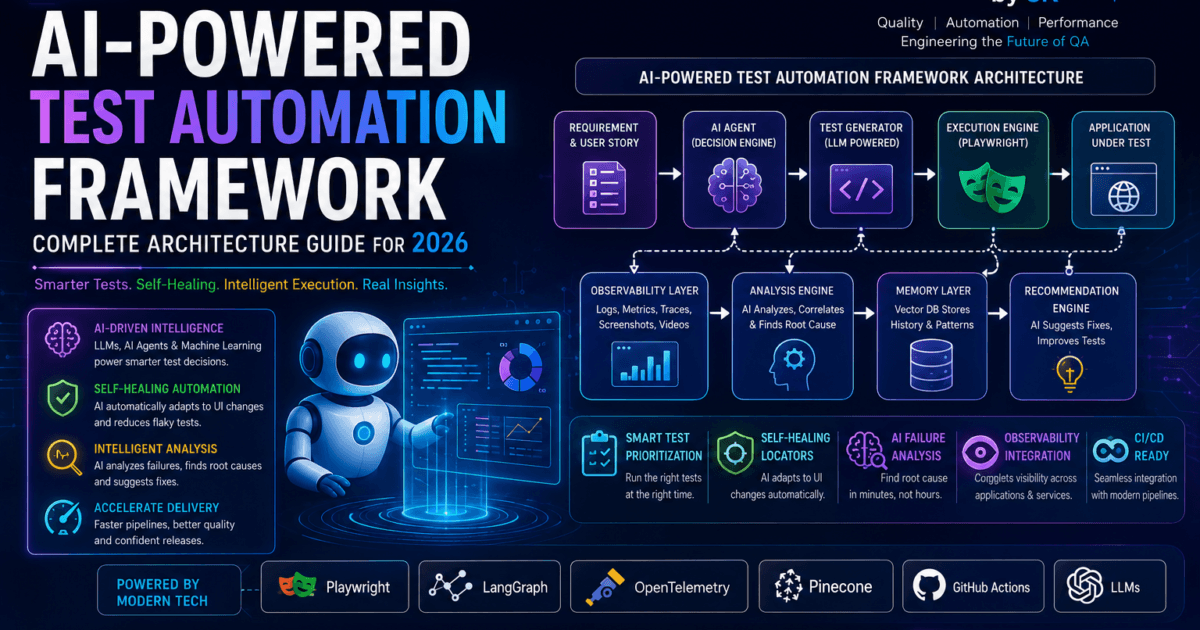
AI-Powered Test Automation Framework is Changing Software Testing Forever
If you spend enough time in QA communities, LinkedIn discussions, or engineering conferences, you will notice something interesting.
A few years ago, everyone was discussing:
- Selenium vs Cypress
- Selenium vs Playwright
- Java vs JavaScript
- Page Object Model
- Automation frameworks
Today the conversation has changed.
The most forward-thinking QA teams are now asking:
How can AI help us build smarter automation systems?
That question is creating an entirely new category of engineering.
Welcome to the era of the AI-Powered Test Automation Framework.
This is not about replacing testers.
It is not about letting ChatGPT write a few test cases.
It is about building intelligent testing ecosystems that can learn, adapt, diagnose problems, and assist engineers throughout the software delivery lifecycle.
Organizations that understand this shift early will gain a significant competitive advantage.
What Is an AI-Powered Test Automation Framework?
An AI-Powered Test Automation Framework combines traditional automation tooling with artificial intelligence capabilities to improve:
- Test creation
- Test maintenance
- Test execution
- Failure analysis
- Risk assessment
- Debugging
- Reporting
Instead of simply running scripts, the framework can make intelligent decisions using historical data, runtime telemetry, and contextual information.
Quick Answer Table
| Component | Purpose |
|---|---|
| Playwright | Browser automation |
| AI Agent | Decision making |
| LLM | Analysis and reasoning |
| Vector Database | Memory layer |
| Observability | Diagnostics |
| CI/CD Pipeline | Continuous execution |
| Reporting Engine | Insights and analytics |
| Self-Healing Layer | Automatic recovery |
Why Traditional Automation is Struggling
Traditional automation frameworks were designed for relatively predictable systems.
Applications used to be:
- Monolithic
- Synchronous
- Simpler
- Easier to debug
Modern applications are very different.
Today’s systems include:
- Microservices
- Cloud infrastructure
- Distributed APIs
- AI-generated content
- Dynamic frontends
- Event-driven architectures
As complexity grows, traditional automation struggles to keep pace.
Traditional Automation Challenges
| Challenge | Business Impact |
|---|---|
| Locator failures | Increased maintenance |
| Flaky tests | Reduced confidence |
| Slow debugging | Delayed releases |
| Manual triage | Higher engineering cost |
| Static execution | Lower adaptability |
| Poor diagnostics | Longer investigations |
| Test duplication | Resource waste |
Why AI Changes Everything
Traditional frameworks execute instructions.
AI-powered frameworks interpret context.
Consider this simple example.
Traditional automation:
await page.click('#login');
If the locator changes:
Test Failed
End of story.
An AI-powered framework can:
- Analyze DOM changes
- Search alternative locators
- Compare previous executions
- Identify similar elements
- Attempt recovery automatically
This dramatically reduces maintenance overhead.
Core Architecture of an AI-Powered Test Automation Framework
Modern intelligent frameworks typically follow this architecture:
User Story
↓
AI Agent
↓
Test Generator
↓
Playwright
↓
Application
↓
Observability Layer
↓
Analysis Engine
↓
Recommendations
Architecture Components
| Layer | Responsibility |
|---|---|
| User Stories | Business requirements |
| AI Agent | Intelligent decisions |
| Test Generator | Test creation |
| Automation Layer | Execution |
| Observability Layer | Telemetry |
| Analysis Layer | Failure diagnostics |
| Reporting Layer | Insights |
Component 1: Modern Automation Layer
The automation layer remains essential.
AI does not replace automation.
It enhances it.
Popular technologies include:
| Tool | Use Case |
|---|---|
| Playwright | Modern web testing |
| Selenium | Enterprise compatibility |
| Cypress | Frontend testing |
| Appium | Mobile automation |
| REST Assured | API testing |
Example Playwright Test
test('checkout flow', async ({ page }) => {

  await page.goto('/shop');

  await page.click('#checkout');

  await expect(page).toHaveURL('/payment');

});
This execution layer remains critical even in AI-powered systems.
Component 2: AI Agent Layer
The AI agent acts as the brain of the framework.
Its responsibilities include:
- Risk analysis
- Test selection
- Failure investigation
- Prioritization
- Recommendations
AI Agent Responsibilities
| Capability | Business Value |
|---|---|
| Test prioritization | Faster pipelines |
| Risk analysis | Better coverage |
| Failure diagnosis | Faster debugging |
| Recommendation engine | Improved productivity |
| Smart execution | Lower costs |
Self-Healing Locators Explained
One of the most practical AI capabilities is self-healing automation.
Locator changes are one of the biggest causes of automation failures.
Traditional Scenario
Original:
<button id="login">
Updated:
<button id="signin">
Result:
Test FailedAI-Powered Scenario
The framework identifies:
- Similar DOM structure
- Similar attributes
- Historical locator patterns
Result:
Alternative locator identified
Execution continued
Example Self-Healing Logic
candidate_locators = [

"#login",

"#signin",

"[data-testid='login']",

"//button[contains(text(),'Login')]"

]

for locator in candidate_locators:

    try:
        page.click(locator)
        break

    except:
        pass
Self-Healing Comparison
| Area | Traditional | AI-Powered |
|---|---|---|
| Locator changes | Failure | Recovery |
| Maintenance | High | Lower |
| Adaptability | Weak | Strong |
| Stability | Moderate | High |
| Learning capability | None | Growing |
AI-Powered Test Generation
Test generation is another major innovation.
Instead of manually creating every scenario, engineers can generate tests using requirements.
Example Prompt
Generate Playwright tests for:

- Login
- Checkout
- Payment
- Order Confirmation
Generated Example
test('user login', async ({ page }) => {

 await page.goto('/login');

 await page.fill('#email','user@test.com');

 await page.fill('#password','password');

 await page.click('#submit');

});
Benefits of AI Test Generation
| Benefit | Impact |
|---|---|
| Faster development | High |
| Better coverage | Medium |
| Reduced manual effort | High |
| Faster onboarding | High |
| Consistency | High |
AI-Powered Failure Analysis
Most automation reports are frustrating.
Typical result:
Timeout exceeded
That tells you what happened.
It does not explain why.
AI can correlate:
- Logs
- Screenshots
- Videos
- Traces
- Historical failures
- Deployment changes
to produce much richer diagnostics.
Traditional vs AI Analysis
| Area | Traditional | AI-Powered |
|---|---|---|
| Failure detection | Yes | Yes |
| Root cause analysis | Manual | Automated |
| Recommendations | No | Yes |
| Pattern detection | Weak | Strong |
| Historical learning | Limited | Advanced |
Example AI Diagnosis
Traditional:
Timeout exceeded
AI-powered:
Checkout failure occurred because payment API latency increased 420% after deployment build #541.
This saves hours of investigation.
Why Observability is Essential
AI is only useful when it has data.
That data comes from observability.
This is why observability is becoming foundational for modern testing.
Observability Sources
| Source | Example |
|---|---|
| Logs | Application events |
| Metrics | CPU and memory |
| Traces | Request journeys |
| Screenshots | UI state |
| Videos | Execution replay |
| Network data | API diagnostics |
AI + Observability Architecture
Application
↓
Telemetry
↓
OpenTelemetry
↓
Metrics
↓
AI Analysis
↓
Recommendations
This creates intelligent debugging capabilities.
Vector Databases and Memory Systems
One limitation of traditional automation is memory.
Every execution starts from zero.
AI-powered frameworks can remember.
This is where vector databases become valuable.
Popular options include:
| Database | Purpose |
|---|---|
| Pinecone | Vector storage |
| Weaviate | Semantic search |
| Chroma | AI memory |
| Qdrant | Embedding storage |
Memory Layer Benefits
| Benefit | Value |
|---|---|
| Historical analysis | High |
| Pattern detection | High |
| Failure correlation | High |
| Test recommendations | High |
AI-Powered Test Prioritization
Large organizations may have:
- 20,000+ test cases
- Hundreds of pipelines
- Multiple releases daily
Running everything is expensive.
AI can prioritize execution intelligently.
Example Prioritization Factors
| Factor | Importance |
|---|---|
| Code changes | Critical |
| Risk score | Critical |
| Defect history | High |
| User impact | High |
| Release urgency | Medium |
This significantly reduces execution time.
CI/CD Integration
Modern frameworks must integrate with CI/CD.
Traditional Pipeline
Code
↓
Build
↓
Test
↓
Deploy
AI-Enhanced Pipeline
Code
↓
Risk Analysis
↓
Smart Test Selection
↓
Execution
↓
AI Diagnostics
↓
Deployment Decision
This creates smarter delivery pipelines.
GitHub Actions Example
name: AI Testing

on: [push]

jobs:

 test:

   runs-on: ubuntu-latest

   steps:

   - uses: actions/checkout@v3

   - run: npm install

   - run: npx playwright test
AI-Powered Reporting
Traditional reports answer:
How many tests passed?
Modern reports answer:
Why did failures occur?
What changed?
What is the risk level?
What should we do next?
Reporting Comparison
| Area | Traditional | AI-Powered |
|---|---|---|
| Pass/Fail Results | Yes | Yes |
| Root Cause Analysis | No | Yes |
| Recommendations | No | Yes |
| Risk Prediction | No | Yes |
| Trend Analysis | Limited | Advanced |
Enterprise Architecture Example
A modern enterprise framework may include:
| Layer | Technology |
|---|---|
| Browser Automation | Playwright |
| API Testing | REST Assured |
| AI Agent | LangGraph |
| LLM | GPT |
| Memory | Pinecone |
| Tracing | OpenTelemetry |
| Monitoring | Grafana |
| Metrics | Prometheus |
| CI/CD | GitHub Actions |
Common Mistakes Teams Make
Many organizations misunderstand AI adoption.
Common Mistakes
| Mistake | Better Approach |
|---|---|
| Expecting AI to replace QA | Use AI to augment QA |
| Ignoring observability | Invest in telemetry |
| No memory layer | Build historical context |
| Blind trust in AI | Validate outputs |
| Static execution | Enable intelligent workflows |
What Skills QA Engineers Need Next
The future QA engineer looks different.
Testing remains important.
But additional skills are becoming valuable.
Future Skills Table
| Skill | Importance |
|---|---|
| Playwright | High |
| AI Prompting | High |
| OpenTelemetry | High |
| CI/CD | High |
| Cloud Platforms | High |
| Vector Databases | Growing |
| LangGraph | Growing |
| Observability | Critical |
Will AI Replace QA Engineers?
This is probably the most common question.
The answer is no.
AI will automate repetitive work.
But quality engineering involves:
- Strategy
- Risk analysis
- Business understanding
- Architecture decisions
- User experience validation
These remain human responsibilities.
Human vs AI Responsibilities
| Area | Human | AI |
|---|---|---|
| Business understanding | Strong | Limited |
| Strategic thinking | Strong | Limited |
| Repetitive execution | Limited | Strong |
| Data analysis | Moderate | Strong |
| Creativity | Strong | Limited |
Future of AI-Powered Test Automation Frameworks
The next few years will bring:
- Autonomous testing agents
- Self-healing frameworks
- AI-generated test suites
- Predictive defect analysis
- Intelligent observability
- Automated root-cause analysis
The strongest teams will not be those that simply automate.
They will be teams that combine:
- Automation
- AI
- Observability
- Engineering discipline
into one scalable ecosystem.
FAQ
What Is an AI-Powered Test Automation Framework?
An AI-Powered Test Automation Framework combines automation tools, AI agents, observability, memory systems, and intelligent analysis to improve testing efficiency and quality.
Which Automation Tool Works Best With AI?
Playwright is currently one of the strongest choices because of its modern architecture, tracing capabilities, and cloud-native design.
Can AI Generate Test Cases Automatically?
Yes. Modern LLMs can generate UI tests, API tests, and exploratory testing scenarios from requirements.
Does AI Eliminate Test Maintenance?
No. It reduces maintenance effort but does not eliminate it entirely.
Is AI Testing Suitable for Enterprises?
Yes. Many enterprises are already investing heavily in AI-assisted testing platforms, observability systems, and intelligent automation workflows.
Final Thoughts
The rise of the AI-Powered Test Automation Framework represents one of the biggest shifts in software testing since automation itself.
The future is no longer simply about executing scripts faster.
It is about creating systems that can:
- Learn
- Adapt
- Diagnose
- Recommend
- Improve continuously
Organizations that embrace AI-powered testing today will build more resilient, scalable, and intelligent quality engineering ecosystems tomorrow.
The future belongs not to teams that automate everything, but to teams that automate intelligently.
More Relevant Articles
- What’s New in n8n 2.21.7 — AI Workflow Fixes for QA Engineers
- Selenium 4.44.0 Released: Why Selenium Still Refuses to Die
- Cypress 15.15.0 Released: Stability, Speed, and the Future of DX
External Resources
- Playwright Documentation
- Selenium Documentation
- OpenTelemetry Documentation
- LangGraph Documentation
- Pinecone Documentation
- GitHub Actions Documentation