 QA
QA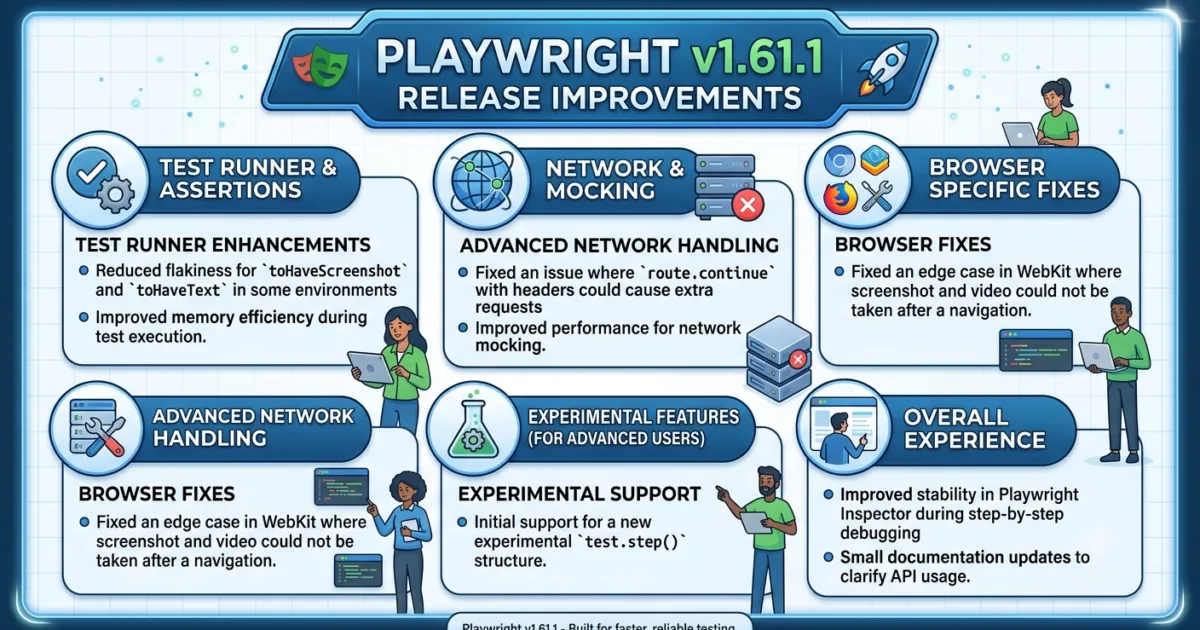
Playwright 1.61.1 has been released, bringing a set of important bug fixes and regression corrections that directly impact automation engineers, SDETs, CI/CD teams, and organizations running large-scale browser testing frameworks.
Unlike Playwright 1.61.0, which introduced major features such as WebAuthn Passkeys and Web Storage APIs, Playwright 1.61.1 focuses entirely on stability and reliability improvements. While feature releases often get the spotlight, experienced QA engineers know that maintenance releases frequently deliver the biggest productivity gains because they eliminate unexpected failures, flaky tests, and debugging headaches.
If your organization uses Playwright for end-to-end testing, API testing, cross-browser automation, or enterprise-scale CI/CD pipelines, Playwright 1.61.1 is a release worth reviewing.
What is Playwright?
Playwright is Microsoft’s modern browser automation framework that supports:
- Chromium
- Firefox
- WebKit
- API Testing
- Mobile Emulation
- Visual Testing
- Accessibility Testing
Playwright has become one of the most widely adopted automation frameworks in 2026 due to its reliability, speed, and developer-friendly APIs.
Official Website:
Official Documentation:
What’s New in Playwright 1.61.1?
The release focuses on five important bug fixes:
Fixed Issues
| Issue Area | Impact |
|---|---|
| Custom Matchers | Prevents overriding default matcher behavior |
| UI Mode | Corrects API request byte reporting |
| Trace Viewer | Fixes WebSocket timestamp scaling |
| Node.js 22 Compatibility | Resolves sync loader failures |
| pnpm Workspace Resolution | Fixes extensionless TypeScript imports |
Although these may look like niche fixes, each one affects real-world enterprise testing environments.
Playwright 1.61.1 vs Playwright 1.61.0
| Area | Playwright 1.61.0 | Playwright 1.61.1 |
|---|---|---|
| New Features | Major | None |
| Stability Improvements | Moderate | High |
| Node.js 22 Compatibility | Regression Present | Fixed |
| Trace Viewer Accuracy | Issue Present | Fixed |
| UI Mode Reliability | Issue Present | Fixed |
| Enterprise Readiness | Excellent | Better |
| Upgrade Risk | Low | Very Low |
For most teams, Playwright 1.61.1 should be viewed as the preferred production version.
1. Critical Fix for Custom Matchers and expect.extend()
One of the most important fixes addresses a bug where:
expect.extend()
could override Playwright’s default matcher implementation when using a custom matcher with the same name.
Why This Matters
Many enterprise frameworks create custom assertions such as:
expect.extend({
  toHaveValidInvoice() {},
  toMatchCustomerData() {}
});
Unexpected matcher overrides can cause:
- False Test Passes
- False Test Failures
- Inconsistent Results
- Framework Maintenance Challenges
This fix improves assertion reliability across large automation projects.
QA Impact
High.
Teams using shared assertion libraries should strongly consider upgrading.
2. UI Mode API Reporting Is Now More Accurate
Playwright UI Mode continues gaining popularity among QA teams because it provides:
- Interactive Debugging
- Step-by-Step Execution
- Test Exploration
- Visual Failure Analysis
The bug fixed in 1.61.1 affected:
apiRequestContext._wrapApiCall
which could report unexpected byte counts.
Why This Matters
QA engineers often use UI Mode to:
- Debug API Tests
- Analyze Payload Sizes
- Investigate Failures
- Monitor Network Requests
Accurate reporting helps teams diagnose issues faster.
QA Impact
Medium to High.
Especially useful for API-heavy automation projects.
3. Trace Viewer WebSocket Timing Fix
Trace Viewer remains one of Playwright’s strongest debugging features.
The release fixes an issue where WebSocket message times were scaled incorrectly by a factor of 1000.
Before
WebSocket timing information could appear misleading.
After
Message timing is displayed correctly.
Why This Matters
Many modern applications rely heavily on:
- Real-Time Dashboards
- Live Notifications
- Chat Applications
- Trading Platforms
- Streaming Systems
Accurate timing information is critical when diagnosing performance and synchronization problems.
QA Impact
High for teams testing real-time applications.
4. Important Node.js 22 Compatibility Fix
A regression caused the following error:
context.conditions?.includes is not a function
under certain Node.js 22.15 environments.
Why This Matters
Organizations are rapidly adopting:
Node.js 22
because of:
- Performance Improvements
- Security Updates
- Long-Term Support Benefits
Without this fix, automation pipelines could fail unexpectedly.
QA Impact
Very High.
Teams running Node.js 22 should prioritize upgrading.
5. pnpm Workspace Resolution Regression Fixed
Modern enterprise monorepos frequently use:
pnpm
for dependency management.
The regression affected:
- Extensionless TypeScript Imports
- Workspace Symlinks
- ESM Loader Resolution
Why This Matters
Large automation platforms often contain:
- Shared Utilities
- Common Page Objects
- Test Libraries
- Framework Components
Broken import resolution can prevent entire test suites from running.
QA Impact
Very High for enterprise teams.
Why QA Engineers Should Upgrade
Playwright 1.61.1 does not introduce new features.
Instead, it improves something even more important:
Reliability
Benefits include:
✅ Better Node.js Compatibility
✅ More Accurate Trace Viewer Data
✅ Improved UI Mode Debugging
✅ Stable Assertion Frameworks
✅ Better Monorepo Support
These improvements directly reduce debugging time and flaky automation behavior.
Impact on Enterprise Automation Teams
Organizations running:
- Thousands of Tests
- CI/CD Pipelines
- Microservices
- Monorepos
- API Automation
- Real-Time Applications
will benefit the most.
The release removes several friction points that commonly appear in large-scale testing environments.
Compatibility Assessment
| Component | Status |
|---|---|
| Chromium | Supported |
| Firefox | Supported |
| WebKit | Supported |
| Node.js 20 | Supported |
| Node.js 22 | Improved |
| TypeScript Projects | Improved |
| pnpm Workspaces | Improved |
| CI/CD Pipelines | Improved |
How to Upgrade Playwright 1.61.1
npm
npm install @playwright/test@latest
Verify Installation
npx playwright --version
Expected output:
Version 1.61.1
Update Browsers
npx playwright install
Playwright Boilerplate Users Should Note
If you’re using the Playwright Boilerplate from QAPulse by SK:
Playwright Boilerplate Repository
you already have support for advanced debugging features including HAR recording.
The HAR capabilities introduced in recent Playwright releases align well with the boilerplate’s reporting and network-analysis workflows, making upgrades straightforward for existing users.
My QA Engineer Verdict
| Category | Rating |
|---|---|
| Stability | 9.5/10 |
| Upgrade Priority | 9/10 |
| Enterprise Value | 9/10 |
| Risk Level | Very Low |
| Recommendation | Upgrade |
Upgrade Recommendation
Upgrade immediately if you use:
- Node.js 22
- pnpm Workspaces
- Custom Matchers
- Trace Viewer
- Playwright UI Mode
Otherwise, include the upgrade in your next scheduled maintenance cycle.
More Related Blogs
- FastAPI 0.137.1 Released: Important API Routing Fixes QA Engineers Should Upgrade For
- PyTest 9.1.0 Released: Critical Fixture Changes QA Engineers Must Understand
- Playwright 1.61.0 Released: Powerful Authentication Testing Features QA Engineers Must Know
- LangChain 1.4.6 Released: Valuable AI Agent Observability Improvements QA Engineers Must Know
External Resources
- Playwright Official Website: https://playwright.dev
- Playwright Documentation: https://playwright.dev/docs
- Playwright GitHub Repository: https://github.com/microsoft/playwright
- Playwright 1.61.1 Release Notes: https://github.com/microsoft/playwright/releases/tag/v1.61.1
- Node.js Official Website: https://nodejs.org
- pnpm Official Website: https://pnpm.io
Frequently Asked Questions
What is Playwright 1.61.1?
Playwright 1.61.1 is a maintenance release focused on bug fixes, regression corrections, and stability improvements.
Does Playwright 1.61.1 contain new features?
No. The release focuses entirely on reliability and compatibility fixes.
Should QA engineers upgrade immediately?
Yes, especially if using Node.js 22, pnpm workspaces, or custom matcher extensions.
Are there breaking changes?
No breaking changes were announced.
Does this improve CI/CD reliability?
Yes. The Node.js and workspace-related fixes improve stability in automated pipelines.
Final Thoughts
Playwright 1.61.1 may not introduce flashy new capabilities, but it delivers 5 critical bug fixes that improve framework stability, debugging accuracy, and enterprise compatibility. For teams relying on Playwright in production, these fixes reduce operational risk and make automated testing more predictable.