 QA
QA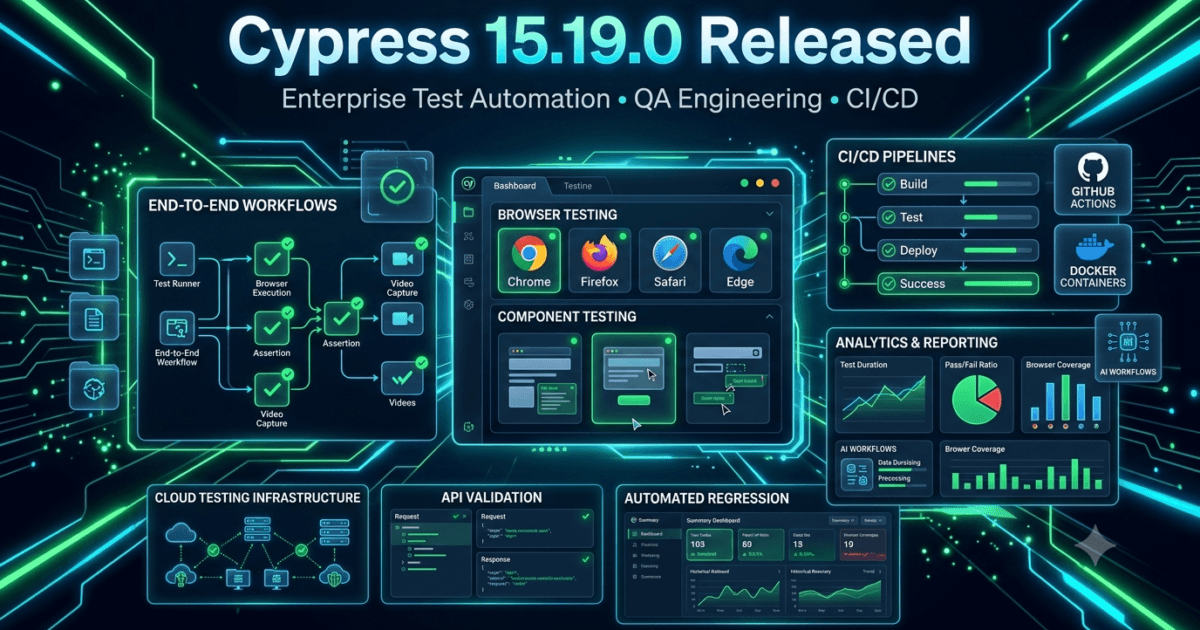
Cypress 15.19.0, released on July 21, 2026, continues Cypress’s commitment to delivering a reliable, developer-friendly, and enterprise-ready end-to-end testing framework. While this release focuses primarily on maintenance, stability improvements, dependency updates, and platform refinements documented in the official changelog, it plays an important role in ensuring that QA teams can continue building dependable, scalable, and maintainable automation frameworks without unexpected disruptions.
As modern software development embraces continuous integration, continuous delivery (CI/CD), microservices, AI-powered applications, and cloud-native architectures, automated testing frameworks must remain stable across browsers, operating systems, and deployment environments. Incremental releases like Cypress 15.19.0 may not introduce headline-grabbing features, but they often eliminate subtle issues that affect test consistency, execution stability, and long-term framework health.
For QA Engineers, SDETs, Automation Engineers, Software Test Architects, DevOps Engineers, and Engineering Managers, maintaining the latest supported Cypress version helps reduce technical debt while benefiting from continuous framework improvements. Organizations running thousands of automated tests daily particularly benefit from maintenance releases that improve reliability, compatibility, and ecosystem stability.
Cypress remains one of the industry’s leading JavaScript-based end-to-end testing frameworks for validating modern web applications. Combined with technologies such as Playwright, Selenium, Docker, GitHub Actions, Jenkins, Azure DevOps, GitLab CI, and AI-assisted testing tools, Cypress continues to serve as a critical component of enterprise quality engineering strategies.
Although the official release notes for version 15.19.0 primarily reference the updated changelog, organizations should treat this release as an opportunity to refresh dependencies, validate automation pipelines, and maintain compatibility with evolving browser technologies and JavaScript ecosystems.
Official Release Highlights
According to the official Cypress release information, Cypress 15.19.0 is available with updates documented in the official Cypress changelog.
Release Summary
- Latest Cypress maintenance release
- Stability and framework refinements
- Compatibility improvements
- Dependency updates
- Ongoing platform maintenance
- Official changelog documentation
Although this release does not advertise major new features, keeping automation frameworks current helps ensure compatibility with rapidly evolving frontend technologies and browser engines.
Cypress 15.19.0 Release Overview
| Category | Details |
|---|---|
| Version | Cypress 15.19.0 |
| Release Date | July 21, 2026 |
| Release Type | Maintenance Release |
| Platform | End-to-End Test Automation |
| Primary Focus | Stability, Reliability & Compatibility |
| Breaking Changes | None Publicly Highlighted |
| Upgrade Recommendation | Recommended |
Why This Release Matters
Enterprise automation frameworks often execute tens of thousands of test cases every day across multiple environments. Small framework improvements can significantly reduce flaky tests, improve CI reliability, and simplify long-term maintenance.
Modern testing environments continuously evolve due to:
- Browser updates
- JavaScript runtime improvements
- Node.js releases
- Package dependency changes
- Cloud infrastructure updates
- Security patches
- Framework integrations
- CI/CD platform updates
Maintenance releases such as Cypress 15.19.0 ensure the testing ecosystem remains aligned with these ongoing platform changes.
Rather than waiting for larger feature releases, organizations should adopt regular upgrade cycles that keep automation infrastructure healthy and reduce future migration complexity.
Improved Framework Stability for Enterprise Testing
Reliability remains one of the most important characteristics of any automation framework.
A highly reliable testing platform enables teams to:
- Reduce flaky test execution
- Improve CI pipeline stability
- Shorten debugging cycles
- Increase confidence in regression suites
- Simplify framework maintenance
- Improve developer productivity
- Support larger automation portfolios
Cypress continues investing in these foundational improvements through regular maintenance releases.
Although some enhancements remain invisible to end users, they contribute directly to more predictable automation results.
Better Long-Term Compatibility
Modern web applications evolve rapidly.
Every framework upgrade should ensure continued compatibility with:
- Latest Chromium browsers
- Firefox
- Microsoft Edge
- Node.js
- JavaScript ecosystem updates
- npm dependency changes
- TypeScript improvements
- CI/CD platforms
- Docker containers
- Cloud execution environments
Keeping Cypress updated minimizes compatibility surprises during future framework upgrades.
What This Means for QA Engineers
For QA Engineers, SDETs, Automation Engineers, and Quality Engineering teams, Cypress 15.19.0 represents another opportunity to improve automation framework health without introducing unnecessary risk.
Although feature additions are limited, organizations should still execute comprehensive validation before production rollout.
Recommended regression testing includes:
- Test execution
- Browser compatibility
- API testing
- Authentication workflows
- File uploads
- Downloads
- Visual regression
- Network interception
- Component testing
- Cross-browser execution
- Docker execution
- Parallel execution
- GitHub Actions
- Jenkins pipelines
- Azure DevOps pipelines
- GitLab CI
- Reporting integrations
- AI-assisted testing workflows
QA teams should also monitor test stability after upgrading to identify improvements in execution consistency.
Key Improvement 1 – Improved Framework Reliability
The most valuable aspect of Cypress 15.19.0 is continued platform stability.
Benefits include:
- More reliable automation
- Better CI execution
- Reduced framework maintenance
- Improved browser compatibility
- Greater long-term support
Stable automation frameworks generate greater confidence in production deployments.
Key Improvement 2 – Better Enterprise Maintainability
Keeping automation frameworks updated reduces technical debt.
Organizations benefit from:
- Easier future upgrades
- Better dependency management
- Improved security posture
- Reduced compatibility risks
- Lower maintenance costs
Routine maintenance releases help avoid large migration efforts later.
Are There Any Breaking Changes?
Based on the available release information, no significant breaking changes have been highlighted for Cypress 15.19.0.
Nevertheless, enterprise teams should always perform complete regression testing before deploying new framework versions.
Validation should include:
- Existing test suites
- Custom commands
- Plugins
- Reporters
- CI/CD integrations
- Docker environments
- Authentication flows
- Network mocking
- Browser execution
- Cloud execution services
Executing a structured validation cycle helps minimize deployment risk.
How to Upgrade
Upgrade Cypress
npm install cypress@latest
Install Specific Version
npm install cypress@15.19.0
Verify Installed Version
npx cypress version
Open Cypress
npx cypress open
Run Test Suite
npx cypress run
After upgrading, execute your smoke tests, regression suites, browser compatibility tests, API validations, reporting integrations, and CI/CD pipelines before deploying the updated framework across production environments.
Upgrade Recommendation
Cypress 15.19.0 is a recommended maintenance upgrade for organizations already using the 15.x release series.
Although this release does not introduce major new testing capabilities, maintaining an up-to-date automation framework improves long-term reliability, reduces technical debt, and ensures continued compatibility with modern web development ecosystems.
Organizations that should prioritize upgrading include:
- QA Engineers
- SDETs
- Automation Engineers
- DevOps Engineers
- Software Architects
- Engineering Managers
- Enterprise Testing Teams
- CI/CD Platform Teams
- Cloud Testing Teams
- Web Application Development Teams
As automation frameworks continue evolving alongside browsers, JavaScript runtimes, AI-powered applications, and cloud-native architectures, regular maintenance updates remain an essential part of every mature quality engineering strategy. Cypress 15.19.0 provides another stable step toward maintaining scalable, reliable, and enterprise-ready test automation platforms.
Enterprise Migration Strategy for Cypress 15.19.0
Although Cypress 15.19.0 is primarily a maintenance release, organizations should still approach the upgrade with a structured migration strategy. Enterprise automation frameworks often execute thousands of end-to-end, regression, API, integration, and component tests every day across multiple environments. Even a small framework update can influence browser compatibility, plugin behavior, custom commands, CI/CD execution, or reporting integrations. A disciplined rollout process minimizes operational risk while ensuring your testing infrastructure remains stable.
The first step should always be deploying Cypress 15.19.0 into a dedicated staging or QA environment rather than directly upgrading production automation pipelines. This allows teams to validate framework behavior without affecting release schedules or developer productivity.
Organizations should execute a phased migration that includes:
- Create a backup of the existing Cypress framework and package-lock files.
- Upgrade Cypress in a staging branch.
- Validate custom Cypress commands.
- Test custom plugins and reporters.
- Verify environment variables and configuration files.
- Execute smoke tests.
- Run the complete regression suite.
- Validate component testing projects.
- Test cross-browser execution.
- Deploy gradually across production CI/CD pipelines.
This staged migration approach significantly reduces deployment risk while allowing QA teams to identify compatibility issues before they impact production software delivery.
What This Means for QA Engineers
For QA Engineers, SDETs, Automation Engineers, Quality Engineering Managers, and Test Architects, Cypress 15.19.0 reinforces an important principle of automation engineering: maintaining a healthy testing framework is just as important as writing high-quality automated test cases.
While feature releases often receive the most attention, maintenance releases frequently improve framework reliability, ecosystem compatibility, dependency stability, and execution consistency—all of which directly influence the quality of automated testing.
QA teams should use this release as an opportunity to perform a comprehensive health check of their automation framework rather than simply updating a package version.
Recommended validation areas include:
- Smoke testing
- End-to-end testing
- API testing
- Component testing
- Authentication workflows
- Session management
- File upload/download
- Visual regression testing
- Network interception
- Browser compatibility
- Cross-browser execution
- Docker containers
- GitHub Actions
- Azure DevOps
- Jenkins pipelines
- GitLab CI
- Cypress Cloud integration
- Test reporting
- Parallel execution
- Retry behavior
Teams that regularly validate these areas after every Cypress upgrade experience fewer production issues and more predictable CI/CD pipelines.
Cypress Framework Regression Testing Checklist
Every Cypress upgrade should include a structured regression validation process before being promoted to production.
| Test Area | Validation |
|---|---|
| Framework Installation | Verify successful installation |
| Cypress Configuration | Validate configuration files |
| Custom Commands | Test reusable commands |
| Custom Plugins | Validate plugin compatibility |
| Test Execution | Run smoke tests |
| Regression Suite | Execute complete automation |
| API Testing | Validate API requests |
| Authentication | Test login workflows |
| Session Handling | Verify persistence |
| Network Intercepts | Confirm request mocking |
| Component Testing | Validate UI components |
| Browser Compatibility | Test Chrome, Edge, Firefox |
| Parallel Execution | Verify distributed runs |
| Docker Execution | Test containerized pipelines |
| GitHub Actions | Validate CI workflows |
| Jenkins | Verify pipeline execution |
| Azure DevOps | Test enterprise pipelines |
| GitLab CI | Confirm automation jobs |
| Reporting | Validate HTML/JUnit reports |
| Performance | Compare execution times |
Completing this checklist ensures your automation framework remains reliable after upgrading to Cypress 15.19.0.
Best Practices Before Upgrading Cypress
Maintenance releases provide an excellent opportunity to review the overall health of your automation ecosystem.
Update Dependencies Together
Rather than upgrading only Cypress, review related packages such as testing libraries, reporters, TypeScript definitions, ESLint configurations, and Node.js compatibility to ensure a fully supported ecosystem.
Execute Automated Smoke Tests First
Run a lightweight smoke suite immediately after upgrading to confirm the framework starts correctly before launching the full regression suite.
Monitor Flaky Tests
Use the upgrade as an opportunity to identify flaky or unstable tests. Many apparent framework issues are actually caused by brittle test implementations.
Validate Cross-Browser Testing
Verify execution across every browser supported by your organization instead of relying solely on Chromium-based testing.
Review CI/CD Performance
Compare execution time, memory usage, and resource consumption before and after upgrading to identify any unexpected regressions.
Production Deployment Best Practices
Successful enterprise upgrades depend on disciplined deployment strategies rather than framework changes alone.
Upgrade Through Staging
Never upgrade Cypress directly in production CI/CD environments. Always validate within isolated staging pipelines first.
Use Incremental Rollouts
Deploy Cypress updates to selected repositories or teams before organization-wide adoption.
Monitor Test Stability
Track pass rates, flaky tests, execution duration, and browser failures after deployment.
Maintain Rollback Capability
Keep previous package versions available so that pipelines can quickly revert if unexpected compatibility issues occur.
Update Documentation
Record new framework versions, dependency changes, migration notes, and testing observations within internal engineering documentation.
Cypress 15.18.x vs Cypress 15.19.0 Comparison
| Feature | Cypress 15.18.x | Cypress 15.19.0 |
|---|---|---|
| Framework Stability | Excellent | Improved |
| Dependency Updates | Previous | Updated |
| Browser Compatibility | Strong | Enhanced |
| CI/CD Reliability | Stable | Better |
| Enterprise Support | Excellent | Improved |
| Maintenance | Previous | Current |
| Breaking Changes | None | None Reported |
| Upgrade Recommendation | Recommended | Highly Recommended |
The comparison demonstrates that Cypress 15.19.0 focuses on strengthening platform stability rather than introducing disruptive feature changes, making it a safe upgrade for most enterprise automation environments.
Are There Any Breaking Changes?
Based on the official Cypress 15.19.0 release information and changelog, no significant breaking changes have been publicly highlighted.
However, every organization should perform complete validation before production rollout because custom automation frameworks often include:
- Custom Cypress commands
- Internal plugins
- Third-party reporters
- Custom tasks
- API helpers
- Authentication libraries
- Docker images
- CI/CD integrations
- Enterprise browser configurations
Even when no framework breaking changes exist, project-specific dependencies may still require verification.
Should You Upgrade?
Upgrade Immediately If You:
- Use the Cypress 15.x release series
- Maintain enterprise CI/CD pipelines
- Execute large regression suites
- Build modern web applications
- Require maximum browser compatibility
- Follow continuous maintenance practices
Upgrade After Validation If You:
- Maintain heavily customized Cypress frameworks
- Operate highly regulated production environments
- Use extensive third-party plugins
- Have mission-critical release pipelines
Overall Recommendation
Yes. Cypress 15.19.0 is a recommended maintenance release for organizations already using the 15.x series. While it does not introduce major end-user functionality, it continues improving the reliability, compatibility, and long-term maintainability of one of the industry’s most widely adopted end-to-end testing frameworks. Enterprise QA teams, SDETs, Automation Engineers, DevOps teams, and Software Architects should include this release in their regular upgrade cycle after completing comprehensive regression testing, browser validation, plugin compatibility checks, and CI/CD verification. Keeping Cypress current helps reduce technical debt, improve framework stability, and maintain confidence in automated quality assurance across modern software delivery pipelines.
More Relevant Articles
- Cypress 15.18.1 Released: Critical Stability & Testing Improvements Every QA Engineer Should Know
- Cypress 15.18.0 Released: 7 Important Improvements QA Engineers Must Know in 2026
- Cypress 15.16.0 Released: 7 Important Updates QA Engineers Should Know
- Cypress 15.15.0 Released: Stability, Speed, and the Future of DX
- Playwright vs Cypress in 2026: Which Tool Actually Wins?
External Resources
- Cypress Official Website: https://www.cypress.io
- Cypress Documentation: https://docs.cypress.io
- Cypress Changelog: https://docs.cypress.io/app/references/changelog#15-19-0
- GitHub Release: https://github.com/cypress-io/cypress/releases/tag/v15.19.0
- Cypress GitHub Repository: https://github.com/cypress-io/cypress
- OWASP Testing Guide: https://owasp.org/www-project-web-security-testing-guide
Featured Snippet Optimized Answer
What is Cypress 15.19.0?
Cypress 15.19.0 is a maintenance release that improves the overall stability, compatibility, and maintainability of the Cypress end-to-end testing framework. Although it does not introduce major end-user features, it strengthens enterprise automation environments through framework refinements, dependency updates, and ongoing platform improvements documented in the official changelog.
People Also Ask
What is new in Cypress 15.19.0?
Cypress 15.19.0 focuses on framework maintenance, stability improvements, dependency updates, and compatibility enhancements that help QA teams maintain reliable automation pipelines.
Should I upgrade to Cypress 15.19.0?
Yes. Organizations already using Cypress 15.x should upgrade after running regression tests to benefit from ongoing framework stability and ecosystem compatibility improvements.
Does Cypress 15.19.0 contain breaking changes?
According to the official release information, no major breaking changes have been highlighted. Teams should still validate custom commands, plugins, and CI/CD pipelines before production rollout.
Is Cypress 15.19.0 suitable for enterprise projects?
Yes. Enterprise teams benefit from improved framework reliability, long-term maintainability, and continued compatibility with modern browsers and JavaScript ecosystems.
How should QA Engineers validate Cypress 15.19.0?
QA teams should execute smoke tests, regression suites, browser compatibility tests, API validations, component tests, CI/CD pipelines, Docker environments, and reporting integrations before deploying the new version.
Frequently Asked Questions
Is Cypress 15.19.0 a major release?
No. It is a maintenance release focused on improving framework stability, compatibility, and long-term reliability.
Does this release improve test execution?
Indirectly, yes. Stability improvements and dependency updates contribute to more reliable automation execution across enterprise environments.
Are plugin updates required?
Most plugins should continue working normally, but teams should verify compatibility during regression testing, especially for custom integrations.
Should DevOps teams update CI/CD pipelines?
Existing pipelines should continue functioning, but validating GitHub Actions, Jenkins, Azure DevOps, GitLab CI, and Docker environments remains a recommended practice.
Is this release recommended for large automation projects?
Yes. Organizations maintaining extensive Cypress automation frameworks should include version 15.19.0 in their regular maintenance schedule.
Does Cypress 15.19.0 improve browser compatibility?
The release contributes to maintaining compatibility with the evolving browser ecosystem through continuous framework maintenance and dependency updates.
Is regression testing still necessary?
Absolutely. Every framework update should be validated using smoke tests, regression suites, browser testing, API testing, and CI/CD verification before production deployment.
Is Cypress still a good choice for enterprise automation?
Yes. Cypress continues to be one of the most popular end-to-end testing frameworks for modern web applications, offering excellent developer experience, powerful debugging, and strong CI/CD integration.
Continue Learning
Explore more expert articles on Cypress, Playwright, Selenium, FastAPI, Docker, LangChain, CrewAI, MCP, AI Agents, Test Automation, Performance Testing, and Software Engineering at www.skakarh.com.
QAPulse by SK delivers expert release analysis, migration guidance, enterprise testing strategies, AI engineering insights, DevOps best practices, and practical automation knowledge to help software professionals build faster, smarter, and more reliable software.