 QA
QA
Cypress version 15.15.0 was officially released on May 12, 2026.
And while this release may not look “massive” at first glance…
Experienced SDETs know something important:
The best framework releases are often the ones that quietly improve reliability, execution consistency, and developer experience.
Because modern automation engineering is no longer just about:
👉 Writing tests
It’s about:
👉 Building stable engineering ecosystems
The Bigger Story Behind Cypress 15.15.0
Most people read changelogs like this:
"Any new commands?"
"Any breaking changes?"
"Anything shiny?"
But mature QA engineers ask different questions:
👉 Is the framework becoming more stable?
👉 Is CI/CD getting more reliable?
👉 Is debugging becoming easier?
👉 Is developer friction reducing?
That’s where real engineering value lives.
What This Release Signals
Cypress 15.15.0 continues a trend we’ve been seeing across modern testing ecosystems:
- Faster execution
- Better stability
- Cleaner developer workflows
- Reduced framework friction
- Improved maintainability
And honestly?
That matters more long term than flashy APIs.
The Hidden Problem Most Teams Face
The biggest pain in test automation today is NOT:
❌ Writing tests
It’s:
🔥 Maintaining them at scale
Because eventually every framework hits:
- CI instability
- Flaky execution
- Plugin conflicts
- Browser inconsistencies
- Environment drift
So modern releases increasingly focus on:
👉 Reliability engineering
Not just feature engineering.
Key Improvement #1 in Cypress 15.15.0— Better Stability for Large Test Suites
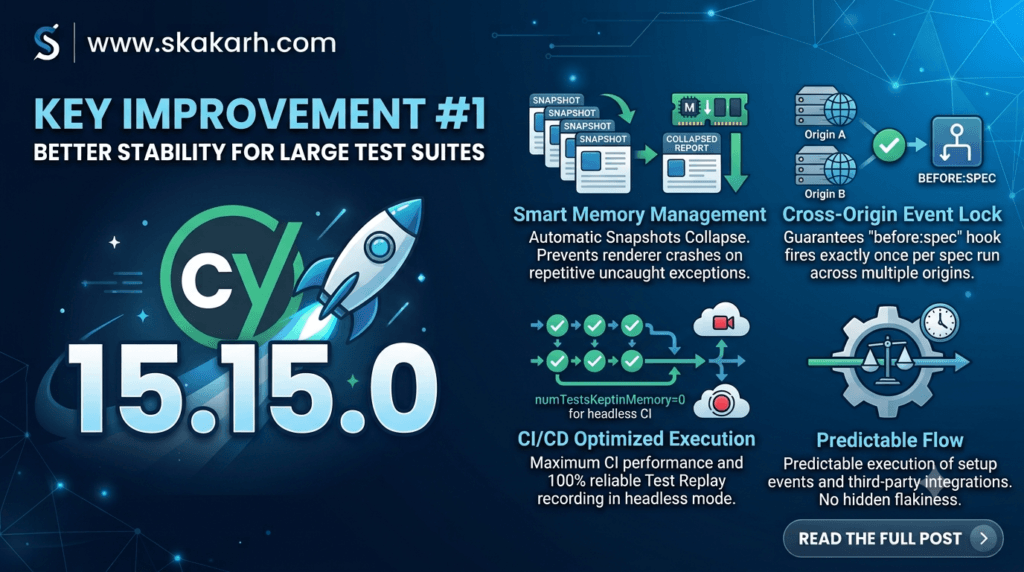
One of the most important ongoing trends in Cypress 15.15.0 releases is:
👉 Stability under scale
Small framework issues become massive when teams run:
- Thousands of tests
- Parallel CI jobs
- Cloud execution
- Multi-environment pipelines
Even “minor” improvements can dramatically reduce:
- Flaky behavior
- Debugging hours
- Retry culture
- Pipeline frustration
At enterprise scale, stability IS a feature.
Why This Matters More in 2026
Modern QA teams now run automation in:
- Distributed pipelines
- Ephemeral environments
- Cloud-native systems
- AI-assisted workflows
That means frameworks must survive:
👉 Complexity
And complexity exposes every tiny framework weakness.
Key Improvement #2 in Cypress 15.15.0— Better Developer Experience (DX)
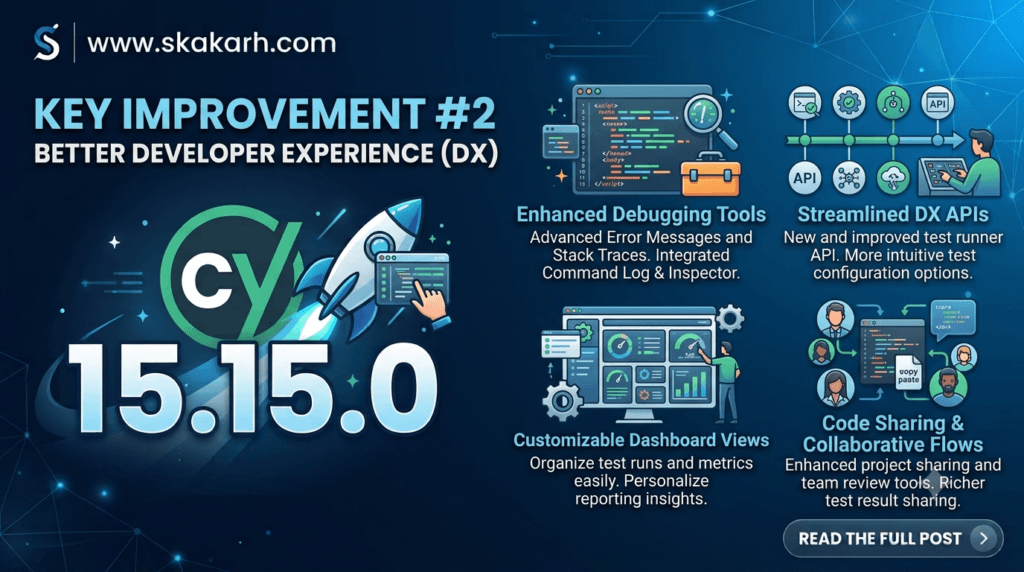
Cypress has always been strong in one area:
👉 Developer experience
And that’s still one of its biggest advantages over many frameworks.
Why engineers still love Cypress:
✅ Real-time reload
✅ Easy debugging
✅ Visual execution
✅ Fast onboarding
✅ Clean syntax
That matters because:
Engineers adopt tools they enjoy using.
And honestly?
Developer frustration is one of the biggest hidden costs in automation.
The Bigger Battle Happening Right Now
Automation frameworks are no longer competing only on:
- Features
- Browsers
- Commands
They’re competing on:
👉 Cognitive load
Meaning:
- How easy is debugging?
- How quickly can teams onboard?
- How painful is maintenance?
- How observable are failures?
That’s where Cypress still performs strongly.
But Here’s the Harsh Truth Too
Even though Cypress remains powerful…
The industry is changing.
Fast.
Modern testing increasingly demands:
- Multi-browser execution
- Cross-platform support
- AI-assisted debugging
- Advanced tracing
- Distributed orchestration
And that’s why many teams are now evaluating:
👉 Playwright
👉 AI-native frameworks
👉 Agent-assisted testing systems
This doesn’t make Cypress “bad.”
It simply means:
The expectations for automation frameworks are evolving rapidly.
What QA Engineers Should Learn From This
The future of automation is NOT:
Just writing more Selenium-style scriptsThe future is:
👉 Intelligent testing systems
👉 Observable automation
👉 AI-assisted debugging
👉 Memory-driven execution
👉 Self-healing workflows
Frameworks that evolve toward this future will dominate.
Any Breaking Changes?
Based on the official release notes:
✅ No major catastrophic breaking changes highlighted
✅ Mostly stability and ecosystem-focused improvements
That makes this release:
👉 Relatively safe for most teams
However…
Professional teams should STILL validate:
- Plugin compatibility
- Browser integrations
- CI workflows
- Custom commands
- Reporting systems
Because even minor releases can expose:
- Hidden assumptions
- Timing dependencies
- Flaky synchronization issues
Should You Upgrade Immediately?
My Recommendation:
✅ YES — for actively maintained Cypress projects
Especially if you:
- Run large CI pipelines
- Experience flaky execution
- Maintain enterprise-scale test suites
Because staying too far behind creates:
- Dependency drift
- Ecosystem incompatibility
- Upgrade pain later
Small continuous upgrades are healthier than giant migration disasters.
What Smart SDETs Actually Do
Mature automation teams:
✅ Track framework releases
✅ Upgrade incrementally
✅ Run regression validations
✅ Monitor flaky behavior
✅ Maintain compatibility discipline
Because modern test automation is:
👉 An operational system
Not just a scripting project.
Bigger Industry Insight
This release reflects a larger industry transformation:
Old Automation Thinking
- “Write scripts”
- “Pass tests”
- “Generate reports”
Modern Automation Engineering
- Stability engineering
- Observability
- CI reliability
- Developer productivity
- AI-assisted workflows
That’s a fundamentally different discipline.
How to Upgrade
For Python Tools
pip install cypress --upgrade
For Node.js Tools
npm install cypress@latest
Full Release Notes
https://github.com/cypress-io/cypress/releases/tag/v15.15.0
Let’s Talk
👉 Is Cypress still your primary framework in 2026?
👉 Or are you already moving toward Playwright or AI-native systems?
Drop your thoughts below 👇
Final Line
The future of automation frameworks will not be decided by features alone.
It will be decided by how intelligently they reduce engineering friction.Frequently Asked Questions:
Q: When was Cypress 15.15.0 officially released?
A: Cypress version 15.15.0 was officially released on May 12, 2026.Q: What key improvements does Cypress 15.15.0 signal for modern testing ecosystems?
A: Cypress 15.15.0 signals faster execution, better stability, cleaner developer workflows, and improved maintainability. It focuses on reducing framework friction for a better long-term experience.Q: What is considered the biggest challenge in test automation today?
A: The biggest pain in test automation today is not writing tests, but maintaining them at scale. Modern releases increasingly focus on reliability engineering over just feature engineering to address this.
More Relevant Articles
- What’s New in n8n 2.21.7 — AI Workflow Fixes for QA Engineers
- Selenium 4.44.0 Released: Why Selenium Still Refuses to Die
Cypress 15.15.0 Released: Key Takeaways
Cypress 15.15.0 delivers important improvements that enhance the stability, performance, and reliability of one of the most popular end-to-end testing frameworks. While this release doesn’t introduce major new features, it includes valuable maintenance updates and bug fixes that strengthen test execution, improve CI/CD reliability, and provide a more consistent automation experience. For QA engineers and automation teams maintaining enterprise-scale test suites, upgrading to Cypress 15.15.0 helps ensure more dependable regression testing, faster feedback loops, and greater confidence in every software release.
Continue Learning
Explore more expert articles on Cypress, Playwright, Selenium, FastAPI, Docker, LangChain, CrewAI, MCP, AI Agents, Test Automation, Performance Testing, and Software Engineering at www.skakarh.com.
QAPulse by SK delivers expert release analysis, migration guidance, enterprise testing strategies, AI engineering insights, DevOps best practices, and practical automation knowledge to help software professionals build faster, smarter, and more reliable software.