QA
QA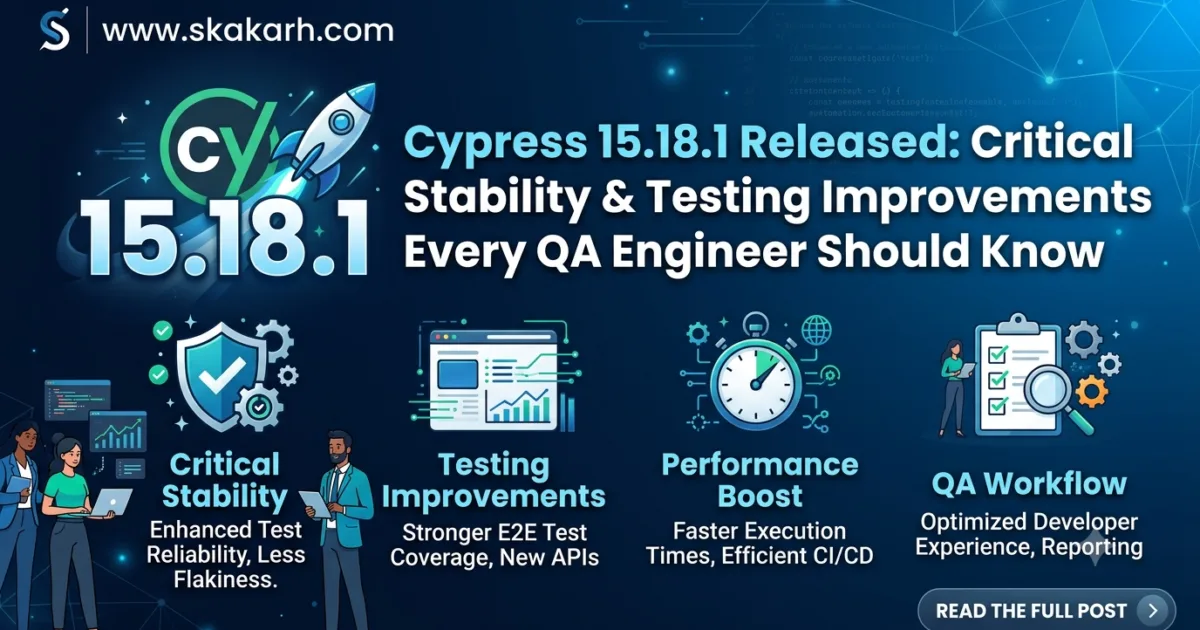
Cypress 15.18.1 Released: A Reliability Update That Every Automation Team Should Notice
Modern software delivery depends on one critical capability—trustworthy automated testing. Whether your organization ships updates several times a day or follows a traditional release cycle, the stability of your testing framework directly impacts developer confidence, release quality, and deployment speed.
That is why maintenance releases deserve just as much attention as feature releases.
Released on July 7, 2026, Cypress 15.18.1 focuses on improving the overall reliability and stability of one of the world’s most widely adopted end-to-end testing frameworks. While this release doesn’t introduce new APIs or major capabilities, it continues Cypress’s commitment to refining the testing experience through important fixes and platform improvements.
In enterprise environments where thousands of automated tests execute daily across multiple browsers, operating systems, and CI/CD pipelines, even a small framework issue can translate into hours of debugging, delayed releases, or flaky test execution.
This update aims to eliminate that friction.
For QA Engineers, SDETs, Test Automation Engineers, DevOps professionals, and Engineering Managers, Cypress 15.18.1 is a recommended maintenance release that strengthens test reliability while maintaining full backward compatibility.
What’s New in Cypress 15.18.1?
According to the official Cypress release information, version 15.18.1 is a maintenance release focused on platform stability and bug fixes.
Although no major features have been introduced, releases like this are extremely valuable because they help ensure:
- Better framework reliability.
- More predictable test execution.
- Improved compatibility with modern development environments.
- Enhanced stability across local and CI/CD executions.
- Continuous refinement of the Cypress testing ecosystem.
Rather than expanding the feature set, Cypress continues investing in improving the overall quality of the testing platform—a strategy that benefits every automation team.
Release Highlights
| Area | Improvement | Why It Matters |
|---|---|---|
| Framework Stability | General maintenance improvements | Reduces unexpected framework failures |
| Test Reliability | Bug fixes and platform refinements | Improves confidence in automated regression testing |
| CI/CD Compatibility | Better execution consistency | More predictable pipeline results |
| Developer Experience | Ongoing framework improvements | Faster debugging and smoother automation workflows |
| Breaking Changes | None announced | Safe maintenance upgrade for production teams |
Why Maintenance Releases Matter More Than Most Teams Realize
Many engineering teams naturally become excited about major feature releases. However, experienced automation engineers know that maintenance releases often provide the greatest day-to-day value.
New features expand capabilities.
Maintenance releases improve trust.
When a regression suite contains thousands of UI tests running every day, the biggest productivity killer isn’t usually missing functionality—it’s inconsistent framework behavior.
Common issues include:
- Random test failures.
- Browser synchronization problems.
- Environment-specific inconsistencies.
- CI/CD instability.
- Intermittent timing issues.
- Difficult-to-reproduce execution errors.
Each small improvement in framework stability helps eliminate these sources of engineering waste.
Over months of continuous integration, those improvements compound into:
- Faster feedback cycles.
- Lower maintenance costs.
- Higher developer confidence.
- More reliable deployments.
- Reduced release risk.
That is exactly why organizations running large automation suites routinely adopt maintenance updates shortly after validation.
Why Cypress Remains a Leading Choice for Modern Test Automation
Cypress has evolved far beyond being “just another UI testing tool.”
Today it serves as a complete developer-focused testing platform supporting:
- End-to-end testing
- Component testing
- API validation
- Cross-browser automation
- Visual debugging
- Time-travel debugging
- Automatic waiting
- Network interception
- CI/CD integration
- Cloud-based test analytics
Its architecture eliminates many of the synchronization issues traditionally associated with Selenium-based automation while giving developers immediate visibility into application behavior.
For agile teams practicing Continuous Integration and Continuous Delivery (CI/CD), Cypress has become a foundational component of modern quality engineering strategies.
Every stability release therefore contributes directly to faster software delivery.
Why QA Engineers Should Care About Cypress 15.18.1
From a QA perspective, framework stability is every bit as important as application stability.
When the testing framework itself becomes unreliable, engineering teams lose confidence in automation results.
False positives begin increasing.
Developers start rerunning pipelines.
Release approvals become slower.
Investigation time grows.
Maintenance releases like Cypress 15.18.1 help reduce these risks by improving the reliability of the underlying framework rather than forcing teams to redesign existing test suites.
For organizations maintaining hundreds—or even tens of thousands—of automated tests, improved framework stability can save dozens of engineering hours every sprint.
That makes this release particularly valuable for enterprise automation teams focused on long-term productivity rather than short-term feature adoption.
What Cypress 15.18.1 Means for QA Engineers
For many engineering teams, a release without flashy new features can easily be overlooked. However, experienced QA professionals understand that the health of a test automation framework is measured less by the number of new capabilities it introduces and more by its ability to execute tests consistently, accurately, and efficiently over time.
That is exactly where Cypress 15.18.1 delivers value.
Although the official release focuses on maintenance and stability improvements, these updates directly contribute to one of the most important objectives in software testing: building trust in automated test results.
Reliable automation enables teams to release software faster, detect regressions earlier, and reduce the operational cost of maintaining large testing suites.
Why Stability is a Competitive Advantage
Every mature software organization eventually reaches a point where automation becomes part of its business-critical infrastructure.
Large organizations often execute:
- Thousands of UI tests every day.
- Hundreds of API validation suites.
- Cross-browser regression pipelines.
- Continuous Integration (CI) verification.
- Nightly end-to-end regression runs.
- Performance validation before production deployments.
When the testing framework itself becomes unstable, even a tiny issue can create significant operational challenges.
Examples include:
- Increased flaky test failures.
- Random pipeline interruptions.
- Longer debugging sessions.
- Delayed software releases.
- Reduced confidence in regression reports.
- Higher maintenance costs.
Maintenance releases like Cypress 15.18.1 help eliminate these risks by improving the overall robustness of the framework.
For QA leaders, stability improvements often generate a greater long-term return than introducing new testing features.
Enterprise Impact
Enterprise QA teams depend on Cypress for validating complex business applications across multiple environments.
Common use cases include:
- Enterprise web applications.
- Banking and fintech platforms.
- Healthcare systems.
- E-commerce websites.
- SaaS products.
- Government portals.
- Customer self-service applications.
- AI-powered web interfaces.
These applications frequently execute automated tests across:
- Chrome
- Edge
- Firefox
- Electron
- Docker containers
- GitHub Actions
- Azure DevOps
- GitLab CI
- Jenkins
- Kubernetes-based testing infrastructure
Any instability within the framework can affect thousands of automated executions every day.
By continuously refining the Cypress engine through maintenance releases, the Cypress team helps organizations maintain predictable automation pipelines while reducing infrastructure-related failures.
Why This Release Matters for Modern QA Teams
Today’s QA engineers do far more than automate button clicks.
Modern automation responsibilities include:
- End-to-end testing.
- API validation.
- Component testing.
- Accessibility testing.
- Visual regression testing.
- Network mocking.
- Test data management.
- AI-assisted testing.
- Continuous testing within CI/CD.
- Release quality analysis.
As automation ecosystems continue growing, the testing framework becomes the foundation upon which every quality initiative depends.
A stable framework allows teams to focus on validating business functionality rather than investigating intermittent automation failures.
That is one of the biggest advantages delivered by maintenance releases like Cypress 15.18.1.
Breakdown of the critical stability and testing improvements you need to know to optimize your test automation strategy:
1. Advanced Memory Management: Mitigating Browser & Command Log Crashes
One of the most persistent bottlenecks in large-scale E2E testing is renderer memory exhaustion, which causes browsers to crash unexpectedly during a test run. Building upon core performance overhauls in the 15.18 release line, Cypress has refined how the Command Log handles consecutive uncaught exceptions (such as benign ResizeObserver loops that fire relentlessly on every animation frame).
- The Fix: Consecutive identical uncaught exceptions now automatically collapse into a single, updating command-log entry.
- The Impact for QA: Handled or suppressed exceptions no longer capture heavy, redundant DOM snapshots. This prevents the browser from running out of memory mid-run, significantly boosting test reliability during overnight CI pipelines.
2. Eliminating Flaky Cross-Origin Hook Loops
If your tests interact with third-party authentication providers or payment gateways using cy.visit() to cross-origin URLs, you’ve likely dealt with erratic hooks.
- Previous versions had an issue where the
before:specplugin event could mistakenly fire twice for a single spec when encountering cross-origin navigation. - This version guarantees the event fires exactly once per spec run, eliminating redundant test setup reloads during heavy cross-origin testing.
3. Smart numTestsKeptInMemory Overrides in CI
A major victory for teams utilizing Cypress Cloud and Test Replay is the standardized handling of memory allocation during headless execution (cypress run).
- In past iterations, setting
numTestsKeptInMemoryto a value greater than 0 insidesetupNodeEventswould carry over into CI. This inadvertently hindered Cypress Cloud from accurately capturing DOM and network snapshots. - Cypress now forces
numTestsKeptInMemoryto 0 strictly duringcypress run, ensuring maximum execution speed and completely reliable Test Replay recording without manual configuration switching.
4. Seamless Subresource Integrity (SRI) Bypassing
Testing environments that strictly enforce Subresource Integrity can break when Cypress injects its own automation scripts, leading to blocked assets.
- This update reinforces the
removeSRIAttributesconfiguration option. When active, Cypress strips the integrity tag from first-party<script>and<link>elements—whether they are defined in static HTML, as JS string literals, or dynamically assigned at runtime (such as code-splitting via Webpack or Vite). - Your security policies remain intact in production, while your E2E environment runs without asset-blocking friction.
5. Critical Installation and CI Environment Fixes
Cypress has resolved a frustrating Node.js ecosystem issue affecting modern runtimes (Node 24.16.0+ and Node 26.1.0+).
- The Bug: A silent extraction error during
npm install cypresscould occasionally extract only the first file from the binary archive, leading to a cryptic “Cypress binary is missing” crash on launch. - The Resolution: Binary extraction logic has been hardened to prevent incomplete installs across local machines and Docker containers. Additionally, a regression causing the task list output to render awkwardly (one character per line) in specific pseudo-TTY CI environments has been completely resolved.
Key Dependency Upgrades to Know
Security compliance is crucial for modern enterprise QA pipelines. This release cycle updates multiple underlying dependencies to patch known ReDoS (Regular Expression Denial of Service) and Prototype Pollution vulnerabilities:
minimatchupgraded to address ReDoS vulnerabilities (CVE-2026-26996,CVE-2026-27903).simple-gitupgraded to mitigate remote code execution and case-sensitivity vulnerabilities.flattedpatched to eliminate prototype pollution risks (CVE-2026-33228).socket.iosuite bumped to address critical Denial of Service vectors.
Should You Upgrade?
Yes.
Even without major feature additions, Cypress 15.18.1 is a recommended production update because it continues improving framework stability and reliability.
Reasons to upgrade include:
- Improved framework stability.
- Better reliability during regression execution.
- Reduced risk of framework-related failures.
- Continued compatibility with modern development environments.
- Safe maintenance release with no announced breaking changes.
- Recommended for enterprise CI/CD environments.
Teams running large automated regression suites should generally stay current with Cypress maintenance releases after validating them in staging environments.
Regression Testing Checklist
Before promoting Cypress 15.18.1 to production, QA teams should validate:
- Existing end-to-end test suites.
- Component testing projects.
- Cross-browser execution.
- API interception and mocking.
- Authentication workflows.
- File upload and download scenarios.
- Visual regression tests.
- CI/CD pipeline execution.
- Docker-based test environments.
- Existing Cypress plugins and custom commands.
Executing a representative regression suite ensures the upgrade behaves consistently across local development, staging, and production pipelines.
How to Upgrade
Upgrade Cypress
Using npm:
npm install cypress@latest
Or update an existing project:
npm update cypress
Verify the installed version:
npx cypress --version
After upgrading, execute your smoke suite followed by a complete regression run across all supported browsers before rolling the update into production CI/CD pipelines.
More Relevant Articles
- Cypress 15.18.0 Released: 7 Important Improvements QA Engineers Must Know in 2026
- Cypress 15.16.0 Released: 7 Important Updates QA Engineers Should Know
- Cypress 15.15.0 Released: Stability, Speed, and the Future of DX
- Playwright vs Cypress in 2026: Which Tool Actually Wins?
External Resources
- Cypress Official Website: https://www.cypress.io
- Cypress Documentation: https://docs.cypress.io
- Cypress Changelog: https://docs.cypress.io/app/references/changelog#15-18-1
- GitHub Release: https://github.com/cypress-io/cypress/releases/tag/v15.18.1
- Cypress GitHub Repository: https://github.com/cypress-io/cypress
- OWASP Testing Guide: https://owasp.org/www-project-web-security-testing-guide
Final Verdict
Cypress 15.18.1 reinforces an important principle of mature software engineering: the reliability of your testing framework is just as important as the quality of your application. While this release does not introduce new testing capabilities, it continues Cypress’s focus on improving execution stability, platform reliability, and the overall developer experience.
For organizations practicing Continuous Testing, Continuous Integration, and DevOps, these incremental improvements translate into more dependable regression suites, fewer flaky pipeline failures, and greater confidence in release decisions.
For QA engineers, SDETs, Automation Architects, and Engineering Managers, this is a recommended maintenance upgrade that strengthens the testing foundation without requiring changes to existing automation suites.
Recommendation: Upgrade to Cypress 15.18.1 after completing standard regression validation. It is a low-risk, production-ready release that helps keep your automation platform stable, predictable, and ready for large-scale continuous delivery.
Frequently Asked Questions
Does Cypress 15.18.1 introduce breaking changes?
No. The official release does not announce any breaking changes. This is a maintenance release focused on improving stability and overall framework reliability.
Should enterprise automation teams upgrade immediately?
Yes. After validating the release in a staging environment, enterprise teams should upgrade to benefit from ongoing framework improvements and maintain compatibility with the latest Cypress ecosystem.
Will I need to modify my existing test suites?
In most cases, no. Since this is a maintenance release, existing Cypress projects should continue to work without requiring significant code changes.
Why are maintenance releases important for QA teams?
Maintenance releases reduce framework-related failures, improve execution consistency, strengthen CI/CD reliability, and lower the long-term maintenance cost of automated testing.
Cypress 15.18.1 Released: Key Takeaways
Cypress 15.18.1 Released focuses on improving the stability and reliability of one of the industry’s leading end-to-end testing frameworks. Although no major features were introduced, the maintenance improvements strengthen automated regression testing, CI/CD execution, and overall framework consistency. For QA engineers and automation teams managing enterprise-scale test suites, this release is a worthwhile upgrade that helps deliver more reliable pipelines, faster feedback cycles, and greater confidence in every software release.
Continue Learning
Explore more expert articles on Cypress, Playwright, Selenium, FastAPI, Docker, LangChain, CrewAI, MCP, AI Agents, Test Automation, Performance Testing, and Software Engineering at www.skakarh.com.
QAPulse by SK delivers expert release analysis, migration guidance, enterprise testing strategies, AI engineering insights, DevOps best practices, and practical automation knowledge to help software professionals build faster, smarter, and more reliable software.