 QA
QA
AI applications used to follow a simple pattern.
You send a prompt.
The model thinks.
The model responds.
You send another prompt.
The model responds again.
That pattern is still useful. In fact, most AI-powered applications today still work this way.
But increasingly complex AI systems are hitting a problem.
One agent cannot always do everything well.
Imagine asking one AI system to:
- understand a business requirement
- search documentation
- write Python code
- execute the code
- analyze the result
- test the implementation
- find bugs
- review the solution
- improve it
- and finally explain the result
It can attempt all of those tasks.
But attempting everything is not the same as doing everything reliably.
What if instead we created specialized AI agents?
One agent plans.
Another writes code.
Another reviews the code.
Another executes tests.
Another analyzes failures.
Another decides what should happen next.
Now we are no longer thinking about one AI assistant.
We are designing an AI team.
That is where AutoGen becomes interesting.
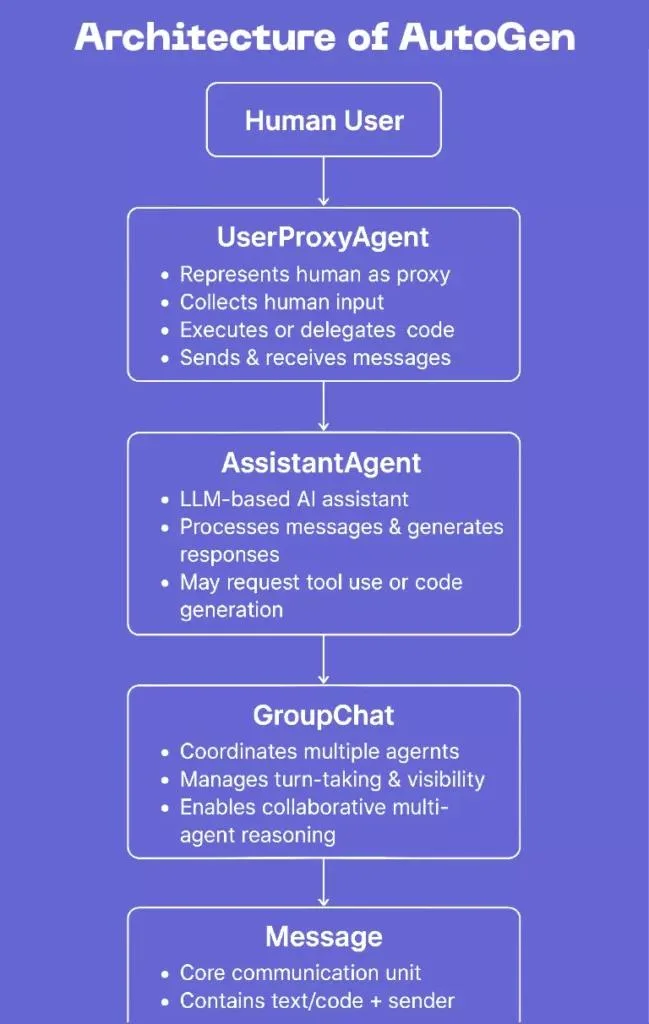
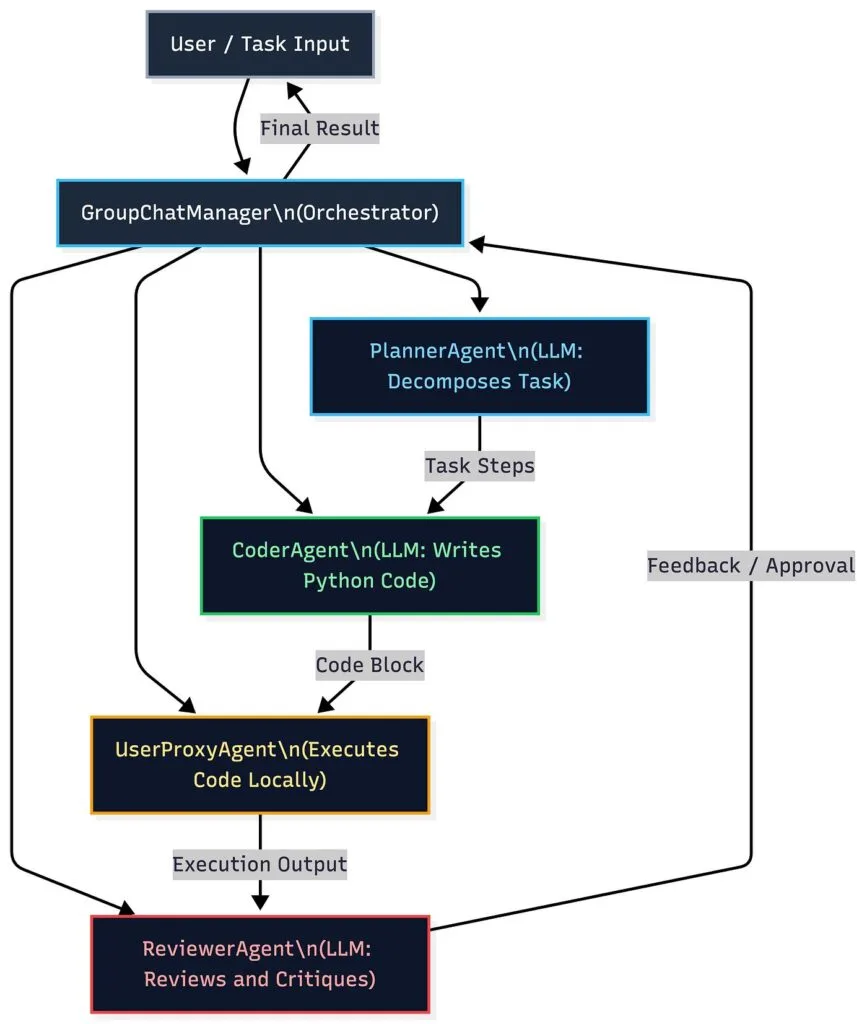
AutoGen Is More Than an AI Chatbot Framework
AutoGen is an open-source framework for building AI-agent applications in which agents can operate autonomously or work together with humans.
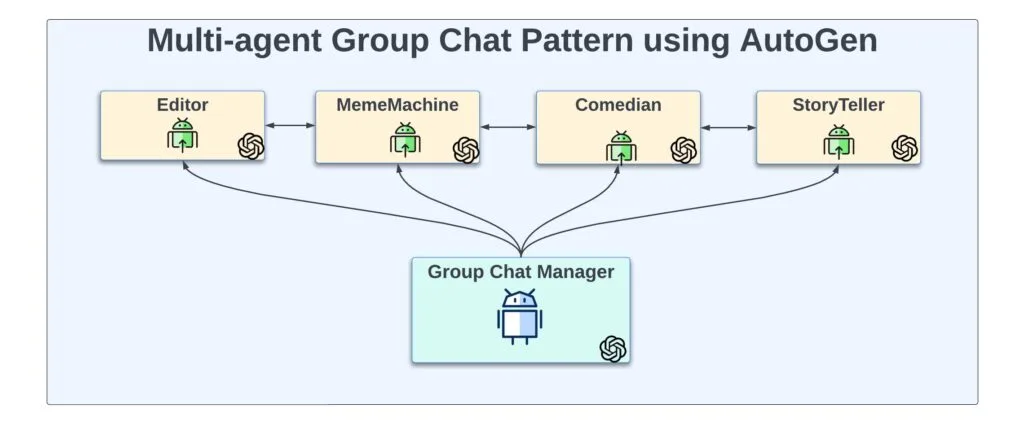
The project originated from Microsoft Research and evolved into a layered architecture containing concepts such as AgentChat, Core, and Extensions. The current documentation describes AgentChat as the higher-level API for building multi-agent applications, while autogen-core provides lower-level event-driven primitives. (GitHub)
But there is an important 2026 reality that anyone learning AutoGen today should understand.
The official AutoGen repository currently describes AutoGen as being in maintenance mode and recommends Microsoft Agent Framework for new projects requiring long-term active development. Existing AutoGen applications can still be used and maintained, and the AutoGen ecosystem remains highly valuable for understanding multi-agent architecture and for working with existing systems. (GitHub)
That distinction matters.
This series is not going to pretend that AutoGen exists in a frozen ecosystem.
Instead, we will learn AutoGen as an important multi-agent engineering framework, understand its architecture and patterns, build practical systems with it, and understand where its concepts fit into the broader Microsoft agent ecosystem.
That makes this series much more useful than simply learning syntax.
The Big Idea Behind AutoGen
Let’s start with the simplest possible mental model.
A traditional LLM application looks like this:
User
  ↓
Application
  ↓
LLM
  ↓
Response
For example:
response = llm.generate(
    "Explain how API testing works."
)

print(response)
There is nothing wrong with this architecture.
It is simple.
It is understandable.
It is often inexpensive.
And for many applications, it is exactly what you need.
But now consider a more complicated task:
“Analyze this API specification, identify important endpoints, generate test cases, execute the tests, investigate failures, and produce a QA report.”
You could build one huge prompt.
Something like:
You are a senior QA engineer.

Read the API specification.

Identify all important endpoints.

Generate test cases.

Execute the tests.

Analyze failures.

Investigate root causes.

Create a final QA report.
The model might produce something impressive.
But you’ve created a problem.
You are asking one reasoning system to play multiple roles.
A multi-agent architecture takes a different approach.
                         ┌─────────────────┐
                         │   User Request  │
                         └────────┬────────┘
                                  │
                                  ▼
                         ┌─────────────────┐
                         │   Orchestrator  │
                         └────────┬────────┘
                                  │
                 ┌────────────────┼────────────────┐
                 │                │                │
                 ▼                ▼                ▼
          ┌────────────┐   ┌────────────┐   ┌────────────┐
          │   Planner  │   │   Coder    │   │  Researcher│
          └─────┬──────┘   └─────┬──────┘   └─────┬──────┘
                │                │                │
                └────────────────┼────────────────┘
                                 ▼
                         ┌─────────────────┐
                         │     Reviewer    │
                         └────────┬────────┘
                                  │
                                  ▼
                         ┌─────────────────┐
                         │     Result      │
                         └─────────────────┘
Each agent has a responsibility.
That is the fundamental idea we will build upon throughout this 30-day series.
What Exactly Is an AI Agent?
Before understanding AutoGen, we need to understand the word agent.
The term is used everywhere in AI right now, but it is often used loosely.
A useful engineering definition is:
An AI agent is a software component that uses a model and contextual information to decide what action to take toward a goal.
An agent may have:
- instructions
- a model
- tools
- memory
- state
- access to external systems
- the ability to communicate
- the ability to make decisions
- termination conditions
A basic conceptual model is:
                 ┌─────────────────┐
                 │      Goal       │
                 └────────┬────────┘
                          │
                          ▼
                 ┌─────────────────┐
                 │      Agent      │
                 │                 │
                 │  Instructions   │
                 │  Model          │
                 │  Context        │
                 │  State          │
                 └────────┬────────┘
                          │
              ┌───────────┼───────────┐
              ▼           ▼           ▼
           Think        Tool        Message
              │           │           │
              └───────────┼───────────┘
                          ▼
                       Result
The important point is that an agent is not simply an LLM.
The LLM is usually one component inside the agent.
This distinction becomes extremely important when we start building real systems.
LLM vs Agent vs Multi-Agent System
These three concepts are often mixed together.
Let’s separate them.
| Concept | Main Responsibility | Example |
|---|---|---|
| LLM | Generate or reason about text/data | GPT, Claude, Gemini |
| AI Agent | Use an LLM with instructions, state, tools and actions | QA Agent |
| Multi-Agent System | Coordinate multiple specialized agents | Planner + Coder + Tester |
| Agent Framework | Infrastructure for building and coordinating agents | AutoGen |
| Application | Complete product built around agents | AI QA platform |
Think of it like software engineering.
A programming language is not an application.
A framework is not an application.
A database is not an application.
Similarly:
An LLM is not automatically an agent.
Why Do We Need Multiple Agents?
This is the question that matters most.
Why not simply use one powerful model?
Because specialization can make complex workflows easier to reason about.
Consider software testing.
One AI agent might be responsible for generating tests.
Another might analyze the application’s architecture.
Another could inspect API responses.
Another could review generated tests.
Another could act as a security reviewer.
You could define responsibilities like this:
QA Orchestrator
       │
       ├── Requirements Agent
       │
       ├── Test Design Agent
       │
       ├── API Testing Agent
       │
       ├── Security Agent
       │
       ├── Test Review Agent
       │
       └── Report Agent
The system becomes a team.
And that leads to an important engineering principle:
Don’t make one agent responsible for everything when the problem naturally contains multiple responsibilities.
This is exactly the same principle we use when designing traditional software.
We don’t normally put an entire enterprise system into one function.
We separate responsibilities.
We create services.
We create modules.
We create interfaces.
We create workers.
We create pipelines.
Multi-agent systems apply similar thinking to AI workflows.
AutoGen’s Mental Model
A useful way to think about AutoGen is:
                    AutoGen Application
                           │
             ┌─────────────┴─────────────┐
             │                           │
          Agents                       Teams
             │                           │
      ┌──────┼──────┐             ┌──────┼──────┐
      │      │      │             │      │      │
    Model  Tools  State         Agent A Agent B Agent C
The current AutoGen architecture separates responsibilities into different layers.
At a high level:
AgentChat
   ↓
Core
   ↓
Extensions
AgentChat provides higher-level abstractions for agents and teams and is the recommended starting point for beginners in the current documentation.
Core provides lower-level event-driven agent infrastructure and more control.
Extensions provide integrations such as model clients and other capabilities. (GitHub)
This layered design is important because it allows developers to choose how much control they need.
AgentChat vs AutoGen Core
This is one of the first comparisons you should understand.
| Feature | AgentChat | AutoGen Core |
|---|---|---|
| Abstraction level | High | Low |
| Beginner friendly | Yes | More advanced |
| Prebuilt agents | Yes | More building blocks |
| Teams | Yes | Build more yourself |
| Event-driven architecture | Abstracted | Central concept |
| Customization | Good | Very high |
| Learning curve | Lower | Higher |
| Best starting point | Most developers | Advanced architectures |
The official documentation describes AgentChat as a high-level API built on top of autogen-core, while Core provides the lower-level event-driven programming model. (Microsoft GitHub)
For this series, we’ll start with the higher-level concepts.
Later, we’ll go deeper.
That progression is deliberate.
You should understand what you are building before learning how the framework implements it internally.
A Simple Agent Example
Modern AutoGen AgentChat provides an AssistantAgent abstraction.
A simplified example looks like this:
import asyncio

from autogen_agentchat.agents import AssistantAgent
from autogen_ext.models.openai import OpenAIChatCompletionClient


async def main():
    model_client = OpenAIChatCompletionClient(
        model="gpt-4.1"
    )

    agent = AssistantAgent(
        name="qa_agent",
        model_client=model_client,
        system_message=(
            "You are a senior QA engineer. "
            "Analyze software requirements and suggest "
            "high-quality test cases."
        )
    )

    result = await agent.run(
        task="Create test cases for a login API."
    )

    print(result)


asyncio.run(main())
The exact model and configuration can change over time, but the important architecture is:
User Task
    ↓
AssistantAgent
    ↓
Model Client
    ↓
LLM
    ↓
Agent Response
The current AutoGen documentation shows AssistantAgent as a built-in AgentChat agent and provides run() and run_stream() methods for executing tasks. (Microsoft GitHub)
Notice something important.
We didn’t manually construct an entire conversation engine.
We created an agent.
We gave it instructions.
We connected a model.
We gave it a task.
That’s the beginning of the AutoGen experience.
But an Agent Alone Isn’t the Interesting Part
Here’s where things get exciting.
Suppose we create two agents.
planner = AssistantAgent(
    name="planner",
    model_client=model_client,
    system_message=(
        "You are a software test planner. "
        "Create a detailed testing strategy."
    )
)

tester = AssistantAgent(
    name="tester",
    model_client=model_client,
    system_message=(
        "You are a senior automation engineer. "
        "Turn testing strategies into executable test plans."
    )
)
Now we have two different AI roles.
                User
                 │
                 ▼
              Planner
                 │
                 ▼
               Tester
                 │
                 ▼
              Results
The planner thinks about what should be tested.
The tester thinks about how it should be tested.
That is fundamentally different from asking one generic assistant to do everything.
Specialized Agents
One of the strongest concepts in multi-agent engineering is specialization.
Imagine an AI development organization:
                    AI Engineering Team
                           │
          ┌────────────────┼────────────────┐
          │                │                │
          ▼                ▼                ▼
       Planner           Coder           Reviewer
          │                │                │
          │                ▼                │
          │             Executor            │
          │                │                │
          └────────────────┼────────────────┘
                           ▼
                         Result
Each agent has a clearly defined role.
For example:
Planner Agent
Responsibilities:
- Understand requirements
- Break task into steps
- Identify dependencies
- Produce execution plan
Coder Agent
Responsibilities:
- Write code
- Follow project conventions
- Implement requested functionality
Reviewer Agent
Responsibilities:
- Inspect implementation
- Find defects
- Check quality
- Recommend improvements
Tester Agent
Responsibilities:
- Generate tests
- Execute tests
- Analyze failures
- Report results
This is not just an AI concept.
It is classic software architecture applied to agentic systems.
The Difference Between Automation and Agentic Workflows
This distinction is extremely important.
Traditional automation might look like:
Step 1 → Step 2 → Step 3 → Step 4
For example:
requirements = load_requirements()
tests = generate_tests(requirements)
results = execute_tests(tests)
report = create_report(results)
Everything is predetermined.
An agentic workflow can be more dynamic:
Task
  ↓
Agent decides next action
  ↓
Tool / Agent
  ↓
Observe result
  ↓
Decide next action
  ↓
Tool / Agent
  ↓
Evaluate
  ↓
Finish or continue
The difference is decision-making inside the workflow.
That does not mean agents should have unlimited freedom.
Quite the opposite.
Good agentic engineering requires boundaries.
We will spend later days discussing:
- termination
- permissions
- tools
- retries
- state
- guardrails
- observability
- cost
- security
AutoGen and Traditional Workflow Engines
AutoGen is also worth comparing with traditional workflow systems.
| Capability | Traditional Workflow | AutoGen-style Agent Workflow |
|---|---|---|
| Flow | Mostly predefined | Can be dynamic |
| Decision-making | Application code | Agent/model + application logic |
| Tasks | Explicit steps | Can be dynamically selected |
| Communication | Function/API calls | Agent messages + tools |
| Adaptation | Limited | Higher |
| Predictability | High | Lower unless constrained |
| Debugging | Usually simpler | More complex |
| Best for | Deterministic processes | Reasoning-heavy workflows |
This doesn’t mean agents replace traditional workflows.
In production systems, the strongest architecture is often a combination.
For example:
Deterministic Workflow
        │
        ▼
    AI Agent
        │
        ▼
  Tool Execution
        │
        ▼
Deterministic Validation
        │
        ▼
    AI Reviewer
        │
        ▼
Deterministic Deployment
That is a much more realistic way to think about production agentic systems.
The First Strategic Lesson
If you remember only one thing from Day 1A, remember this:
Agentic AI is not about giving an LLM unlimited autonomy. It is about designing controlled systems where AI can reason, communicate, use tools, and make decisions within defined boundaries.
This is where many beginner tutorials go wrong.
They focus on:
Create agent
Ask question
Get answer
That’s useful for learning syntax.
But it doesn’t teach you how to build systems.
An engineer should instead ask:
What is the goal?

Which responsibilities exist?

Which agent should own each responsibility?

Which tools should each agent access?

How should agents communicate?

Who decides the next step?

When does the workflow stop?

What happens when an agent fails?

How do we validate the result?

How much does each execution cost?

What data can the agent access?
These questions will become the foundation of this entire series.
AutoGen vs Single-Agent Architecture
Let’s visualize the difference.
Single-Agent System
             User
              │
              ▼
       ┌─────────────┐
       │ AI Assistant│
       └──────┬──────┘
              │
       ┌──────┼──────┐
       ▼      ▼      ▼
     Tool A Tool B Tool C
              │
              ▼
            Result
Simple.
Fast to implement.
Easy to understand.
But the agent carries many responsibilities.
Multi-Agent System
                         User
                          │
                          ▼
                    Orchestrator
                          │
          ┌───────────────┼───────────────┐
          ▼               ▼               ▼
       Planner          Coder          Researcher
          │               │               │
          └───────────────┼───────────────┘
                          ▼
                       Reviewer
                          │
                          ▼
                        Tester
                          │
                          ▼
                        Result
More components.
More complexity.
But also more specialization and potentially more controllable workflows.
The engineering challenge is deciding when the additional complexity is justified.
When Should You Use Multi-Agent Systems?
Don’t create five agents just because a framework makes it easy.
That’s one of the biggest mistakes beginners make.
Use multiple agents when the problem naturally benefits from separation.
Good candidates include:
- complex research
- software development
- QA automation
- document analysis
- data analysis
- planning and execution
- code review
- security analysis
- customer support escalation
- content pipelines
- enterprise workflows
A simple FAQ bot probably doesn’t need seven agents.
Question
   ↓
LLM
   ↓
Answer
A complex software engineering workflow might.
Requirement
     ↓
Planner
     ↓
Developer
     ↓
Tester
     ↓
Reviewer
     ↓
Security Agent
     ↓
Final Result
The goal is not:
“Use as many agents as possible.”
The goal is:
Use the minimum architecture that solves the problem reliably.
That is an important strategy for the rest of this series.
A Practical AutoGen Architecture
Let’s imagine we’re building an AI QA platform.
A user provides:
"Analyze this API and create a complete automated test suite."
Our system could eventually contain:
                         User
                          │
                          ▼
                   QA Orchestrator
                          │
             ┌────────────┼────────────┐
             │            │            │
             ▼            ▼            ▼
         API Agent   Requirements   Security
             │          Agent          Agent
             │            │            │
             └────────────┼────────────┘
                          ▼
                    Test Generator
                          │
                          ▼
                    Test Executor
                          │
                          ▼
                    Failure Analyzer
                          │
                          ▼
                     QA Reviewer
                          │
                          ▼
                     Final Report
This could eventually combine:
- AutoGen agents
- APIs
- databases
- test frameworks
- MCP servers
- RAG
- code execution
- CI/CD
- observability
- human approval
And that is exactly why this series has 30 days.
We are not trying to understand the entire architecture today.
We are building the mental model first.
Interactive Challenge: Think Like an Agent Architect
Before continuing, try this exercise.
Imagine a company asks:
“Build an AI system that receives a software requirement and automatically creates a test strategy, generates Playwright tests, executes them, analyzes failures, and creates a report.”
Don’t write code yet.
Design the agents.
You might start with:
Agent 1:
?

Agent 2:
?

Agent 3:
?

Agent 4:
?

Agent 5:
?
Now answer these questions:
Question 1: Who understands the requirement?
Question 2: Who creates the testing strategy?
Question 3: Who writes Playwright tests?
Question 4: Who executes the tests?
Question 5: Who analyzes failures?
Question 6: Who decides whether the work is complete?
There isn’t necessarily one correct architecture.
That’s the point.
You are beginning to think like an agent architect, not merely an AI API consumer.
Mini Design Exercise
Try designing this system yourself:
User:
"Test our login API and tell me whether it is production ready."
Create a possible architecture.
For example:
User
 ↓
?
 ↓
?
 ↓
?
 ↓
Final Report
Now add specialized responsibilities.
Maybe you decide:
User
 ↓
API Analysis Agent
 ↓
Test Design Agent
 ↓
Test Execution Agent
 ↓
Security Agent
 ↓
Review Agent
 ↓
Final Report
Then ask yourself:
Does every agent really need to exist?
Perhaps not.
Maybe the better architecture is:
User
 ↓
QA Agent
 ├── API Tool
 ├── Test Tool
 └── Security Tool
 ↓
Final Report
And this is where real engineering begins.
Multi-agent does not automatically mean better.
AutoGen’s Core Philosophy
The deeper lesson behind AutoGen is not simply “create multiple bots.”
It is about creating programmable agent systems.
The current AutoGen architecture supports agents, messages, teams, tools, model clients, event-driven execution, and extensions. AgentChat provides higher-level abstractions while Core exposes lower-level primitives for more advanced designs. (GitHub)
That means AutoGen can sit somewhere between:
Simple LLM Application
        │
        ▼
    AI Agent
        │
        ▼
  Agent Team
        │
        ▼
Agentic Workflow
        │
        ▼
Production AI System
And our job throughout this series is to understand every layer.
Why Engineers Should Care About AutoGen
If you’re a software engineer, QA engineer, SDET, backend developer, or AI engineer, the important question isn’t:
“Can AutoGen generate an AI response?”
Almost every modern AI framework can help with that.
The more interesting questions are:
How do agents communicate?
How do we assign responsibilities?
How do agents use tools?
How do we coordinate multiple agents?
How do we maintain state?
How do we recover from failures?
How do we observe agent behavior?
How do we control cost?
How do we secure agent capabilities?
How do we test an agentic system?
How do we deploy it?
Those are engineering questions.
And those are the questions this series will answer.
The AutoGen Learning Strategy
Don’t try to memorize every AutoGen class.
Instead, learn the concepts in this order:
1. Agent
   ↓
2. Model
   ↓
3. Message
   ↓
4. Tool
   ↓
5. State
   ↓
6. Team
   ↓
7. Orchestration
   ↓
8. Human-in-the-loop
   ↓
9. Memory
   ↓
10. RAG
   ↓
11. MCP
   ↓
12. Observability
   ↓
13. Security
   ↓
14. Production
Once you understand these concepts, framework APIs become much easier to learn.
If an API changes, your knowledge remains useful.
That’s the difference between learning a framework and learning agent engineering.
One More Important Reality: AutoGen’s Evolution
If you’ve searched for AutoGen tutorials before, you may have encountered code such as:
import autogen
or older patterns involving classes such as:
autogen.AssistantAgent
autogen.UserProxyAgent
Be careful when mixing those tutorials with modern AutoGen examples.
AutoGen 0.4 represented a major architectural rewrite, and the current package structure uses packages such as autogen-agentchat, autogen-core, and autogen-ext. The official FAQ describes 0.4 as a ground-up redesign with asynchronous messaging, scalable agent runtimes, modularity, improved observability, and stronger typing. (GitHub)
The current installation documentation requires Python 3.10 or later for AgentChat. (Microsoft GitHub)
For example, current installation commonly starts with:
pip install -U "autogen-agentchat"
and model-provider integrations are installed through extensions such as:
pip install -U "autogen-ext[openai]"
So throughout this series, we will avoid blindly mixing old AutoGen 0.2 tutorials with modern AutoGen architecture.
We’ll explicitly identify legacy concepts when they are useful for understanding the ecosystem.
What We Will Build Across 30 Days
By the end of this series, the goal isn’t merely to say:
“I know AutoGen.”
The goal is to be able to reason about a system like this:
                    ┌────────────────────┐
                    │       User         │
                    └─────────┬──────────┘
                              │
                              ▼
                    ┌────────────────────┐
                    │   Orchestrator     │
                    └─────────┬──────────┘
                              │
              ┌───────────────┼────────────────┐
              │               │                │
              ▼               ▼                ▼
          Researcher       Developer        Analyst
              │               │                │
              ▼               ▼                ▼
            Tools           Tools            RAG
              │               │                │
              └───────────────┼────────────────┘
                              ▼
                         Reviewer
                              │
                              ▼
                       Human Approval
                              │
                              ▼
                         Final Agent
                              │
                              ▼
                       Production API
We’ll gradually introduce the components needed to make such a system practical.
And because this series is aimed at engineers, we won’t stop at “hello world.”
We’ll eventually ask harder questions:
What happens if an agent fails?

What if two agents disagree?

What if the model produces invalid JSON?

What if a tool returns an error?

What if the agent enters a loop?

What if token costs explode?

What if a tool is dangerous?

What if the model receives a prompt injection?

What if an agent accesses sensitive data?

What if the workflow needs human approval?

What if the application must run asynchronously?

What if we need CI/CD?

What if the system needs production observability?
Those questions separate a demo from an engineering system.
Day 1A Takeaway
AutoGen gives us a way to think beyond the traditional:
Prompt → LLM → Response
and toward:
Goal
 ↓
Agents
 ↓
Messages
 ↓
Tools
 ↓
Decisions
 ↓
Coordination
 ↓
Validation
 ↓
Result
The biggest mindset shift is simple:
Stop thinking of AI as one chatbot.
Start thinking of AI as a system of components that can have different responsibilities.
An agent can reason.
An agent can use tools.
An agent can communicate.
An agent can delegate.
Agents can work together.
Humans can participate.
And deterministic software can still control the boundaries.
That combination is where agentic engineering becomes powerful.
One final caveat matters for anyone starting this series in 2026: AutoGen is now maintained as a community project, and Microsoft recommends its newer Microsoft Agent Framework for new projects needing active, long-term support. (GitHub)
That does not make AutoGen irrelevant.
Its architecture, patterns, and ecosystem provide valuable lessons for understanding multi-agent systems, especially if you’re working with existing AutoGen applications or studying the evolution of agent frameworks.
And that is exactly how we will approach this series.
Why AutoGen Matters in the Evolution of AI Applications
The easiest way to understand AutoGen is to first understand how AI applications have evolved.
The first generation of AI applications was mostly about sending a prompt to a language model and displaying the response.
The architecture was simple:
User
  ↓
Application
  ↓
LLM
  ↓
Response
A user asks a question.
The application sends the question to a model.
The model generates an answer.
The application displays it.
For many use cases, this architecture is still perfectly valid.
A chatbot, writing assistant, summarization tool, or simple question-answering application may not need anything more complicated.
But as developers started asking AI systems to perform larger tasks, the limitations of a single model interaction became obvious.
Instead of asking:
“Explain API testing.”
developers started asking:
“Analyze this API specification, understand the requirements, create a testing strategy, identify edge cases, and help me produce a complete test plan.”
Now the application isn’t simply generating text.
It is solving a problem.
And problem-solving usually contains multiple responsibilities.
From Prompts to AI Agents
Consider a simple prompt:
prompt = """
Explain the difference between API testing
and UI testing.
"""
A language model can respond to this very well.
But now consider:
Analyze our login API.

1. Understand the requirements.
2. Identify test scenarios.
3. Design positive and negative tests.
4. Identify security risks.
5. Recommend automation coverage.
6. Produce a final QA strategy.
This requires more than generating a paragraph.
The system needs to understand a goal and potentially perform several reasoning steps.
This is where the idea of an AI agent becomes useful.
An AI agent can be thought of as a software component that uses an AI model to pursue a particular objective within a defined environment.
A simplified mental model is:
                Goal
                 ↓
              AI Agent
                 ↓
        ┌────────┼────────┐
        ↓        ↓        ↓
     Reasoning  Context  Actions
        │        │        │
        └────────┼────────┘
                 ↓
               Result
The important distinction is that an agent is not simply the model itself.
The model provides language understanding and generation.
The surrounding agent system provides the structure required to use that intelligence for a particular task.
LLM vs AI Agent
This distinction is fundamental to understanding AutoGen.
| LLM | AI Agent |
|---|---|
| AI model | Software component using an AI model |
| Generates responses | Works toward a goal |
| Primarily handles reasoning/generation | Combines reasoning with application behavior |
| Usually receives prompts | Can operate within a defined workflow |
| Stateless by default at the application level | Can be designed with state/context |
| Doesn’t inherently represent a business role | Can have a specific role |
| Doesn’t automatically form a workflow | Can participate in workflows |
For example, an LLM might answer:
"What are common API testing techniques?"
An AI agent might be given a more specific objective:
"You are a QA analyst.
Analyze this API specification
and identify high-risk test scenarios."
The difference is not simply the wording of the prompt.
The agent represents a purpose and responsibility inside an application.
Why One AI Agent Is Sometimes Not Enough
Imagine building an AI software engineering assistant.
You give it this task:
Build a new authentication service.

Understand the requirements.
Design the architecture.
Write the implementation.
Review the code.
Create tests.
Analyze the test results.
Prepare documentation.
A single capable model may be able to attempt all of this.
But the problem is not necessarily model capability.
The problem is responsibility.
The system is asking one component to behave like:
Architect
Developer
Tester
Reviewer
Technical Writer
That creates a very large conceptual responsibility.
A different approach is to divide the problem.
                  Software Task
                       │
             ┌─────────┼─────────┐
             ↓         ↓         ↓
          Planner    Developer  Tester
             │         │         │
             └─────────┼─────────┘
                       ↓
                    Reviewer
Now the system has specialized AI components.
This is the fundamental idea behind multi-agent AI.
What Is a Multi-Agent System?
A multi-agent system contains multiple agents that participate in solving a larger problem.
Each agent can have a different role.
For example:
Research Agent
    ↓
Developer Agent
    ↓
Testing Agent
    ↓
Review Agent
The goal isn’t simply to create more AI.
The goal is to divide a complex problem into meaningful responsibilities.
Consider a research workflow.
Instead of asking one agent to:
Search
Analyze
Verify
Summarize
Write
we could conceptually divide those responsibilities:
Researcher
    ↓
Analyst
    ↓
Fact Checker
    ↓
Writer
Each component has a clearer purpose.
This is similar to how teams work in traditional software organizations.
A software company doesn’t normally expect one person to simultaneously act as:
Product Manager
Architect
Developer
QA Engineer
Security Engineer
DevOps Engineer
Technical Writer
The responsibilities are distributed.
Multi-agent AI applies a similar principle to AI-powered systems.
The Core Idea Behind AutoGen
This gives us a useful definition:
AutoGen is a framework for building AI-agent applications, including systems where multiple agents can communicate and collaborate to accomplish tasks.
The important word here is framework.
AutoGen is not itself an AI model.
It doesn’t replace models such as GPT, Claude, or Gemini.
Instead, it provides abstractions and infrastructure that help developers construct applications around AI agents.
Think about the relationship like this:
AI Model
   ↓
Provides intelligence
   ↓
AutoGen
   ↓
Provides agent/application abstractions
   ↓
Your Application
   ↓
Solves a real-world problem
This distinction prevents a common misunderstanding.
You don’t “use AutoGen instead of an LLM.”
You use AutoGen to help build an application that uses AI models as part of an agent-based architecture.
AutoGen’s Place in the AI Ecosystem
The modern AI ecosystem contains several different layers.
At the bottom, we have models.
GPT
Claude
Gemini
Other LLMs
Above the models, applications can introduce agent abstractions.
Model
  ↓
Agent
Then multiple agents can participate in a larger system.
Model
  ↓
Agents
  ↓
Multi-Agent System
And finally:
Multi-Agent System
        ↓
Business Application
AutoGen fits into this middle layer.
A simplified view is:
┌──────────────────────────────┐
│      Your AI Application     │
├──────────────────────────────┤
│   Agent / Team Architecture  │
├──────────────────────────────┤
│           AutoGen            │
├──────────────────────────────┤
│       Model Providers        │
├──────────────────────────────┤
│            LLMs              │
└──────────────────────────────┘
This is why learning AutoGen is not simply about learning a collection of Python classes.
You are learning how AI capabilities can be organized into software systems.
Why Was AutoGen Created?
The problem AutoGen addresses comes from increasingly complex AI workflows.
A basic LLM interaction looks like:
Question
   ↓
Model
   ↓
Answer
But a more complex workflow may look like:
Goal
 ↓
Planning
 ↓
Reasoning
 ↓
Specialized Work
 ↓
Evaluation
 ↓
Improvement
 ↓
Final Result
Developers need ways to represent these interactions programmatically.
Instead of manually building every interaction from scratch, a framework can provide reusable concepts for agents, communication, teams, and workflows.
That is the fundamental value proposition behind AutoGen.
It helps developers move from:
"I have an LLM."
to:
"I have an AI system."
That is a significant conceptual shift.
AutoGen Is About Conversations Between Intelligent Components
One of the most interesting ideas in AutoGen is the concept of agents communicating.
Imagine:
Planner Agent
     ↓
"Here is the implementation plan."
     ↓
Developer Agent
     ↓
"Here is the implementation."
     ↓
Reviewer Agent
     ↓
"These issues need to be fixed."
The system becomes conversational.
Instead of your application manually defining every piece of text that one component must send to another, agents can participate in structured interactions.
This leads to another useful mental model:
              ┌──────────────┐
              │    Agent A   │
              └──────┬───────┘
                     │
                  Message
                     │
                     ▼
              ┌──────────────┐
              │    Agent B   │
              └──────┬───────┘
                     │
                  Message
                     │
                     ▼
              ┌──────────────┐
              │    Agent C   │
              └──────────────┘
The agents don’t necessarily have identical responsibilities.
Their value comes from their different roles.
Specialization Is the Real Power
Suppose we are creating an AI testing platform.
One agent could specialize in requirements.
Requirements Agent
Its responsibility:
Understand requirements
Identify acceptance criteria
Find ambiguities
Another could specialize in test design.
Test Design Agent
Its responsibility:
Create test scenarios
Identify edge cases
Define expected outcomes
Another could specialize in review.
Test Review Agent
Its responsibility:
Review test coverage
Identify missing scenarios
Evaluate test quality
The architecture becomes:
                Requirement
                     │
                     ▼
            Requirements Agent
                     │
                     ▼
             Test Design Agent
                     │
                     ▼
              Review Agent
                     │
                     ▼
                QA Result
The important concept is not that there are three agents.
The important concept is that each agent has a meaningful responsibility.
AutoGen vs a Traditional LLM Application
Let’s compare the two architectures.
Traditional LLM Application
User
 ↓
Prompt
 ↓
LLM
 ↓
Response
This architecture is:
- simple
- predictable
- easy to implement
- easy to debug
- often inexpensive
It is excellent for many use cases.
Agent-Based Application
User
 ↓
Agent
 ↓
Goal
 ↓
Reasoning
 ↓
Actions / decisions
 ↓
Result
This architecture can support more complex tasks.
Multi-Agent Application
User
 ↓
Agent A
 ↓
Agent B
 ↓
Agent C
 ↓
Final Result
Now the system can distribute responsibilities.
| Architecture | Complexity | Flexibility | Best Use |
|---|---|---|---|
| Direct LLM call | Low | Low | Simple generation |
| Prompt-based workflow | Low–Medium | Medium | Structured AI tasks |
| Single AI agent | Medium | High | Goal-oriented tasks |
| Multi-agent system | High | Very High | Complex collaborative tasks |
This comparison reveals an important engineering principle:
More agents do not automatically mean a better system.
Complexity should only be introduced when it provides meaningful value.
AutoGen vs Single-Agent AI
A single-agent application might look like:
User
 ↓
AI Agent
 ↓
Result
This is often enough.
For example:
“Summarize this document.”
There is little reason to create:
Summarizer Agent
Reviewer Agent
Formatting Agent
Final Agent
for such a simple problem.
But consider:
“Analyze this large technical specification, identify architectural risks, compare possible solutions, and produce a recommendation.”
Now specialized roles may become useful.
              User
               │
               ▼
          Research Agent
               │
               ▼
          Analysis Agent
               │
               ▼
          Review Agent
               │
               ▼
          Final Result
The architectural choice depends on the problem.
That is why agent architecture should follow task complexity, not trends.
AutoGen vs Traditional Automation
This is another important distinction.
Traditional automation usually follows predefined instructions.
For example:
requirements = load_requirements()
test_cases = generate_test_cases(requirements)
results = execute_tests(test_cases)
report = generate_report(results)
The application knows the sequence.
An agent-based system can introduce AI-driven decision-making into the workflow.
Conceptually:
Task
 ↓
Agent understands the goal
 ↓
Agent determines what is needed
 ↓
Agent performs or requests work
 ↓
Agent evaluates the result
 ↓
Agent produces an outcome
This doesn’t mean traditional automation is obsolete.
In fact, the strongest AI applications often combine both approaches.
For example:
AI reasoning
     ↓
Deterministic automation
     ↓
AI analysis
     ↓
Deterministic validation
AI can handle ambiguity and reasoning while conventional software handles predictable operations.
This hybrid approach is one of the most useful concepts to keep in mind as we learn AutoGen.
Where AutoGen Can Be Useful
AutoGen becomes particularly interesting when the problem involves complex reasoning, collaboration, or multiple specialized responsibilities.
Software Development
Requirement
 ↓
Planning
 ↓
Implementation
 ↓
Review
 ↓
Testing
Software Testing
Requirement
 ↓
Test Strategy
 ↓
Test Design
 ↓
Test Analysis
 ↓
QA Report
Research
Research Question
 ↓
Information Gathering
 ↓
Analysis
 ↓
Verification
 ↓
Summary
Data Analysis
Business Question
 ↓
Data Analysis
 ↓
Interpretation
 ↓
Validation
 ↓
Recommendation
Customer Support
Customer Request
 ↓
Classification
 ↓
Specialized Assistance
 ↓
Resolution
The framework becomes interesting when the application requires more than simply generating a response.
AutoGen for QA and SDET Engineers
For QA and SDET engineers, the concept becomes especially practical.
Imagine a requirement:
Users must be able to reset their password
using a registered email address.
A traditional approach might require a QA engineer to manually translate that requirement into:
Functional tests
Negative tests
Boundary tests
Security tests
API tests
UI tests
Regression tests
An AI-powered testing system could potentially divide this reasoning among specialized components.
Conceptually:
                Requirement
                     │
                     ▼
             QA Analysis Agent
                     │
          ┌──────────┼──────────┐
          ▼          ▼          ▼
        API        UI       Security
       Analysis   Analysis   Analysis
          │          │          │
          └──────────┼──────────┘
                     ▼
                 QA Review
This doesn’t mean every production QA platform needs this exact architecture.
The point is to understand how agent specialization can map naturally to engineering responsibilities.
The Main Benefits of AutoGen
AutoGen’s biggest value can be understood through several areas.
1. Separation of Responsibilities
Different agents can focus on different tasks.
Planner
Developer
Tester
Reviewer
This can make complex AI applications easier to reason about.
2. Reusable Agent Concepts
Instead of designing every AI interaction from scratch, developers can work with reusable agent abstractions.
3. Multi-Agent Collaboration
Complex tasks can be divided among multiple AI components.
4. Flexible Architectures
Applications can range from simple agent interactions to more sophisticated multi-agent systems.
5. Software Engineering Mindset
AutoGen encourages developers to think about AI as a system rather than simply a prompt.
That last point is particularly important.
The Limitations You Should Know From Day One
AutoGen is not magic.
Multi-agent systems introduce their own problems.
More Complexity
Instead of:
Application
 ↓
LLM
you may now have:
Application
 ↓
Agent
 ↓
Agent
 ↓
Agent
 ↓
Model
More components mean more things to understand.
More Cost
Multiple agents can mean multiple model interactions.
A workflow that requires several model calls can become significantly more expensive than a single response.
Less Predictability
AI-generated decisions are probabilistic.
A multi-agent system can therefore behave differently across runs.
More Difficult Debugging
When a result is wrong, you may need to determine:
Which agent made the wrong decision?

Which message caused it?

Was the context incomplete?

Was the model response incorrect?

Was the workflow design wrong?
Potentially More Latency
More AI interactions can mean more waiting.
These limitations don’t make multi-agent systems bad.
They simply mean that architecture matters.
The Most Important Question: Do You Need AutoGen?
Before adopting any AI framework, ask whether you actually need it.
If your application is:
User
 ↓
Prompt
 ↓
LLM
 ↓
Answer
a direct model API may be enough.
If you need:
User
 ↓
Agent
 ↓
Goal-oriented response
a single-agent approach may be enough.
If your problem looks like:
Complex Task
 ↓
Multiple Responsibilities
 ↓
Specialized AI Roles
 ↓
Collaboration
then a multi-agent framework such as AutoGen becomes much more interesting.
The decision should therefore follow the architecture:
Simple problem
    ↓
Simple architecture

Complex problem
    ↓
Appropriate complexity
Not:
New AI framework
    ↓
Use it everywhere
That distinction is important for professional engineering.
A Small AutoGen Conceptual Example
Let’s see what the basic idea looks like in Python without turning this into the installation tutorial that comes later.
A conceptual agent can be represented like this:
from autogen_agentchat.agents import AssistantAgent

agent = AssistantAgent(
    name="qa_analyst",
    model_client=model_client,
    system_message="""
    You are a senior QA analyst.

    Analyze software requirements,
    identify important test scenarios,
    and explain potential risks.
    """
)
The important parts are easy to understand:
AssistantAgent
     │
     ├── name
     │
     ├── model
     │
     └── instructions
The agent represents a role.
The model provides the AI capability.
The instructions define the agent’s responsibility.
Later in the series, we’ll build on this foundation and learn how AutoGen applications actually execute and coordinate these components.
For now, the important thing is understanding the architecture rather than memorizing the API.
A Better Way to Think About AutoGen
Instead of thinking:
“AutoGen lets me create AI bots.”
Think:
“AutoGen gives me abstractions for designing applications where AI agents can perform specialized roles and participate in larger workflows.”
That definition is much closer to the engineering mindset we need.
The progression looks like this:
LLM
 ↓
AI capability
 ↓
Agent
 ↓
Specialized responsibility
 ↓
Multiple agents
 ↓
Collaboration
 ↓
AI application
This is the foundation of the entire AutoGen journey.
Interactive Check: Can You Identify the Architecture?
Consider this requirement:
“Build an AI system that receives a software requirement and produces a complete QA strategy.”
Which architecture would you choose?
Option A
User
 ↓
LLM
 ↓
Answer
Option B
User
 ↓
QA Agent
 ↓
Answer
Option C
User
 ↓
Requirements Agent
 ↓
Test Strategy Agent
 ↓
Review Agent
 ↓
Final QA Strategy
There is no universal answer.
For a simple requirement, Option A might be sufficient.
For a goal-oriented QA assistant, Option B could be appropriate.
For a complex enterprise QA analysis system, Option C might provide useful specialization.
The engineering skill is knowing why you selected one architecture over another.
Your Turn: Design Before You Code
Take this requirement:
“Analyze a web application’s checkout process and identify the most important testing areas.”
Before writing any AutoGen code, answer:
What is the goal?
____________________________

Is one AI agent enough?
____________________________

If multiple agents are useful,
what responsibilities should they have?
____________________________

What should each agent produce?
____________________________

Which architecture is simpler?
____________________________

Is the additional complexity justified?
____________________________
This exercise looks simple, but it teaches one of the most valuable lessons in agent engineering:
Architecture comes before implementation.
Don’t start by asking which AutoGen class to import.
Start by asking what problem you are solving.
The AutoGen Mindset
AutoGen becomes much easier to understand when you adopt five simple ideas:
1. Start with the problem.

2. Identify the responsibilities.

3. Decide whether AI reasoning is actually needed.

4. Introduce agents only where they provide value.

5. Keep the architecture as simple as possible.
This mindset will help you avoid one of the biggest mistakes in agentic AI:
building a complicated multi-agent system simply because you can.
The best agent system isn’t the one with the most agents.
It’s the one that solves the problem effectively with an architecture you can understand, test, monitor, and eventually operate in the real world.
That is the foundation we need before moving deeper into AutoGen.
Continuing directly from the previous section. This section goes deeper into AutoGen fundamentals, architecture, mental models, comparisons, and practical understanding, while deliberately saving the strategy, conclusion, and final key takeaways for the final section.
Understanding the Architecture Behind AutoGen
Now that we understand why AI agents exist and why multiple agents can be useful, the next step is to understand how AutoGen fits into an actual application.
The easiest mistake to make at this stage is to think:
AutoGen = Agent
That is too narrow.
A better mental model is:
Your Application
       ↓
    AutoGen
       ↓
   AI Agents
       ↓
   AI Models
But a real application can contain more than just agents.
You may eventually have:
                    Your Application
                          │
                          ▼
                       AutoGen
                          │
            ┌─────────────┼─────────────┐
            ▼             ▼             ▼
          Agents         Teams        Workflows
            │             │             │
            └─────────────┼─────────────┘
                          ▼
                     AI Models
And the application itself may contain:
Database
APIs
Files
User Interface
Business Logic
Monitoring
Authentication
The important idea for Day 1 is that AutoGen sits inside a larger software system.
It is not the entire application.
AutoGen Is a Framework, Not an AI Model
Let’s remove another common misunderstanding.
Suppose you use GPT, Claude, Gemini, or another large language model.
The model is responsible for things such as:
- understanding natural language
- generating text
- reasoning over provided information
- producing structured or unstructured output
AutoGen provides a framework for organizing those model capabilities into agent-based applications.
Think about a traditional software stack.
You might have:
Python
   ↓
FastAPI
   ↓
PostgreSQL
FastAPI isn’t the database.
PostgreSQL isn’t the programming language.
Each layer has a responsibility.
Similarly:
LLM
   ↓
Provides AI capability

AutoGen
   ↓
Provides agent/application abstractions

Your application
   ↓
Provides the business purpose
This separation is important because it prevents you from treating AutoGen as another LLM.
The Basic AutoGen Mental Model
At a beginner level, you can think about an AutoGen application using five concepts:
Model
  ↓
Agent
  ↓
Message
  ↓
Interaction
  ↓
Result
Let’s break them down.
Model
The model provides the underlying AI capability.
Conceptually:
Question
   ↓
LLM
   ↓
Generated response
Agent
The agent gives the AI a role or responsibility.
For example:
QA Analyst
Developer
Researcher
Reviewer
Planner
Message
Agents need information to communicate.
A message may contain:
Instruction
Question
Result
Feedback
Decision
Context
Interaction
Agents can participate in a conversation or workflow.
For example:
Planner
  ↓
Developer
  ↓
Reviewer
Result
The overall system eventually produces something useful:
Test Plan
Code
Research Report
Analysis
Recommendation
This simple mental model will help you understand the more advanced concepts later.
Agent Roles Are Software Responsibilities
A role shouldn’t simply be a fancy name.
If you create an agent called:
"Super AI Agent"
that tells you almost nothing.
Instead:
"API Test Analyst"
immediately communicates a responsibility.
For example:
qa_agent = AssistantAgent(
    name="api_test_analyst",
    model_client=model_client,
    system_message="""
    You are an API testing specialist.

    Analyze API requirements,
    identify functional and negative test scenarios,
    and explain important testing risks.
    """
)
The agent has:
Name
 ↓
Role
 ↓
Instructions
 ↓
Model
The role gives the agent a place within the larger architecture.
A Useful Analogy: Software Team
Imagine a traditional software team.
You might have:
Product Manager
      ↓
Software Architect
      ↓
Developer
      ↓
QA Engineer
      ↓
Reviewer
Each person has different responsibilities.
Now imagine representing similar responsibilities using AI agents:
Product Agent
      ↓
Architecture Agent
      ↓
Developer Agent
      ↓
QA Agent
      ↓
Review Agent
The analogy is useful, but there is one major difference.
Human teams have broad real-world understanding, experience, accountability, and judgment.
AI agents don’t automatically have those qualities.
You have to explicitly design:
- their instructions
- available information
- boundaries
- communication
- validation
- decision-making rules
Therefore:
Creating an agent role is easy. Designing a reliable agent responsibility is the real engineering challenge.
Agents Should Have Clear Inputs and Outputs
One of the best ways to think about an agent is as a software component.
For example:
Input
  ↓
Requirements Agent
  ↓
Output
The input could be:
Product requirement
The output could be:
Acceptance criteria
Risks
Ambiguities
Testable requirements
Then another agent consumes that output.
Requirements Agent
        │
        │ Testable requirements
        ▼
Test Design Agent
        │
        │ Test scenarios
        ▼
Review Agent
This resembles function composition in traditional programming.
For example:
requirements = analyze_requirement(raw_requirement)

tests = generate_tests(requirements)

review = review_tests(tests)
The same conceptual pattern can exist in agent-based systems:
Requirement
    ↓
Agent A
    ↓
Agent B
    ↓
Agent C
    ↓
Result
This makes the architecture easier to reason about.
Agent Communication Is Data Flow
When agents communicate, don’t think only in terms of “chat.”
Think about data flow.
For example:
Requirement
    │
    ▼
┌───────────────┐
│ Requirements  │
│    Agent      │
└───────┬───────┘
        │
        │ Structured understanding
        ▼
┌───────────────┐
│ Test Strategy │
│    Agent      │
└───────┬───────┘
        │
        │ Test strategy
        ▼
┌───────────────┐
│ Test Review   │
│    Agent      │
└───────────────┘
This perspective is extremely useful.
Instead of asking:
“How do I make two agents talk?”
ask:
“What information needs to move from one responsibility to another?”
That question leads to better architecture.
Conversation vs Workflow
These two concepts can look similar but are not identical.
A conversation might look like:
Agent A
   ↓
Agent B
   ↓
Agent A
   ↓
Agent B
A workflow might look like:
Input
 ↓
Planning
 ↓
Analysis
 ↓
Review
 ↓
Output
A conversation focuses on communication.
A workflow focuses on completing a process.
A sophisticated application can contain both.
For example:
Workflow
   ↓
Research Agent
   ↕
Review Agent
   ↓
Workflow continues
This distinction becomes important when designing larger systems.
Sequential Thinking
The simplest multi-agent architecture is sequential.
Agent A
   ↓
Agent B
   ↓
Agent C
For example:
Requirement
   ↓
Planner
   ↓
Developer
   ↓
Tester
   ↓
Reviewer
The advantage is simplicity.
You can understand the flow immediately.
The disadvantage is that it assumes the workflow always follows the same path.
Suppose the tester discovers a serious problem.
Should the workflow continue directly to the reviewer?
Maybe not.
Perhaps it should return to the developer.
Developer
   ↓
Tester
   ↓
Failure
   │
   └────────→ Developer
Now the workflow is no longer purely linear.
This distinction will become important later when we study orchestration, but the fundamental concept belongs here:
AI workflows can be linear or adaptive depending on the problem.
One Agent vs Multiple Agents
Let’s compare the architectures directly.
Single Agent
User
 ↓
Agent
 ↓
Result
Advantages:
- simple
- easy to understand
- fewer model interactions
- easier debugging
- potentially lower cost
Disadvantages:
- broad responsibility
- larger instructions
- potentially mixed context
- less specialization
Multiple Agents
User
 ↓
Agent A
 ↓
Agent B
 ↓
Agent C
 ↓
Result
Advantages:
- specialization
- separation of responsibilities
- potentially better task decomposition
- easier conceptual ownership
Disadvantages:
- more complexity
- more communication
- more model calls
- more potential failure points
- potentially higher cost
The key question isn’t:
“Which architecture is more advanced?”
The key question is:
“Which architecture is appropriate for the problem?”
Multi-Agent Does Not Automatically Mean Better Results
This deserves emphasis.
Imagine a simple task:
Convert 10 Celsius to Fahrenheit.
You don’t need:
Research Agent
Calculation Agent
Verification Agent
Formatting Agent
You need a calculation.
Adding agents would make the system worse from an engineering perspective.
You introduce:
Complexity
Latency
Cost
Failure points
without creating meaningful value.
Now consider:
Analyze a large software project, understand its architecture, identify risky components, propose tests, and review the findings.
Specialization may provide real value.
Therefore:
Simple Task
    ↓
Simple Architecture
and:
Complex Task
    ↓
Potentially Specialized Architecture
This principle should remain with you throughout the entire series.
AutoGen vs LangChain and LangGraph
If you’re already exploring the modern AI ecosystem, you will eventually encounter AutoGen alongside frameworks such as LangChain and LangGraph.
These technologies overlap in some areas, but they are not simply interchangeable names.
At a very high level:
| Technology | General Focus |
|---|---|
| AutoGen | Agent-based and multi-agent application development |
| LangChain | Building applications around LLMs, models, tools, retrieval, and integrations |
| LangGraph | Building stateful, controllable agent workflows and graphs |
| Direct model SDK | Calling an AI model directly |
| Traditional application code | Deterministic business logic |
These categories can overlap.
A real production application may even combine concepts from several ecosystems.
For Day 1, the important point is not to decide which framework “wins.”
Instead, understand the problem each abstraction is trying to solve.
AutoGen’s central attraction is its focus on agent-based collaboration and application design.
AutoGen vs Direct OpenAI API Usage
Consider a direct model call.
Conceptually:
response = client.responses.create(
    model="your-model",
    input="Analyze this requirement."
)
The application controls the interaction directly.
That is often excellent for simple applications.
Now consider an agent-oriented architecture:
Requirement
    ↓
AI Agent
    ↓
Agent responsibility
    ↓
Interaction
    ↓
Result
The framework provides additional abstractions around the AI interaction.
A useful comparison is:
| Approach | Best For |
|---|---|
| Direct model API | Simple AI features |
| Prompt workflow | Predictable multi-step tasks |
| Single agent | Goal-oriented AI tasks |
| Multi-agent framework | Collaborative AI workflows |
Again, none of these approaches is universally better.
AutoGen vs Traditional Software Architecture
This comparison is even more interesting for experienced developers.
Traditional application:
Controller
   ↓
Service
   ↓
Repository
   ↓
Database
The flow is largely determined by application code.
Agent-based application:
User Goal
   ↓
Agent
   ↓
AI Decision
   ↓
Next Responsibility
   ↓
Result
The difference is that part of the decision-making process can be delegated to an AI model.
That introduces flexibility.
It also introduces uncertainty.
Traditional software says:
if condition:
    execute A
else:
    execute B
An agent may instead reason over a goal and determine what action appears appropriate.
That makes agentic systems powerful.
It also makes them harder to guarantee.
This is why software engineering principles become even more important in AI applications.
Deterministic Logic Still Matters
One of the biggest mistakes beginners make is assuming:
“If I am building an AI agent, everything should be handled by AI.”
No.
Suppose you need to validate an email address.
Use deterministic code when appropriate.
def is_valid_email(email: str) -> bool:
    return "@" in email
Suppose you need to calculate a total.
Use a function:
def calculate_total(price: float, quantity: int) -> float:
    return price * quantity
Suppose you need to decide whether a required configuration value exists.
Use application logic.
if not configuration:
    raise ValueError("Missing configuration")
AI is most valuable where interpretation, ambiguity, reasoning, or generation is required.
A strong architecture therefore looks like:
                 Application
                     │
          ┌──────────┴──────────┐
          ▼                     ▼
    Deterministic Logic      AI Agent
          │                     │
          │              Reasoning/Analysis
          │                     │
          └──────────┬──────────┘
                     ▼
                   Result
This hybrid mindset is much more practical than making everything agentic.
The Difference Between Automation and Agency
Automation and agency are related, but they are not the same.
Traditional automation:
Trigger
 ↓
Step 1
 ↓
Step 2
 ↓
Step 3
 ↓
Result
The developer defines the sequence.
Agentic behavior:
Goal
 ↓
Agent interprets situation
 ↓
Determines appropriate next step
 ↓
Continues toward goal
The important word is goal.
Traditional automation often answers:
“What steps should the system execute?”
Agentic systems can answer:
“Given this goal and the current situation, what should happen next?”
That doesn’t mean agents should have unlimited freedom.
It means some decision-making has moved from fixed code into an AI-driven component.
The Agent Has a Role, Not a Personality
You’ll often see AI agents described with human-like personalities:
"You are a brilliant senior engineer..."
That can be useful for prompting, but personality isn’t the core concept.
For software architecture, focus on:
Role
Responsibility
Input
Output
Context
Constraints
For example:
Agent:
API Test Analyst

Input:
API requirements

Responsibility:
Identify functional and negative scenarios

Output:
Prioritized test scenarios

Constraint:
Do not invent undocumented API behavior
This is much more useful than:
"You are the world's greatest QA engineer."
The second sounds impressive.
The first is architecturally meaningful.
Agent Instructions Are Part of the Architecture
Consider this:
system_message = """
You are a helpful AI assistant.
Answer the user's questions.
"""
This creates a generic assistant.
Now compare:
system_message = """
You are a requirements analysis agent.

Your responsibilities:
- identify functional requirements
- identify non-functional requirements
- detect ambiguity
- identify missing acceptance criteria

Do not implement code.
Do not invent requirements.
Clearly separate assumptions from confirmed requirements.
"""
The second agent has a much stronger architectural boundary.
The instructions communicate:
What the agent does
       +
What the agent does not do
This becomes increasingly important as the number of agents grows.
Responsibility Boundaries Prevent Overlap
Imagine these three agents:
Agent A: Requirements Analyst
Agent B: Test Designer
Agent C: Test Reviewer
If all three are instructed:
"Analyze the requirement and create the best tests."
their responsibilities overlap.
A better design is:
Requirements Analyst
    ↓
Defines what must be tested

Test Designer
    ↓
Defines how it should be tested

Test Reviewer
    ↓
Evaluates whether coverage is sufficient
Now the workflow has separation.
Requirement
    ↓
What?
    ↓
How?
    ↓
Is it sufficient?
This is exactly the kind of architectural thinking that makes multi-agent systems easier to understand.
A Simple Agent Contract
You can document an agent almost like an API.
For example:
Agent Name:
Test Designer

Purpose:
Create test scenarios from approved requirements.

Input:
Functional requirements
Acceptance criteria

Output:
Test scenarios
Expected results
Risk classification

Responsibilities:
Test design only.

Not Responsible For:
Executing tests
Changing application code
Approving releases
This is a powerful habit.
Before creating an agent, define its contract.
If you cannot explain its contract clearly, you may not need a separate agent.
The “Why This Agent?” Test
Before adding an agent to an AutoGen application, ask:
Why does this agent exist?
A good answer might be:
“This agent specializes in analyzing security requirements and has different instructions and evaluation criteria from the functional testing agent.”
A weak answer might be:
“Because multi-agent systems are cool.”
That sounds obvious, but this distinction prevents unnecessary complexity.
You should be able to explain every major agent in your architecture.
Agent Count Is Not a Performance Metric
Suppose someone tells you:
"Our system uses 25 AI agents."
That doesn’t tell you whether the system is good.
It could mean:
Excellent specialization
or:
Unnecessary complexity
A better set of questions is:
What problem does each agent solve?

How do agents communicate?

How many model calls are required?

What happens when an agent fails?

How is the output validated?

Can the system be tested?

Can the workflow be reproduced?

What does the architecture cost?
The number of agents is just an implementation detail.
Understanding the Cost of Agentic Architecture
Suppose one request requires one model call.
User
 ↓
LLM
 ↓
Response
Now suppose a multi-agent workflow requires:
Planner
 ↓
Developer
 ↓
Tester
 ↓
Reviewer
That may involve multiple model interactions.
Even if each interaction is individually inexpensive, the total can grow.
Conceptually:
Total Cost
=
Model Call 1
+
Model Call 2
+
Model Call 3
+
Model Call 4
And potentially:
Total Latency
=
Call 1
+
Call 2
+
Call 3
+
Call 4
This doesn’t mean multi-agent architecture is bad.
It means the additional intelligence must justify the additional cost.
That trade-off will become much more important when we reach optimization topics later in the series.
Why Context Matters Even at the Fundamental Level
Imagine an agent receives:
Create a QA strategy.
That’s not much context.
Now provide:
Application:
E-commerce platform

Critical workflow:
Checkout

Users:
Authenticated customers

Primary risks:
Payment failures
Duplicate orders
Inventory mismatch
The agent can reason within a much better-defined environment.
Therefore:
Better Context
      ↓
Better Grounding
      ↓
Potentially Better Decisions
But context should also be relevant.
Giving the agent an entire unrelated codebase doesn’t automatically improve its reasoning.
A useful principle is:
Relevant context is more valuable than excessive context.
We will later build on this idea when discussing memory and RAG.
AI Agents Still Need Grounding
Suppose a QA agent says:
"The checkout API definitely returns HTTP 201."
Where did that information come from?
If the agent doesn’t have the actual API documentation or evidence, it may simply be generating a plausible statement.
This is one reason agent systems should eventually be connected to reliable information sources.
At the fundamental level, think about the distinction:
AI-generated assumption
        vs
Evidence-based conclusion
For example:
Agent:
"I believe this endpoint returns 201."

Evidence:
OpenAPI specification says 201.

Conclusion:
Endpoint is documented to return 201.
This distinction is essential for professional AI applications.
Agentic AI Does Not Remove Software Testing
If anything, it makes testing more important.
A traditional function might have:
def calculate_discount(price, discount):
    return price * discount
You can write deterministic tests.
An AI agent can produce different outputs depending on:
- model
- prompt
- context
- input
- previous messages
- model settings
- external information
That means testing agentic systems requires additional thinking.
You may need to evaluate:
Correctness
Consistency
Safety
Relevance
Tool selection
Task completion
Output quality
Even on Day 1, this is worth understanding:
An AI agent is still software.
It needs engineering discipline.
A QA Engineer’s Mental Model
For an SDET, a useful way to think about an agent is:
Agent
 │
 ├── Input
 │
 ├── Instructions
 │
 ├── Context
 │
 ├── Model
 │
 └── Output
You can test each area.
Input Testing
What happens with:
Valid input
Invalid input
Missing input
Ambiguous input
Large input
Adversarial input
Instruction Testing
Does the agent consistently follow its role?
Context Testing
What happens when required information is missing?
Model Testing
Does the selected model produce acceptable reasoning and output?
Output Testing
Does the response satisfy the expected contract?
This way of thinking will become extremely useful when we eventually build AI testing agents.
A Practical Architecture Exercise
Let’s design a simple AI-powered test planning system.
Requirement:
Create an automated test strategy
for a banking application's login flow.
Start with the simplest architecture.
User
 ↓
QA Agent
 ↓
Test Strategy
Now ask whether specialization adds value.
Perhaps:
                 Requirement
                      │
                      ▼
              Requirements Agent
                      │
             ┌────────┴────────┐
             ▼                 ▼
       Functional Agent   Security Agent
             │                 │
             └────────┬────────┘
                      ▼
                 Review Agent
                      │
                      ▼
                QA Strategy
This is more complex.
But now each responsibility has a clear purpose.
The question becomes:
Does the extra complexity produce better results?
That’s the engineering decision.
Compare Three Architectures
| Architecture | Design | Complexity | Suitable For |
|---|---|---|---|
| Direct LLM | Prompt → Model → Result | Low | Simple questions |
| Single Agent | Goal → Agent → Result | Medium | Goal-oriented tasks |
| Multi-Agent | Goal → Multiple roles → Result | High | Complex collaborative tasks |
A useful decision rule is:
Start simple
   ↓
Identify limitations
   ↓
Add an agent when specialization helps
   ↓
Add multiple agents when collaboration helps
Don’t reverse the process.
Don’t start with:
10 agents
and then search for a problem to justify them.
AutoGen and the Shift From “Prompt Engineering” to “System Engineering”
This is one of the biggest lessons of the entire series.
Prompt engineering focuses heavily on:
What should I tell the model?
Agent engineering asks broader questions:
What is the goal?

What role should the AI have?

What information should it receive?

What responsibilities should it own?

What should happen next?

What should another agent handle?

What should be deterministic?

How should the result be evaluated?
The difference is significant.
A prompt is one component.
An agent system is an architecture.
AutoGen becomes interesting precisely because it operates closer to that system level.
A Complete Mental Picture
By now, you can visualize a basic AutoGen application like this:
                         USER
                          │
                          ▼
                       GOAL
                          │
                          ▼
                    ┌──────────┐
                    │  AGENT   │
                    └────┬─────┘
                         │
                Understand the task
                         │
                         ▼
                ┌────────────────┐
                │ Agent Context  │
                └───────┬────────┘
                        │
                        ▼
                    AI MODEL
                        │
                        ▼
                    RESPONSE
                        │
                        ▼
                  Application
                        │
                        ▼
                     RESULT
For a multi-agent system:
                         USER
                          │
                          ▼
                         GOAL
                          │
                          ▼
                    ┌──────────┐
                    │ Agent A  │
                    └────┬─────┘
                         │
                      Message
                         │
                         ▼
                    ┌──────────┐
                    │ Agent B  │
                    └────┬─────┘
                         │
                      Message
                         │
                         ▼
                    ┌──────────┐
                    │ Agent C  │
                    └────┬─────┘
                         │
                         ▼
                       RESULT
And the complete application can eventually become:
                         USER
                          │
                          ▼
                    APPLICATION
                          │
                          ▼
                      AUTOGEN
                          │
             ┌────────────┼────────────┐
             ▼            ▼            ▼
          AGENT A      AGENT B      AGENT C
             │            │            │
             └────────────┼────────────┘
                          ▼
                       MODELS
                          │
                          ▼
                     FINAL RESULT
This is the core picture to keep in mind.
What AutoGen Does Not Automatically Solve
It is equally important to understand what AutoGen does not magically solve.
AutoGen doesn’t automatically guarantee:
Correct answers
Perfect reasoning
Zero hallucinations
Perfect collaboration
Low cost
Low latency
Security
Production reliability
A framework can provide abstractions.
The developer still has to design the system.
Think of it like a web framework.
Using FastAPI doesn’t automatically make your application:
Secure
Scalable
Bug-free
Well-designed
Similarly, using AutoGen doesn’t automatically make your AI application:
Reliable
Accurate
Safe
Cost-effective
Production-ready
The framework is a tool.
The architecture is your responsibility.
The Beginner Mistake to Avoid
The biggest beginner mistake is jumping directly into code.
You install a package.
You create an agent.
You send a prompt.
It responds.
Everything looks amazing.
Then you create five more agents.
Then ten.
Then you discover:
Why is the workflow slow?

Why are agents repeating themselves?

Why is the output inconsistent?

Why did the cost increase?

Why can't I reproduce the failure?

Why doesn't Agent B understand Agent A?
The solution isn’t necessarily another prompt.
Often, the solution is better architecture.
That’s why this series begins with fundamentals.
Before learning every API, you need to understand why the components exist.
The Fundamental AutoGen Design Loop
A useful way to approach every AutoGen problem is:
Understand the Problem
        ↓
Define the Goal
        ↓
Identify Responsibilities
        ↓
Choose the Simplest Architecture
        ↓
Decide Where AI Adds Value
        ↓
Define Agent Roles
        ↓
Define Expected Outputs
        ↓
Build
        ↓
Evaluate
Notice what isn’t at the beginning:
"Which AutoGen class should I use?"
The API comes after the architecture.
That is the mindset of an engineer rather than simply a framework user.
Interactive Challenge: Build the Smallest Useful System
Here’s a final challenge before moving deeper into the series.
You are asked:
Build an AI assistant that reviews a pull request and produces a QA-focused assessment.
The system needs to identify:
Changed functionality
Potential regression areas
Missing tests
Risk level
Recommended QA coverage
You have three possible architectures.
Architecture A
Pull Request
      ↓
LLM
      ↓
QA Assessment
Architecture B
Pull Request
      ↓
QA Agent
      ↓
QA Assessment
Architecture C
Pull Request
      ↓
Code Analysis Agent
      ↓
Test Analysis Agent
      ↓
Risk Review Agent
      ↓
QA Assessment
Ask yourself:
Which is simplest?

Which provides enough intelligence?

Does specialization provide measurable value?

Are multiple agents justified?

What information does each agent need?

What should each agent produce?

Could deterministic code handle any part of the problem?
There is no universal answer.
For a small project, Architecture A may be enough.
For a reusable QA assistant, Architecture B could be a better starting point.
For a large engineering platform, Architecture C may eventually make sense.
The skill is not choosing the most complicated architecture.
The skill is choosing the right level of complexity.
The Foundation Is Now Clear
At the fundamental level, AutoGen can be understood as part of a broader transition:
Traditional AI Application
        ↓
Prompt + Model
        ↓
AI Agent
        ↓
Multiple Specialized Agents
        ↓
Collaborative AI System
And the engineering perspective is:
Problem
  ↓
Goal
  ↓
Responsibilities
  ↓
Agent Roles
  ↓
Communication
  ↓
Result
Once you understand this structure, the technical APIs become much easier to learn.
The next step isn’t to memorize every AutoGen feature.
The next step is to understand how the framework is organized and how developers actually begin working with it.
That is where the practical journey starts.
Building the Right Mental Model for AutoGen
After everything we have explored so far, AutoGen should no longer look like just another Python package.
It should look like an architectural tool for building AI-powered software.
The progression is:
LLM
 ↓
AI Capability
 ↓
Agent
 ↓
Agent Responsibility
 ↓
Agent Interaction
 ↓
Multi-Agent System
 ↓
AI Application
This progression is important because many developers start learning agent frameworks from the wrong direction.
They start with:
from autogen_agentchat.agents import AssistantAgent
Then they ask:
“What can I build with this?”
A better engineering approach is the opposite.
Start with:
What problem am I solving?
Then:
What responsibilities exist?
Then:
Where can AI help?
Then:
Do I need one agent or multiple agents?
And only then:
How should AutoGen implement that architecture?
That change in thinking is one of the most important lessons of this entire AutoGen journey.
AutoGen Is Not About Creating More Agents
One of the biggest misconceptions around multi-agent AI is that adding more agents automatically makes an application more powerful.
It doesn’t.
Imagine a simple application:
User
 ↓
Question
 ↓
LLM
 ↓
Answer
Adding five agents would make no sense if the task is simply:
“Explain what an API is.”
You could easily turn that into:
Research Agent
 ↓
Explanation Agent
 ↓
Reviewer Agent
 ↓
Grammar Agent
 ↓
Final Agent
But you have created more complexity without solving a harder problem.
The better architecture is:
User
 ↓
LLM
 ↓
Answer
Now consider a much more complicated task:
Analyze a software requirement, identify functional and security risks, design test scenarios, review the coverage, and produce a QA strategy.
Now specialization may make sense:
                    Requirement
                         │
                         ▼
                Requirements Agent
                         │
              ┌──────────┴──────────┐
              ▼                     ▼
       Test Design Agent      Security Agent
              │                     │
              └──────────┬──────────┘
                         ▼
                    Review Agent
                         │
                         ▼
                    QA Strategy
The difference isn’t the number of agents.
The difference is problem complexity.
The Complexity Ladder
A useful strategy is to think of AI applications as a complexity ladder.
Level 1: Direct LLM
Input
 ↓
LLM
 ↓
Output
Use this when the problem is simple.
Examples:
- summarization
- rewriting
- classification
- simple explanation
- content generation
Level 2: Prompt-Based Workflow
Input
 ↓
Prompt 1
 ↓
LLM
 ↓
Prompt 2
 ↓
LLM
 ↓
Output
Use this when a task has predictable sequential steps.
Level 3: Single Agent
Goal
 ↓
Agent
 ↓
Reasoning
 ↓
Result
Use this when the system needs goal-oriented AI behavior.
Level 4: Multi-Agent System
Goal
 ↓
Agent A
 ↓
Agent B
 ↓
Agent C
 ↓
Result
Use this when multiple responsibilities genuinely benefit from specialization or collaboration.
The strategy is simple:
Move up the complexity ladder only when the problem requires it.
Don’t start at Level 4 because it sounds more advanced.
A Practical Decision Framework
Before introducing AutoGen into a project, ask five questions.
Question 1: What Is the Actual Problem?
Don’t start with:
“I want to build a multi-agent system.”
Start with:
“I want to automate this specific business or engineering problem.”
For example:
Problem:
QA engineers spend hours converting requirements
into test scenarios.
That’s a real problem.
Question 2: Does AI Add Value?
Ask whether the problem contains:
- ambiguity
- natural language
- reasoning
- classification
- interpretation
- generation
- decision support
If the task is completely deterministic, traditional code may be better.
For example:
def calculate_tax(amount, rate):
    return amount * rate
There is no reason to ask an AI agent to calculate something that ordinary code can calculate reliably.
Question 3: Does the Problem Need an Agent?
A model call may be enough.
If the application needs a persistent responsibility, goal-oriented behavior, contextual decision-making, or interaction with other components, an agent may be more appropriate.
Question 4: Does the Problem Need Multiple Agents?
This is the critical question.
Ask:
Are there genuinely different responsibilities?
If yes, specialization may help.
If no, one agent may be enough.
Question 5: Is the Complexity Worth It?
Every additional agent introduces potential:
Cost
Latency
Failure
Debugging
Testing
Maintenance
So ask:
“What do I gain by adding this agent?”
If the answer isn’t clear, don’t add it.
The Agent Responsibility Matrix
A simple matrix can help you design an AutoGen system before writing code.
Imagine an AI-powered API testing assistant.
| Responsibility | Possible Agent | Input | Output |
|---|---|---|---|
| Requirement analysis | Requirements Agent | Requirement | Testable requirements |
| Test design | Test Agent | Requirements | Test scenarios |
| Security analysis | Security Agent | API details | Security risks |
| Review | Review Agent | Generated tests | Coverage feedback |
| Final reporting | Reporting Agent | All findings | QA report |
Now the architecture becomes easier to understand.
Requirements
     │
     ▼
Requirements Agent
     │
     ├──────────────┐
     ▼              ▼
 Test Agent    Security Agent
     │              │
     └──────┬───────┘
            ▼
       Review Agent
            │
            ▼
        QA Report
This is much better than randomly creating agents and hoping they collaborate correctly.
The “One Responsibility” Rule
A useful beginner rule is:
Give each agent a clear primary responsibility.
For example:
Good:
Requirements Agent
Test Design Agent
Security Analysis Agent
Review Agent
Less useful:
Super Agent
Everything Agent
Ultimate QA Agent
General AI Agent
Clear responsibilities make systems easier to:
- understand
- test
- debug
- improve
- monitor
- replace
This principle comes directly from good software engineering.
Agent Boundaries Matter
Imagine your Test Design Agent starts modifying requirements.
That’s a problem.
Imagine your Requirements Agent starts deciding deployment architecture.
That’s another problem.
Define boundaries.
Requirements Agent
    ├── Analyze requirements
    ├── Find ambiguity
    └── Identify acceptance criteria

Test Agent
    ├── Create test scenarios
    ├── Identify edge cases
    └── Define expected results

Review Agent
    ├── Evaluate coverage
    ├── Find missing tests
    └── Recommend improvements
Now each agent knows what it owns.
This is the same principle used when designing services in a traditional application.
Think of Agents Like Services
This analogy can make AutoGen much easier to understand.
A traditional application might contain:
User Service
Payment Service
Order Service
Notification Service
Each service owns a particular responsibility.
A multi-agent application might contain:
Research Agent
Analysis Agent
Review Agent
Reporting Agent
Each agent owns a particular cognitive responsibility.
The difference is that the agent can use an AI model to perform reasoning within that responsibility.
So instead of:
Microservice
you can mentally think:
Cognitive service
This isn’t a strict technical definition, but it’s a useful architecture analogy.
AI Agents Are Probabilistic Components
Traditional software generally behaves according to explicitly defined logic.
For example:
if status_code == 200:
result = "success"
else:
result = "failure"
The same input should normally produce the same result.
An AI agent is different.
You might provide:
Analyze this API requirement and identify risks.
The result can vary.
That means agent-based applications need to account for probabilistic behavior.
Conceptually:
Input
↓
Instructions
↓
Context
↓
Model
↓
Probabilistic Output
This is one reason AI engineering cannot simply copy traditional application patterns without modification.
You need both:
Traditional software engineering
+
AI-specific evaluation
The QA Perspective: Test the System, Not Just the Code
For QA and SDET engineers, this creates an interesting opportunity.
Imagine an AutoGen application with three agents:
Planner
↓
Developer
↓
Tester
Traditional testing might validate:
API responses
Database state
Function results
UI behavior
But now you also need to consider:
Agent behavior
Message flow
Prompt adherence
Role boundaries
Output quality
Failure recovery
Consistency
For example:
Given:
A valid software requirement
When:
The QA agent analyzes it
Then:
It should identify the required functional scenarios
and should not invent unsupported requirements.
This is closer to evaluating AI behavior.
The agent itself becomes part of the system under test.
A Simple Evaluation Contract
You can define an expected output contract.
For example:
Agent:
QA Analyst
Input:
Software requirement
Expected output:
1. Functional scenarios
2. Negative scenarios
3. Edge cases
4. Risks
Must not:
- invent undocumented features
- modify requirements
- provide implementation code
Now the agent can be evaluated against explicit criteria.
This is much more professional than simply looking at a response and saying:
“Looks good.”
The Human Still Matters
Another important fundamental concept is that agents don’t eliminate human expertise.
Consider a critical banking system.
You might build:
Requirement
↓
AI Analysis
↓
AI Test Design
↓
AI Review
↓
Human Approval
The AI can accelerate analysis.
The human can provide judgment and accountability.
This hybrid approach is often more realistic than:
AI
↓
AI
↓
AI
↓
Production
The goal of agentic AI isn’t necessarily to remove humans.
It can also be about amplifying human capabilities.
Human Expertise + AI Agents
For engineering teams, a powerful model is:
Human
│
│ Goal
▼
AI Agents
│
├── Analyze
├── Generate
├── Review
└── Recommend
│
▼
Human
│
│ Validate
▼
Final Decision
This gives humans control over important decisions while allowing AI to handle repetitive or reasoning-intensive work.
Later in the AutoGen series, we will explore human-in-the-loop workflows in much greater depth.
For now, remember the principle:
AI agents should support engineering decisions, not automatically replace engineering responsibility.
AutoGen for Real-World Engineering
Let’s move from theory to a realistic example.
Imagine you’re building an AI QA assistant for an e-commerce platform.
The user provides:
"Analyze our checkout functionality and prepare
a high-risk testing strategy."
A simple implementation could use one agent:
User
↓
QA Agent
↓
Testing Strategy
A more specialized architecture could look like:
Checkout Requirement
│
▼
Requirements Agent
│
┌────────────────┼────────────────┐
▼ ▼ ▼
Functional Security API
Agent Agent Agent
│ │ │
└────────────────┼────────────────┘
▼
Review Agent
│
▼
QA Strategy
Now imagine the same system in production.
You may eventually add:
Database
Monitoring
Authentication
External APIs
Test execution
Reporting
Human approval
CI/CD
The system becomes much larger.
That’s why Day 1 fundamentals matter.
If you don’t understand the architecture at the beginning, advanced features quickly become confusing.
A Stronger Comparison: Automation vs Agentic Systems
| Characteristic | Traditional Automation | AI Agent System |
|---|---|---|
| Primary driver | Predefined logic | Goal + AI reasoning |
| Decision-making | Explicit rules | Model-assisted |
| Behavior | Mostly deterministic | Probabilistic |
| Flexibility | Lower | Higher |
| Predictability | High | Lower |
| Testing | Traditional test methods | Traditional + AI evaluation |
| Debugging | Usually straightforward | More complex |
| Best for | Known workflows | Ambiguous/complex tasks |
Neither side is automatically better.
A mature engineering architecture often combines both.
For example:
AI Agent
↓
Determines what should happen
↓
Deterministic Function
↓
Performs the operation
↓
AI Agent
↓
Interprets the result
This combination can be extremely powerful.
The Hybrid Architecture
Consider a test-generation application.
The AI agent can decide:
"These five scenarios should be tested."
But deterministic application code can:
for test_case in test_cases:
execute_test(test_case)
The architecture becomes:
Requirement
↓
AI Agent
↓
Test Scenarios
↓
Deterministic Test Runner
↓
Test Results
↓
AI Agent
↓
Analysis
This is often more practical than asking an AI model to perform everything.
The AI reasons.
The software executes.
The AI interprets.
That separation is a powerful design pattern.
A Day 1 Architecture Checklist
Before building an AutoGen application, you should now be able to answer:
□ What problem am I solving?
□ What is the desired outcome?
□ Where does AI add value?
□ Can deterministic code handle part of the task?
□ Do I need an agent?
□ What responsibility does the agent own?
□ What information does it need?
□ What should it produce?
□ Do I actually need multiple agents?
□ Why does each agent exist?
□ How will agents communicate?
□ How will outputs be evaluated?
□ What happens when an agent is wrong?
□ Is the additional complexity justified?
If you can answer these questions, you already understand a large part of the conceptual foundation required for AutoGen.
Interactive Challenge: Design Your First AutoGen System
Let’s make this practical.
Imagine you are building:
An AI assistant that analyzes API specifications and creates a QA strategy.
You have three possible designs.
Design 1: Direct LLM
API Specification
↓
LLM
↓
QA Strategy
Design 2: Single Agent
API Specification
↓
QA Agent
↓
QA Strategy
Design 3: Multi-Agent
API Specification
↓
Requirements Agent
↓
Test Design Agent
↓
Security Agent
↓
Review Agent
↓
QA Strategy
Now answer these questions yourself:
1. Which design would you choose for a small project?
2. Which design would you choose for an enterprise QA platform?
3. Which design is easiest to debug?
4. Which design potentially requires the most model calls?
5. Which design offers the most specialization?
6. Would the extra complexity of Design 3
actually improve your results?
There isn’t one universal answer.
That’s the point.
Good AI engineering is about making the correct trade-off.
Mini Exercise: Define an Agent
Create your own agent specification.
Agent Name:
____________________________
Role:
____________________________
Goal:
____________________________
Input:
____________________________
Output:
____________________________
Responsibilities:
____________________________
Not Responsible For:
____________________________
Success Criteria:
____________________________
For example:
Agent Name:
API Risk Analyst
Role:
Senior API testing specialist
Goal:
Identify high-risk areas in an API specification
Input:
OpenAPI specification
Output:
Prioritized risk report
Responsibilities:
Functional and API risk analysis
Not Responsible For:
Writing production code
Success Criteria:
Risks are relevant, explainable,
and traceable to the specification
This simple exercise is more valuable than memorizing dozens of framework APIs.
Because when you understand the role, the implementation becomes much easier to reason about.
A Strategic Learning Path for AutoGen
The best way to learn AutoGen is not to memorize everything at once.
Build understanding progressively.
Start with:
AI
↓
LLM
↓
Agent
↓
Multi-Agent
Then learn:
Agent
↓
Communication
↓
Tools
↓
Workflows
↓
State
↓
Memory
Then move toward:
RAG
↓
Research
↓
Coding Agents
↓
QA Agents
↓
MCP
Finally:
Observability
↓
Optimization
↓
Security
↓
Async
↓
Production
↓
Deployment
This progression mirrors how real systems evolve.
You first understand the building blocks.
Then you compose them.
Then you make them reliable.
Then you make them production-ready.
The Strategic Rule for This 30-Day Journey
There is one principle worth carrying throughout this entire series:
Don’t learn AutoGen as a collection of APIs. Learn it as a way of designing AI systems.
If you only memorize:
AssistantAgent(...)
you’ve learned syntax.
If you understand:
Why this agent exists
What responsibility it owns
What information it needs
How it interacts
How its output is evaluated
Why the architecture is appropriate
you’ve learned engineering.
That difference matters.
What You Should Understand Before Moving Forward
At this point, you should be able to explain AutoGen to another developer without opening the documentation.
You should be able to say:
AutoGen is a framework for building AI-agent applications. It is particularly useful when an application benefits from agents with defined responsibilities communicating or collaborating to solve more complex tasks.
You should also understand that AutoGen is not:
An LLM
It is not:
A replacement for Python
It is not:
A magic autonomous software engineer
And it is not:
A reason to turn every application into a multi-agent system
Instead, think of it as:
A framework
+
Agent abstractions
+
Communication concepts
+
Application architecture
↓
AI-powered systems
The Most Important Architectural Insight
There is one idea that connects almost everything we have discussed:
Complexity should follow the problem.
If the problem is simple:
Use a simple architecture.
If the problem requires reasoning:
Introduce AI.
If the problem requires a goal-oriented component:
Introduce an agent.
If the problem contains genuinely different responsibilities:
Consider multiple agents.
If multiple agents create more complexity than value:
Simplify.
This principle will prevent you from overengineering AI applications.
Final Strategy: Think Like an AI Systems Engineer
Before writing AutoGen code, use this sequence:
1. Define the problem.
2. Define the desired outcome.
3. Separate deterministic work from AI work.
4. Identify responsibilities.
5. Decide whether one agent is enough.
6. Introduce additional agents only when specialization
provides meaningful value.
7. Define clear input/output contracts.
8. Design communication deliberately.
9. Evaluate the results.
10. Keep the architecture understandable.
A good AutoGen system isn’t necessarily the one with the most sophisticated architecture.
It’s the one where every component has a reason to exist.
Internal Links:
- Learn MCP – Zero to Hero
- Learn AI Agents for QA – Zero to Hero
- Playwright Automation – Zero to Hero
- LangGraph: Complete Zero to Hero
- Learn Python – Zero to Hero
- OpenAI Codex: Complete Zero to Hero
- Cursor AI: Complete Zero to Hero
- Claude Code Tutorial: Complete Zero to Hero
- AutoGen: Complete Zero to Hero Guide
- Free QA Resources Built From Real Experience
- QA Glossary: Test Automation Terms Every Engineer Should Know
External Links:
- Official AutoGen Repository: Microsoft AutoGen GitHub Repository
- Official AutoGen Documentation: AutoGen Official Documentation
- AutoGen Agents Documentation: AutoGen Agents Documentation
- AutoGen Agent and Multi-Agent Concepts: AutoGen Agent and Multi-Agent Applications
- AutoGen Messages: AutoGen Message Documentation
People Asked Questions
What is AutoGen?
AutoGen is a framework for building AI-agent applications, including applications where multiple agents communicate and collaborate to accomplish tasks.
Is AutoGen an AI model?
No. AutoGen is a framework. AI models provide the underlying language and reasoning capabilities used by agents.
What is AutoGen used for?
AutoGen can be used to build AI-agent and multi-agent applications involving tasks such as research, software development, analysis, automation, and collaborative AI workflows.
What is a multi-agent system?
A multi-agent system consists of multiple software agents that communicate and coordinate to accomplish a shared or larger objective.
What is an AutoGen agent?
An AutoGen agent is a software component designed to perform a defined role within an AI application. AgentChat provides preset agent abstractions, while AutoGen Core provides lower-level building blocks.
Is AutoGen better than a single AI agent?
Not necessarily. A multi-agent architecture adds complexity, cost, latency, and additional failure points. Multiple agents are useful when specialization or collaboration provides meaningful value.
Is AutoGen only for Python?
AutoGen’s architecture has supported Python and .NET components, although the practical APIs and examples depend on the version and layer being used. Always check the current official documentation for supported capabilities.
Is AutoGen still maintained?
The current official AutoGen repository states that AutoGen is in maintenance mode and will not receive new features or enhancements. Microsoft recommends Microsoft Agent Framework for new projects.
Should beginners still learn AutoGen?
Yes, AutoGen remains valuable for understanding agent architecture, multi-agent design patterns, and the evolution of agentic AI. However, beginners starting a new production project should also evaluate Microsoft’s current Agent Framework recommendation.
What is AutoGen AgentChat?
AgentChat is AutoGen’s higher-level API for building multi-agent applications. It provides preset agents and team-oriented abstractions intended to make agent development easier.
AI Overview Optimization
What is AutoGen?
AutoGen is an open-source framework from Microsoft for building AI-agent and multi-agent applications. It provides abstractions for agents, messages, communication, teams, and other components used to create applications where AI agents can work independently or collaborate with other agents and humans.
AutoGen is not an AI model itself. Instead, it sits between the underlying AI models and the application layer, helping developers organize model capabilities into agent-based software systems.
What is AutoGen Used For?
AutoGen can be used for applications involving:
- AI agents
- Multi-agent collaboration
- Software development
- Research workflows
- Data analysis
- QA and testing
- AI-assisted engineering
- Agent-based automation
How Does AutoGen Work?
At a conceptual level:
User Goal
↓
AutoGen Application
↓
AI Agent
↓
AI Model
↓
Reasoning / Response
↓
ResultFor multi-agent applications:
User Goal
↓
Agent A
↓
Agent B
↓
Agent C
↓
Final ResultThe agents can have different responsibilities and communicate through messages.
Is AutoGen an LLM?
No.
AutoGen is a framework.
The relationship can be simplified as:
AI Model
↓
Provides AI capability
AutoGen
↓
Organizes that capability into agent applications
Your Application
↓
Solves the real-world problemAutoGen vs Traditional LLM Application
A traditional LLM application may use:
Prompt
↓
LLM
↓
ResponseAn AutoGen-based application can introduce:
Goal
↓
Agent
↓
Reasoning
↓
Agent Interaction
↓
ResultThe important difference is the application architecture, not simply the number of prompts.
Should You Use AutoGen for Every AI Application?
No.
Simple applications may work better with a direct model API or a straightforward workflow.
AutoGen becomes more interesting when the application requires defined agent responsibilities, collaboration, or more complex AI-driven workflows.
Conclusion: AutoGen Starts With Architecture, Not Code
AutoGen becomes much easier to understand once you stop viewing it as simply another AI library.
The real subject is AI system architecture.
A language model gives an application powerful generative capabilities.
An agent gives those capabilities a defined role and objective.
Multiple agents can divide complex responsibilities.
Communication allows those agents to collaborate.
And the surrounding application turns all of this into something useful for a real user.
The progression can be summarized as:
LLM
↓
AI Capability
↓
Agent
↓
Specialized Responsibility
↓
Agent Collaboration
↓
Multi-Agent System
↓
Real-World AI Application
But there is an equally important engineering progression:
Problem
↓
Goal
↓
Architecture
↓
Agents
↓
Implementation
↓
Evaluation
↓
Reliable System
Always start with the second one.
Don’t start with the framework.
Start with the problem.
That mindset will make the rest of this AutoGen journey dramatically easier.
Final Key Takeaways
1. AutoGen is a framework, not an LLM
AutoGen helps developers build applications around AI agents and agent interactions. The underlying intelligence still comes from AI models.
2. An AI agent is more than a model call
An agent represents a role, responsibility, goal, instructions, context, and interaction within an application.
3. Multi-agent systems divide responsibility
Instead of forcing one AI component to handle everything, complex problems can be divided among specialized agents.
4. More agents do not automatically mean better AI
Every additional agent introduces complexity, cost, latency, debugging challenges, and additional failure points.
5. Start simple
Use a direct model call when that’s enough.
Use a single agent when the problem requires agent behavior.
Use multiple agents only when specialization or collaboration provides real value.
6. Agent roles should have clear boundaries
A good agent should have a defined purpose, inputs, outputs, responsibilities, and limitations.
7. AI and deterministic software should work together
Don’t use AI for everything.
Let AI handle reasoning and ambiguity while traditional code handles predictable and deterministic operations.
8. Agent communication is really information flow
Instead of thinking only about agents “chatting,” think about what information one responsibility needs to pass to another.
9. AI systems need evaluation
Agents can produce probabilistic outputs. They need testing and evaluation just like other software components, with additional attention to AI-specific behavior.
10. Architecture comes before implementation
Before asking:
Which AutoGen class should I use?
ask:
What problem am I solving?
Why do I need an agent?
Why do I need multiple agents?
What responsibility does each component own?
How will I know the system works?
That is the foundation of professional AutoGen development.
And this is exactly why Day 1 matters.
You are not just learning another AI framework.
You are learning how to think about AI agents as software architecture.
Continue Learning
Explore more expert articles on n8n, Autogen, Postman AI, LangChain, CrewAI, MCP Servers, AI Agents, LlamaIndex, Docker, FastAPI, Playwright, Cypress, Test Automation, DevOps, and Software Engineering at www.skakarh.com.
QAPulse by SK delivers expert release analysis, AI engineering insights, enterprise automation strategies, migration guidance, DevOps best practices, and practical testing knowledge to help software professionals build scalable, intelligent, and production-ready software systems.