 QA
QA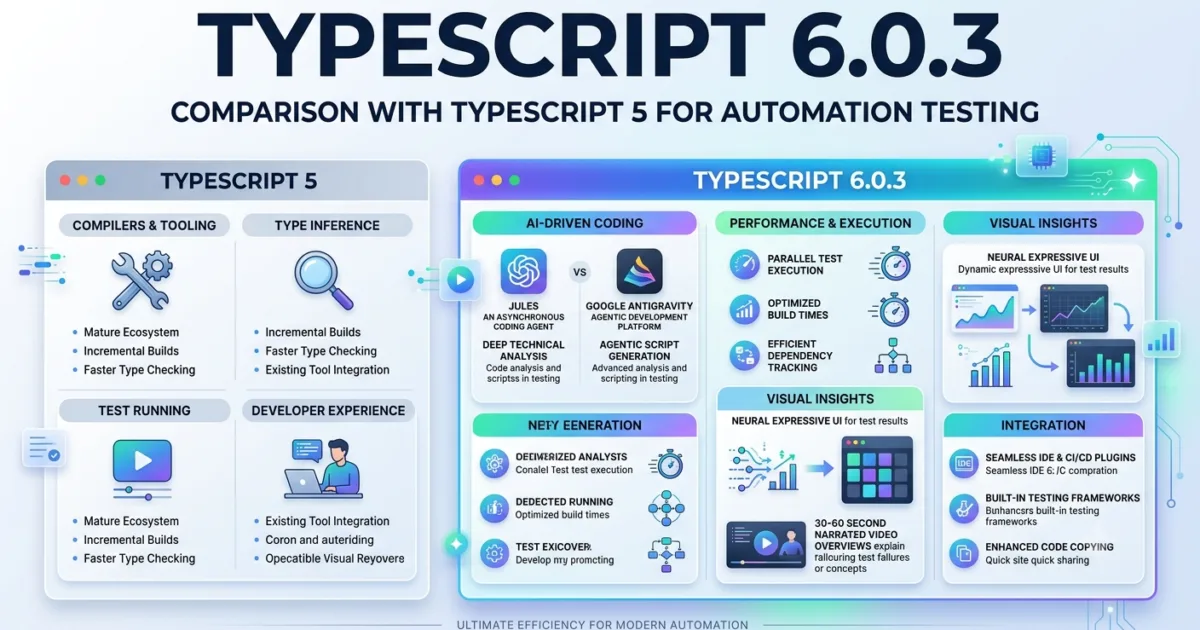
Microsoft has released TypeScript 6.0.3, the latest stable version of the popular typed JavaScript language that powers modern web development and test automation frameworks.
While TypeScript 6.0.3 is primarily a maintenance release, it represents the stabilization of the TypeScript 6.x generation that began with beta and release candidate versions.
For QA engineers, SDETs, Playwright users, Cypress teams, Selenium developers, and automation architects, understanding the transition from TypeScript 5.x to TypeScript 6.0.3 is more important than the release notes might initially suggest.
What is TypeScript
TypeScript is Microsoft’s statically typed superset of JavaScript that provides:
- Static Type Checking
- Improved IDE Support
- Better Refactoring
- Compile-Time Error Detection
- Enterprise-Scale Code Management
Today, TypeScript is widely used in:
- Playwright Automation
- Cypress Testing
- React Applications
- Node.js Services
- Agentic AI Applications
- MCP Servers
- LangChain Projects
- CrewAI Workflows
Official Website:
https://www.typescriptlang.org
Official Documentation:
https://www.typescriptlang.org/docs
Official Release Notes:
https://github.com/microsoft/TypeScript/releases/tag/v6.0.3
What’s New in TypeScript 6.0.3?
According to the release notes, Microsoft published fixes and stability improvements following:
- TypeScript 6.0.0 Beta
- TypeScript 6.0.1 RC
- TypeScript 6.0.2 Stable
- TypeScript 6.0.3 Stable
The primary goal of TypeScript 6.0.3 is platform stabilization and issue resolution.
TypeScript 6.0.3 vs TypeScript 5.x
| Feature | TypeScript 5.x | TypeScript 6.0.3 |
|---|---|---|
| Compiler Stability | Mature | Improved |
| Type Inference | Strong | Enhanced |
| Editor Experience | Excellent | Better |
| Error Reporting | Good | More Refined |
| Modern JS Support | Strong | Expanded |
| Large Project Handling | Good | Improved |
| Future Compatibility | Limited | Better Long-Term Support |
1. Better Stability for Test Automation Frameworks
One of the biggest advantages of TypeScript 6.0.3 is stability.
Automation frameworks such as:
- Playwright
- Cypress
- WebdriverIO
- Selenium with TypeScript
depend heavily on compiler reliability.
A stable compiler reduces:
- False Build Failures
- Type Resolution Errors
- CI/CD Pipeline Breakages
For enterprise automation projects, stability is often more important than flashy new features.
2. Improved Developer Experience
QA engineers spend significant time working in IDEs.
TypeScript 6.0.3 continues improving:
- IntelliSense
- Auto-completion
- Refactoring
- Error Highlighting
These improvements reduce debugging time and help engineers identify issues earlier in the development lifecycle.
3. Stronger Support for Playwright Projects
Playwright has become the dominant browser automation framework in 2026.
Most Playwright projects are written in TypeScript.
Benefits include:
- Strong Page Object Models
- Safer Refactoring
- Better Test Maintainability
- Improved Locator Validation
Teams using Playwright should benefit from the continued maturity of TypeScript 6.0.3.
4. Better Support for Agentic AI Systems
Modern AI projects increasingly use TypeScript.
Examples include:
- MCP Servers
- AI Agents
- LangChain JS
- OpenAI SDK Projects
- CrewAI Integrations
Strong typing becomes critical when AI systems exchange:
- Structured Data
- Tool Calls
- Function Schemas
- Context Objects
TypeScript helps detect integration issues before runtime.
5. Enhanced CI/CD Reliability
Continuous Integration pipelines depend heavily on predictable builds.
TypeScript 6.0.3 helps by:
- Improving Compiler Consistency
- Reducing Unexpected Build Issues
- Improving Type Validation
For QA teams running hundreds of automated tests per day, build stability directly impacts productivity.
6. Improved Maintainability for Large Test Suites
Large automation projects often contain:
- Thousands of Tests
- Hundreds of Page Objects
- Shared Libraries
- Utility Functions
TypeScript provides stronger safeguards against accidental code changes.
This becomes increasingly valuable as test suites grow.
7. Better Long-Term Future Compatibility
TypeScript 6.x represents Microsoft’s future roadmap.
Organizations staying on older versions may eventually face:
- Dependency Conflicts
- Framework Compatibility Issues
- Maintenance Challenges
Moving toward TypeScript 6.0.3 helps align projects with future ecosystem developments.
Why QA Engineers Should Care
QA engineers frequently maintain automation frameworks that remain active for years.
TypeScript improvements affect:
Test Development
✅ Better Type Safety
✅ Improved Refactoring
✅ Faster Debugging
CI/CD
✅ Stable Builds
✅ Fewer Pipeline Failures
Framework Maintenance
✅ Easier Upgrades
✅ Better Dependency Compatibility
Impact on Playwright, Cypress, and Selenium
| Framework | Impact |
|---|---|
| Playwright | High |
| Cypress | High |
| Selenium TypeScript | Medium |
| WebdriverIO | High |
| TestCafe | Medium |
Playwright and Cypress teams are likely to benefit the most because TypeScript is deeply integrated into their ecosystems.
Migration Considerations
Before upgrading:
Validate
- Build Pipelines
- Shared Libraries
- Custom Typings
- Third-Party Dependencies
Test
- CI Workflows
- IDE Integration
- Test Framework Plugins
Review
- Deprecated APIs
- Package Compatibility
- Compiler Configuration
How to Upgrade TypeScript 6.0.3
npm install typescript@latest
Verify installation:
tsc --version
Expected output:
Version 6.0.3My QA Assessment of TypeScript 6.0.3
Stability
9/10
Enterprise Readiness
9.5/10
Automation Framework Support
9/10
AI Development Support
9/10
Upgrade Risk
Low
Recommendation
Recommended for most teams after validating CI/CD pipelines and dependencies.
More Related Blogs
- Playwright vs Cypress in 2026: Which Tool Actually Wins?
- Why QA Observability Will Become Bigger Than Automation Frameworks in 2026
- AI Agents vs Agentic AI — Stop Confusing These Concepts (90% of Developers Get It Wrong)
External Resources
TypeScript Official Website: https://www.typescriptlang.org
TypeScript Documentation: https://www.typescriptlang.org/docs
TypeScript GitHub Repository: https://github.com/microsoft/TypeScript
TypeScript 6.0.3 Release Notes: https://github.com/microsoft/TypeScript/releases/tag/v6.0.3
Frequently Asked Questions
What is TypeScript 6.0.3?
TypeScript 6.0.3 is a stable maintenance release that improves reliability and addresses issues discovered during beta and release candidate phases.
Should QA engineers upgrade?
Yes, after validating dependencies and CI/CD pipelines.
Does TypeScript 6.0.3 contain breaking changes?
Most breaking changes were introduced earlier in the TypeScript 6.x lifecycle. Version 6.0.3 focuses on stabilization.
Does Playwright support TypeScript 6.0.3?
Yes. Playwright works very well with modern TypeScript versions.
Does TypeScript help test automation?
Absolutely. TypeScript improves maintainability, reliability, and developer productivity.
Final Thoughts
TypeScript 6.0.3 is not a feature-heavy release, but it represents an important stabilization milestone for the TypeScript 6.x generation. For QA engineers, SDETs, automation architects, and AI developers, the release offers improved reliability, stronger tooling, and better long-term ecosystem alignment.
Teams using Playwright, Cypress, WebdriverIO, Agentic AI frameworks, MCP Servers, and modern JavaScript applications should evaluate upgrading to TypeScript 6.0.3 as part of their regular maintenance strategy.