 QA
QA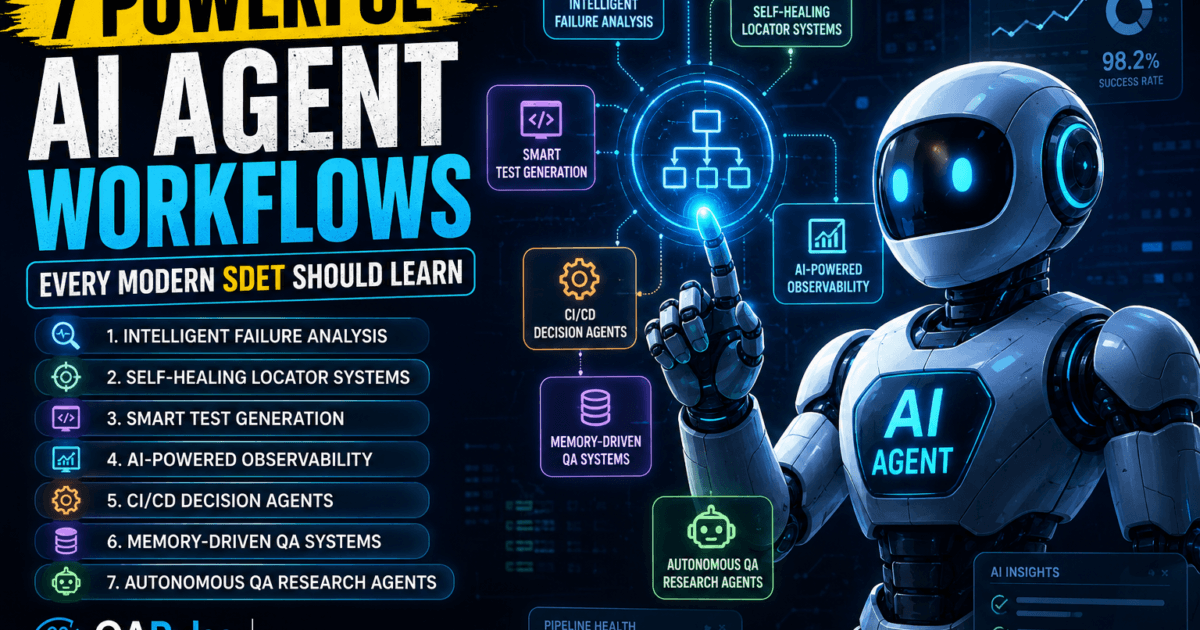
AI Agent Workflows Are Reshaping Modern QA Engineering
AI agent workflows are no longer experimental side projects.
They are rapidly becoming part of:
- test automation
- debugging systems
- CI/CD pipelines
- observability
- intelligent QA workflows
And honestly?
Most QA engineers still underestimate how massive this shift will become.
Because the future of testing is no longer just:
run tests → generate reports
The future is increasingly:
reason → analyze → adapt → optimize
That changes the entire role of modern SDETs.
Why AI Agent Workflows Matter in 2026
Modern software systems are becoming:
- distributed
- AI-assisted
- event-driven
- continuously changing
Traditional automation frameworks struggle to handle:
- flaky behavior
- dynamic UI rendering
- runtime instability
- large-scale debugging
- adaptive workflows
This is exactly where AI agent workflows become powerful.
Because agents can:
✅ analyze context
✅ retrieve information
✅ make decisions
✅ interact with tools
✅ adapt dynamically
That moves QA engineering toward:
👉 intelligent systems
Not just automation scripts.
AI Agent Workflow #1 — Intelligent Failure Analysis
This is one of the strongest AI agent workflows emerging right now.
Instead of simply reporting:
Test Failed
An AI agent can:
- analyze logs
- inspect screenshots
- cluster failures
- compare historical patterns
- identify likely root causes
Example flow:
Pipeline Failure
    ↓
AI Failure Analyzer
    ↓
Log Pattern Detection
    ↓
Root Cause Suggestion
    ↓
Slack/Jira Summary
Now debugging becomes:
✅ proactive
instead of:
❌ reactive
AI Agent Workflow #2 — Self-Healing Locator Systems
Modern frontends change constantly.
Traditional locators break easily:
await page.locator('.submit-btn').click();But intelligent agents can:
- detect UI changes
- compare semantic structure
- identify fallback selectors
- suggest resilient locators
This dramatically reduces:
- flaky failures
- maintenance overhead
- pipeline instability
Future AI agent workflows will increasingly include:
👉 adaptive locator intelligence
AI Agent Workflow #3 — Smart Test Generation
Many engineers misunderstand this workflow badly.
The real goal is NOT:
generate random tests automaticallyThe real power is:
✅ context-aware generation
✅ risk-based coverage
✅ workflow understanding
✅ production-aware scenarios
Example:
An AI agent analyzes:
- API specs
- user behavior
- production telemetry
- historical bugs
Then generates:
👉 meaningful test coverage
That’s much smarter than:
record-and-playback automationAI Agent Workflow #4 — AI-Powered Observability
Modern QA increasingly requires:
- traces
- logs
- telemetry
- runtime visibility
An intelligent agent can monitor:
- failed services
- performance anomalies
- unusual execution patterns
- infrastructure instability
Example architecture:
Telemetry Stream
    ↓
AI Monitoring Agent
    ↓
Pattern Analysis
    ↓
Risk Detection
    ↓
Engineering Alert
This transforms observability from:
data overload
Into:
engineering intelligenceAI Agent Workflow #5 — CI/CD Decision Agents
This is becoming extremely important.
Instead of blindly deploying:
AI agents can evaluate:
- test health
- risk signals
- flaky probability
- runtime stability
- production similarity
Then decide:
✅ proceed deployment
⚠️ partial rollback
🚨 block release
This creates:
👉 intelligent CI/CD pipelines
Not static automation chains.
AI Agent Workflow #6 — Memory-Driven QA Systems
Memory is becoming one of the biggest shifts in AI engineering.
Modern AI agent workflows increasingly use:
- vector databases
- contextual memory
- historical execution storage
- retrieval systems
Meaning the agent can remember:
- recurring failures
- previous fixes
- architectural patterns
- known flaky areas
Now the system evolves continuously instead of:
starting from zero every runThat’s a MASSIVE engineering advantage.
AI Agent Workflow #7 — Autonomous QA Research Agents
This area is still underrated.
AI agents can increasingly:
- analyze documentation
- compare release notes
- monitor framework updates
- identify breaking changes
- generate migration summaries
Imagine an agent automatically detecting:
Playwright API deprecation detected
Then generating:
- upgrade suggestions
- migration risks
- impacted tests
- refactoring recommendations
That’s where intelligent QA is heading.
Fast.
Why AI Agent Workflows Will Separate Future SDETs
The strongest QA engineers in coming years will increasingly understand:
- AI orchestration
- observability
- memory systems
- workflow design
- intelligent automation
- adaptive systems
Because future QA engineering is evolving toward:
AI systems engineering
Not only:
framework scriptingHuge difference.
What Most Teams Still Get Wrong
Many teams think AI means:
replace testers
But the real transformation is:
augment engineering intelligenceThat means future SDETs become:
✅ system thinkers
✅ workflow architects
✅ AI-integrated engineers
Not just:
❌ test writers
Why AI Agent Workflows Matter for Modern QA Teams
Modern AI agent workflows are transforming software testing, CI/CD, debugging, observability, and intelligent automation in 2026. By combining memory systems, adaptive reasoning, telemetry analysis, and AI-driven orchestration, modern AI agent workflows help SDETs reduce flaky tests, improve debugging efficiency, optimize deployment decisions, and build scalable intelligent QA systems. Future QA engineering increasingly depends on intelligent workflows rather than static automation frameworks alone.
External Resources (DoFollow)
Let’s Talk
👉 Which AI agent workflow will impact QA the most?
👉 Would you trust autonomous agents in production CI/CD pipelines?
Drop your thoughts below 👇
Final Line
The future SDET will not just execute tests.
They will orchestrate intelligent systems.
More Relevant Articles
- Day 4: MCP Architecture Deep Dive
- Day 3: MCP vs REST APIs vs Plugins
- Day 2: Why MCP Matters for AI Agents