 QA
QA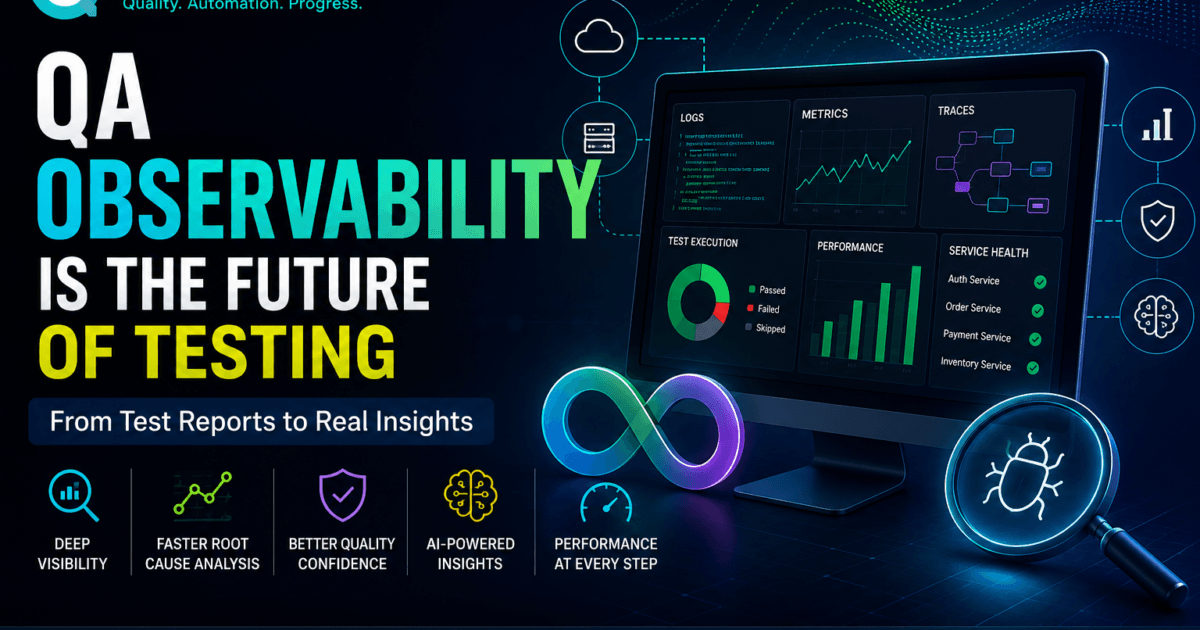
QA Observability Is Changing Everything
For years, software testing teams have relied on the same approach.
Run tests.
Generate reports.
Review failures.
Fix issues.
Repeat.
It sounds logical.
And for a long time, it worked.
But modern software systems are no longer simple.
Applications today are built using:
- Microservices
- Distributed architectures
- Cloud-native platforms
- Event-driven systems
- AI-powered services
- Third-party integrations
As systems became more complex, traditional test reporting started showing its limitations.
Many teams now face a frustrating situation:
Tests Failed
But nobody knows why.
The report shows the symptom.
It does not show the cause.
This is exactly why QA Observability is becoming one of the most important concepts in modern quality engineering.
In 2026, elite QA teams are shifting their focus away from static test reports and toward deep system observability.
The goal is no longer just to know that a test failed.
The goal is to understand:
- Why it failed
- Where it failed
- What changed
- What service caused it
- How to prevent it again
That is the promise of QA Observability.
What is QA Observability?
Quick Definition
QA Observability is the ability to understand the internal behavior of an application by analyzing logs, metrics, traces, events, and test execution data.
Traditional reporting answers:
Did the test pass or fail?
QA Observability answers:
Why did the test fail?
That difference is massive.
Traditional Reporting vs QA Observability
| Capability | Traditional Reporting | QA Observability |
|---|---|---|
| Pass/Fail Status | Yes | Yes |
| Screenshots | Yes | Yes |
| Root Cause Analysis | Limited | Strong |
| Distributed Tracing | No | Yes |
| Metrics Correlation | No | Yes |
| Performance Visibility | Limited | Excellent |
| Service Dependencies | No | Yes |
| AI Insights | No | Emerging |
Traditional reporting provides outcomes.
QA Observability provides understanding.
Why Traditional Test Reporting Is Breaking Down
Imagine your Playwright test fails.
The report shows:
Login Test Failed
That’s useful.
But not enough.
Questions immediately arise:
- Was the database slow?
- Did the authentication service fail?
- Was there a network timeout?
- Was the API returning 500 errors?
- Was a third-party provider unavailable?
Most traditional reports cannot answer these questions.
This creates lengthy debugging sessions.
Many QA engineers spend more time investigating failures than actually creating tests.
The Real Cost of Poor Visibility
One of the biggest hidden costs in software testing is investigation time.
Consider this scenario:
| Activity | Time |
|---|---|
| Test Execution | 5 Minutes |
| Failure Investigation | 2 Hours |
| Root Cause Discovery | 3 Hours |
| Total Effort | 5+ Hours |
The test itself is fast.
Finding the problem is expensive.
QA Observability reduces this investigation burden dramatically.
The Rise of Distributed Systems
Ten years ago many applications looked like this:
Browser
   ↓
Application
   ↓
Database
Simple.
Today many systems look like this:
Browser
   ↓
API Gateway
   ↓
Authentication Service
   ↓
Order Service
   ↓
Payment Service
   ↓
Notification Service
   ↓
Analytics Service
When something breaks, identifying the failing component becomes difficult.
Traditional reports struggle here.
Observability excels.
7 Powerful Reasons QA Observability Is Replacing Traditional Reporting
1. Faster Root Cause Analysis
This is the biggest benefit.
Traditional reports tell you:
Checkout Test Failed
Observability tells you:
Checkout Test Failed

Payment Service:
503 Error

Response Time:
11 Seconds

Database Connection:
Timed Out
Now engineers know exactly where to look.
Comparison
| Question | Traditional Reporting | QA Observability |
|---|---|---|
| Did it fail? | Yes | Yes |
| Why did it fail? | Limited | Yes |
| Where did it fail? | Limited | Yes |
| What service failed? | No | Yes |
2. Better Visibility Into Microservices
Modern applications rely heavily on microservices.
Failures rarely occur in isolation.
A failed checkout might be caused by:
- Authentication service
- Inventory service
- Payment service
- Recommendation service
Observability allows teams to visualize dependencies.
Example Trace
User Login
 ↓
Authentication Service
 ↓
Order Service
 ↓
Inventory Service
 ↓
Payment Service
 ↓
Success
When failures occur, traces reveal the exact breakdown point.
3. Reduced Flaky Test Investigation
Flaky tests remain one of the biggest challenges in automation.
Typical causes include:
- Slow environments
- Network instability
- Timing issues
- Infrastructure problems
Without observability:
Flaky Failure
 ↓
Guessing
 ↓
Investigation
 ↓
Re-run
With observability:
Flaky Failure
 ↓
Trace Analysis
 ↓
Root Cause Found
This significantly reduces wasted effort.
4. Better Performance Insights
Traditional reporting focuses on functionality.
Observability also focuses on performance.
Consider this Playwright test:
await page.goto('/checkout');
await page.click('#pay');
The test passes.
Everything appears healthy.
However observability reveals:
| Metric | Value |
|---|---|
| Page Load | 9 Seconds |
| API Response | 6 Seconds |
| Database Query | 4 Seconds |
The application works.
But performance is degrading.
Traditional reports would miss this warning sign.
5. Stronger CI/CD Feedback Loops
Modern engineering teams deploy continuously.
Fast feedback matters.
A CI/CD pipeline should provide:
- Functional status
- Performance insights
- Infrastructure visibility
- Service health
Observability improves all four.
Traditional Pipeline
Build
 ↓
Tests
 ↓
Pass/Fail
Observability Pipeline
Build
 ↓
Tests
 ↓
Metrics
 ↓
Traces
 ↓
Logs
 ↓
Insights
This creates much richer feedback.
6. AI-Powered Failure Analysis
One of the biggest trends in 2026 is AI-assisted testing.
AI systems work best when they have data.
Observability generates huge amounts of useful information.
Examples:
- Logs
- Metrics
- Traces
- Events
- Test history
AI can analyze these patterns to:
- Predict failures
- Identify bottlenecks
- Recommend fixes
- Detect anomalies
Traditional reports do not provide enough context for advanced AI analysis.
7. Better Business Confidence
Ultimately testing exists to build confidence.
Not reports.
Not dashboards.
Not execution counts.
Confidence.
QA Observability improves confidence because teams understand their systems more deeply.
Confidence Comparison
| Area | Traditional Reporting | QA Observability |
|---|---|---|
| Visibility | Moderate | High |
| Diagnostics | Moderate | Excellent |
| Reliability | Moderate | High |
| Risk Detection | Limited | Strong |
| Confidence | Moderate | High |
Core Pillars of QA Observability
Modern observability is typically built around three pillars.
Logs
Logs answer:
What happened?
Example:
Authentication Failed
User ID: 12345
Timestamp: 10:01 PM
Metrics
Metrics answer:
How much happened?
Examples:
- Response time
- CPU usage
- Error rate
- Throughput
Traces
Traces answer:
Where did it happen?
Distributed tracing is one of the most powerful observability capabilities.
Observability Pillars
| Pillar | Purpose |
|---|---|
| Logs | Event details |
| Metrics | Quantitative measurement |
| Traces | Request journey |
QA Observability and Playwright
Playwright already includes features that support observability.
Examples:
- Traces
- Screenshots
- Videos
- Network monitoring
Playwright Trace Example
import { defineConfig } from '@playwright/test';

export default defineConfig({
  use: {
    trace: 'on-first-retry'
  }
});
Trace Viewer provides detailed execution insights.
This is a major step toward observability-driven testing.
Tools Powering QA Observability
Several platforms are leading this movement.
| Tool | Purpose |
|---|---|
| OpenTelemetry | Telemetry collection |
| Grafana | Visualization |
| Jaeger | Distributed tracing |
| Datadog | Monitoring |
| New Relic | Performance insights |
| Elastic Stack | Log analysis |
These tools help QA teams move beyond pass/fail reporting.
How To Start Implementing QA Observability
Many teams assume observability requires massive investment.
It doesn’t.
Start small.
Step 1
Collect logs consistently.
Step 2
Track performance metrics.
Step 3
Enable tracing.
Step 4
Correlate test failures with telemetry.
Step 5
Introduce AI analysis later.
FAQ
What Is QA Observability?
QA Observability is the ability to understand application behavior through logs, metrics, traces, and testing data.
Is QA Observability Replacing Test Automation?
No.
It complements automation.
Automation finds failures.
Observability explains them.
Why Is QA Observability Important?
It reduces investigation time, improves diagnostics, and increases confidence.
Does Playwright Support Observability?
Yes.
Playwright supports traces, videos, screenshots, and network monitoring.
What Is the Biggest Benefit?
Faster root cause analysis.
Final Thoughts
The future of software testing is not simply running more tests.
The future is understanding systems more deeply.
Traditional reporting helped teams answer:
Did the test fail?
QA Observability helps teams answer:
Why did it fail?
That shift changes everything.
Organizations that embrace QA Observability will spend less time chasing failures, less time debugging pipelines, and more time improving software quality.
And that is why QA Observability is rapidly becoming one of the most valuable skills a quality engineer can develop in 2026.
More Relevant Articles
- Why QA Observability Will Become Bigger Than Automation Frameworks in 2026
- What is Playwright? Powerful Beginner Guide for QA Engineers in 2026
- The Hidden Architecture Behind Scalable QA Platforms in 2026
- Why AI Agents Will Replace Fragile Test Frameworks Before They Replace QA Engineers
- AI Testing vs Traditional Automation in 2026: What Smart QA Teams Are Quietly Changing
External Resources
QAPulse by SK – For more QA, AI Testing, Test Automation, and Playwright content, visit www.skakarh.com.