 QA
QA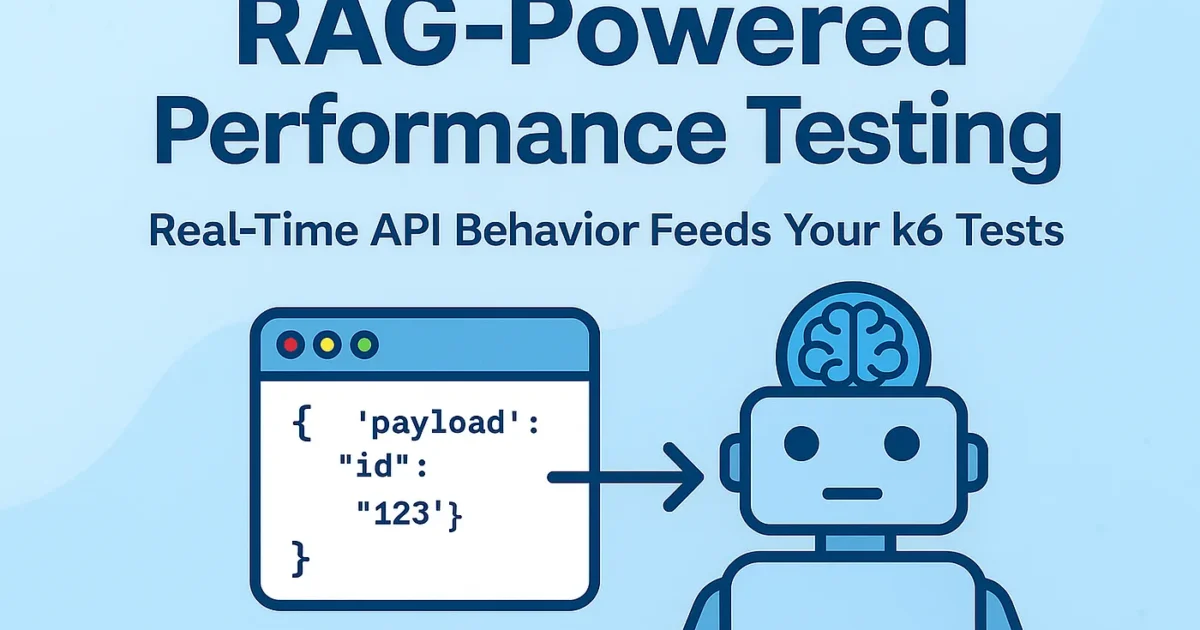
The future of load testing isn’t synthetic — it’s intelligent, adaptive, and production-aware.
Let’s be honest…
Most performance tests today are guesses.
We assume traffic patterns.
We approximate peak load.
We pick random stages like:
stages: [
  { duration: "1m", target: 50 },
  { duration: "2m", target: 300 }
]
even though real-world traffic never behaves that cleanly.
By the time this “theoretical” test reaches CI, production has already changed.
But 2026 is different.
We’re entering the era of RAG-powered performance testing — where your k6 scripts learn from real API behavior, store it in a vector database, and dynamically generate load patterns that actually match how users behave.
This is how we get real performance validation. Not simulations.
Not guesses.
Reality → encoded into your tests.
Let’s break the future down. 🔍
What Is RAG-Powered Performance Testing?
RAG (Retrieval-Augmented Generation) + k6 = a load testing engine that knows your system.
How it works (simple flow):
- Collect real API responses
Logs, failures, payloads, usage frequency, timestamp-based request density, device types, paths hit, user journeys — everything. - Store them in a Vector DB
Like Pinecone, Qdrant, Weaviate, or even Chroma. - LLM retrieves & understands patterns
✔ Peak times
✔ Payload sizes
✔ Error bursts
✔ Slow endpoints
✔ Multi-step user flows
✔ Real concurrency pressure - LLM generates k6 load stages
Based on actual historical behavior, not developer imagination. - Performance tests evolve daily, automatically.
This is what adaptive testing looks like.
What Traditional Load Testing Gets Wrong
Most k6 scripts suffer from:
Static scenarios
Same load stages every run → not reflective of shifting traffic.
Missing diversity
Real users behave differently during:
- sales spikes
- failed payment retries
- auth sessions expiring
- background cron jobs triggering
- mobile app batching requests
Synthetic test scripts don’t capture this.
No memory
Tests don’t learn from real performance issues.
Hardcoded assumptions
User journeys change → script becomes outdated.
And all of this leads to…
📉 False confidence in system stability.
The New Method: RAG + Vector DB → Intelligent k6
With RAG, your performance testing stack becomes self-improving.
Step 1: Store everything
Your system generates gold — API data:
- request payloads
- response times
- error clusters
- throughput spikes
- device distribution
- regional differences
- daily/hourly patterns
This becomes your performance “knowledge base.”
Step 2: Ask the LLM
Example prompt to your testing agent:
“Generate k6 load stages that reflect last week’s checkout-service traffic.”
The LLM fetches relevant vectors and responds with context-aware logic like:
export const options = {
  stages: [
    { duration: "2m", target: 120 },   // Morning peak
    { duration: "1m", target: 80 },    // Mid-day drop
    { duration: "3m", target: 420 },   // Evening surge
    { duration: "2m", target: 600 },   // Sale traffic spike
  ],
  thresholds: {
    http_req_duration: ["p(95)<420"],
  },
};
Generated from:
- real-world usage
- real failures
- real payload sizes
- real concurrency
Not imagination.
Step 3: k6 Runs Like Production
The test now:
- simulates realistic burstiness
- hits the same hotspots users hit
- repeats the same problematic user flows
- replays actual request patterns
- applies real inter-request timing
This is what developers always wanted but could never generate manually.
The Secret Benefit: Self-Healing Load Tests
RAG-powered load testing means your system can:
✔ Detect unusual traffic
✔ Update test scenarios
✔ Strengthen weak endpoints
✔ Evolve with your API
✔ Avoid stale scripts
Imagine an AI telling you:
“Yesterday, the
/checkout/payendpoint had a 9% spike in timeout errors. I increased the load stage for this endpoint to validate the fix.”
This is the future of SRE.
🧬 Example Real-World Workflow
1️⃣ Ingestion pipeline
FastAPI → Kafka → Vector DB
Every API call (sampled intelligently) gets embedded.
2️⃣ Daily test generation
At 2 AM:
- LLM queries past 30 days
- Builds new stages for k6
- Injects real traffic signatures
3️⃣ Test execution
Github Actions or k6 cloud runs with evolving scenarios.
4️⃣ AI analysis
LLM reads the results:
Latency spikes, error clusters, stage failures → converts into an actionable SRE-style report.
🌍 Why Companies Will Switch to This in 2026
Companies want:
- realistic load models
- faster detection of regressions
- test suites that adapt
- aligned performance scenarios
- AI-driven reliability engineering
RAG + k6 delivers exactly that.
2026 belongs to intelligent performance engineering, not static load scripts.
🏁 Final Thoughts: Welcome to Adaptive Performance Testing
This approach gives you:
🔥 Realistic load patterns
🔥 Auto-updating scenarios
🔥 AI-driven debugging
🔥 Continuous performance alignment
🔥 A test suite that evolves like production
🔥 The first truly intelligent load tester
Say goodbye to synthetic, guess-based performance testing.
Say hello to RAG-powered, production-aware, self-evolving k6 load tests.
More Relevant Articles
- How Vector DB Latency Impacts AI-Driven Test Optimization in the Agentic QA Stack
- Cypress Component Testing Is the Future — Why You Should Learn It Now
- Level Up Your Claude Code with CLAUDE.md