QA
QA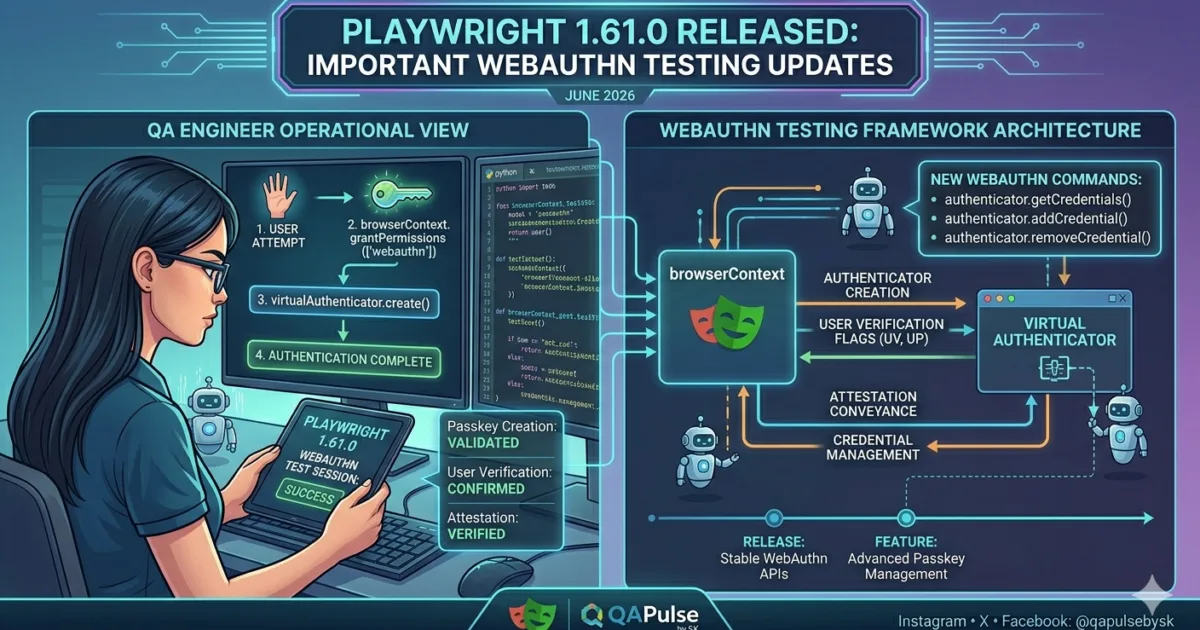
The Playwright team has officially released Playwright 1.61.0, introducing one of the most significant authentication testing improvements we’ve seen in recent releases.
The headline feature is native WebAuthn Passkey Testing, allowing QA engineers to automate passkey authentication flows without requiring physical security keys or hardware authenticators.
Combined with the new Web Storage API, Playwright 1.61.0 continues strengthening its position as one of the most advanced browser automation frameworks available in 2026.
For QA Engineers, SDETs, Automation Architects, and Security Testing teams, this release is particularly important.
What is Playwright 1.61.0?
Playwright is Microsoft’s modern browser automation framework supporting:
- Chromium
- Firefox
- WebKit
It is widely used for:
- End-to-End Testing
- UI Automation
- API Testing
- Accessibility Testing
- Performance Validation
- Cross-Browser Testing
Official Release Notes:
https://github.com/microsoft/playwright/releases/tag/v1.61.0
Official Documentation:
Official GitHub Repository:
https://github.com/microsoft/playwright
Why Playwright 1.61.0 Matters for QA Engineers
Authentication is one of the hardest areas to automate.
Historically, testing:
- MFA
- Security keys
- FIDO2
- Passkeys
- WebAuthn flows
required:
- Manual intervention
- Mock implementations
- Test environment workarounds
- Browser-specific hacks
Playwright 1.61.0 dramatically simplifies this challenge.
Playwright 1.61.0 WebAuthn Passkey Testing
The biggest feature in this release is:
Native WebAuthn Passkey Testing Support
Playwright introduces a new:
browserContext.credentials
API that provides a virtual authenticator.
This allows tests to:
- Register passkeys
- Store credentials
- Authenticate users
- Simulate hardware security keys
without requiring physical devices.
Why this is a Major Breakthrough
Many modern platforms now support:
- Passkeys
- Passwordless Authentication
- FIDO2 Authentication
- WebAuthn Login
Examples include:
- GitHub
- Microsoft
- Amazon
- Enterprise SSO Platforms
Before Playwright 1.61.0, automated testing of these workflows was difficult and often unreliable.
Now teams can fully automate authentication scenarios.
QA Testing Scenarios Enabled
Passkey Registration Testing
Validate:
- Account creation
- Credential registration
- Device enrollment
Passkey Login Testing
Verify:
- User authentication
- Session creation
- Login success flows
Security Testing
Test:
- Invalid credentials
- Expired credentials
- Revoked credentials
- Authentication failures
Regression Testing
Include passkey workflows in CI/CD pipelines.
This is a huge win for enterprise automation teams.
Example Playwright 1.61.0 Passkey Test
const context = await browser.newContext();

await context.credentials.create('example.com', {
  id: credentialId,
  userHandle,
  privateKey,
  publicKey,
});

await context.credentials.install();

const page = await context.newPage();
await page.goto('https://example.com/login');
This removes the need for physical authentication devices during automated testing.
New Web Storage API
Another important addition is:
Web Storage API Support
Playwright now exposes:
page.localStorage
page.sessionStorage
making storage interaction significantly easier.
Why This Matters
Many web applications store:
- JWT Tokens
- Session Data
- User Preferences
- Feature Flags
- Application State
inside browser storage.
Previously, teams often used:
page.evaluate()
workarounds to access storage values.
Now Playwright provides cleaner APIs.
QA Benefits of Web Storage APIs
Easier State Validation
Verify:
- Authentication tokens
- Session values
- Feature toggles
Faster Test Setup
Seed storage directly.
Improved Debugging
Inspect browser state without custom scripts.
Cleaner Test Code
Reduce reliance on JavaScript injection.
What This Means for Security Testing
Playwright 1.61.0 becomes even more attractive for:
- Authentication testing
- Authorization testing
- Session management testing
- Identity platform validation
Organizations adopting passwordless authentication should strongly evaluate this release.
Impact on SDETs
| Area | Impact |
|---|---|
| Authentication Testing | Very High |
| Security Testing | Very High |
| Browser Automation | High |
| Session Validation | High |
| Web Storage Testing | High |
| Existing Test Suites | Low |
Impact on Enterprise Teams
Large organizations implementing:
- Azure AD
- Okta
- Auth0
- Ping Identity
- Google Identity
can now automate more authentication workflows than ever before.
This significantly reduces manual testing effort.
Impact on Playwright Frameworks
Teams maintaining internal frameworks should consider adding:
- Passkey helpers
- Authentication utilities
- Credential management wrappers
to support the new capabilities.
Playwright Boilerplate Users
If you’re using our Playwright Boilerplate:
https://github.com/QAPulse-by-SK/playwright-boilerplate
you already have support for:
- HAR Recording
- Tracing
- Reporting
- Scalable Framework Design
Playwright 1.61.0’s new authentication capabilities can be integrated into existing framework architecture with minimal effort.
Migration Guide
Upgrade Playwright
npm install @playwright/test@latest
or
pip install --upgrade playwright
Update Browsers
npx playwright install
Verify Installation
npx playwright --version
Testing Checklist After Upgrading
Authentication Testing
✅ Passkey registration
✅ Passkey login
✅ Credential lifecycle
Storage Testing
✅ localStorage validation
✅ sessionStorage validation
✅ Token persistence
Browser Testing
✅ Chromium
✅ Firefox
✅ WebKit
Regression Testing
✅ Existing suites
✅ Authentication workflows
✅ CI/CD execution
Playwright 1.61.0 vs Playwright 1.60.0
| Feature | Playwright 1.60.0 | Playwright 1.61.0 |
|---|---|---|
| HAR Recording API | ✅ | ✅ |
| locator.drop() | ✅ | ✅ |
| ARIA Snapshots | ✅ | ✅ |
| Passkey Testing | ❌ | ✅ |
| Virtual Authenticator | ❌ | ✅ |
| Web Storage API | ❌ | ✅ |
| Passwordless Testing | Limited | Full Support |
My QA Assessment of Playwright 1.61.0
Biggest Win
WebAuthn Passkey Testing.
Most Valuable Enterprise Feature
Virtual Authenticator Support.
Most Useful Developer Feature
Web Storage APIs.
Upgrade Risk
Very Low.
Enterprise Recommendation
Upgrade immediately if your organization uses passkeys or passwordless authentication.
Overall Rating
9.4/10
This is one of the most impactful Playwright releases of 2026 for authentication automation.
Relevant Articles
- What is Playwright and Why Everyone is Talking About It
- The Hidden Architecture Behind Scalable QA Platforms in 2026
- AI-Powered Test Automation Framework: Powerful Complete Guide for 2026
- AI Agent Testing: 12 Critical Strategies Every QA Engineer Must Master in 2026
External Resources
Playwright Release Notes: https://github.com/microsoft/playwright/releases/tag/v1.61.0
Playwright Documentation: https://playwright.dev
WebAuthn Standard: https://webauthn.guide
Passkeys Explained: https://developers.google.com/identity/passkeys
Frequently Asked Questions
What is Playwright 1.61.0?
Playwright 1.61.0 introduces WebAuthn passkey testing, virtual authenticators, and browser storage APIs.
What is the biggest feature?
Native passkey automation support.
Can Playwright test passkeys now?
Yes. Playwright can simulate WebAuthn passkey registration and authentication without physical hardware.
Is Playwright 1.61.0 backward compatible?
Yes, for most projects there are no significant migration concerns.
Should teams upgrade immediately?
If your organization uses modern authentication systems, upgrading is highly recommended.
Does this help CI/CD pipelines?
Absolutely. Passkey workflows can now be fully automated in pipelines.
What should QA teams validate first?
Authentication workflows, browser storage operations, and cross-browser compatibility.
Final Thoughts
Playwright 1.61.0 is a major step forward for authentication testing. Native support for WebAuthn passkeys and virtual authenticators removes one of the biggest automation challenges facing QA teams today.
Combined with the new Web Storage APIs, this release improves both test reliability and developer productivity.
For organizations building secure, passwordless applications, Playwright 1.61.0 should be considered a high-priority upgrade.