 QA
QA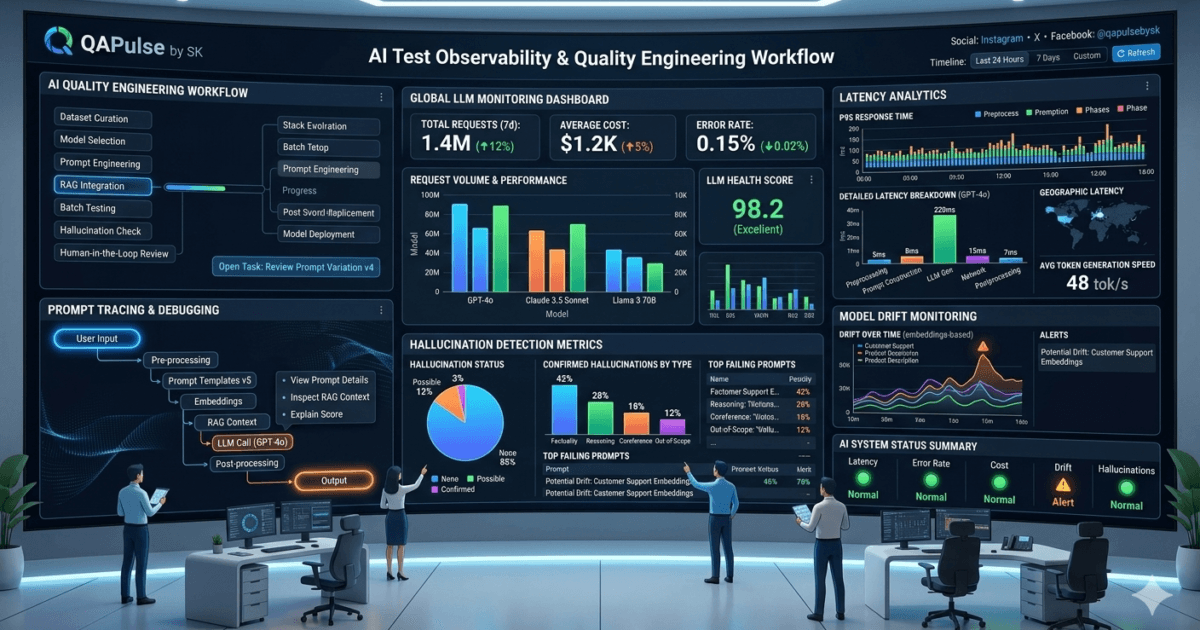
Why AI Test Observability is Becoming a Core QA Skill
Traditional software testing answers a simple question:
Does the system work?
Modern AI systems introduce a more difficult challenge:
Why did the system behave that way?
This is where AI Test Observability becomes essential.
Many organizations successfully deploy AI applications.
Far fewer can explain:
- Why outputs changed
- Why costs suddenly increased
- Why latency doubled
- Why hallucinations appeared
- Why quality declined after deployment
Traditional logging cannot answer these questions.
Observability can.
In 2026, AI Test Observability is rapidly becoming one of the most valuable skills for QA engineers, SDETs, AI testers, and quality architects.
What is AI Test Observability?
Definition
AI Test Observability is the practice of monitoring, tracing, measuring, and understanding AI system behavior across development, testing, and production environments.
Unlike traditional monitoring, AI observability focuses on:
- Prompt execution
- Context retrieval
- Model behavior
- Tool interactions
- Agent decisions
- Token consumption
- Response quality
Quick Comparison
| Area | Traditional Testing | AI Test Observability |
|---|---|---|
| API Calls | Yes | Yes |
| Logs | Yes | Yes |
| Traces | Limited | Critical |
| Model Decisions | No | Yes |
| Prompt Tracking | No | Yes |
| Hallucination Analysis | No | Yes |
| Token Usage | No | Yes |
Why Traditional Logs Are No Longer Enough
Most QA teams are familiar with application logs.
Example:
API Request Received
Response Returned
Status 200
Useful.
But what happens when an AI assistant generates an incorrect answer?
Traditional logs typically cannot explain:
- Which prompt was used
- Which documents were retrieved
- Which model generated the answer
- Which tool failed
- Why latency increased
AI systems require much deeper visibility.
The Shift from Logs to Traces
One of the biggest changes in AI quality engineering is moving from logs to traces.
Traditional View
Request
 ↓
Response
AI Observability View
User Prompt
      ↓
Prompt Template
      ↓
RAG Retrieval
      ↓
LLM
      ↓
Tool Calls
      ↓
Response
Every step becomes visible.
This is the foundation of AI Test Observability.
Why QA Teams Need AI Test Observability
Modern AI systems are significantly more complex than traditional applications.
AI Workflow Example
User Question
      ↓
Retriever
      ↓
Vector Database
      ↓
Prompt Builder
      ↓
LLM
      ↓
Agent Tool
      ↓
Response
Failures can occur at any step.
Without observability, troubleshooting becomes guesswork.
The 11 Critical AI Test Observability Metrics
1. Latency
Latency measures how long an AI system takes to generate a response.
Why It Matters
Users expect fast answers.
Even accurate responses become frustrating when they are slow.
Latency Targets
| Experience | Response Time |
|---|---|
| Excellent | Under 2 Seconds |
| Good | 2–5 Seconds |
| Moderate | 5–10 Seconds |
| Poor | Over 10 Seconds |
2. Token Consumption
Every AI interaction consumes tokens.
Example
Prompt:
Explain Playwright automation.
Response:
Playwright is a browser automation framework...
Both prompt and response consume tokens.
Why QA Should Monitor Tokens
| Risk | Impact |
|---|---|
| Increased Cost | High |
| Longer Latency | High |
| Context Overflow | High |
| Reduced Efficiency | Medium |
3. Prompt Version Tracking
One hidden challenge in AI systems is prompt evolution.
Example
Prompt Version 1:
Answer briefly.
Prompt Version 2:
Answer with detailed examples.
Output quality may change dramatically.
Without observability, teams cannot identify the cause.
4. Retrieval Precision
For RAG systems, retrieval quality is critical.
Question
Did the system retrieve useful information?
Retrieval Precision Formula
\text{Precision} = \frac{\text{Relevant Retrieved Documents}}{\text{Total Retrieved Documents}}
Higher precision usually improves answer quality.
5. Retrieval Recall
Retrieval precision alone is not enough.
You also need recall.
Retrieval Recall Formula
\text{Recall} = \frac{\text{Relevant Retrieved Documents}}{\text{Total Relevant Documents}}
Low recall often causes hallucinations.
6. Hallucination Rate
Hallucinations remain one of the largest AI risks.
Example
Question:
What is our annual leave policy?
Context:
20 Days
Response:
25 Days
This is a hallucination.
Hallucination Monitoring Table
| Answer Type | Classification |
|---|---|
| Source Supported | Valid |
| Unsupported Claim | Hallucination |
| Invented Fact | Hallucination |
7. Faithfulness Score
Faithfulness measures whether answers are grounded in retrieved context.
Why It Matters
Many AI systems appear correct while actually inventing information.
Faithfulness helps identify this problem.
Faithfulness Examples
| Response | Faithful |
|---|---|
| Matches Source | ✅ |
| Adds New Facts | ❌ |
| Invents Data | ❌ |
8. Agent Success Rate
AI agents perform multi-step tasks.
Observability helps measure success.
Agent Metrics
| Metric | Purpose |
|---|---|
| Goal Completion Rate | Success |
| Recovery Rate | Resilience |
| Failure Rate | Reliability |
| Tool Success Rate | Accuracy |
9. Tool Invocation Accuracy
Many AI agents call:
- APIs
- Databases
- Search engines
- Internal tools
Observability helps verify those interactions.
Example
User Request
      ↓
Agent
      ↓
Weather API
      ↓
Response
Failures become visible through tracing.
10. Cost Per Request
Enterprise AI systems often process millions of requests.
Small inefficiencies become expensive.
Example Cost Monitoring
| Month | Requests | Cost |
|---|---|---|
| January | 100K | $1,200 |
| February | 100K | $1,800 |
| March | 100K | $2,400 |
Observability helps identify cost drift.
11. Model Drift Detection
AI quality changes over time.
Example
| Month | Quality Score |
|---|---|
| January | 92% |
| February | 91% |
| March | 87% |
| April | 83% |
Without observability, drift often goes unnoticed.
AI Test Observability Architecture
Modern observability pipelines often look like this:
User Prompt
      ↓
Tracing Layer
      ↓
LLM
      ↓
Evaluation Layer
      ↓
Metrics Storage
      ↓
Dashboard
Every interaction becomes measurable.
Best Tools for AI Test Observability
Tool Comparison
| Tool | Primary Purpose |
|---|---|
| LangSmith | Tracing |
| Arize AI | Monitoring |
| OpenTelemetry | Telemetry |
| Braintrust | Evaluation |
| Weights & Biases | Experiment Tracking |
LangSmith for AI Test Observability
LangSmith has become one of the most popular observability platforms.
Key Features
| Capability | Supported |
|---|---|
| Tracing | ✅ |
| Prompt Tracking | ✅ |
| Evaluation | ✅ |
| Debugging | ✅ |
| Agent Monitoring | ✅ |
OpenTelemetry and AI Systems
OpenTelemetry is increasingly being adopted for AI monitoring.
Benefits
- Vendor neutral
- Open source
- Enterprise ready
- Cloud friendly
Many organizations integrate OpenTelemetry into AI platforms for end-to-end visibility.
Common Observability Mistakes
Mistake #1
Only monitoring latency.
Mistake #2
Ignoring prompt versions.
Mistake #3
Not tracking hallucinations.
Mistake #4
No production monitoring.
Mistake #5
No retrieval metrics.
How QA Engineers Can Start Learning AI Test Observability
Start small.
Step 1
Track prompts.
Step 2
Track responses.
Step 3
Track token usage.
Step 4
Track latency.
Step 5
Add evaluation metrics.
Step 6
Introduce tracing tools.
Step 7
Build dashboards.
AI Test Observability vs Traditional Monitoring
| Capability | Monitoring | Observability |
|---|---|---|
| Metrics | Yes | Yes |
| Logs | Yes | Yes |
| Traces | Limited | Extensive |
| Root Cause Analysis | Limited | Strong |
| AI Workflow Visibility | Limited | Strong |
Future of AI Test Observability
Over the next few years, QA engineers will increasingly move beyond:
- UI testing
- API testing
- Regression testing
Into:
- AI evaluation
- AI monitoring
- Agent validation
- Observability engineering
Organizations deploying AI at scale will require these skills.
FAQ
What is AI Test Observability?
AI Test Observability is the practice of monitoring, tracing, measuring, and understanding AI system behavior across development and production environments.
Why is AI Test Observability Important?
It helps identify hallucinations, latency issues, cost increases, retrieval failures, and model drift.
Which Tool Is Best for AI Test Observability?
LangSmith is currently one of the most popular choices for tracing and debugging AI systems.
Is AI Test Observability Different from Monitoring?
Yes. Observability provides deeper visibility into system behavior and root causes.
Can Traditional QA Engineers Learn AI Test Observability?
Absolutely. Many concepts build on existing testing and monitoring experience.
Final Thoughts
Building an AI application is only the first step.
Understanding how that AI behaves in production is where real quality engineering begins.
This is why AI Test Observability is rapidly becoming one of the most important disciplines in modern QA.
Organizations that invest in observability gain:
✅ Better quality
✅ Faster debugging
✅ Lower costs
✅ Improved reliability
✅ Safer AI systems
As GenAI adoption accelerates, observability will become as essential to AI teams as Selenium and Playwright became to traditional automation teams.
Related Reading
More Related Blogs
- AI Testing vs Traditional Automation in 2026: What Smart QA Teams Are Quietly Changing
- Selenium vs Playwright in 2026: The Brutal Truth Most QA Teams Ignore
- 7 Brutal AI QA Failures Destroying Modern Testing Teams in 2026
- What is Playwright? Powerful Beginner Guide for QA Engineers in 2026
- Playwright vs Selenium Grid for Enterprise-Scale Testing in 2026