 QA
QA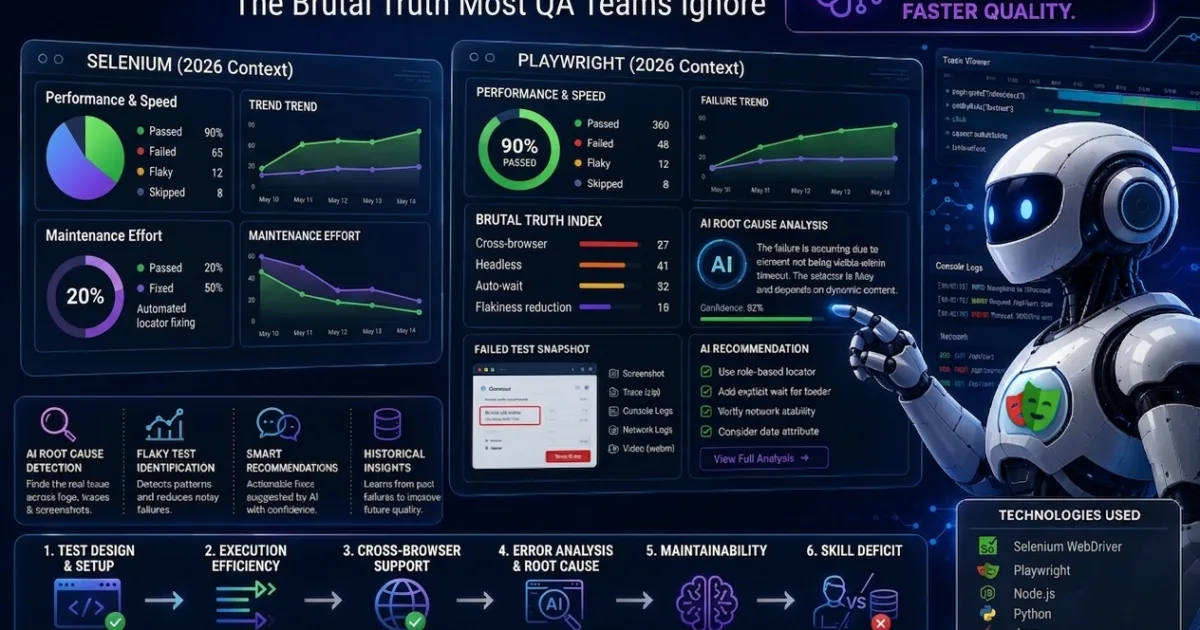
Selenium vs Playwright Is No Longer Just a Framework Debate
The modern Selenium vs Playwright discussion is not really about:
- syntax
- selectors
- assertions
- browser clicks
That was the old conversation.
In 2026, the debate became much deeper.
Engineering teams now evaluate automation frameworks based on:
- scalability
- debugging visibility
- observability
- AI readiness
- distributed execution
- orchestration support
- infrastructure compatibility
- maintenance overhead
This changes everything.
Because choosing between Selenium and Playwright increasingly becomes:
an engineering systems decision
not simply:
a testing framework decisionAnd honestly?
A lot of engineers online oversimplify this debate badly.
Some engineers aggressively claim:
“Playwright killed Selenium.”
Others still believe:
“Selenium is the enterprise king forever.”
Reality is far more nuanced.
Why Selenium Still Dominates Massive Enterprise Ecosystems
People often underestimate how deeply embedded Selenium still is inside enterprise infrastructure.
Large organizations continue relying on Selenium because:
- ecosystems are mature
- integrations are battle-tested
- language support is massive
- enterprise tooling already exists
- internal frameworks were built over years
Many enterprise automation ecosystems contain:
- thousands of tests
- custom Selenium utilities
- distributed Selenium Grids
- CI/CD integrations
- cloud execution layers
- telemetry systems
Replacing all of that overnight is unrealistic.
This is one reason Selenium continues surviving wave after wave of:
- modern frameworks
- AI tooling
- frontend trends
- browser automation hype
Because enterprise engineering moves differently from:
social media trend cyclesWhy Playwright Is Growing So Aggressively
Playwright grew rapidly because it solved many frustrations engineers faced for years.
Especially:
- flaky synchronization
- browser inconsistencies
- parallel execution complexity
- debugging pain
- WebDriver limitations
Playwright introduced:
- auto waiting
- browser contexts
- trace viewer
- modern APIs
- better parallelization
- stronger browser control
For many engineers:
it felt like a completely modern automation experience.
Playwright also aligned extremely well with:
- modern frontend ecosystems
- cloud-native pipelines
- AI-native tooling
- distributed engineering systems
That timing mattered enormously.
Selenium vs Playwright Architecture Comparison
This is where the biggest long-term differences appear.
🟢 Selenium Architecture
Selenium relies heavily on:
- WebDriver protocol
- browser-driver communication
- external browser control
This architecture became an industry standard for years.
It provides:
- broad browser support
- language flexibility
- enterprise interoperability
However, Selenium architecture also introduces:
- additional communication layers
- synchronization complexity
- driver management overhead
At massive scale:
these challenges become more noticeable.
🔵 Playwright Architecture
Playwright uses:
- direct browser communication
- event-driven execution
- browser contexts
- modern automation APIs
This allows:
- faster execution
- improved isolation
- stronger synchronization
- smoother parallelization
Playwright feels more aligned with:
modern distributed engineering systems
especially in:
- cloud CI/CD
- AI workflows
- observability-first ecosystems
Selenium vs Playwright for Modern AI-Native Engineering
This category barely existed a few years ago.
Now it matters massively.
Modern engineering increasingly involves:
- AI agents
- adaptive workflows
- intelligent debugging
- semantic validation
- orchestration systems
- autonomous execution
Why Playwright Fits AI Systems Better
Playwright increasingly becomes popular for AI-native workflows because it provides:
- strong browser visibility
- robust APIs
- traceability
- modern runtime control
- deterministic automation behavior
Many modern AI agent systems now use Playwright as:
the browser orchestration layer
for autonomous workflows.
Playwright’s architecture works extremely well with:
- telemetry pipelines
- agentic workflows
- observability systems
- distributed execution
Selenium Challenges for AI Workflows
Selenium can absolutely integrate into AI systems.
But older Selenium ecosystems often struggle because:
- frameworks were designed years ago
- observability was weak
- telemetry pipelines were limited
- debugging visibility was minimal
The problem is usually:
👉 ecosystem maturity
not:
👉 Selenium capability itself
Selenium vs Playwright Debugging Experience
This is one of the biggest practical differences engineers feel immediately.
🟢 Playwright Debugging Strengths
Playwright provides:
- trace viewer
- screenshots
- videos
- network logs
- DOM snapshots
- timeline visibility
The trace viewer alone dramatically changed debugging workflows.
Engineers can replay failures visually while inspecting:
- DOM state
- network activity
- execution timing
- browser behavior
That significantly reduces debugging friction.
🟠 Selenium Debugging Reality
Traditional Selenium ecosystems often relied on:
- screenshots
- console logs
- stack traces
- external logging systems
This made debugging:
far more fragmented
especially in distributed CI systems.
Modern Selenium ecosystems increasingly improve observability.
But Playwright still feels significantly stronger out-of-the-box for debugging visibility.
Selenium vs Playwright Browser Support
This area is more nuanced than many engineers realize.
🟢 Selenium Browser Support
Selenium historically became dominant partly because of:
excellent cross-browser compatibility
It supports:
- Chrome
- Firefox
- Safari
- Edge
- legacy enterprise browsers
Enterprise organizations still value this heavily.
🔵 Playwright Browser Support
Playwright supports:
- Chromium
- Firefox
- WebKit
with extremely strong consistency.
Its WebKit support became a major advantage because many teams struggled testing Safari reliably before Playwright.
For many modern teams:
Playwright browser handling feels:
- smoother
- more deterministic
- easier to scale
Selenium vs Playwright Performance at Scale
Performance conversations online often become oversimplified.
The real answer depends heavily on:
- architecture
- CI/CD design
- infrastructure quality
- execution strategy
Why Playwright Often Feels Faster
Playwright benefits from:
- direct browser communication
- isolated browser contexts
- optimized parallel execution
This creates extremely strong performance for:
- large regression suites
- distributed CI/CD
- cloud-native automation
Selenium Scaling Complexity
Selenium scaling often requires:
- Selenium Grid
- distributed infrastructure
- driver orchestration
- environment management
- synchronization handling
Poorly designed Selenium systems frequently become:
operationally heavy
at scale.
But well-engineered Selenium ecosystems can still scale extremely effectively.
That distinction matters.
Why Observability Matters More Than Framework Popularity
This is one of the biggest shifts happening quietly across QA engineering.
Many teams still obsess over:
- Selenium vs Playwright
- Playwright vs Cypress
- tool popularity battles
But modern high-performing teams increasingly focus on:
automation observability
instead.
Because eventually:
every framework becomes difficult without visibility.
Modern scalable automation increasingly requires:
- distributed traces
- telemetry pipelines
- structured logging
- runtime diagnostics
- execution analytics
Without observability:
even the best frameworks become difficult to maintain.
This is why modern QA increasingly moves toward:
👉 observability-first automation systems
Selenium vs Playwright for CI/CD Systems
Modern CI/CD ecosystems increasingly prioritize:
- fast feedback
- parallel execution
- debugging visibility
- deterministic execution
- scalable orchestration
🔵 Playwright CI/CD Strengths
Playwright aligns naturally with:
- containerized execution
- cloud pipelines
- GitHub Actions
- modern DevOps workflows
- distributed execution systems
Its architecture feels very optimized for:
cloud-native engineering🟠 Selenium CI/CD Strengths
Selenium still performs extremely well when organizations already invested heavily in:
- Selenium Grid
- enterprise orchestration
- large-scale legacy ecosystems
Many enterprises still execute:
- millions of Selenium tests monthly
successfully.
The real question is not:
“Can Selenium scale?”
The question is:
“How modern is the engineering system around Selenium?”Why Many Selenium Migrations Fail
This is something many engineers never discuss honestly.
A huge number of teams migrate from Selenium to Playwright expecting:
- instant stability
- zero flakiness
- magical scaling improvements
Then later discover:
- pipelines still fail
- environments remain unstable
- debugging still hurts
- flaky systems still exist
Because the deeper issue was never only:
👉 Selenium
The deeper issue was:
- architecture quality
- environment stability
- engineering discipline
- observability maturity
Switching frameworks without fixing those areas often reproduces:
the same engineering problems
with newer syntax.
What Smart QA Teams Actually Do Differently
Strong engineering teams increasingly avoid framework tribalism completely.
Instead they focus on:
- scalable architecture
- observability
- telemetry
- intelligent retries
- distributed execution
- debugging efficiency
The strongest teams treat automation as:
an engineering platform
not:
a collection of test scripts
That mindset changes everything.
High-performing QA organizations increasingly invest in:
- execution analytics
- flaky detection
- AI-assisted debugging
- adaptive automation systems
- intelligent orchestration pipelines
Because modern QA complexity increasingly depends on:
👉 systems engineering
not simply:
👉 test writing
Should New QA Engineers Learn Selenium or Playwright?
Honestly?
Both.
Why Selenium Still Matters
Selenium still teaches:
- browser automation fundamentals
- synchronization concepts
- distributed execution
- automation architecture
- CI/CD scaling
These concepts remain valuable across every major automation ecosystem.
🔵 Why Playwright Is Important for the Future
Playwright increasingly represents:
- modern automation design
- observability-first tooling
- AI-native engineering compatibility
- cloud-native execution philosophy
It aligns extremely well with:
- future QA engineering
- intelligent workflows
- adaptive automation systems
The strongest engineers increasingly understand:
👉 both ecosystems
instead of blindly following:
👉 framework hype cycles
Selenium vs Playwright Is Really About Engineering Philosophy
The modern Selenium vs Playwright debate is no longer simply about browser automation APIs or framework syntax. In 2026, engineering teams increasingly evaluate automation ecosystems based on scalability, observability, debugging intelligence, AI readiness, distributed execution, and operational maintainability. Selenium continues dominating many enterprise ecosystems because of maturity, interoperability, and massive infrastructure investment, while Playwright increasingly becomes the preferred choice for modern cloud-native, AI-native, and observability-first automation systems.
More Related Blogs
- Load Testing Microservices with AI Personas: k6 + LLM-Generated User Journeys
- How I Built a Postman Bot That Detects Breaking API Changes Before Deployment (Using LLM)
- From Pytest Scripts to Test Agents: Building Autonomous API Testing Systems with Autogen
External Resources
Final Verdict
If your organization prioritizes:
- enterprise legacy compatibility
- mature ecosystems
- broad language support
- existing infrastructure investment
Selenium still remains extremely powerful.
But if your engineering direction focuses heavily on:
- cloud-native systems
- observability-first automation
- AI-assisted workflows
- intelligent debugging
- scalable distributed execution
then Playwright increasingly feels like:
the future-facing automation ecosystemThe real Selenium vs Playwright decision is not about which framework is more popular.
It is about which engineering future your organization is trying to build.