 QA
QA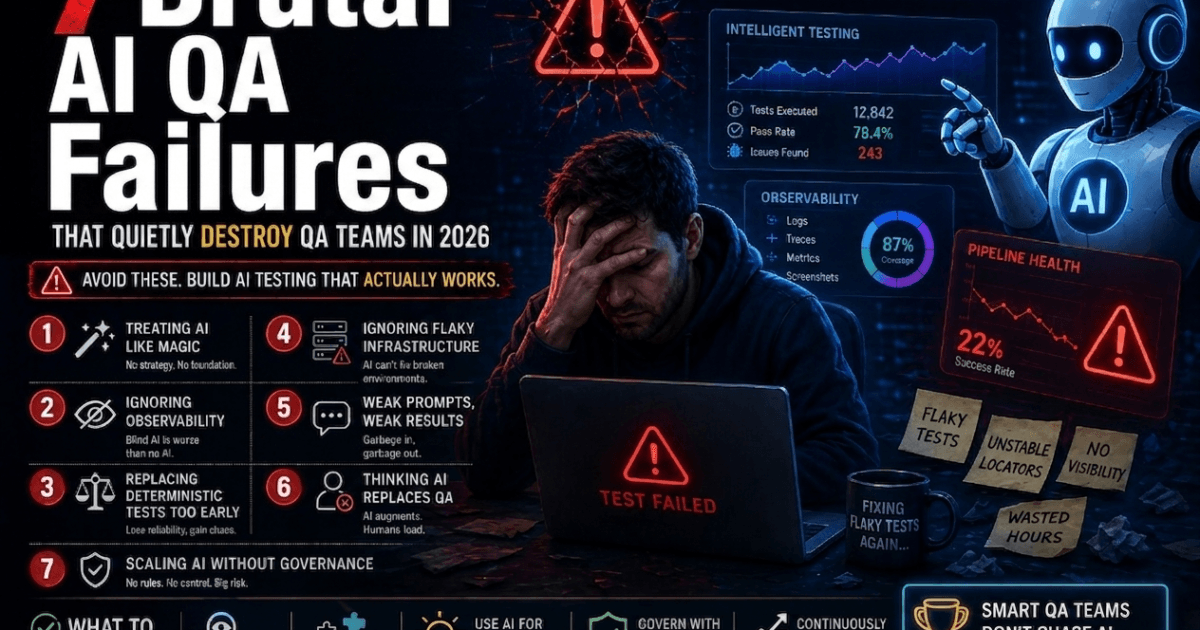
AI QA Failures are Becoming the Biggest Hidden Risk in Modern QA
The conversation around AI in testing has exploded across the software industry.
Everywhere engineers hear:
- AI-powered automation
- autonomous testing
- self-healing frameworks
- intelligent QA
- agentic workflows
- AI-native pipelines
And honestly?
A huge number of teams are rushing into AI QA Failures without understanding the operational consequences.
That is creating a new category of engineering problems:
AI QA Failures
And some of these mistakes are quietly becoming:
- expensive
- dangerous
- difficult to debug
- operationally chaotic
The biggest problem?
Many organizations think adding AI automatically creates:
smarter engineering systems
But badly designed AI workflows can actually create:
- more instability
- more confusion
- weaker debugging
- lower reliability
- false confidence
This is why modern QA teams must understand:
👉 intelligent systems still require intelligent engineering
Why Most AI QA Failures Conversations Are Superficial
A lot of online AI-testing content focuses heavily on:
- hype
- flashy demos
- autonomous agents
- AI-generated test cases
But very few people discuss:
- operational stability
- observability
- debugging complexity
- telemetry quality
- infrastructure impact
- long-term maintainability
That is where the real engineering problems begin.
Because production-scale QA systems are very different from:
conference-stage AI demosAI QA Failure – Mistake #1 — Treating AI Like Magic Instead of Infrastructure
This is probably the biggest mistake happening right now.
Many teams deploy AI systems expecting:
- perfect automation
- intelligent decisions
- autonomous debugging
- instant productivity gains
without building:
- telemetry pipelines
- observability systems
- structured logging
- orchestration layers
- validation frameworks
But AI systems are not magic.
They are infrastructure-dependent engineering systems.
Without proper runtime visibility:
AI reasoning becomes weak very quickly.
For example:
const response = await aiAgent.analyzeFailure(logs);
If:
- logs are incomplete
- traces are missing
- screenshots are unavailable
- telemetry is poor
the AI system produces:
weak operational intelligenceThis is why observability matters massively in AI testing.
AI QA Failure – Mistake #2 — Ignoring Observability Completely
Modern AI systems require:
- runtime context
- execution visibility
- telemetry correlation
- distributed diagnostics
Without observability:
AI systems behave blindly.
Strong AI-testing ecosystems increasingly depend on:
- OpenTelemetry
- structured logging
- execution tracing
- metrics pipelines
- centralized debugging systems
because AI quality depends heavily on:
👉 execution signal quality
Many teams underestimate this badly.
They focus on:
- prompts
- models
- agents
while ignoring:
the operational foundation underneath
That eventually creates fragile automation ecosystems.
AI QA Failure – Mistake #3 — Replacing Deterministic Validation Too Early
This mistake is becoming increasingly common.
Some organizations aggressively attempt replacing:
- assertions
- deterministic checks
- stable workflows
- regression validation
with:
- fully AI-driven reasoning
too early.
That creates dangerous instability.
Traditional deterministic automation is still extremely valuable for:
- compliance workflows
- critical business logic
- stable regression suites
- repeatable validations
For example:
await expect(page.locator('.payment-success')).toBeVisible();
This deterministic validation remains extremely reliable.
The future is not:
AI replacing all deterministic logic
The future is:
hybrid intelligent automation systemsAI QA Failure – Mistake #4 — Ignoring Flaky Infrastructure Problems
This is a huge hidden issue.
Many teams assume:
AI will fix flaky automation
But often the deeper issue is:
- unstable environments
- slow APIs
- bad infrastructure
- unreliable test data
- weak orchestration systems
AI systems cannot magically solve:
👉 broken engineering ecosystems
For example:
an unstable staging environment still creates:
- inconsistent behavior
- timing problems
- distributed failures
even if AI agents are involved.
Strong QA teams increasingly optimize:
- environment stability
- orchestration quality
- telemetry reliability
- infrastructure consistency
before aggressively scaling AI systems.
AI QA Failure – Mistake #5 — Weak Prompt Engineering for QA Workflows
This is one area where many engineers underestimate complexity.
Poor prompts create:
- vague analysis
- inconsistent recommendations
- hallucinated debugging
- misleading summaries
Example weak prompt:
Analyze this test failure.
That is far too ambiguous.
Better QA-oriented prompts increasingly include:
- failure context
- logs
- screenshots
- environment data
- expected output structures
Example:
Analyze this Playwright failure.

Logs:
${logs}

Return:
1. Root cause
2. Failure category
3. Suggested fix
4. Flaky probability
Structured prompts dramatically improve operational usefulness.
AI QA Failure – Mistake #6 — Believing AI Removes the Need for QA Engineers
This misunderstanding is everywhere.
AI systems increasingly improve:
- debugging speed
- workflow orchestration
- summarization
- semantic interpretation
- telemetry analysis
But experienced QA engineers still provide:
- systems thinking
- business understanding
- risk analysis
- architectural judgment
- release strategy
AI agents currently excel more at:
👉 acceleration
than:
👉 complete engineering ownership
Modern QA increasingly becomes:
AI-augmented engineering
not:
fully autonomous quality systemsAI QA Failure – Mistake #7 — Scaling AI Without Governance
This is becoming a serious enterprise issue.
As organizations deploy:
- AI agents
- intelligent workflows
- adaptive automation
- autonomous orchestration
they increasingly require:
- governance policies
- validation systems
- auditability
- execution tracking
- compliance visibility
Without governance:
AI ecosystems can become:
operationally chaotic
very quickly.
Modern enterprise AI-testing systems increasingly need:
- execution audit trails
- observability governance
- prompt versioning
- model monitoring
- rollback strategies
because intelligent systems still require:
👉 operational control
Why Hybrid QA Systems Are Becoming the Real Future
The strongest engineering teams are not:
- abandoning traditional automation
- blindly trusting AI
- replacing deterministic systems entirely
Instead they increasingly combine:
- Playwright
- Selenium
- AI reasoning
- telemetry pipelines
- vector retrieval
- observability systems
- intelligent orchestration
This creates:
hybrid intelligent QA ecosystems
which balance:
- reliability
- scalability
- contextual intelligence
- operational visibility
Example Hybrid AI QA Failure – Workflow
A modern workflow increasingly looks like this:
Step 1 — Traditional Automation Executes
Using:
- Playwright
- Selenium
- API automation
- CI/CD pipelines
Step 2 — Observability Pipelines Collect Data
Including:
- traces
- screenshots
- logs
- metrics
- execution telemetry
Step 3 — AI Systems Analyze Failures
AI agents:
- classify failures
- detect flaky behavior
- summarize probable causes
- retrieve historical incidents
Step 4 — Engineers Validate Strategic Decisions
Experienced engineers still handle:
- release risk
- architectural reasoning
- escalation decisions
- business-critical validation
This hybrid model increasingly represents the future of scalable QA engineering.
Why AI QA Failure Requires Systems Thinking
Modern AI-testing ecosystems are no longer:
simple automation projects
They increasingly behave like:
- distributed engineering platforms
- intelligent orchestration systems
- operational intelligence ecosystems
That changes the role of QA engineers massively.
Modern QA increasingly requires understanding:
- observability
- distributed systems
- telemetry pipelines
- AI reasoning
- infrastructure reliability
- orchestration architecture
The strongest QA engineers increasingly behave like:
automation systems architects
instead of:
script maintainersWhy Small AI QA Failures Become Massive at Scale
Small operational problems become extremely dangerous at enterprise scale.
For example:
- poor telemetry
- flaky orchestration
- weak debugging pipelines
- incomplete logs
may initially seem manageable.
But across:
- thousands of executions
- distributed pipelines
- multiple environments
- AI-driven workflows
these problems amplify dramatically.
This is why scalable AI testing increasingly depends on:
👉 operational engineering discipline
not:
👉 AI hype alone
What Smart QA Teams Are Quietly Doing Differently
The strongest teams increasingly invest heavily in:
- observability-first architecture
- telemetry pipelines
- intelligent debugging
- execution analytics
- AI-assisted orchestration
- hybrid validation systems
Because modern software ecosystems are becoming:
- more distributed
- more AI-generated
- more operationally complex
And traditional debugging workflows alone no longer scale efficiently.
AI QA Failures Are Really About Operational Maturity
The modern AI QA Failures problem is not simply about bad prompts or weak automation tools. In 2026, the biggest risks increasingly involve poor observability, weak governance, unstable infrastructure, incomplete telemetry, operational fragility, and unrealistic expectations around autonomous AI systems. Strong QA organizations increasingly combine deterministic automation, intelligent orchestration, telemetry pipelines, distributed diagnostics, AI-assisted debugging, and systems-thinking engineering practices to build scalable and reliable modern QA ecosystems.
More Relevant Articles
- Load Testing Microservices with AI Personas: k6 + LLM-Generated User Journeys
- How I Built a Postman Bot That Detects Breaking API Changes Before Deployment (Using LLM)
- From Pytest Scripts to Test Agents: Building Autonomous API Testing Systems with Autogen
External Resources
Recommended Video Section
Suggested embedded YouTube topics:
- AI agents in software testing
- observability in QA engineering
- Playwright debugging workflows
- OpenTelemetry for automation systems
- LangChain orchestration tutorials
Final Thoughts
The future of QA is not about:
blindly replacing engineers with AI
The future is about:
building intelligent, observable, scalable engineering ecosystems
Because AI without operational maturity eventually creates:
- fragile automation
- unreliable debugging
- false confidence
- chaotic engineering systems
And modern QA teams cannot afford that risk anymore.
The most dangerous AI testing mistake is not using AI poorly.
It is believing AI eliminates the need for strong engineering systems underneath.