 QA
QA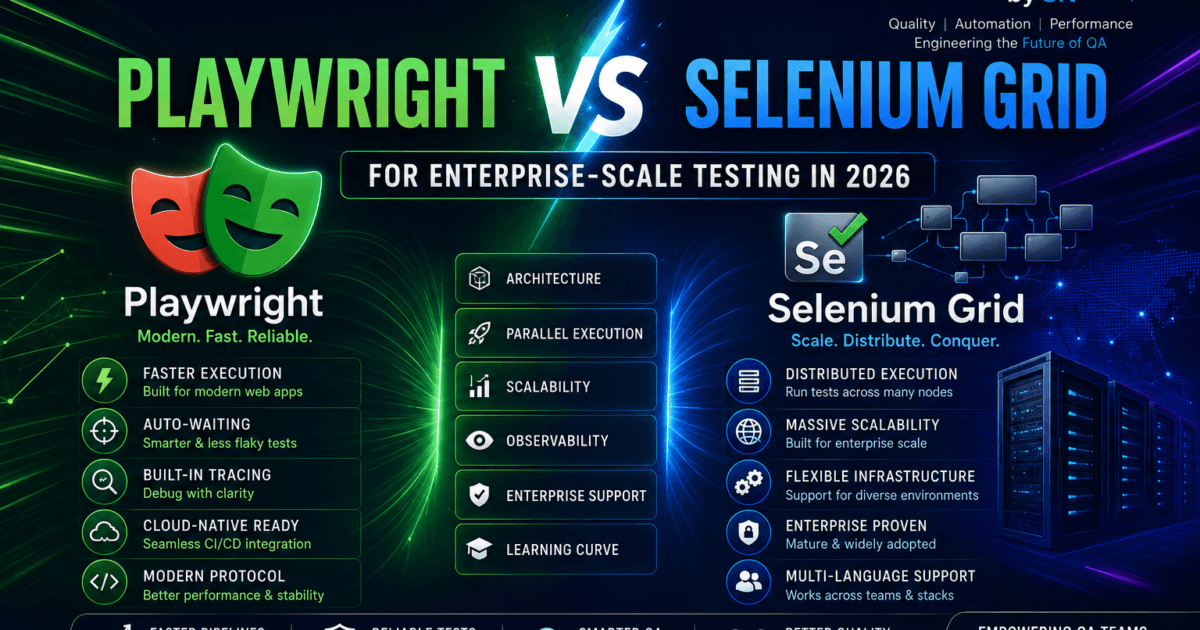
Playwright vs Selenium Grid is No Longer a Simple Framework Debate
For years, automation discussions looked like this:
Which testing tool is better?But in 2026, the conversation changed completely.
Modern QA engineering is no longer only about:
- writing scripts
- automating browsers
- validating UI flows
The real challenge now is:
building scalable testing infrastructure
And that is exactly why the Playwright vs Selenium Grid discussion became so important.
Because this is no longer:
👉 a tool comparison
It is increasingly:
👉 an architecture decision
Modern enterprise systems now require:
- distributed execution
- cloud scalability
- parallel pipelines
- observability
- intelligent debugging
- AI-assisted analysis
- operational reliability
That changes how organizations evaluate automation platforms.
What is Playwright?
Short Answer
Microsoft Playwright is a modern browser automation framework designed for:
- fast execution
- modern web apps
- cross-browser automation
- cloud-native CI/CD pipelines
- reliable synchronization
Core Playwright Capabilities
| Capability | Purpose |
|---|---|
| Auto-waiting | Reduce flaky tests |
| Parallel execution | Faster CI/CD |
| Built-in tracing | Better debugging |
| API testing | Backend validation |
| Modern browser protocols | Faster execution |
| Mobile emulation | Responsive testing |
What Is Selenium Grid?
Short Answer
Selenium Project Selenium Grid is a distributed test execution platform that allows automation tests to run:
- across multiple browsers
- across multiple machines
- in parallel
- at enterprise scale
Why Selenium Grid Became Important
Large organizations needed:
- distributed execution
- parallel browser coverage
- scalable infrastructure
Selenium Grid solved this problem years before cloud-native automation became mainstream.
Playwright vs Selenium Grid — Core Difference
This is where many engineers misunderstand the comparison.
The Real Difference
| Platform | Primary Focus |
|---|---|
| Playwright | Modern automation framework |
| Selenium Grid | Distributed execution infrastructure |
This means:
they solve different layers of the testing ecosystem
But organizations often compare them because:
- both impact scalability
- both affect CI/CD
- both influence execution architecture
Playwright vs Selenium Grid — Enterprise Comparison Table
High-Level Comparison
| Feature | Playwright | Selenium Grid |
|---|---|---|
| Architecture | Modern automation framework | Distributed execution platform |
| Setup Complexity | Easier and developer-friendly | More infrastructure-heavy |
| Auto-Waiting | Built-in intelligent waiting | Limited native support |
| Parallel Execution | Native parallel execution | Grid-based distributed execution |
| Browser Communication | Modern browser protocol | WebDriver protocol |
| CI/CD Integration | Excellent for cloud-native pipelines | Excellent for enterprise pipelines |
| Observability | Strong built-in tracing and debugging | Requires external tooling |
| Cloud-Native Readiness | Strong modern architecture | Mature but operationally heavier |
| Enterprise Legacy Support | Growing rapidly | Extremely strong in enterprises |
| Learning Curve | Easier for beginners | Moderate to advanced |
| Debugging Experience | Excellent Trace Viewer support | More manual debugging workflows |
| Infrastructure Maintenance | Lower operational overhead | Higher maintenance complexity |
| Scaling Massive Browser Farms | Moderate to strong | Excellent |
| Execution Speed | Faster startup and execution | Slower comparatively |
| Best Fit | Modern web apps and fast-moving teams | Large enterprise distributed systems |
Why Modern Enterprises Still Use Selenium Grid
Many engineers incorrectly assume Selenium Grid is “outdated.”
That is not true.
Large enterprises still heavily rely on Selenium Grid because they already invested:
- years of engineering effort
- massive test suites
- distributed infrastructure
- internal tooling ecosystems
Common Enterprise Selenium Grid Advantages
| Advantage | Why It Matters |
|---|---|
| Massive ecosystem | Mature tooling |
| Legacy compatibility | Enterprise stability |
| Language support | Multi-team flexibility |
| Browser coverage | Large-scale validation |
| Infrastructure control | Internal governance |
For many organizations:
migration cost becomes a bigger concern than framework capabilityWhy Playwright Is Growing So Fast
Playwright exploded in popularity because it aligns extremely well with:
- modern frontend systems
- CI/CD acceleration
- cloud-native workflows
- asynchronous web apps
Playwright Strengths
Key Advantages
| Advantage | Impact |
|---|---|
| Auto-waiting | Fewer flaky tests |
| Built-in tracing | Faster debugging |
| Fast execution | Better pipelines |
| Simpler setup | Faster onboarding |
| Modern browser control | Better reliability |
| API testing support | Unified workflows |
This makes Playwright especially attractive for:
- startups
- fast-moving engineering teams
- cloud-native organizations
- modern frontend platforms
Architecture Matters More Than Framework Choice
Here is the most important insight in this article:
Most automation failures are not caused by:
- Selenium
- Playwright
- Cypress
They are caused by:
weak testing architecture
Because eventually every framework struggles if organizations ignore:
- observability
- orchestration
- telemetry
- execution visibility
- infrastructure scaling
Playwright Architecture Explained
Playwright uses a modern execution model directly connected to browser engines.
Playwright Architecture
Test Script
↓
Playwright API
↓
Browser Engine
↓
Application Under Test
This architecture enables:
- faster execution
- modern browser control
- reduced synchronization issues
Example Playwright Test
test('login test', async ({ page }) => {
  await page.goto('https://example.com');

  await page.fill('#email', 'admin@test.com');
  await page.fill('#password', 'password');

  await page.click('#login');
});
Selenium Grid Architecture Explained
Selenium Grid uses distributed hub-node architecture.
Selenium Grid Workflow
Test Script
↓
WebDriver
↓
Grid Hub
↓
Grid Nodes
↓
Browsers
This architecture is powerful for:
- massive distributed execution
- enterprise browser farms
- large-scale parallel testing
But it introduces:
- infrastructure complexity
- maintenance overhead
- operational management requirements
Selenium Grid Example Setup
version: '3'

services:
  selenium-hub:
    image: selenium/hub

  chrome:
    image: selenium/node-chrome
    depends_on:
      - selenium-hub
This is powerful:
but operationally heavier than Playwright’s simpler startup model.
Playwright vs Selenium Grid — Scalability Comparison
Parallel Execution Comparison
| Area | Playwright | Selenium Grid |
|---|---|---|
| Native Parallelism | Strong built-in support | Strong distributed execution support |
| Distributed Execution | Moderate cloud-native scaling | Excellent enterprise-scale distribution |
| Infrastructure Overhead | Lower operational complexity | Higher infrastructure management |
| Resource Management | Easier container handling | More complex orchestration |
| Massive Scaling | Good for modern teams | Excellent for very large enterprises |
| Execution Coordination | Simpler workflow management | Advanced hub-node coordination |
| CI/CD Scalability | Excellent for fast pipelines | Excellent for large execution farms |
| Maintenance Effort | Lower maintenance overhead | Higher operational maintenance |
| Environment Management | Easier setup and isolation | More configuration-heavy |
| Enterprise Scaling Flexibility | Growing rapidly | Extremely mature and proven |
Important Insight about Playwright vs Selenium Grid
Playwright simplifies:
👉 modern execution
Selenium Grid optimizes:
👉 massive distributed scaling
These are different priorities.
Playwright vs Selenium Grid – CI/CD Performance Comparison
Modern CI/CD pipelines require:
- speed
- reliability
- deterministic execution
- debugging visibility
CI/CD Comparison Table
| Capability | Playwright | Selenium Grid |
|---|---|---|
| Pipeline Startup Speed | Faster execution startup | Slower initialization |
| Debugging Support | Excellent built-in debugging tools | Moderate debugging capabilities |
| Cloud Integration | Excellent cloud-native compatibility | Excellent enterprise cloud support |
| Trace Visualization | Built-in Trace Viewer support | Requires external observability tooling |
| Pipeline Maintenance | Easier operational maintenance | More infrastructure management work |
| CI/CD Developer Experience | Cleaner and simpler workflows | More operational configuration |
| Failure Analysis | Strong visual debugging and tracing | More manual investigation |
| Infrastructure Complexity | Lower complexity | Higher orchestration overhead |
| Scaling CI/CD Pipelines | Excellent for modern fast pipelines | Excellent for distributed enterprise execution |
| Setup for New Teams | Faster onboarding | More setup and operational learning |
Example GitHub Actions with Playwright
name: Playwright Tests

on: [push]

jobs:
  test:
    runs-on: ubuntu-latest

    steps:
    - uses: actions/checkout@v3

    - run: npm install
    - run: npx playwright test
This simplicity is one reason many modern teams adopt Playwright rapidly.
Why Observability is Changing Enterprise Testing
Modern QA systems increasingly depend on:
- logs
- traces
- telemetry
- execution analytics
- AI-assisted debugging
This is where Playwright currently provides strong advantages.
Playwright Observability Strengths
| Feature | Benefit |
|---|---|
| Trace Viewer | Visual debugging |
| Screenshots | UI inspection |
| Video recording | Failure replay |
| Console logs | Runtime visibility |
| Network tracing | API debugging |
Example Trace Configuration
use: {
  trace: 'on',
  screenshot: 'only-on-failure'
}
This dramatically improves debugging workflows.
Why Selenium Grid Still Wins in Some Enterprises
Despite Playwright’s growth, Selenium Grid remains extremely powerful for:
- regulated industries
- legacy systems
- enterprise governance
- massive browser farms
- internal infrastructure ecosystems
Enterprise Scenarios Favoring Selenium Grid
| Scenario | Why Selenium Grid Wins |
|---|---|
| Existing enterprise investment | Lower migration cost |
| Multi-language support | Wider compatibility |
| Massive distributed browser infrastructure | Mature scaling |
| Legacy frameworks | Easier integration |
| Long-term enterprise governance | Operational familiarity |
Why Cloud-Native Teams Prefer Playwright
Cloud-native engineering teams increasingly prioritize:
- fast feedback loops
- lightweight infrastructure
- modern browser architecture
- developer-friendly workflows
This is where Playwright shines.
Playwright Advantages for Modern Teams
Key Benefits
- simpler onboarding
- lower maintenance
- cleaner debugging
- faster CI/CD
- modern frontend compatibility
- strong developer experience
The Hidden Cost of Enterprise Testing
One major factor organizations underestimate is:
operational complexity cost
Large-scale automation systems require:
- infrastructure maintenance
- debugging pipelines
- execution visibility
- orchestration engineering
- telemetry systems
That means testing eventually becomes:
👉 a platform engineering challenge
not simply:
👉 a framework choice
Playwright vs Selenium Grid — Performance Comparison
Speed Comparison
| Area | Playwright | Selenium Grid |
|---|---|---|
| Startup Speed | Faster browser startup and execution | Slower initialization process |
| Browser Communication | Modern browser protocol | WebDriver-based communication |
| Synchronization | Better built-in auto-waiting | More manual synchronization handling |
| Execution Latency | Lower execution latency | Higher distributed execution overhead |
| Massive Distributed Scale | Moderate enterprise scaling | Excellent large-scale distributed execution |
| Debugging Workflow | Strong built-in tracing support | Requires additional debugging tooling |
| Infrastructure Complexity | Lower operational complexity | Higher infrastructure management |
| CI/CD Pipeline Efficiency | Optimized for fast pipelines | Better for large distributed ecosystems |
| Maintenance Effort | Easier ongoing maintenance | More operational maintenance required |
| Cloud-Native Readiness | Excellent for modern cloud workflows | Mature but heavier architecture |
Important Clarification
Playwright often feels faster because:
- browser communication is modern
- auto-waiting reduces instability
- startup overhead is smaller
But Selenium Grid can still outperform in:
👉 huge distributed enterprise execution environments
Hybrid Enterprise Strategy Is Becoming Common
Many large organizations increasingly combine:
- Playwright
- Selenium Grid
- cloud execution
- AI debugging
- telemetry systems
instead of choosing only one.
Example Hybrid Strategy
| Use Case | Tool |
|---|---|
| Legacy enterprise apps | Selenium Grid |
| Modern frontend systems | Playwright |
| Massive browser farms | Selenium Grid |
| Fast CI/CD workflows | Playwright |
This hybrid approach is becoming increasingly common.
AI is Quietly Changing Testing Infrastructure
Modern testing ecosystems increasingly integrate:
- AI-assisted debugging
- flaky detection
- telemetry analysis
- semantic failure classification
This changes platform requirements dramatically.
Modern Testing Infrastructure Requires
| Requirement | Why It Matters |
|---|---|
| Observability | Failure analysis |
| Telemetry | Execution intelligence |
| Tracing | Distributed debugging |
| AI analytics | Root-cause acceleration |
| Scalable orchestration | Enterprise reliability |
This shift favors:
👉 modern intelligent testing ecosystems
over:
👉 isolated automation frameworks
The choice between Playwright and Selenium Grid for enterprise-scale testing in 2026 presents a fundamental decision between modern architectural efficiency and the stability of a mature, broad ecosystem.
Comparison Summary: Playwright vs Selenium Grid
In 2026, Playwright is generally the superior choice for new enterprise web applications, offering substantial advantages in execution speed, resource efficiency, and debugging tools. Its WebSocket-based protocol and efficient resource model allow teams to achieve significantly faster CI/CD pipelines with lower infrastructure costs.
Selenium Grid 4 remains a powerful and necessary tool for enterprises with massive, established test suites (particularly in Java), and those requiring support for native mobile apps (via Appium) or very broad/legacy browser environments.
Detailed Analysis by Category
| Category | Playwright (2026) | Selenium Grid 4 (2026) |
| Architecture | Native, event-driven WebSocket communication with modern browser engines (Chromium, WebKit, Firefox). Ephemeral ‘BrowserContexts’ provide fast, clean isolation for each test without new browser launches. | Re-architected for containerization (Router, Distributor, Session Queue, Event Bus), fitting better into Kubernetes. Uses HTTP RESTful communication (W3C standard) which is inherently ‘chattier’ and introduces latency. |
| Scalability | High Efficiency. Exploits a single browser process for multiple isolated parallel contexts. Supports sharding natively in test runners (e.g., Playwright Test, Pytest) to distribute tests across multiple machines easily. | High Power, Lower Efficiency. Spins up one browser process per parallel node, consuming more CPU and memory per worker. Scalability is achieved by scaling the numbers of worker pods/containers in the Grid. |
| CI/CD Integration | Seamless. Light runners and sharding make it well-suited for high-concurrency CI environments like GitHub Actions, GitLab CI, or Azure DevOps. Fast startup ensures minimal delay. | Mature. Has well-established integrations and Docker images. While improved in Grid 4, setting up a distributed Grid can require more configuration and maintenance than managing Playwright shards. |
| Execution Speed | Fast. Architecturally faster due to the WebSocket protocol and faster browser context creation. Some 2026 benchmarks indicate it is ~1.85x faster per action on a modern SPA and up to 2x faster for an end-to-end suite than Selenium. | Moderate. Architecturally constrained by the latency of HTTP-based WebDriver protocol and the time needed to initialize a fresh browser session for each test to ensure state isolation. |
| Observability | Built-in. Features the powerful Trace Viewer, which records actions, network traffic, DOM snapshots, console logs, and videos for complete, offline post-mortem debugging of CI failures. | Infrastructure-focused. Grid 4 exposes Prometheus metrics and has GraphQL support for real-time Grid status. However, test-level tracing (what failed in the script and why) requires third-party reporting or custom solutions. |
| Debugging | Superior. The VS Code extension and the Trace Viewer provide a state-of-the-art interactive experience, allowing developers to replay tests step-by-step and inspect the DOM at any point in the run. | Traditional. Relies heavily on screenshots upon failure and text logs. While useful, it lacks the deep, interactive state visibility provided by Playwright’s tools. |
| Cloud Testing | Efficient. Can be run directly against real-device clouds, often requiring fewer runner hours and lower cost due to its resource efficiency. Integrates natively with cloud runners in major providers. | Broad. Long-standing partnerships with major cross-browser testing platforms (e.g., Sauce Labs, BrowserStack). Setting up a self-hosted cloud grid is possible but complex. |
| Ecosystem & Best Fits | Best for New Modern Apps. Strong support for TypeScript, JavaScript, Python, Java, and .NET. Best for SPAs and teams focused on developer-like productivity and minimal maintenance. | Best for Legacy Java Suites. Massive ecosystem and community support since 2004. Safest for Java teams with huge existing automation frameworks, specific browser requirements, or the need to test native mobile apps. |
Beginner FAQ — Playwright vs Selenium Grid
Is Playwright Better Than Selenium Grid?
Not necessarily.
Playwright and Selenium Grid solve different problems.
Playwright focuses more on:
- modern automation
- developer experience
- fast execution
- cloud-native testing
Selenium Grid focuses more on:
- distributed execution
- enterprise scaling
- browser farms
- infrastructure orchestration
Can Playwright Replace Selenium Grid?
For some organizations:
👉 yes
For others:
👉 no
Especially enterprises with:
- massive legacy systems
- existing Grid ecosystems
- large operational investment
Which is Easier to Maintain?
Generally:
Playwright is easier operationally
because:
- setup is simpler
- debugging is stronger
- synchronization is modern
Which is Better for Massive Enterprise Scale?
Selenium Grid still remains extremely strong for:
- distributed browser farms
- very large execution infrastructure
- enterprise governance ecosystems
Is Playwright the Future?
Playwright is definitely becoming one of the most important modern automation frameworks.
But enterprise ecosystems rarely change overnight.
The future will likely involve:
👉 hybrid testing architectures
Playwright vs Selenium Grid Is Really About Engineering Philosophy
The modern Playwright vs Selenium Grid debate is no longer simply about choosing a testing tool. In 2026, the real discussion increasingly involves execution architecture, distributed scalability, cloud-native engineering, observability maturity, CI/CD acceleration, debugging intelligence, operational complexity, and how organizations design scalable testing ecosystems for modern software delivery platforms.
More Relevant Articles
- The Self-Healing Load Test: How k6 + AI Auto-Tunes Thresholds & Fixes Performance Regressions
- Load Testing Microservices with AI Personas: k6 + LLM-Generated User Journeys
- How I Built a Postman Bot That Detects Breaking API Changes Before Deployment (Using LLM)
External Resources
Recommended Video Section
Suggested embedded video topics:
- Selenium Grid setup tutorial
- Playwright enterprise architecture
- Playwright vs Selenium explained
- CI/CD scaling for automation
- Distributed testing infrastructure
Final Thoughts
Modern automation engineering is evolving rapidly.
The future is no longer simply about:
which framework writes tests faster
The future increasingly belongs to teams that understand:
- scalability
- observability
- orchestration
- telemetry
- cloud-native architecture
- intelligent debugging systems
Because eventually:
every large QA ecosystem becomes:
👉 an engineering platform problem
not merely:
👉 an automation framework decision.
The strongest QA teams in 2026 are not choosing tools blindly.
They are designing scalable testing ecosystems around business scale, operational maturity, and modern software architecture.