QA
QA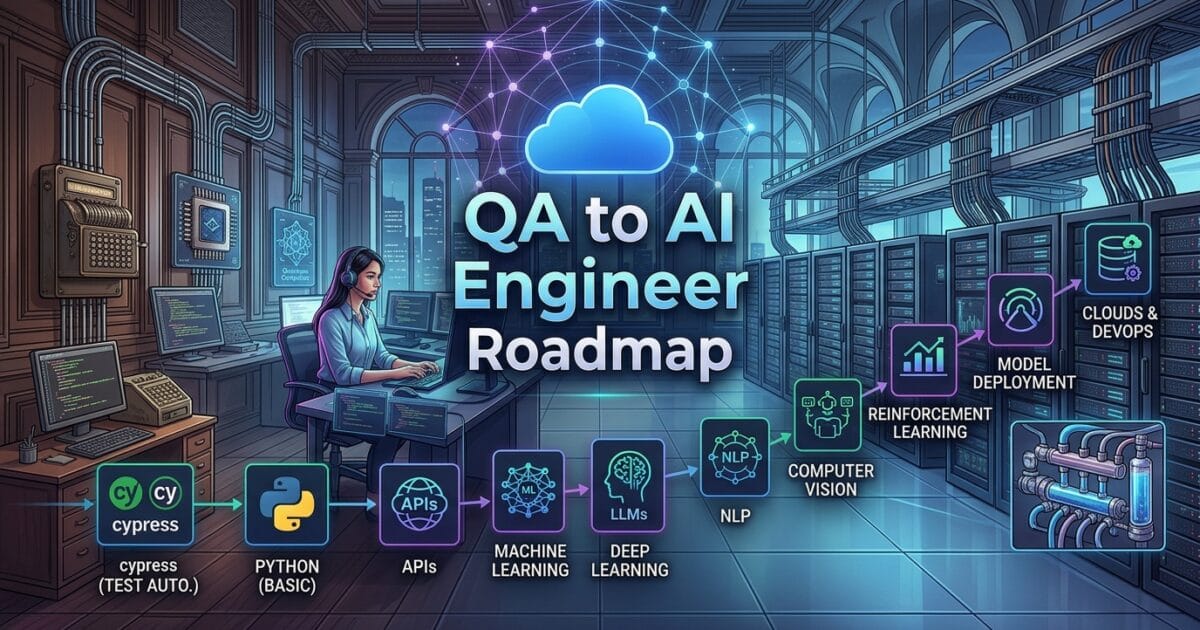
QA to AI Engineer is not a career jump that happens by simply learning Python, calling an LLM API, or adding “AI” to your resume. It is a gradual shift from validating software behavior to engineering systems that can reason, use tools, work with data, make decisions, and operate reliably in production.
For experienced QA and SDET professionals, that distinction matters.
You already understand software behavior, failure modes, automation, APIs, CI/CD, debugging, test architecture, observability, and release risk. Those skills are not something you need to throw away. They become the engineering foundation for building reliable AI systems.
The real challenge is knowing what to learn, what to skip, and in what order to learn it.
A developer starting from scratch may begin with Python, machine learning, or LLM APIs. A QA engineer can take a different route because much of the software engineering foundation already exists.
The better question is therefore not:
“How do I become an AI engineer?”
It is:
“How do I convert my existing QA and automation engineering skills into AI engineering capabilities?”
That is the roadmap this guide explores.
What Does an AI Engineer Actually Do?
The term AI Engineer has become extremely broad.
One company may use it for someone building LLM-powered applications. Another may expect machine-learning knowledge. Another may want someone who builds AI agents, RAG systems, evaluation pipelines, model integrations, and production infrastructure.
That means you should avoid treating AI engineering as one single technology.
A modern AI engineer may work across several layers:
| Layer | Typical Responsibility | Useful Skills |
|---|---|---|
| Application | Build AI-powered products | Python, APIs, backend development |
| LLM | Integrate foundation models | Prompting, structured output, tool calling |
| RAG | Connect models to private knowledge | Embeddings, vector search, retrieval |
| Agents | Build systems that take actions | Tool use, workflows, state management |
| Evaluation | Measure AI behavior | Test automation, datasets, LLM evaluation |
| Infrastructure | Run AI systems reliably | Docker, CI/CD, observability |
| Data | Prepare and transform information | SQL, Python, data pipelines |
| Production | Monitor and improve systems | Logging, tracing, cost and latency analysis |
This is where a QA background becomes surprisingly valuable.
A conventional application might have a relatively deterministic expectation:
assert response.status_code == 200
assert response.json()["status"] == "success"
An AI application may produce different valid answers for the same input.
That changes the testing problem.
You may instead need to evaluate:
response = agent.run("Explain the payment failure")

assert response["answer"]
assert response["sources"]
assert response["latency"] < 5
assert response["tool_calls"] <= 3
The engineering question becomes more sophisticated:
Was the system useful, grounded, safe, consistent, observable, and efficient?
That is already familiar territory for strong SDETs.
Why QA Engineers Have an Unexpected Advantage
The traditional perception is that an AI engineer must begin with mathematics, neural networks, and model training.
Those subjects are valuable, but they are not the only route into modern AI engineering.
If your target is AI application engineering, you may spend considerably more time building systems around models than building models themselves.
Consider a typical AI application:
User
  ↓
API
  ↓
Application Logic
  ↓
LLM
  ↓
Tools / Database / APIs
  ↓
Response
  ↓
Evaluation + Monitoring
Every arrow introduces potential failure.
An API can fail.
A prompt can produce unexpected behavior.
A tool can return incorrect information.
A retrieval system can select irrelevant documents.
An LLM can hallucinate.
A workflow can enter an unintended loop.
A model can become slower or more expensive.
The database can return stale information.
The response can violate a business rule.
This is where a testing mindset becomes an engineering advantage.
A QA engineer naturally asks:
- What can fail?
- How can I reproduce it?
- How do I detect regression?
- What happens at the boundary?
- What happens with malformed input?
- What happens when a dependency is unavailable?
- How do I measure reliability?
- How do I automate verification?
- How do I prevent the same failure from returning?
Those questions are fundamental to production AI systems.
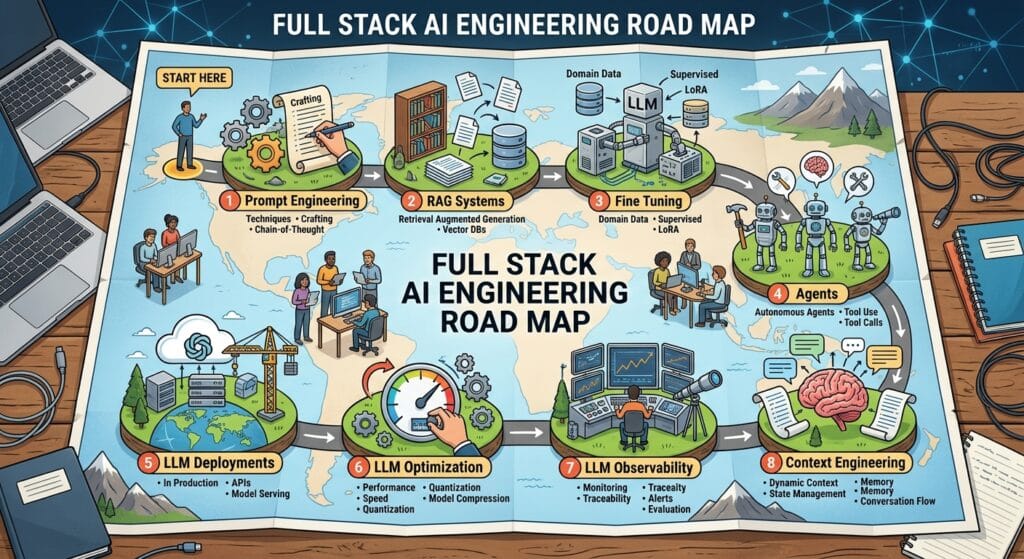
The Biggest Mistake: Trying to Learn Everything
One of the fastest ways to become overwhelmed is creating a learning list like this:
Python
Machine Learning
Deep Learning
TensorFlow
PyTorch
Transformers
LangChain
LangGraph
RAG
Vector Databases
MLOps
Kubernetes
CUDA
Fine-Tuning
Agents
MCP
LLMs
Computer Vision
NLP
Reinforcement Learning
This looks impressive.
It is also strategically inefficient for most people targeting AI application engineering.
The goal is not to collect technologies.
The goal is to build capabilities.
For example, instead of saying:
“I need to learn LangGraph.”
define the capability:
“I need to build stateful multi-step AI workflows.”
Then identify the technology that helps you develop that capability.
This distinction changes the entire learning strategy.
QA Engineer vs AI Engineer: What Actually Changes?
The transition is not about abandoning QA.
It is about moving further down the engineering stack.
A traditional QA automation workflow may look like:
Application
    ↓
Test Automation
    ↓
Assertions
    ↓
Reports
    ↓
CI/CD
An AI engineering workflow may look like:
User
 ↓
AI Application
 ↓
LLM
 ↓
Tools / APIs / Data
 ↓
Agent Workflow
 ↓
Evaluation
 ↓
Observability
 ↓
Production
The second workflow introduces new engineering problems.
You must understand both the system that produces the answer and the system that evaluates the answer.
That creates a powerful intersection:
| Existing QA Skill | AI Engineering Extension |
|---|---|
| API testing | LLM/API integration testing |
| UI automation | AI-driven browser workflows |
| Test data | Evaluation datasets |
| Assertions | AI quality criteria |
| Regression testing | Prompt/model regression |
| CI/CD | Automated AI evaluation pipelines |
| Performance testing | LLM latency and token-cost testing |
| Contract testing | Structured-output validation |
| Mocking | Model/tool dependency isolation |
| Observability | AI traces and agent execution traces |
This is why the transition can be faster than starting from zero.
The First Skill You Should Strengthen: Python
If Python is not already one of your strongest programming languages, make it a priority.
You do not need to become a Python language-lawyer.
You need enough Python to build production-quality AI applications.
That means becoming comfortable with:
def process_request(request: dict) -> dict:
    user_input = request["message"]

    result = call_model(user_input)

    return {
        "answer": result,
        "status": "success"
    }
Then move toward real application patterns:
from dataclasses import dataclass

@dataclass
class AIResponse:
    answer: str
    latency_ms: float
    model: str
    tokens: int
You should understand:
- functions
- classes
- modules
- packages
- exceptions
- typing
- dataclasses
- async programming
- HTTP clients
- environment variables
- logging
- testing
- dependency management
- virtual environments
- JSON
- REST APIs
For AI engineering, Python is not merely a scripting language.
It becomes the glue connecting models, APIs, databases, agents, evaluation frameworks, and infrastructure.
Your API Testing Experience Becomes More Valuable
Consider a conventional REST API:
response = client.post(
    "/payments",
    json={
        "amount": 100,
        "currency": "USD"
    }
)

assert response.status_code == 200
Now consider an AI service:
response = client.post(
    "/assistant",
    json={
        "message": "Why was my payment rejected?"
    }
)

assert response.status_code == 200
assert response.json()["answer"]
The HTTP assertion is still useful.
But it is no longer enough.
You may also need to evaluate:
body = response.json()

assert body["answer"]
assert body["latency_ms"] < 5000
assert body["tokens"] < 3000
assert body["sources"]
And eventually:
assert is_grounded(
    answer=body["answer"],
    sources=body["sources"]
)
That final assertion represents a major change in thinking.
Instead of testing only whether the software responded, you are testing whether the AI behavior satisfies an engineering criterion.
From Deterministic Assertions to AI Evaluation
Traditional automation depends heavily on exact expectations.
For example:
assert actual == expected
AI systems often require a different evaluation model.
Instead of:
assert answer == expected_answer
you may evaluate:
score = evaluate_answer(
    question=question,
    answer=answer,
    reference=reference
)

assert score >= 0.8
This introduces concepts such as:
- relevance
- correctness
- groundedness
- factual consistency
- completeness
- toxicity
- safety
- instruction following
- tool-use accuracy
- retrieval quality
This is one of the most important bridges between QA engineering and AI engineering.
You are not leaving testing behind.
You are expanding what testing means.
Where Machine Learning Fits
There is an important distinction between using AI models and building AI models.
If your goal is AI application engineering, you should understand machine-learning fundamentals without necessarily beginning with advanced research mathematics.
At minimum, understand:
Dataset
   ↓
Features
   ↓
Model
   ↓
Training
   ↓
Validation
   ↓
Prediction
   ↓
Evaluation
You should know what concepts such as these mean:
- supervised learning
- unsupervised learning
- training data
- validation data
- test data
- overfitting
- underfitting
- classification
- regression
- embeddings
- inference
- precision
- recall
- F1 score
The goal is not to turn every QA engineer into a machine-learning researcher.
The goal is to understand what happens underneath AI-powered applications well enough to make sound engineering decisions.
LLM Engineering Is the Critical Bridge
Once your Python and AI fundamentals are strong, move into LLM application development.
A basic application might look like:
from openai import OpenAI

client = OpenAI()

response = client.responses.create(
    model="your-model",
    input="Explain API contract testing."
)

print(response.output_text)
The code is simple.
The engineering challenge is not.
Production systems need to deal with:
Prompt
 ↓
Model
 ↓
Structured Output
 ↓
Validation
 ↓
Business Logic
 ↓
Tools
 ↓
Persistence
 ↓
Observability
You need to understand:
- system instructions
- user messages
- context windows
- tokens
- temperature
- structured outputs
- tool calling
- streaming
- retries
- timeouts
- rate limits
- model fallbacks
- prompt versioning
- cost management
This is where your existing engineering discipline starts becoming extremely useful.
RAG Changes the Testing Problem Again
Retrieval-Augmented Generation introduces another layer.
Instead of asking the model to answer entirely from its learned knowledge, the application retrieves external information.
A simplified RAG pipeline looks like:
Question
   ↓
Embedding
   ↓
Vector Search
   ↓
Relevant Documents
   ↓
Prompt Construction
   ↓
LLM
   ↓
Answer
Now imagine the user asks:
“What is our refund policy?”
The model itself may not know your company’s latest policy.
The application must retrieve the correct document.
This creates new failure modes:
Wrong document
      ↓
Wrong context
      ↓
Confident model
      ↓
Wrong answer
A conventional API test might never detect this.
An AI-aware evaluation system can.
You can test:
retrieved = retrieve_documents(
    "What is our refund policy?"
)

assert retrieved
assert relevant_documents(retrieved)
Then test the generated response:
answer = generate_answer(
    question="What is our refund policy?",
    context=retrieved
)

assert grounded_in_context(answer, retrieved)
Now testing has become part of AI system architecture.


Agents Are Where the Engineering Challenge Gets Interesting
A normal LLM application may generate an answer.
An agent can decide what action to take.
For example:
User
 ↓
Agent
 ↓
Should I search?
 ↓
Search Tool
 ↓
Should I call API?
 ↓
API Tool
 ↓
Should I verify?
 ↓
Validation
 ↓
Final Response
The system is no longer a simple request-response application.
It becomes a workflow.
That means you must test:
- tool selection
- tool arguments
- execution order
- retries
- state
- loops
- failures
- permissions
- unexpected tool results
- final response quality
A QA engineer already understands workflow testing.
The difference is that the workflow may now be partially decided by a model.
That makes observability and evaluation even more important.
Compare the Three Career Paths
There are at least three different directions you can take.
| Career Direction | Main Focus | Difficulty | Best Starting Point |
|---|---|---|---|
| ML Engineer | Training and deploying ML models | High | ML + statistics |
| AI Engineer | Building AI-powered applications | Medium–High | Python + LLMs + APIs |
| AI Test / Evaluation Engineer | Reliability and evaluation of AI systems | Medium–High | QA + Python + AI |
The third path is particularly interesting for experienced QA professionals.
But you do not have to remain there.
A strong AI evaluation engineer can progressively move toward broader AI engineering by learning:
QA
 ↓
Automation
 ↓
Python
 ↓
AI APIs
 ↓
LLMs
 ↓
RAG
 ↓
Agents
 ↓
AI Evaluation
 ↓
AI Engineering
The path is cumulative.
You are building on existing knowledge rather than restarting your career.
A Practical Self-Assessment
Before starting your transition, score yourself from 1 to 5.
| Skill | Score |
|---|---|
| Python | /5 |
| API development | /5 |
| REST | /5 |
| Git | /5 |
| CI/CD | /5 |
| Docker | /5 |
| SQL | /5 |
| Cloud | /5 |
| LLM APIs | /5 |
| Prompt engineering | /5 |
| RAG | /5 |
| AI agents | /5 |
| AI evaluation | /5 |
| Observability | /5 |
Now identify your three weakest high-impact areas.
Do not attempt to fix everything simultaneously.
For example, if your scores look like this:
Python       2/5
APIs         4/5
CI/CD        4/5
Docker       3/5
LLMs         1/5
RAG          1/5
Agents       1/5
your immediate roadmap should probably look like:
Python
  ↓
LLM APIs
  ↓
RAG
  ↓
Agents
Not:
Python
ML
Deep Learning
CUDA
Kubernetes
Computer Vision
Robotics
Fine-Tuning
RL
The first roadmap creates a coherent capability chain.
The second creates ten partially completed courses.
The Strategic Rule: Build While You Learn
Do not spend six months consuming tutorials before building anything.
Use a learn → build → test → document → improve cycle.
For example:
Learn LLM API
      ↓
Build small assistant
      ↓
Write automated tests
      ↓
Add structured output
      ↓
Measure latency
      ↓
Add evaluation
      ↓
Add RAG
      ↓
Add observability
Each project should introduce one new engineering capability.
A useful progression could be:
Project 1: AI API Assistant
Build a small API that accepts a question and returns an LLM-generated response.
Test:
def test_assistant_returns_answer(client):
    response = client.post(
        "/assistant",
        json={"message": "Explain REST APIs"}
    )

    assert response.status_code == 200
    assert response.json()["answer"]
Project 2: RAG Knowledge Assistant
Add document ingestion, embeddings, retrieval, and grounded responses.
Project 3: AI Agent
Add tools such as:
Search
Calculator
Database
REST API
Browser
Project 4: AI Evaluation Pipeline
Automatically evaluate:
Accuracy
Groundedness
Latency
Token usage
Tool selection
Regression
Safety
Project 5: Production AI System
Add:
Docker
CI/CD
Logging
Tracing
Monitoring
Secrets
Retries
Rate limits
Cost controls
At that point, you are no longer simply studying AI.
You are engineering an AI system.
The Career Shift Is a Capability Shift
The most important mindset change is this:
Do not ask:
“Which AI tool should I learn next?”
Ask:
“Which engineering capability am I missing?”
If you cannot build a reliable API, learn backend fundamentals.
If you cannot work comfortably with Python, strengthen Python.
If you can build APIs but cannot integrate models, learn LLM application development.
If your model cannot access private information, learn RAG.
If your application cannot perform actions, learn agents and tool calling.
If you cannot determine whether the AI system is reliable, learn AI evaluation.
If you cannot operate the system in production, learn deployment and observability.
This creates a much more deliberate path from QA to AI engineering.
Your Existing Testing Mindset Should Stay
The goal is not to become an AI engineer who forgets testing.
The strongest AI engineers increasingly need engineering discipline around reliability.
Before shipping an AI feature, ask:
Can I reproduce failures?
Can I evaluate quality automatically?
Can I detect regressions?
Can I trace model decisions?
Can I measure latency?
Can I control cost?
Can I validate tool calls?
Can I detect hallucinations?
Can I test degraded dependencies?
Can I roll back safely?
If your answer to these questions is yes, you are thinking beyond experimentation.
You are thinking like an engineer responsible for a production system.
And that is the real transition.
The path from QA to AI Engineer is therefore not a complete career reset. It is an expansion of your engineering scope: from testing software behavior to designing, building, evaluating, and operating intelligent software systems.
The AI Engineer Shift: What Changes After QA Automation
The move from QA to AI engineering becomes real when you stop thinking only in terms of test execution and start thinking in terms of systems, data, models, agents, evaluation, and production reliability.
A QA engineer already has several foundations that an AI engineer needs: programming, debugging, API knowledge, automation, CI/CD, observability, failure analysis, and the ability to think about edge cases. The challenge is learning how those skills connect to AI systems.
The biggest mistake is treating the transition as a list of AI courses.
You do not need to learn every machine-learning framework before building useful AI systems. You need a progression that converts your existing engineering experience into AI engineering capability.
Your QA experience is more valuable than you think
A traditional QA workflow might look like this:
Requirement
   ↓
Test Case
   ↓
Automation
   ↓
Execution
   ↓
Failure
   ↓
Debugging
   ↓
Report
An AI engineering workflow is different:
Business Problem
   ↓
Data
   ↓
Model / LLM
   ↓
Prompt / Tool / Agent
   ↓
Evaluation
   ↓
Observability
   ↓
Production Feedback
   ↓
Continuous Improvement
Notice something important: testing does not disappear.
It becomes part of the AI engineering lifecycle.
That is where experienced QA engineers have an advantage.
You already understand questions such as:
- What can go wrong?
- What happens with unexpected input?
- How do we reproduce the failure?
- How do we measure correctness?
- How do we automate regression checks?
- What happens when an external dependency fails?
- How do we know a release is safe?
AI systems introduce new versions of these questions.
For example:
response = llm.invoke("Summarize this customer complaint")

assert response is not None
That test is almost useless by itself.
An AI engineer needs to think about:
response = llm.invoke("Summarize this customer complaint")

assert response is not None
assert len(response.content) > 20
assert not contains_sensitive_information(response.content)
assert meets_quality_threshold(response.content)
The difficult part is no longer simply checking whether the application returned 200 OK.
The difficult part is determining whether an AI-generated result is useful, safe, consistent, grounded, and acceptable.
Interactive checkpoint: Take one automated test from your current or previous QA work. Ask yourself: If an LLM replaced one component of this system, what new failure modes would I need to test?
That question begins the transition from automation engineer to AI engineer.
The roadmap is not “learn AI”
The phrase “learn AI” is too broad to be useful.
AI engineering combines several disciplines.
| Area | What you need to understand | Why it matters |
|---|---|---|
| Programming | Python, APIs, Git, packages | Build AI applications |
| Software engineering | Architecture, testing, CI/CD | Production reliability |
| Data | Cleaning, transformation, retrieval | Give systems useful information |
| Machine learning | Models, training, evaluation | Understand model behavior |
| LLMs | Tokens, context, prompting, embeddings | Build generative AI applications |
| RAG | Retrieval, chunking, ranking | Ground responses in external knowledge |
| Agents | Tools, workflows, state, decisions | Build autonomous systems |
| Evaluation | Quality, hallucination, relevance | Measure AI behavior |
| Observability | Traces, latency, cost, failures | Operate AI systems |
| Deployment | Containers, cloud, APIs | Put systems into production |
You do not need equal depth in every category.
For a software engineer moving from QA, the most valuable path is usually:
Python
  ↓
APIs & Software Engineering
  ↓
ML Fundamentals
  ↓
LLM Fundamentals
  ↓
RAG
  ↓
AI Agents
  ↓
Evaluation
  ↓
LLMOps
  ↓
Production AI Systems
This is considerably more practical than attempting to become a research scientist first.
Where QA automation ends and AI engineering begins
Consider an API automation engineer testing a chatbot.
A traditional approach could validate:
response = client.post("/chat", json={
    "message": "What is your refund policy?"
})

assert response.status_code == 200
assert "refund" in response.json()["answer"].lower()
That validates the API contract.
But an AI engineer asks additional questions:
Is the answer grounded in the company's policy?

Did the model invent a refund period?

Did retrieval return the correct document?

Was the correct tool called?

How many tokens were consumed?

How long did retrieval take?

What happens when the knowledge base contains conflicting information?

Does the answer change dramatically after a model upgrade?
This is a major mindset shift.
The API still matters, but the behavior of the intelligent system becomes the primary engineering problem.
Comparison: QA engineer vs SDET vs AI engineer
These roles overlap heavily, but their primary responsibilities differ.
| Capability | QA Engineer | SDET | AI Engineer |
|---|---|---|---|
| Functional testing | High | High | Medium |
| Test automation | Medium–High | Very High | High |
| Programming | Medium | High | High |
| API engineering | Medium | High | High |
| CI/CD | Medium | High | High |
| ML fundamentals | Low | Low–Medium | High |
| LLM application development | Low | Medium | Very High |
| RAG | Low | Medium | Very High |
| AI agents | Low | Medium | Very High |
| AI evaluation | Medium | High | Very High |
| Model behavior analysis | Low | Medium | High |
| Production AI architecture | Low | Medium | Very High |
The important takeaway is that becoming an AI engineer does not mean throwing away your SDET background.
It means adding a new technical layer to it.

Step 1: Strengthen Python before touching advanced AI frameworks
Python is one of the most important foundations for AI engineering.
If you can already write automation frameworks, API clients, fixtures, utilities, assertions, and CI scripts, you are not starting from zero.
But AI engineering requires deeper Python skills.
You should be comfortable with:
from dataclasses import dataclass
from typing import Any

@dataclass
class EvaluationResult:
    score: float
    passed: bool
    feedback: str

def evaluate_response(
    response: str,
    expected: str
) -> EvaluationResult:

    score = calculate_similarity(response, expected)

    return EvaluationResult(
        score=score,
        passed=score >= 0.80,
        feedback="Evaluation completed"
    )
You should progressively learn:
- type hints
- dataclasses
- async programming
- generators
- decorators
- context managers
- exception handling
- dependency management
- HTTP clients
- structured logging
- testing
- packaging
- environment management
The objective is not to become a Python language expert.
The objective is to write production-quality AI software.
Step 2: Understand machine learning without getting trapped in mathematics
You need enough machine-learning knowledge to understand what models are doing.
You should understand:
- supervised learning
- unsupervised learning
- classification
- regression
- clustering
- training and inference
- features and labels
- overfitting
- underfitting
- validation
- precision
- recall
- F1 score
- embeddings
- vector similarity
For example:
from sklearn.metrics import precision_score, recall_score

precision = precision_score(y_true, y_pred)
recall = recall_score(y_true, y_pred)

print("Precision:", precision)
print("Recall:", recall)
As a QA engineer, metrics such as precision and recall should feel familiar because they resemble the mindset of measuring system behavior.
But do not confuse traditional test pass rates with ML evaluation.
A test suite might say:
950 / 1000 tests passed
An ML evaluation might say:
Precision: 0.91
Recall:    0.87
F1:        0.89
And an LLM evaluation may involve:
Faithfulness: 0.94
Answer relevance: 0.91
Context relevance: 0.88
Toxicity: 0.01
Different systems require different definitions of quality.
Step 3: Learn how LLM applications actually work
You do not need to begin by training a foundation model.
Start by understanding how applications consume existing models.
A simple application might look like:
from openai import OpenAI

client = OpenAI()

response = client.responses.create(
    model="your-model",
    input="Explain API testing to a beginner."
)

print(response.output_text)
But the important engineering concepts are behind the API:
User Input
   ↓
Prompt Construction
   ↓
Model
   ↓
Output Parsing
   ↓
Validation
   ↓
Application Logic
   ↓
Response
You should understand:
- tokens
- context windows
- system instructions
- structured outputs
- temperature and sampling
- tool calling
- streaming
- model selection
- latency
- token cost
- rate limits
- retries
- fallbacks
These concepts become essential when building production systems.
Step 4: RAG turns AI into a knowledge system
One of the most practical areas for an engineer is Retrieval-Augmented Generation.
A basic RAG architecture looks like this:
Documents
   ↓
Chunking
   ↓
Embeddings
   ↓
Vector Database
   ↓
User Question
   ↓
Retriever
   ↓
Relevant Context
   ↓
LLM
   ↓
Grounded Answer
For example:
documents = load_documents()

chunks = split_documents(documents)

vectors = embed(chunks)

vector_store.add(vectors)

context = vector_store.search(
    "What is our refund policy?"
)

answer = llm.generate(
    question="What is our refund policy?",
    context=context
)
This introduces an entirely new testing surface.
You now need to test:
Document ingestion
       ↓
Chunk quality
       ↓
Embedding quality
       ↓
Retrieval relevance
       ↓
Context completeness
       ↓
Generation quality
       ↓
Grounding
This is where a strong QA background becomes particularly valuable.
RAG testing vs traditional API testing
| Traditional API testing | RAG testing |
|---|---|
| Status code | Retrieval quality |
| Response schema | Context quality |
| Field validation | Grounding |
| Business rules | Answer relevance |
| Exact expected values | Semantic correctness |
| Deterministic assertions | Evaluation thresholds |
For example, traditional testing might use:
assert response.status_code == 200
assert response.json()["status"] == "success"
RAG evaluation might look more like:
result = evaluate_rag_response(
    question=question,
    retrieved_context=context,
    answer=answer
)

assert result.faithfulness >= 0.90
assert result.relevance >= 0.85
This is a much closer bridge between SDET experience and modern AI engineering.
Step 5: Learn agents after understanding workflows
An AI agent is not simply a chatbot with a fancy prompt.
An agent can reason about a task, choose tools, execute actions, inspect results, and continue until a goal is reached.
A simplified workflow is:
Goal
 ↓
Plan
 ↓
Choose Tool
 ↓
Execute
 ↓
Observe Result
 ↓
Decide
 ↓
Repeat
For example:
tools = [
    search_database,
    create_ticket,
    send_email,
]

agent = create_agent(
    model=llm,
    tools=tools
)

result = agent.run(
    "Find failed payment incidents and create tickets for critical ones."
)
Now testing becomes substantially more interesting.
You need to ask:
- Did the agent select the correct tool?
- Did it pass valid arguments?
- Did it stop at the right time?
- What happens when a tool fails?
- Can it recover?
- Can it accidentally execute a dangerous action?
- Does it expose sensitive information?
- Does it loop indefinitely?
An SDET mindset is extremely useful here.
The AI engineer’s testing pyramid looks different
Traditional software might have:
       E2E
      /   \
   API     UI
   /         \
Unit       Integration
AI systems need additional layers:
          Production Evaluation
                 ↑
          Agent Evaluation
                 ↑
          RAG Evaluation
                 ↑
       LLM / Prompt Evaluation
                 ↑
       Integration / API Tests
                 ↑
            Unit Tests
The exact architecture varies, but the principle is important:
AI testing cannot be reduced to UI automation.
The most important failures can happen inside retrieval, model reasoning, tool selection, prompt construction, and data pipelines without producing an obvious UI defect.
Build instead of only studying
A common mistake is spending six months collecting certificates.
A better strategy is to build progressively harder projects.
Start with:
Project 1
LLM-powered API
Then:
Project 2
RAG document assistant
Then:
Project 3
AI test-case generator
Then:
Project 4
Autonomous API testing agent
Then:
Project 5
AI evaluation and observability platform
Each project should introduce one major engineering capability.
Your GitHub portfolio should eventually demonstrate that you can:
Build
Test
Evaluate
Observe
Deploy
Improve
AI systems.
Your existing automation framework can become an AI engineering laboratory
Suppose you already have a Playwright or API automation framework.
Instead of abandoning it, extend it.
Imagine:
Automation Framework
        ↓
Test Results
        ↓
LLM Analysis
        ↓
Failure Classification
        ↓
Root Cause Suggestion
        ↓
Generated Regression Test
A simple prototype could look like:
def analyze_failure(error_message: str) -> str:
    prompt = f"""
    Analyze this automation failure.

    Failure:
    {error_message}

    Return:
    1. probable root cause
    2. confidence
    3. recommended investigation
    4. regression test idea
    """

    return llm.invoke(prompt)
Now your QA experience becomes training data for an AI-powered engineering workflow.
That is a far stronger portfolio story than simply saying:
“I completed an AI course.”
The strategic difference between learning and becoming employable
Learning asks:
“What should I study?”
AI engineering asks:
“What can I build, evaluate, deploy, and operate?”
That distinction matters.
A strong transition roadmap therefore has four parallel tracks:
| Track | Goal |
|---|---|
| Knowledge | Understand AI concepts |
| Engineering | Build production-quality systems |
| Evaluation | Measure AI behavior |
| Portfolio | Prove capability publicly |
If you only follow the first track, you become knowledgeable.
If you follow all four, you become much closer to an AI engineer.
A practical weekly learning loop
Instead of spending every evening watching tutorials, use a build-heavy loop:
Learn
 ↓
Build
 ↓
Break
 ↓
Test
 ↓
Measure
 ↓
Improve
 ↓
Document
For example:
Monday: Learn one concept.
Tuesday: Build a minimal implementation.
Wednesday: Intentionally break it.
Thursday: Add tests and evaluation.
Friday: Improve architecture.
Weekend: Document what you learned and publish the project.
This approach turns learning into engineering evidence.
The biggest mistake to avoid
Do not attempt to become an AI engineer by abandoning your existing strengths.
If you already understand:
- software testing
- automation
- APIs
- CI/CD
- debugging
- distributed systems
- databases
- observability
then you already possess a significant portion of the engineering foundation.
Your job is to add:
ML
+
LLMs
+
RAG
+
Agents
+
Evaluation
+
AI Infrastructure
rather than starting your career from zero.

A better definition of the transition
The transition from QA to AI engineering is not about changing your job title.
It is about changing the scope of systems you can engineer.
A QA engineer asks:
“Does this system work?”
An SDET asks:
“Can I automate and continuously validate whether this system works?”
An AI engineer increasingly asks:
“Can I design, build, evaluate, deploy, observe, and continuously improve an intelligent system?”
That final question requires everything that came before it.
Your testing background is not the baggage you need to leave behind.
It can become the foundation that makes you unusually good at building reliable AI systems.
People Asked Questions
Can a QA engineer become an AI engineer?
Yes. QA engineers with programming, automation, API, CI/CD, debugging, and software engineering experience already have many foundations required for AI engineering. They need to add machine learning, LLMs, RAG, agents, AI evaluation, and production AI skills.
How do I move from QA to AI engineering?
Start with Python and software engineering fundamentals, then learn machine-learning basics, LLM application development, RAG, AI agents, evaluation, observability, and deployment. Build progressively more advanced AI projects to demonstrate practical ability.
Do I need machine learning to become an AI engineer?
You need practical machine-learning fundamentals, but you do not necessarily need advanced research-level mathematics. Understanding models, inference, evaluation, embeddings, training concepts, and common ML metrics is a strong starting point.
Is SDET experience useful for AI engineering?
Yes. SDET experience in automation, APIs, CI/CD, debugging, test architecture, and reliability transfers particularly well to AI application engineering and AI evaluation.
Should QA engineers learn Python before AI?
Yes. Python is one of the most useful programming languages for AI engineering. Strong Python fundamentals make it easier to work with ML libraries, LLM APIs, RAG frameworks, evaluation tools, and AI agents.
What AI technologies should QA engineers learn?
A practical progression is Python, machine-learning fundamentals, LLM APIs, embeddings, RAG, tool calling, AI agents, evaluation, observability, and deployment.
Can QA experience help with AI testing?
Absolutely. AI systems introduce new testing challenges involving hallucination, grounding, retrieval quality, model behavior, tool selection, safety, latency, and cost. A strong QA mindset is valuable for identifying and evaluating these risks.
What projects should a QA engineer build to become an AI engineer?
Good portfolio projects include an AI-powered API tester, RAG knowledge assistant, AI test-case generator, autonomous testing agent, and an AI evaluation/observability platform.
Answer Engine Optimization
Can a QA engineer become an AI engineer?
Yes. QA engineers already possess transferable skills in programming, automation, APIs, CI/CD, debugging, and software reliability. The major additions are machine learning, LLMs, RAG, agents, AI evaluation, and production AI infrastructure.
The fastest practical path from QA to AI engineering is Python → ML fundamentals → LLMs → RAG → agents → evaluation → observability → production deployment.
QA to AI Engineer roadmap: Start with Python and software engineering, add machine-learning fundamentals, learn LLM application development, build RAG systems, understand AI agents, master AI evaluation, then learn observability and production deployment. Use existing QA automation experience throughout the process rather than treating it as a separate career.
Internal Blog Links
Internal Series Links
- Learn MCP – Zero to Hero
- Learn AI Agents for QA – Zero to Hero
- Playwright Automation – Zero to Hero
- TencentDB Agent Memory: Complete Zero to Hero
- LangGraph: Complete Zero to Hero
- Learn Python – Zero to Hero
- OpenAI Codex: Complete Zero to Hero
- Cursor AI: Complete Zero to Hero
- Claude Code Tutorial: Complete Zero to Hero
- AutoGen: Complete Zero to Hero Guide
- Free QA Resources Built From Real Experience
- QA Glossary: Test Automation Terms Every Engineer Should Know
External Links
- Python Documentation — Python fundamentals and language reference.
- scikit-learn Documentation — Machine-learning fundamentals and practical examples.
- PyTorch Documentation — Deep-learning and model-development concepts.
- Hugging Face Documentation — Models, datasets, transformers, and modern AI tooling.
- LangChain Documentation — LLM application and agent development.
- LangGraph Documentation — Stateful agent and workflow development.
- OpenTelemetry Documentation — Observability concepts applicable to AI applications.
Key Takeaways
- QA to AI Engineer is an evolution, not a complete career reset. Your existing experience in automation, APIs, debugging, CI/CD, and failure analysis provides a strong engineering foundation.
- Strengthen Python and software engineering fundamentals before jumping into advanced AI frameworks.
- Learn enough machine learning fundamentals to understand models, evaluation, embeddings, precision, recall, and inference.
- Build practical expertise with LLMs, RAG, tool calling, and AI agents rather than only studying theoretical AI.
- Treat AI evaluation as a first-class engineering discipline. Traditional pass/fail testing is not enough for systems that generate probabilistic outputs.
- Use your QA mindset to test hallucinations, retrieval quality, tool selection, grounding, safety, latency, cost, and failure recovery.
- Build projects that demonstrate the complete lifecycle: build → test → evaluate → observe → deploy → improve.
- Your strongest portfolio projects should combine your existing automation expertise with AI capabilities instead of creating unrelated toy applications.
- Learn to think beyond UI and API validation. Modern AI systems require testing across prompts, models, retrieval, agents, tools, data, and production behavior.
- The goal is not to know every AI tool. The goal is to become capable of engineering reliable AI-powered software.
Conclusion
The path from QA to AI Engineer is not about throwing away everything you learned in testing. It is about expanding your engineering responsibility.
Your experience with automation teaches you how to build repeatable systems. Your debugging experience teaches you how to investigate failures. Your API knowledge teaches you how software components communicate. Your CI/CD experience teaches you how to continuously validate software. Your testing mindset teaches you to question assumptions and search for failure conditions.
Those skills become extremely valuable when software starts making probabilistic decisions.
The major shift is learning to work with models, data, LLMs, RAG pipelines, agents, evaluation frameworks, and AI infrastructure.
Instead of asking only whether an application works, you eventually need to determine whether an AI system is accurate enough, grounded enough, reliable enough, safe enough, observable enough, and economical enough for production.
That is where the real opportunity lies.
You do not need to become a machine-learning researcher overnight. You need to become an engineer who can progressively move from consuming AI APIs to building AI applications, from building applications to evaluating them, and from evaluation to operating intelligent systems in production.
The most powerful roadmap is therefore not:
QA → quit QA → learn AI → become AI Engineer
It is:
QA → SDET → AI-enabled SDET → AI Application Engineer → AI Engineer
Your existing engineering experience becomes the foundation, while AI becomes the new layer you build on top of it.
And the strongest proof that you have made the transition will not be a certificate.
It will be the systems you can build, test, evaluate, deploy, observe, and improve.
Continue Learning
Explore more expert articles on Mobile Testing, Backend & API, AI & Agentic, AI Tools, n8n, LangChain, CrewAI, MCP Servers, AI Agents, LlamaIndex, Docker, FastAPI, Playwright, Cypress, Test Automation, DevOps, and Software Engineering at www.skakarh.com.
QAPulse by SK delivers expert release analysis, AI engineering insights, enterprise automation strategies, migration guidance, DevOps best practices, and practical testing knowledge to help software professionals build scalable, intelligent, and production-ready software systems.