 QA
QA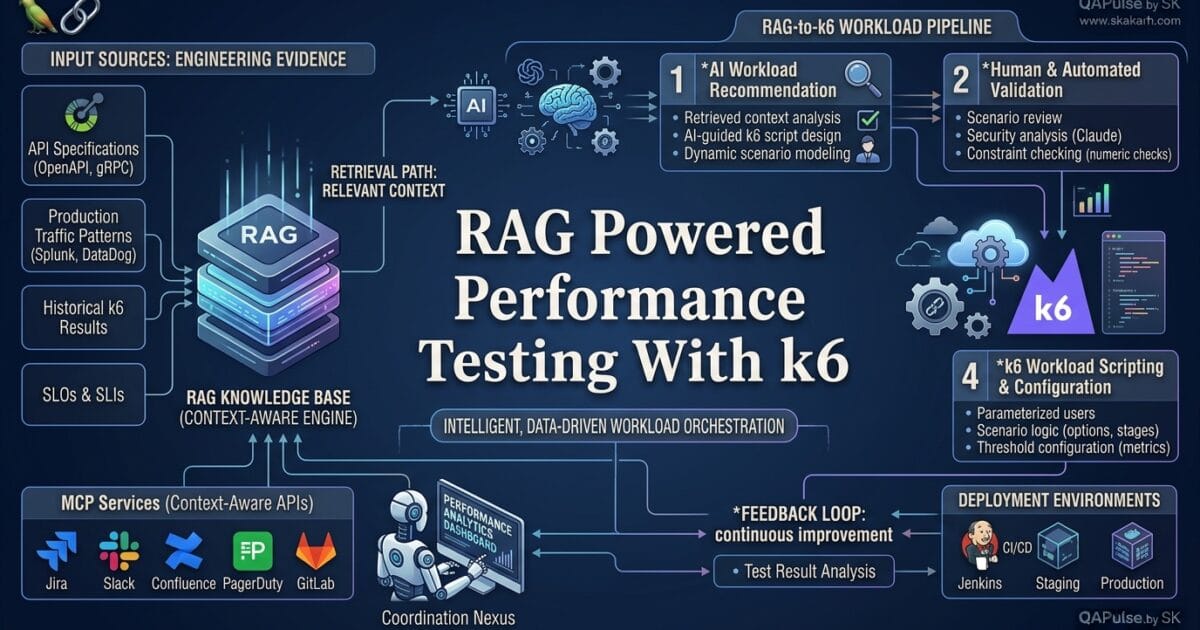
RAG Powered Performance Testing changes the way performance engineers think about realistic load. Instead of generating traffic from static assumptions, a RAG-powered performance testing workflow can retrieve current API behavior, historical test evidence, endpoint documentation, production-like payload patterns, and known performance constraints before a k6 test is executed.
The key idea is simple: your load test should know what the system actually does before it decides what traffic to generate.
Traditional performance testing often begins with a manually created k6 script:
import http from 'k6/http';
import { check } from 'k6';

export default function () {
  const response = http.get('https://api.example.com/products');

  check(response, {
    'status is 200': (r) => r.status === 200,
    'response under 500ms': (r) => r.timings.duration < 500,
  });
}
This works, but the test assumes that /products is the endpoint that matters, that a simple GET represents realistic behavior, and that 500 milliseconds is an appropriate threshold.
Those assumptions may already be wrong.
An API can evolve while its performance suite remains unchanged. New endpoints appear. Payloads become larger. Authentication flows change. Expensive database queries are introduced. A formerly lightweight endpoint starts calling multiple downstream services.
This is where RAG-powered performance testing becomes strategically interesting.
Instead of asking an engineer to remember all of that context, we can retrieve relevant engineering knowledge and use it to influence the performance scenario.


What RAG-Powered Performance Testing Actually Means
RAG stands for Retrieval-Augmented Generation.
A conventional generative AI workflow asks a model to generate a performance test from its existing knowledge. A RAG workflow adds a retrieval layer that supplies relevant project-specific information before generation.
Conceptually:
Engineering Knowledge
        ↓
Documentation
API Specifications
Previous k6 Results
Logs
Architecture Notes
Production Patterns
        ↓
     Retrieval
        ↓
 Relevant Context
        ↓
      LLM / RAG
        ↓
Performance Scenario
        ↓
       k6
        ↓
Metrics + Results
        ↓
Knowledge Store
The important part is the feedback loop.
A weak implementation uses RAG only to generate a k6 script.
A stronger implementation uses RAG to continuously connect system behavior → test design → execution evidence → future test decisions.
That distinction matters.
Traditional AI-assisted performance testing
Prompt
  ↓
LLM
  ↓
k6 script
RAG-powered performance testing
Question
  ↓
Retrieve relevant API evidence
  ↓
Context-aware generation
  ↓
k6 scenario
  ↓
Execution
  ↓
Performance evidence
  ↓
Indexed knowledge
  ↓
Better future scenarios
The second architecture gives the test engineer something much more valuable than generated code: context-aware test design.
Why Static k6 Scripts Eventually Become a Problem
k6 is excellent at executing repeatable performance scenarios. But repeatability can become a weakness when the scenario itself becomes stale.
Imagine your application has this API flow:
POST /auth/login
      ↓
GET /catalog
      ↓
GET /catalog/{id}
      ↓
POST /cart
      ↓
POST /checkout
Your k6 script might reproduce this flow perfectly.
Six months later, the architecture changes:
POST /auth/login
      ↓
GET /recommendations
      ↓
GET /catalog
      ↓
POST /cart
      ↓
POST /payment-intent
      ↓
POST /checkout
The original performance suite still passes.
But it is no longer testing the workload that matters.
This is one of the most dangerous situations in performance engineering:
A stable test can produce stable results while testing an unstable assumption.
RAG-powered performance testing addresses this by allowing the test-generation layer to retrieve current evidence before constructing the workload.
RAG vs Traditional Performance Testing
The difference becomes clearer when we compare the workflows.
| Capability | Static k6 testing | AI-generated k6 | RAG-powered performance testing |
|---|---|---|---|
| Generates k6 code | Manual | Yes | Yes |
| Uses API documentation | Manually | Sometimes | Systematically |
| Uses historical results | Manual | Usually no | Yes |
| Uses architecture context | Engineer-dependent | Limited | Yes |
| Uses known bottlenecks | Engineer-dependent | Limited | Yes |
| Adapts to API changes | Manual maintenance | Possible | Stronger |
| Provides traceable context | Yes | Limited | Yes |
| Creates feedback loop | Limited | Limited | Strong |
| Risk of stale assumptions | High | Medium | Lower |
The goal is not to replace k6.
The goal is to make the test-generation and test-selection layer smarter while keeping k6 as the execution engine.
The Architecture: From API Behavior to k6
A practical implementation can use five major layers.
Layer 1: API Behavior Sources
The first layer contains the information that describes how the system behaves.
Potential sources include:
- OpenAPI specifications
- API gateway logs
- historical k6 results
- application logs
- database query metrics
- incident reports
- performance baselines
- architecture documentation
- service dependency maps
- API examples
- known production traffic patterns
For example, an OpenAPI document might contain:
paths:
  /orders:
    post:
      summary: Create an order
      requestBody:
        required: true
      responses:
        "201":
          description: Order created
But the OpenAPI document alone does not tell us that the endpoint currently experiences high latency during checkout peaks.
A performance-result document might contain:
Endpoint: POST /orders
p95: 1420ms
p99: 2810ms
Traffic spike: 3x baseline
Primary dependency: payment-service
Observed: database connection pool saturation
Now the RAG system has something much more useful.
It can connect what the API is with how the API behaves.
Layer 2: Document Chunking and Metadata
Performance knowledge should not simply be dumped into a vector database.
It needs structure.
A useful document might look like:
{
  "endpoint": "POST /orders",
  "service": "order-service",
  "environment": "staging",
  "p95_ms": 1420,
  "p99_ms": 2810,
  "traffic_profile": "checkout_peak",
  "dependency": "payment-service",
  "date": "2026-08-10"
}
Metadata becomes particularly important when retrieving performance evidence.
You may want to ask:
Find performance results for checkout APIs
from the last 30 days
where p95 exceeded 1000ms.
That is much more useful than retrieving documents based solely on semantic similarity.
Layer 3: Retrieval
The retrieval layer searches for relevant evidence.
A simplified Python example could look like:
def retrieve_performance_context(query, vector_store):
    results = vector_store.similarity_search(
        query,
        k=5
    )

    return [
        {
            "content": item.page_content,
            "metadata": item.metadata
        }
        for item in results
    ]
But production systems should consider more than semantic similarity.
A better retrieval strategy combines:
Semantic similarity
+
Metadata filtering
+
Recency
+
Endpoint relevance
+
Performance severity
For performance engineering, recency can be critical.
A result from two years ago should not automatically outrank a result from yesterday simply because its text is semantically similar.
Layer 4: Scenario Generation
Once relevant evidence has been retrieved, an LLM can generate a workload proposal.
For example:
Retrieved evidence:

POST /orders
p95 = 1420ms
p99 = 2810ms
Traffic profile = checkout_peak
Dependency = payment-service
Observed issue = connection pool saturation

Generate a k6 scenario that:
1. Models checkout traffic.
2. Uses realistic request sequencing.
3. Applies gradual ramp-up.
4. Measures p95 and p99.
5. Avoids uncontrolled traffic amplification.
6. Validates the order response.
The generated result could look like:
import http from 'k6/http';
import { check, sleep } from 'k6';

export const options = {
  stages: [
    { duration: '2m', target: 20 },
    { duration: '5m', target: 50 },
    { duration: '2m', target: 100 },
    { duration: '2m', target: 0 },
  ],

  thresholds: {
    http_req_duration: ['p(95)<1000'],
    http_req_failed: ['rate<0.01'],
  },
};

export default function () {
  const payload = JSON.stringify({
    productId: 'product-123',
    quantity: 1,
  });

  const response = http.post(
    'https://api.example.com/orders',
    payload,
    {
      headers: {
        'Content-Type': 'application/json',
      },
    }
  );

  check(response, {
    'order created': (r) => r.status === 201,
  });

  sleep(1);
}
The important point is not that AI generated the JavaScript.
The important point is why those workload parameters were selected.
Don’t Let RAG Invent Performance Thresholds
This is where many AI-assisted testing implementations can become dangerous.
Suppose the retrieved documentation says:
Target p95: < 1000ms
Target error rate: < 1%
The generator can use those values.
But if no evidence exists, the model should not simply invent:
http_req_duration: ['p(95)<500']
That number might look professional while being completely arbitrary.
A safer design is:
if not performance_baseline:
    raise ValueError(
        "No approved performance baseline found."
    )
This creates an important engineering principle:
AI should retrieve performance expectations; it should not manufacture them.
RAG-Powered Performance Testing Needs Guardrails
A production-quality implementation should introduce validation before executing generated tests.
A useful pipeline is:
Retrieve
   ↓
Generate
   ↓
Static validation
   ↓
Policy validation
   ↓
Human approval
   ↓
k6 execution
For example:
def validate_scenario(scenario):
    if scenario.max_vus > 500:
        raise ValueError("VUS limit exceeded")

    if scenario.duration_minutes > 30:
        raise ValueError("Maximum duration exceeded")

    if not scenario.baseline:
        raise ValueError("Performance baseline missing")

    return True
This prevents an LLM from accidentally producing an extremely expensive or unsafe load test.
Comparing RAG With AI Agents
RAG and agentic testing are related, but they are not identical.
| Approach | Primary capability | Best use |
|---|---|---|
| Traditional k6 | Deterministic execution | Repeatable load tests |
| AI-generated k6 | Code generation | Faster script creation |
| RAG | Context retrieval | Evidence-driven test design |
| AI agent | Planning + tool execution | Autonomous testing workflows |
| RAG + agent | Retrieval + reasoning + execution | Adaptive performance engineering |
A useful architecture can therefore combine them:
Agent
  ↓
Ask:
"What should I test?"
  ↓
RAG
  ↓
Retrieve:
API + architecture + history + baselines
  ↓
Agent
  ↓
Generate scenario
  ↓
Validate
  ↓
k6
  ↓
Analyze results
  ↓
Store evidence
The agent becomes the orchestrator.
RAG becomes the knowledge layer.
k6 remains the performance execution engine.
The QA Strategy Changes From Script-Centric to Evidence-Centric
This is perhaps the biggest conceptual shift.
Traditional performance engineering often asks:
“Which script should we run?”
A more intelligent workflow asks:
“What evidence tells us which behavior deserves load?”
That changes the testing strategy.
Instead of maintaining only:
tests/
  checkout.js
  login.js
  catalog.js
you can maintain a performance knowledge system containing:
API behavior
+
Traffic patterns
+
Performance baselines
+
Known bottlenecks
+
Historical regressions
+
Architecture dependencies
The k6 scripts then become executable expressions of that knowledge.


A Practical RAG-to-k6 Data Model
A useful performance record could contain:
{
  "endpoint": "POST /orders",
  "method": "POST",
  "service": "order-service",
  "traffic_profile": "checkout",
  "baseline": {
    "p95_ms": 1000,
    "p99_ms": 2000,
    "error_rate": 0.01
  },
  "observed": {
    "p95_ms": 1420,
    "p99_ms": 2810,
    "error_rate": 0.018
  },
  "dependencies": [
    "payment-service",
    "inventory-service"
  ],
  "risk": "high"
}
Now retrieval can answer questions such as:
Which checkout APIs currently exceed
their approved p95 baseline?
Or:
Which APIs depend on payment-service
and experienced regressions during the
last three releases?
Those are much better inputs for intelligent performance-test planning than:
Generate a k6 test for my API.
Make the Workflow Interactive
Try this exercise with your own API.
Pick one endpoint and answer:
1. What is its normal traffic volume?
2. What is its p95?
3. What is its p99?
4. What dependencies does it call?
5. Which historical test exposed its worst behavior?
6. What payload represents realistic usage?
7. What is the approved failure threshold?
If your team cannot answer these questions, the biggest problem may not be the k6 script.
It may be the lack of performance knowledge.
That is exactly where RAG-powered performance testing can provide value.
Instead of merely generating another script, build a system that makes this information discoverable.
Where This Approach Can Fail
RAG is not magic.
Poor retrieval produces poor test scenarios.
Failure 1: Stale documents
If your vector store contains obsolete API behavior, the generated workload can reproduce outdated assumptions.
Failure 2: Missing metadata
Without environment, date, endpoint and service metadata, retrieval can mix unrelated performance results.
Failure 3: Incorrect baselines
If historical numbers are treated as current targets without validation, the test may enforce obsolete expectations.
Failure 4: Synthetic payloads
AI can generate technically valid payloads that do not represent real user behavior.
Failure 5: Uncontrolled load
A generated k6 script can create excessive traffic if VU limits and execution policies are not enforced.
The solution is not to remove AI.
The solution is to surround AI with retrieval quality, validation and execution controls.
The Production-Ready Mental Model
A mature architecture should look like this:
                 ┌───────────────────┐
                 │ API Documentation │
                 └─────────┬─────────┘
                           │
┌───────────────┐          │
│ Historical k6 │──────────┤
│    Results    │          │
└───────────────┘          │
                           ▼
                  ┌─────────────────┐
                  │ Knowledge Store │
                  └────────┬────────┘
                           │
                           ▼
                  ┌─────────────────┐
                  │    Retrieval    │
                  └────────┬────────┘
                           │
                           ▼
                  ┌─────────────────┐
                  │      LLM        │
                  └────────┬────────┘
                           │
                           ▼
                  ┌─────────────────┐
                  │ Scenario Policy │
                  │   Validation    │
                  └────────┬────────┘
                           │
                           ▼
                    ┌────────────┐
                    │    k6      │
                    └─────┬──────┘
                          │
                          ▼
                    ┌────────────┐
                    │  Results   │
                    └─────┬──────┘
                          │
                          └──────► Knowledge Store
This creates a feedback loop rather than a one-time generation process.
The system learns from evidence, not from imagined behavior.
The Strategic Advantage
The most valuable outcome of RAG-powered performance testing is not faster script creation.
It is faster decision-making.
A performance engineer can move from:
"I think checkout is important."
to:
"Checkout represents 38% of observed traffic,
POST /orders exceeded its p95 baseline by 42%,
payment-service is its highest-risk dependency,
and the last three releases show increasing latency."
That is a fundamentally better foundation for performance testing.
And once that evidence is available to the test-generation layer, k6 becomes more than a load generator.
It becomes the execution layer for an evidence-driven performance engineering system.
Turning RAG Into a Performance-Test Decision Engine
RAG powered performance testing becomes significantly more useful when it stops behaving like a documentation lookup mechanism and starts influencing how a performance test behaves. The real opportunity is not simply asking an AI system to explain a k6 script. It is allowing current API behavior, historical test evidence, service contracts, and known performance risks to influence the workload itself.
That distinction matters.
A traditional k6 test usually follows a fixed model:
Test script
   ↓
Fixed requests
   ↓
Fixed data
   ↓
Fixed thresholds
   ↓
Performance results
A RAG-driven approach can create a more adaptive loop:
API behavior
     ↓
Telemetry + contracts + history
     ↓
Retrieval
     ↓
RAG context
     ↓
Workload decisions
     ↓
k6 execution
     ↓
New performance evidence
     ↓
Updated knowledge
This changes the role of AI from test assistant to test intelligence layer.
Feed Real API Behavior Into the Test
Suppose your application exposes:
GET /api/products
GET /api/products/{id}
POST /api/orders
GET /api/orders/{id}
A conventional performance test may distribute traffic like this:
export const options = {
  scenarios: {
    workload: {
      executor: 'constant-vus',
      vus: 50,
      duration: '10m',
    },
  },
};
The problem is that those numbers may have little relationship to what users actually do.
Production telemetry might show:
/api/products          52%
/api/products/{id}     23%
/api/orders             8%
/api/orders/{id}       17%
Now your workload can represent observed behavior rather than assumptions.
const distribution = {
  products: 0.52,
  productDetails: 0.23,
  createOrder: 0.08,
  orderDetails: 0.17,
};
The strategic improvement is simple:
Performance tests should model behavior, not merely endpoints.
RAG helps connect the behavioral evidence with the test-generation process.
Image placement
Image prompt:
“Technical architecture diagram showing production API telemetry flowing into a RAG retrieval layer containing API contracts, historical k6 results, incident reports and performance baselines, then generating adaptive k6 workloads, modern software engineering architecture, clean professional infographic, QAPulse by SK branding”
Why Static Workloads Eventually Become Weak
Consider two systems.
| Approach | Static k6 test | RAG-driven performance testing |
|---|---|---|
| Traffic model | Manually defined | Evidence-informed |
| API knowledge | Embedded in scripts | Retrieved dynamically |
| Historical results | Often separate | Can become retrievable context |
| Incident knowledge | Manual review | Available to retrieval |
| Endpoint changes | Script maintenance | Context can reflect changes |
| Workload adaptation | Limited | Possible |
| Test intelligence | Mostly human | Human + AI |
| Reusability | Script dependent | Knowledge + script dependent |
This does not mean that RAG should automatically rewrite production performance tests.
That would introduce another problem: unpredictability.
A better architecture separates recommendation from execution.
RAG
 ↓
Recommend workload
 ↓
Human/CI validation
 ↓
Approved configuration
 ↓
k6
 ↓
Results
That design gives you AI-assisted intelligence without giving an LLM uncontrolled authority over your load generator.
Build a Performance Knowledge Base
The quality of RAG powered performance testing depends heavily on the quality of the information being retrieved.
A useful performance knowledge base could contain:
API specifications
Architecture documentation
Historical k6 results
Performance baselines
Production traffic distributions
Known bottlenecks
Incident reports
SLOs
Database query information
Capacity planning documents
Previous test scenarios
Release notes
For example, imagine your knowledge base contains this historical observation:
Endpoint: POST /api/orders

Baseline:
p95: 420ms
p99: 810ms

At 500 RPS:
p95: 1.2s
p99: 2.7s

Primary bottleneck:
Order database connection pool.

Known mitigation:
Increase pool from 30 to 50 connections.
A conventional test runner does not automatically understand what this means.
A RAG system can retrieve this evidence when someone asks:
Generate a performance scenario for the order API
based on historical bottlenecks and current API behavior.
The retrieved context can influence the proposed workload.
For example:
Recommended workload:

POST /api/orders
Target: 500 RPS
Warm-up: 5 minutes
Sustained load: 15 minutes
Stress phase: 700 RPS
Primary metric: p95 latency
Secondary metric: database connection utilization
The important point is that the recommendation is backed by retrieved evidence.
RAG Should Retrieve Evidence, Not Invent Performance Facts
This is one of the most important design principles.
An LLM can confidently produce:
The API supports 2,000 requests per second.
But where did that number come from?
If the system has no benchmark supporting it, the statement is useless for performance engineering.
Instead, your RAG pipeline should retrieve supporting information:
Current production peak: 430 RPS
Previous stress test: 600 RPS
Observed degradation: 650 RPS
SLO: p95 < 800ms
The model can then reason:
The existing evidence suggests that 600 RPS
is a meaningful stress point because previous testing
identified degradation near this level.
That is much safer.
A Practical Retrieval Structure
You can represent performance knowledge as structured documents:
{
  "endpoint": "POST /api/orders",
  "environment": "production",
  "baseline_rps": 430,
  "stress_rps": 600,
  "p95_ms": 420,
  "p99_ms": 810,
  "known_bottleneck": "database connection pool",
  "source": "k6-test-2026-07-28"
}
The embedding layer can make this information searchable semantically.
A query such as:
What is the historical stress limit for order creation?
can retrieve the relevant evidence even if the stored document uses different wording.
Combine RAG With k6 Thresholds
The biggest mistake would be treating RAG as a replacement for deterministic performance assertions.
It is not.
k6 should continue to enforce measurable thresholds.
export const options = {
  thresholds: {
    http_req_failed: ['rate<0.01'],
    http_req_duration: ['p(95)<800'],
  },
};
The RAG layer can help determine why these thresholds matter and which workload should be tested.
For example:
RAG context:
SLO = p95 < 800ms

Historical degradation:
p95 exceeds 800ms above 600 RPS
The resulting k6 test remains deterministic:
thresholds: {
  http_req_duration: ['p(95)<800'],
}
This separation is powerful:
RAG → intelligence and context

k6 → execution and measurement
You get flexibility without sacrificing test reliability.
Compare RAG With AI Test Generation
These concepts are related but not identical.
| Capability | AI test generation | RAG | RAG + k6 |
|---|---|---|---|
| Generate scripts | Strong | Strong | Strong |
| Use company-specific knowledge | Limited | Strong | Strong |
| Retrieve historical results | Limited | Strong | Strong |
| Execute load | No | No | Yes |
| Measure latency | No | No | Yes |
| Enforce thresholds | No | No | Yes |
| Adapt workload | Possible | Possible | Practical |
| Evidence-based recommendations | Variable | Strong | Strong |
An AI coding assistant might generate:
http.get(`${BASE_URL}/api/orders`);
That is useful.
But RAG can answer a more valuable question:
Which endpoints should we load, at what ratios, and why?
Then k6 answers the engineering question:
What actually happens under that workload?
That combination creates a much stronger performance engineering workflow.
Create a Closed Feedback Loop
The most interesting architecture is not one-way retrieval.
It is continuous learning.
Imagine a test runs at 500 RPS.
The results are:
Requests:       450,000
Failure rate:   0.8%
p50:            210ms
p95:            690ms
p99:            1.4s
The result can be converted into structured evidence.
{
  "test": "orders-load-test",
  "rps": 500,
  "duration": "15m",
  "error_rate": 0.008,
  "p95_ms": 690,
  "p99_ms": 1400
}
That evidence can then be indexed into your performance knowledge base.
The next RAG query can retrieve it.
Now the system has historical context:
Previous:
500 RPS → p95 690ms

Older:
600 RPS → p95 1.2s
The next workload can be designed around those observations.
This creates a feedback loop:
Test
 ↓
Measure
 ↓
Store
 ↓
Retrieve
 ↓
Reason
 ↓
Improve workload
 ↓
Test again
This is where RAG powered performance testing starts becoming an engineering system rather than an AI gimmick.
Make the System Interactive for Engineers
Do not hide the reasoning behind an automated pipeline.
Give engineers a way to interrogate the evidence.
For example:
Engineer:
Why are you recommending 600 RPS?

RAG:
A previous test reached 600 RPS and produced
1.2s p95 latency. Production traffic currently
peaks at 430 RPS. The recommendation uses 500 RPS
as sustained load and 600 RPS as the stress phase.

Sources:
- k6-test-2026-07-28
- production-traffic-2026-08-10
- orders-api-slo
This is dramatically more useful than:
AI generated a 600 RPS test.
The engineer can challenge the recommendation.
Engineer:
What if production traffic increases by 40%?

RAG:
Current peak = 430 RPS

430 × 1.40 = 602 RPS

Recommended stress target:
650 RPS
Now the system is supporting engineering decisions rather than pretending to replace them.
Use Different Workload Profiles
A single load profile is rarely sufficient.
RAG can help select different scenarios based on retrieved evidence.
Baseline
Production-like traffic
Expected normal behavior
Stress
Historical degradation point
+ safety margin
Spike
Sudden traffic increase
Soak
Long-duration stability
Breakpoint
Incrementally increase load
until SLO failure
For example:
export const options = {
  scenarios: {
    baseline: {
      executor: 'constant-arrival-rate',
      rate: 400,
      timeUnit: '1s',
      duration: '10m',
      preAllocatedVUs: 100,
    },

    stress: {
      executor: 'ramping-arrival-rate',
      startRate: 400,
      timeUnit: '1s',
      stages: [
        { target: 500, duration: '5m' },
        { target: 600, duration: '5m' },
        { target: 700, duration: '5m' },
      ],
      preAllocatedVUs: 150,
    },
  },
};
The important part is not the JavaScript.
The important part is why those numbers exist.
That explanation should come from measurable evidence.
Protect the Pipeline From Bad Retrieval
RAG introduces a new failure mode: incorrect context.
Imagine your vector database retrieves an old benchmark:
2024:
API capacity = 800 RPS
But the service architecture changed in 2026.
If the system blindly uses that information, it could generate a completely misleading test.
Therefore, retrieval should consider metadata.
{
  "source": "performance-test",
  "service": "orders",
  "environment": "production",
  "version": "2026.08",
  "timestamp": "2026-08-10",
  "confidence": "high"
}
You can then prioritize recent evidence.
Conceptually:
documents = retrieve(
    query,
    filters={
        "service": "orders",
        "environment": "production"
    }
)

documents = sort_by_recency(documents)
This is especially important for systems whose APIs and infrastructure change rapidly.
Add a Human Approval Gate
For production-grade performance engineering, an AI-generated workload should not automatically become an uncontrolled production test.
A safer pipeline looks like this:
Production/API evidence
        ↓
RAG retrieval
        ↓
AI recommendation
        ↓
Engineer review
        ↓
Git commit
        ↓
CI pipeline
        ↓
k6 execution
        ↓
Results
The engineer can inspect:
Traffic model
Endpoints
Request rates
Thresholds
Test duration
Environment
Data requirements
Risk level
Then approve the test.
This also gives you an audit trail.
A Useful Repository Structure
A practical implementation might look like:
performance-intelligence/
├── api/
│   ├── openapi.yaml
│   └── graphql-schema.graphql
├── knowledge/
│   ├── baselines/
│   ├── incidents/
│   ├── slo/
│   └── historical-tests/
├── rag/
│   ├── ingestion.py
│   ├── retrieval.py
│   └── reasoning.py
├── k6/
│   ├── baseline.js
│   ├── stress.js
│   └── spike.js
└── results/
    └── latest.json
This separation prevents the RAG system from becoming tangled with the actual load-generation code.
The Strategic Difference: Generate Less, Understand More
The temptation with AI-assisted testing is to generate thousands of test scripts.
That is usually the wrong optimization.
A mature performance engineering platform should instead reduce the number of decisions engineers must make manually.
For example:
Old workflow:

Engineer researches API
        ↓
Engineer reads historical tests
        ↓
Engineer finds production traffic
        ↓
Engineer designs workload
        ↓
Engineer writes k6
        ↓
Engineer runs test
        ↓
Engineer analyzes results
A RAG-assisted workflow becomes:
Engineer defines objective
        ↓
RAG retrieves evidence
        ↓
AI proposes workload
        ↓
Engineer validates
        ↓
k6 executes
        ↓
Results become evidence
The engineer remains accountable, but spends less time searching for information.
That is the real productivity gain.
Answer Engine Optimization
RAG powered performance testing is an approach that combines retrieval-augmented generation with performance testing so that API contracts, production traffic, historical performance results, SLOs, and other engineering evidence can influence the design of k6 workloads.
AI Overview Optimization
What Is RAG Powered Performance Testing?
RAG powered performance testing uses retrieval-augmented generation to provide performance-test generation or workload-design systems with relevant engineering context such as API contracts, traffic patterns, historical k6 results, SLOs, and performance baselines.
How Does RAG Improve k6 Testing?
RAG can provide k6 workload generation with evidence about how an API actually behaves. Instead of creating request ratios entirely from assumptions, the system can retrieve historical traffic patterns, endpoint usage, latency data, and previous test results before recommending a workload.
Does RAG Replace k6?
No. RAG provides context and intelligence for workload design, while k6 remains responsible for executing the performance workload and collecting metrics such as response time, throughput, failures, and percentile latency.
AI Overview-Friendly Comparison
| Traditional Approach | RAG-Assisted Approach |
|---|---|
| Manual workload assumptions | Evidence-based workload recommendations |
| Static request distribution | Production-informed request distribution |
| Separate historical reports | Historical results available during retrieval |
| Manually selected scenarios | Context-aware scenario recommendations |
| Test results reviewed separately | Results can feed a continuous knowledge loop |
| Human creates most workload logic | AI assists workload design |
| k6 executes the test | k6 still executes the test |
People Asked Questions
What is RAG powered performance testing?
RAG powered performance testing combines retrieval-augmented generation with performance testing so that API behavior, production traffic, historical results, SLOs, and other engineering knowledge can influence performance workload design.
How does RAG work with k6?
RAG retrieves relevant engineering information and provides it as context for workload recommendations or test generation. k6 then executes the validated workload and collects performance metrics.
Can RAG generate k6 tests?
Yes. A RAG system can retrieve API specifications, traffic patterns, historical performance results, and SLOs and use that information to help generate or recommend k6 scenarios. Generated tests should be reviewed before execution.
Why use real API behavior in performance testing?
Real API behavior can reveal endpoint popularity, request distributions, payload characteristics, dependencies, and historical latency patterns. Using this evidence can make workloads more representative than arbitrary assumptions.
Can production traffic be used with k6?
Production traffic patterns can be used to model realistic workloads, but sensitive information should be anonymized, filtered, and handled according to the organization’s security and privacy requirements.
Is RAG better than traditional performance testing?
RAG does not replace traditional performance testing. It improves the information available during workload design. Tools such as k6 still execute the workload and measure the system’s performance.
What data should be stored for RAG performance testing?
Useful information includes API specifications, endpoint usage, historical performance results, SLOs, latency baselines, traffic distributions, known bottlenecks, incidents, capacity information, and architecture documentation.
Can AI automatically execute performance tests?
It can technically be integrated into automated pipelines, but production-grade systems should introduce validation and authorization controls before allowing AI-generated workloads to execute against sensitive environments.
What is the difference between RAG and AI test generation?
AI test generation focuses on creating tests. RAG adds relevant external knowledge to the generation process, allowing the generated workload to be based on actual engineering evidence rather than only the model’s general knowledge.
Does RAG make performance tests dynamic?
RAG can make workload recommendations context-aware by retrieving current or historical information. However, the actual k6 workload should remain controlled and deterministic enough to produce meaningful performance measurements.
Internal Series Links
- Learn MCP – Zero to Hero
- Learn AI Agents for QA – Zero to Hero
- Playwright Automation – Zero to Hero
- TencentDB Agent Memory: Complete Zero to Hero
- LangGraph: Complete Zero to Hero
- Learn Python – Zero to Hero
- OpenAI Codex: Complete Zero to Hero
- Cursor AI: Complete Zero to Hero
- Claude Code Tutorial: Complete Zero to Hero
- AutoGen: Complete Zero to Hero Guide
- Free QA Resources Built From Real Experience
- QA Glossary: Test Automation Terms Every Engineer Should Know
External Links
- https://www.postgresql.org
- Grafana k6 Documentation
- Grafana k6 GitHub Repository
- LangChain Documentation
- LangChain GitHub Repository
- OpenAI Platform Documentation
Conclusion
RAG powered performance testing is most valuable when retrieval is connected to real engineering evidence: API contracts, production traffic, historical k6 runs, SLOs, incidents, bottlenecks, and previous capacity experiments.
The winning architecture is not LLM → generate k6 script.
It is:
Real system behavior
        ↓
Performance evidence
        ↓
RAG retrieval
        ↓
Evidence-based workload recommendation
        ↓
Human validation
        ↓
k6 execution
        ↓
Measured results
        ↓
New performance evidence
That creates a performance testing system capable of using what the organization already knows instead of starting every test from an empty JavaScript file.
The strategic lesson is simple: use RAG to improve decisions, and use k6 to prove those decisions against reality.
Final Key Takeaways
- RAG powered performance testing should connect AI reasoning with real API and performance evidence.
- RAG is best used for context, recommendations, and workload intelligence, not uncontrolled test execution.
- k6 should remain responsible for load generation, measurements, and deterministic thresholds.
- Production traffic data can make workloads much more realistic than manually invented request ratios.
- Historical performance results can help identify meaningful baseline, stress, spike, and breakpoint targets.
- Retrieved evidence should include timestamps, service versions, environments, and source metadata to reduce stale-context problems.
- AI recommendations should pass through a human approval gate before becoming executable performance tests.
- Test results can be fed back into the knowledge base, creating a continuous measure → retrieve → reason → test feedback loop.
- The biggest opportunity is not generating more performance scripts; it is helping engineers make better workload and capacity decisions faster.
- The strongest architecture keeps the responsibilities clear: RAG provides intelligence; k6 provides empirical proof.
Continue Learning
Explore more expert articles on Mobile Testing, Backend & API, AI & Agentic, AI Tools, n8n, LangChain, CrewAI, MCP Servers, AI Agents, LlamaIndex, Docker, FastAPI, Playwright, Cypress, Test Automation, DevOps, and Software Engineering at www.skakarh.com.
QAPulse by SK delivers expert release analysis, AI engineering insights, enterprise automation strategies, migration guidance, DevOps best practices, and practical testing knowledge to help software professionals build scalable, intelligent, and production-ready software systems.