 QA
QA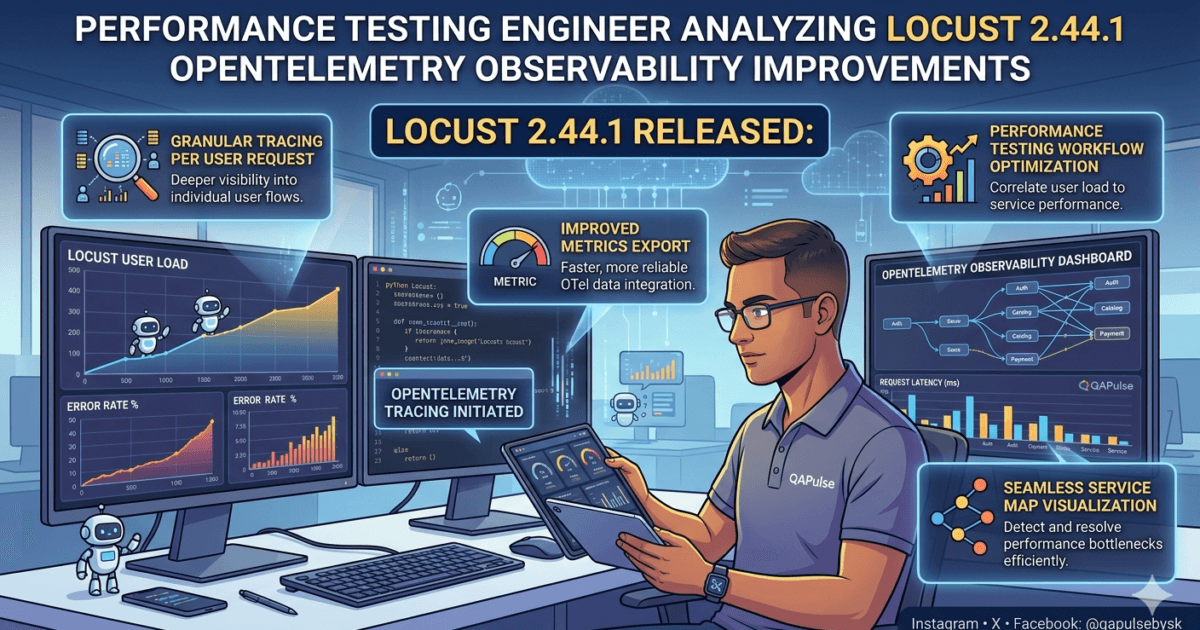
The Locust team has officially released Locust 2.44.1, a maintenance update that focuses on documentation improvements, OpenTelemetry enhancements, logging support, and better visibility into performance testing environments.
While this is not a major feature release, it contains several improvements that are particularly relevant for QA Engineers, SDETs, Performance Test Engineers, DevOps teams, and organizations building modern observability-driven testing strategies.
For teams already using Locust in production, this update is worth reviewing because observability and telemetry continue to become critical components of performance engineering.
What Is Locust 2.44.1?
Locust 2.44.1 is the latest maintenance release of the popular open-source load testing framework written in Python.
Locust is widely used for:
- API load testing
- Performance testing
- Stress testing
- Scalability testing
- Distributed load generation
- Cloud performance validation
Official Release Notes:
https://github.com/locustio/locust/releases/tag/2.44.1
Official Documentation:
Official Website:
Why Locust 2.44.1 Matters for QA Engineers
Modern performance testing is no longer limited to measuring response times.
Today’s engineering teams must understand:
- Application bottlenecks
- Infrastructure behavior
- Distributed system performance
- Cloud resource utilization
- End-to-end request tracing
This is where observability becomes essential.
Several updates in Locust 2.44.1 directly support this evolution.
What’s New in Locust 2.44.1?
OpenTelemetry Resource Metadata Improvements
One of the most important enhancements adds:
- hostname
- locustfile
- profile
to OpenTelemetry resource metadata.
Why This Matters
Performance testing environments often generate large amounts of telemetry data.
Without sufficient metadata, it becomes difficult to determine:
- Which load test generated traffic
- Which environment was targeted
- Which test profile was executed
The new metadata additions make telemetry analysis significantly easier.
QA Impact
Teams using:
- Grafana
- Jaeger
- Tempo
- Datadog
- New Relic
- Azure Monitor
can now gain better visibility into load test execution contexts.
OpenTelemetry Logging Support Added
Another major enhancement introduces:
Logging support for OpenTelemetry.
Why This Is Important
Performance engineers frequently struggle to correlate:
- Test execution
- Infrastructure metrics
- Application traces
- System logs
By improving OpenTelemetry logging integration, Locust moves closer to a complete observability ecosystem.
Benefits for QA Teams
Organizations can now more easily:
- Correlate failures
- Troubleshoot bottlenecks
- Analyze distributed systems
- Investigate performance regressions
This is arguably the most valuable improvement in Locust 2.44.1.
Azure Load Testing Documentation Added
The release also improves documentation around:
- Azure Load Testing
- Locust integration
Why This Matters
Many enterprise organizations are moving performance testing workloads into cloud environments.
Azure users can benefit from clearer guidance on:
- Deployment
- Integration
- Execution
- Scaling
Impact on Enterprise Teams
Organizations already invested in Microsoft Azure will likely find this documentation update valuable for operational adoption.
AIOLocust Documentation Improvements
Locust 2.44.1 now includes documentation updates related to:
AIOLocust
Why This Matters
Async performance testing continues to grow in importance because modern systems increasingly rely on:
- Event-driven architectures
- Async APIs
- Microservices
- Streaming systems
Improved guidance helps teams better understand how asynchronous testing approaches fit into their performance engineering strategy.
Security and Route Protection Improvements
The release also introduces documentation improvements around:
Guarding custom web routes without the web UI.
QA Perspective
Organizations that expose custom Locust endpoints should review:
- Authentication
- Authorization
- Access controls
- Route protection
This update encourages stronger operational security practices.
Impact on Performance Testing Teams
| Area | Impact |
|---|---|
| OpenTelemetry Integration | High |
| Observability | High |
| Azure Load Testing | Medium |
| Async Performance Testing | Medium |
| Security Practices | Medium |
| Existing Test Scripts | Low |
Impact on SDETs
SDETs responsible for performance automation can benefit from:
- Better telemetry context
- Improved debugging
- Enhanced monitoring visibility
- Easier root cause analysis
The OpenTelemetry improvements are especially useful in enterprise environments where multiple teams analyze performance data.
Impact on DevOps Teams
DevOps engineers should pay particular attention to:
- OpenTelemetry logging
- Distributed tracing
- Monitoring integrations
- Cloud-native performance testing
The release helps improve observability across testing pipelines.
Impact on AI Testing Teams
AI-powered systems frequently involve:
- Distributed services
- Vector databases
- LLM APIs
- Retrieval systems
- Event-driven processing
Performance testing these architectures requires strong observability.
The telemetry improvements in Locust 2.44.1 make performance investigations easier in AI-centric environments.
What Should QA Engineers Test After Upgrading?
Functional Validation
Verify:
- Existing Locust scripts
- Distributed workers
- Master-worker communication
Observability Validation
Verify:
- OpenTelemetry exports
- Logging integrations
- Resource attributes
- Monitoring dashboards
Cloud Validation
Test:
- Azure integrations
- Container deployments
- Kubernetes execution
Reporting Validation
Ensure:
- Metrics remain accurate
- Dashboards display correctly
- Historical comparisons remain valid
Migration Guide
Upgrade Locust
pip install --upgrade locust
Verify Version
locust --version
Validate OpenTelemetry
After upgrading, verify:
- Resource metadata collection
- Log exports
- Trace exports
- Monitoring dashboards
Testing Checklist
Performance Testing
✅ Existing test scripts
✅ Distributed execution
✅ Worker communication
Observability Testing
✅ OpenTelemetry traces
✅ Log exports
✅ Metrics exports
✅ Dashboard validation
Cloud Testing
✅ Azure integrations
✅ Kubernetes deployments
✅ Docker environments
Security Testing
✅ Custom route protection
✅ Access controls
✅ Endpoint restrictions
Upgrade Recommendation
Upgrade Immediately If
✅ You use OpenTelemetry
✅ You rely on distributed observability
✅ You integrate Locust with monitoring platforms
✅ You use Azure Load Testing
Additional Validation Recommended If
⚠️ You maintain custom monitoring integrations
⚠️ You have enterprise observability pipelines
⚠️ You use custom telemetry exporters
My QA Assessment of Locust 2.44.1
Biggest Win
OpenTelemetry logging support.
Most Valuable Enterprise Improvement
Additional OpenTelemetry resource metadata.
Most Useful Documentation Update
Azure Load Testing guidance.
Upgrade Risk
Very Low.
Enterprise Recommendation
Upgrade during the next planned maintenance cycle.
Overall Rating
8.6/10
Although Locust 2.44.1 is primarily a maintenance release, the observability enhancements provide meaningful value for performance engineering teams.
Comparison: Locust 2.44.1 vs Previous Release
| Feature Area | Locust 2.44.0 | Locust 2.44.1 |
|---|---|---|
| OpenTelemetry Metadata | Basic | Enhanced |
| OpenTelemetry Logging | Limited | Improved |
| Azure Load Testing Docs | Basic | Expanded |
| AIOLocust Documentation | Limited | Improved |
| Security Guidance | Basic | Enhanced |
More Relevant Articles
- Test Automation Strategy: The Dangerous Truth About Chasing 100% Automation Coverage in 2026
- AI-Powered Test Automation Framework: Powerful Complete Guide for 2026
- Why QA Observability Will Become Bigger Than Automation Frameworks in 2026
- Test Automation Strategy: The Dangerous Truth About Chasing 100% Automation Coverage in 2026
- What is Playwright? Powerful Beginner Guide for QA Engineers in 2026
Official Resources
Official Release Notes
https://github.com/locustio/locust/releases/tag/2.44.1
Full Changelog
https://github.com/locustio/locust/compare/2.44.0…2.44.1
Documentation
Official Website
OpenTelemetry
Azure Load Testing
https://learn.microsoft.com/en-us/azure/load-testing
Frequently Asked Questions
What is Locust 2.44.1?
Locust 2.44.1 is a maintenance release focused on OpenTelemetry improvements, observability enhancements, documentation updates, and performance testing ecosystem support.
Does Locust 2.44.1 contain breaking changes?
No major breaking changes were announced in this release.
What is the most important update?
OpenTelemetry logging support and enhanced telemetry resource metadata are the most impactful changes.
Should performance testing teams upgrade?
Most teams can safely upgrade after standard validation testing.
Why is OpenTelemetry important for performance testing?
OpenTelemetry helps correlate traces, logs, metrics, and load testing activity, making root cause analysis significantly easier.
Does this release improve Azure integrations?
The release improves Azure Load Testing documentation and guidance for users deploying Locust in Microsoft Azure environments.
What should QA teams validate after upgrading?
OpenTelemetry exports, logging integrations, monitoring dashboards, distributed execution, and cloud integrations.
Is Locust still relevant in 2026?
Absolutely. Locust remains one of the most widely used Python-based performance testing frameworks for APIs, distributed systems, and cloud-native applications.
Final Thoughts
Locust 2.44.1 may not introduce headline-grabbing features, but it strengthens one of the most important aspects of modern performance engineering: observability.
The improvements to OpenTelemetry logging, telemetry metadata, Azure Load Testing guidance, and AIOLocust documentation help QA Engineers and Performance Test Architects build more reliable and diagnosable testing environments.
For teams focused on distributed systems, cloud-native applications, APIs, AI platforms, and performance engineering, this release is a worthwhile upgrade.