 QA
QA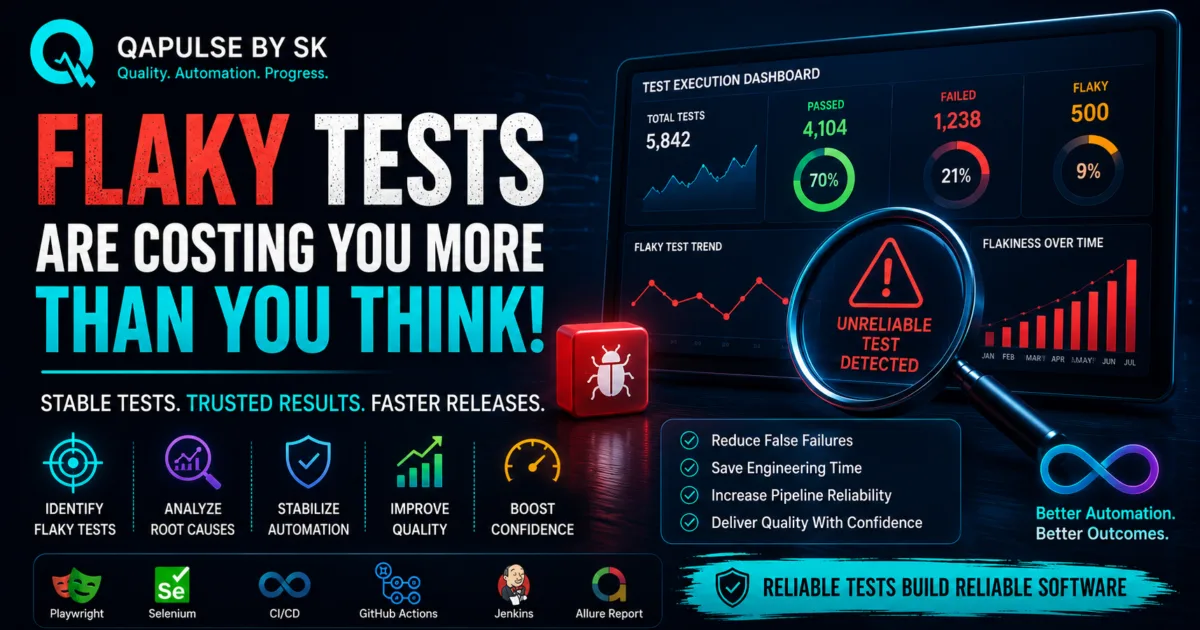
Flaky Test Management Is Quietly Destroying Automation Teams
Imagine this scenario.
Your CI/CD pipeline runs overnight.
The next morning, the dashboard shows:
❌ 12 Failed Tests
The team immediately starts investigating.
Developers pause deployments.
QA engineers begin debugging.
Slack channels become active.
Meetings get scheduled.
Hours later someone discovers the truth:
Nothing was actually broken.
The failures were caused by flaky tests.
Every experienced automation engineer has seen this happen.
And yet many organizations still underestimate how damaging flaky tests can be.
In fact, one of the biggest reasons automation initiatives fail is not framework selection.
It is not Playwright.
It is not Selenium.
It is not Cypress.
It is poor Flaky Test Management.
As automation suites grow larger, flaky tests become one of the most expensive hidden costs in software quality engineering.
What is Flaky Test Management?
Quick Answer
Flaky Test Management is the practice of identifying, analyzing, reducing, and preventing unstable automated tests that produce inconsistent results.
A flaky test is a test that:
- Passes sometimes
- Fails sometimes
- Produces inconsistent outcomes
- Does not reliably reflect application quality
Example
Today:
PASS
Tomorrow:
FAIL
Same code.
Same environment.
Same test.
Different result.
That is a flaky test.
Why Flaky Tests Are So Dangerous
Many teams dismiss flaky tests as a minor annoyance.
That mindset is dangerous.
Flaky tests create consequences that extend far beyond testing.
Hidden Business Impact
| Problem | Impact |
|---|---|
| False failures | Wasted investigation |
| Deployment delays | Slower releases |
| Lost confidence | Teams ignore failures |
| Increased costs | Engineering waste |
| Reduced velocity | Slower delivery |
Over time, these effects compound.
The Real Cost of a Flaky Test
Most organizations calculate automation ROI incorrectly.
They measure:
- Execution speed
- Coverage
- Number of tests
But rarely measure:
Time spent investigating false failures
Example Calculation
Suppose:
- 10 flaky failures daily
- 20 minutes investigation each
Calculation:
10 × 20 minutes
=
200 minutes daily
That equals:
3.3 hours per day
Per year:
3.3 × 250 working days
=
825 hours
That is over 100 engineering days lost annually.
For a single team.
Why Flaky Tests Are Increasing in 2026
Modern applications are becoming more complex.
Old Architecture
Browser
 ↓
Application
 ↓
Database
Modern Architecture
Browser
 ↓
API Gateway
 ↓
Authentication Service
 ↓
Inventory Service
 ↓
Payment Service
 ↓
Notification Service
 ↓
Analytics Platform
More components mean more opportunities for instability.
11 Costly Reasons Automation Frameworks Fail
1. Poor Synchronization
This is the most common cause.
Many engineers still rely on hard waits.
Bad Example
await page.waitForTimeout(5000);
The test assumes:
Element will appear in 5 seconds
What if it appears in 6?
The test fails.
Better Playwright Approach
await page.locator('#login').click();
Playwright automatically waits.
This significantly reduces flakiness.
Comparison
| Approach | Stability |
|---|---|
| Hard Waits | Low |
| Auto Waiting | High |
2. Unstable Test Data
Many failures are caused by bad data.
Examples:
- Duplicate users
- Expired records
- Missing dependencies
- Shared environments
Example
Test creates:
testuser@email.com
Another test already created it.
Result:
User Already Exists
Failure.
Not because the application is broken.
Because the test data is unstable.
3. Environment Instability
Sometimes the application is healthy.
The environment is not.
Common Problems
- Slow servers
- Network issues
- Database outages
- Infrastructure scaling
Example
| Service | Status |
|---|---|
| Application | Healthy |
| Database | Slow |
| Test Result | Failed |
Traditional reports blame the test.
Observability reveals the real issue.
4. Weak Locator Strategies
Many automation suites rely on fragile locators.
Fragile
page.locator('div:nth-child(5)')Stable
page.getByRole('button', { name: 'Login' })
Stable locators dramatically improve reliability.
5. Parallel Execution Problems
Parallel execution is excellent for speed.
But it introduces risks.
Common Issues
- Shared accounts
- Shared databases
- Resource conflicts
Example
Two tests update:
User Profile
Simultaneously.
Unexpected behavior occurs.
Both tests fail.
Parallel Execution Comparison
| Area | Isolated Tests | Shared Resources |
|---|---|---|
| Reliability | High | Lower |
| Scaling | Easier | Harder |
| Stability | Better | Riskier |
6. API Dependency Failures
Modern applications rely heavily on APIs.
A failing dependency can cause automation failures.
Example
Checkout
 ↓
Payment API
 ↓
503 Error
Result:
Test Failed
The UI is fine.
The dependency is not.
7. Third-Party Service Failures
Many applications integrate with:
- Stripe
- PayPal
- Twilio
- Google Maps
Dependency Risk
| Component | Control Level |
|---|---|
| Internal Service | High |
| Third-Party Service | Low |
These external systems can create unpredictable failures.
8. Poor Test Isolation
Each test should be independent.
Unfortunately many suites violate this rule.
Bad Practice
Test A Creates Data
 ↓
Test B Uses Data
If Test A fails:
Test B Fails
Now one issue becomes many failures.
Better Practice
Each Test
 ↓
Creates Own Data
 ↓
Cleans Up
Isolation reduces flakiness significantly.
9. Missing Observability
Many organizations still rely only on pass/fail reports.
That is no longer enough.
Traditional Reporting
Checkout FailedObservability
Checkout Failed

Payment Service:
503 Error

Response Time:
11 Seconds

Database Timeout:
True
The difference is enormous.
10. Weak Retry Strategy
Retries are controversial.
Used incorrectly, they hide defects.
Used properly, they reduce noise.
Playwright Retry Example
import { defineConfig } from '@playwright/test';

export default defineConfig({
  retries: 2
});
Retry Strategy Table
| Scenario | Retry? |
|---|---|
| Network Glitch | Yes |
| Real Defect | No |
| Infrastructure Issue | Yes |
| Logic Error | No |
11. Lack of Flaky Test Management Culture
Technology alone cannot solve the problem.
Culture matters.
Many teams tolerate flaky tests.
Dangerous Mindset
Just rerun it.
This is how automation trust dies.
Healthy Mindset
Every flaky test is a defect.
That mindset creates stronger frameworks.
Playwright vs Selenium for Flaky Test Management
One reason many teams are adopting Playwright is reliability.
Comparison
| Feature | Playwright | Selenium |
|---|---|---|
| Auto Waiting | Built-in automatic waiting for elements and actions | Limited, often requires explicit waits |
| Trace Viewer | Yes, built-in Trace Viewer for debugging | No native Trace Viewer |
| Screenshots | Yes, built-in screenshot support | Yes, screenshot support available |
| Videos | Yes, built-in video recording | Requires additional tools or configuration |
| Network Interception | Excellent support for request/response interception and mocking | Moderate support through external libraries or browser-specific implementations |
| Debugging Experience | Strong, with tracing, inspector, screenshots, and videos | Moderate, relies more on logs and third-party tools |
Playwright is not immune to flakiness.
But it provides tools that help reduce it.
Using Trace Viewer to Debug Failures
One of Playwright’s best features is Trace Viewer.
Enable Tracing
export default defineConfig({
  use: {
    trace: 'on-first-retry'
  }
});
Benefits
- Screenshots
- Network calls
- DOM snapshots
- Action timeline
This dramatically reduces investigation time.
Flaky Test Management Framework
Elite QA teams follow a structured process.
Detection
Identify flaky behavior.
Classification
Determine root cause.
Prioritization
Assess business impact.
Remediation
Fix instability.
Prevention
Implement safeguards.
Framework Overview
| Phase | Goal |
|---|---|
| Detect | Find flakiness |
| Analyze | Understand cause |
| Prioritize | Focus effort |
| Fix | Remove instability |
| Prevent | Avoid recurrence |
How AI Is Helping Flaky Test Management
AI-assisted testing is becoming increasingly valuable.
AI can analyze:
- Historical failures
- Logs
- Metrics
- Traces
And identify patterns humans may miss.
Traditional Workflow
Failure
 ↓
Manual Investigation
AI Workflow
Failure
 ↓
Pattern Analysis
 ↓
Root Cause Suggestion
This significantly improves efficiency.
Best Practices Checklist
Development
✅ Stable locators
✅ Explicit waits only when needed
✅ Isolated test data
Execution
✅ Parallel-safe design
✅ Reliable environments
✅ Dependency monitoring
Analysis
✅ Observability
✅ Traces
✅ Metrics
Culture
✅ Fix flaky tests immediately
✅ Track instability trends
✅ Measure investigation cost
FAQ
What Is Flaky Test Management?
Flaky Test Management is the process of identifying, reducing, and preventing unstable automated tests.
Why Are Flaky Tests Dangerous?
They waste engineering time, delay releases, and reduce confidence in automation.
Does Playwright Eliminate Flaky Tests?
No.
However, features like auto-waiting and Trace Viewer help reduce them significantly.
Should Flaky Tests Be Retried?
Sometimes.
Retries can reduce environmental noise but should not hide real defects.
What Is the Biggest Cause of Flaky Tests?
Poor synchronization remains one of the most common causes.
Final Thoughts
Automation frameworks rarely fail because of technology.
Most failures happen because teams lose trust in their automation.
And nothing destroys trust faster than flaky tests.
That is why Flaky Test Management has become one of the most important quality engineering disciplines in 2026.
Organizations that actively manage flaky tests gain:
- Faster releases
- Better confidence
- Lower costs
- Stronger automation ROI
Because successful automation is not measured by how many tests you run.
It is measured by how much you trust the results.
More Relevant Articles
- What’s New in n8n 2.21.7 — AI Workflow Fixes for QA Engineers
- Selenium 4.44.0 Released: Why Selenium Still Refuses to Die
- Cypress 15.15.0 Released: Stability, Speed, and the Future of DX
External Resources
- Playwright Documentation
- OpenTelemetry Documentation
- GitHub Actions Documentation
- Selenium Documentation
QAPulse by SK
This article is part of QAPulse by SK — your weekly signal for QA, Test Automation and AI in Software Engineering. Subscribe free.