QA
QA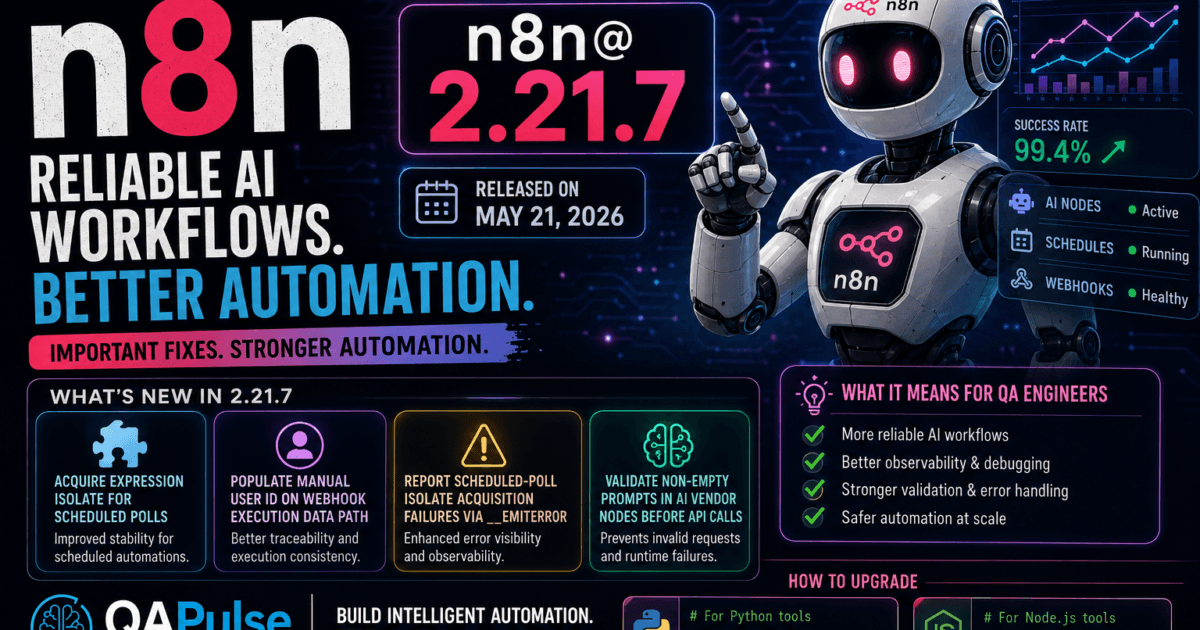
n8n 2.21.7 Improves AI Workflow Reliability for Modern QA Teams
n8n 2.21.7 was officially released on May 21, 2026, bringing several important fixes focused on workflow reliability, AI node validation, scheduled polling stability, and webhook execution improvements.
While this is not a massive feature release, n8n 2.21.7 includes fixes that directly improve:
- AI workflow stability
- scheduled automation reliability
- execution observability
- webhook consistency
- runtime validation behavior
For QA engineers and SDETs building AI-powered automation pipelines, these changes are more important than they may initially appear.
Official Release Notes
2.21.7 (2026-05-21)
Bug Fixes
* **core:** Acquire expression isolate for scheduled polls (#30742) (6167d4a)
* **core:** Populate manual user id on webhook execution data path (#30781) (50c55aa)
* **core:** Report scheduled-poll isolate acquisition failures via __emitError (#30792) (6321390)
* **core:** Validate non-empty prompts in AI vendor nodes before API calls (#30820) (15d0dbb)
How to Upgrade
# For Python tools
pip install n8n --upgrade

# For Node.js tools
npm install n8n@latest
Full release notes: https://github.com/n8n-io/n8n/releases/tag/n8n%402.21.7
Why n8n 2.21.7 Matters for QA Engineers
Modern QA workflows increasingly use:
- AI agents
- webhook orchestration
- scheduled automation
- event-driven pipelines
- autonomous testing workflows
That means workflow engines like n8n are becoming increasingly important inside modern testing ecosystems.
The biggest challenge with AI-driven workflows is:
reliability under real execution conditions
And that’s exactly where n8n 2.21.7 focuses heavily.
n8n 2.21.7 Fixes AI Prompt Validation Issues
One of the most important fixes in n8n 2.21.7 is:
Validate non-empty prompts in AI vendor nodes before API calls
This may sound small.
But for AI workflow systems, this is actually very important.
Previously:
- empty prompts could accidentally execute
- invalid requests might reach AI providers
- workflows could fail unpredictably
- debugging became harder
Now n8n 2.21.7 validates prompts before execution.
That improves:
✅ workflow stability
✅ error visibility
✅ debugging consistency
✅ AI execution reliability
For QA engineers testing AI pipelines, this reduces avoidable runtime failures significantly.
n8n 2.21.7 Improves Scheduled Polling Stability
Another important improvement in n8n 2.21.7 focuses on scheduled polling isolation handling.
Official fix:
Acquire expression isolate for scheduled polls
And:
Report scheduled-poll isolate acquisition failures via __emitError
This matters because scheduled automation systems are extremely common in:
- regression pipelines
- monitoring workflows
- scheduled API checks
- AI automation triggers
- telemetry collection
Before these fixes:
- polling failures may have been harder to detect
- isolation issues could silently impact workflows
- runtime debugging became more difficult
Now failures become more observable and easier to debug.
That is a strong improvement for:
👉 automation reliability
Better Observability in n8n 2.21.7
Modern automation increasingly depends on:
- observability
- telemetry
- runtime visibility
- execution tracing
n8n 2.21.7 improves this through:
better error reporting for scheduled poll failures
This is important because modern AI workflows can become:
black boxes
without proper execution visibility.
For SDETs and QA engineers:
better observability means:
✅ faster debugging
✅ improved failure analysis
✅ more reliable automation pipelines
Webhook Execution Improvements in n8n 2.21.7
Another useful fix in n8n 2.21.7 is:
Populate manual user id on webhook execution data path
This improves execution tracking consistency inside webhook workflows.
Why does this matter?
Because many QA teams increasingly rely on:
- API orchestration
- webhook-driven testing
- distributed automation workflows
- event-driven systems
Better execution tracking improves:
✅ traceability
✅ debugging visibility
✅ audit consistency
✅ workflow analysis
Are There Any Breaking Changes in n8n 2.21.7?
Good news:
there are currently no major breaking changes announced in n8n 2.21.7.
This appears to be a:
✅ stability-focused maintenance release
rather than a disruptive architectural update.
That makes upgrading much safer for most teams.
Should QA Engineers Upgrade to n8n 2.21.7?
For most modern automation teams:
👉 yes
Especially if your workflows involve:
- AI nodes
- scheduled polling
- webhook orchestration
- autonomous pipelines
- AI-powered automation systems
The improvements in:
- validation
- observability
- runtime stability
- error reporting
make n8n 2.21.7 a worthwhile upgrade.
What n8n 2.21.7 Signals About Future Automation
The bigger trend here is interesting.
Workflow systems are increasingly evolving toward:
AI-native orchestration platforms
Not just:
simple automation builders
That means future QA systems will increasingly combine:
- AI agents
- workflow engines
- observability pipelines
- autonomous execution
- intelligent retries
- adaptive automation
And platforms like n8n are becoming part of that evolution.
Why n8n 2.21.7 Matters for Modern QA Engineers
Modern automation systems increasingly depend on reliable AI orchestration, scheduled workflows, observability, and webhook execution pipelines. n8n 2.21.7 improves runtime stability, AI prompt validation, scheduled poll reliability, and workflow observability, making it valuable for QA engineers building intelligent automation systems in 2026. As AI-native workflows continue growing, stable orchestration platforms like n8n become increasingly important for scalable software testing and autonomous QA operations.
External Resources (DoFollow)
Let’s Talk
👉 Are you using workflow orchestration tools in QA pipelines yet?
👉 Do you think AI agents will eventually manage entire testing workflows autonomously?
Drop your thoughts below 👇
Final Line
Modern automation is no longer just about executing workflows.
It’s increasingly about building intelligent systems that can reason, observe, and adapt.
More Relevant Articles
- Selenium 4.44.0 Released: Why Selenium Still Refuses to Die
- Playwright 1.60.0 Released: The Future of Intelligent Test Automation
- Cypress 15.15.0 Released: Stability, Speed, and the Future of DX