 QA
QA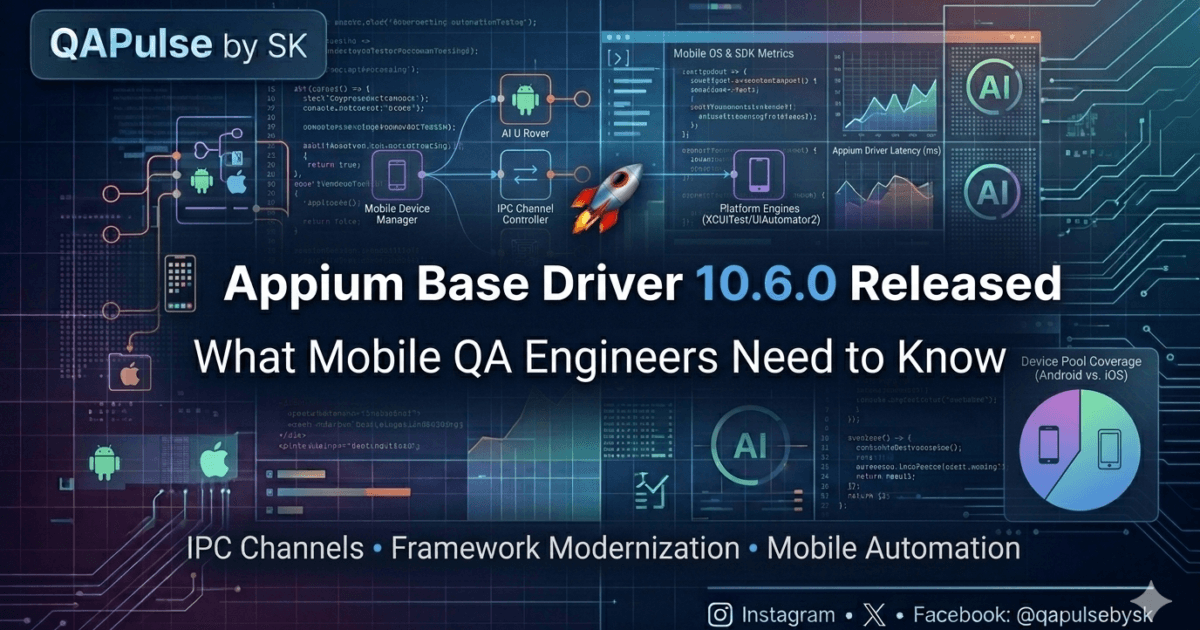
Appium Base Driver 10.6.0 Released: What Mobile QA Engineers Need to Know
Most automation engineers pay attention only when Appium introduces:
- New gestures
- New locator strategies
- New driver capabilities
- Major platform support updates
But experienced SDETs know something important:
The most impactful framework improvements often happen underneath the surface.
On May 31, 2026, the Appium team released @appium/base-driver@10.6.0.
At first glance, many engineers might overlook this release because it focuses on internal framework architecture.
That would be a mistake.
This release introduces important improvements around:
- Driver-to-plugin communication
- Internal framework modernization
- Dependency reduction
- Scalability controls
- Long-term maintainability
For teams building enterprise-grade mobile automation frameworks, these changes are worth understanding.
What is Appium Base Driver?
Before discussing the release, it is important to understand what the Base Driver actually does.
Many engineers think:
“I use Appium. Why should I care about Base Driver?”
The Base Driver is one of the core foundations of the Appium ecosystem.
It provides:
- Session management
- Command routing
- Capability validation
- Driver communication
- Plugin integration
Simplified Architecture
Mobile Test
      ↓
Appium Server
      ↓
Base Driver
      ↓
Platform Driver
      ↓
Android / iOS Device
Every Appium session eventually passes through the Base Driver layer.
That makes changes here potentially important for every Appium user.
Official Release Notes
Version
@appium/base-driver@10.6.0
Release Date: May 31, 2026
Features
- Add IPC channels per session for drivers and plugins to communicate
- Ditch Bluebird
- Ditch Lodash
- Limit maximum count of topics per session and make configurable
- Make assignIpc internal
Official Release:
https://github.com/appium/appium/releases/tag/%40appium/base-driver%4010.6.0
Quick Release Summary
| Area | Impact |
|---|---|
| Mobile Automation APIs | No Change |
| Driver Architecture | Improved |
| Plugin Communication | Significant Improvement |
| Framework Modernization | Strong |
| Breaking Changes | Low |
| Upgrade Complexity | Low |
| Recommended Upgrade | Yes |
What’s New in Appium Base Driver 10.6.0?
High-Level Summary
This release focuses on:
- Internal architecture improvements
- Better plugin communication
- Dependency cleanup
- Improved maintainability
- Better scalability controls
This is less about visible features and more about building a stronger foundation for future Appium releases.
Key Improvement #1 in Appium Base Driver 10.6.0 — IPC Channels Per Session
This is arguably the most important change in the release.
What Are IPC Channels?
IPC stands for:
Inter-Process Communication
These channels allow different Appium components to exchange information.
Before
Communication between drivers and plugins was more limited.
Plugin
   ↓
Appium Server
   ↓
Driver
After
Each session can have dedicated communication channels.
Plugin
   ↔
IPC Channel
   ↔
Driver
Why This Matters
As Appium ecosystems become more sophisticated, plugins are doing much more than simple command interception.
Examples include:
- Device monitoring
- Security scanning
- Performance analysis
- AI-assisted automation
- Reporting integrations
Dedicated IPC channels provide cleaner communication pathways.
Benefits for Enterprise Teams
| Benefit | Impact |
|---|---|
| Better Isolation | Strong |
| Cleaner Architecture | Strong |
| Easier Plugin Development | Strong |
| Future Scalability | High |
| Session Reliability | Improved |
Key Improvement #2 in Appium Base Driver 10.6.0 — Bluebird Removal
One of the most interesting changes is the removal of Bluebird.
What Is Bluebird?
Bluebird is a Promise library that became popular before modern JavaScript introduced robust native Promise support.
Years ago developers frequently wrote:
const Promise = require('bluebird');
because native JavaScript lacked many capabilities.
Today:
async function runTest() {
    await driver.launchApp();
}
is fully supported.
Why Removing Bluebird Matters
Modern frameworks should reduce unnecessary dependencies.
Benefits include:
- Smaller dependency trees
- Fewer vulnerabilities
- Easier maintenance
- Better long-term support
QA Engineering Perspective
Dependency reduction directly impacts:
| Area | Benefit |
|---|---|
| Security | Improved |
| Upgrade Safety | Improved |
| Build Stability | Improved |
| Maintenance Cost | Reduced |
This may not be exciting, but it is extremely important.
Key Improvement #3 in Appium Base Driver 10.6.0 — Lodash Removal
Another major modernization effort is removing Lodash.
What Is Lodash?
Lodash is one of the most popular JavaScript utility libraries.
Historically developers used functions like:
_.cloneDeep()
_.merge()
_.filter()
because native JavaScript was limited.
Modern JavaScript now includes most of these capabilities.
Why This Is Good News
Removing Lodash reduces:
- Package size
- Dependency complexity
- Security exposure
- Upgrade challenges
Long-Term Benefits
| Area | Before | After |
|---|---|---|
| Dependencies | Higher | Lower |
| Security Surface | Larger | Smaller |
| Maintenance | Harder | Easier |
| Framework Modernity | Lower | Higher |
Key Improvement #4 in Appium Base Driver 10.6.0 — Configurable Topic Limits
This change may seem small but has operational value.
The framework now allows configurable limits on topics per session.
Why This Matters
Without limits, systems can experience:
- Resource exhaustion
- Memory growth
- Session instability
Large organizations running:
100+
Concurrent Mobile Sessions
benefit from stronger resource controls.
Scalability Comparison
| Area | Previous Behavior | New Behavior |
|---|---|---|
| Topic Management | More Open | Controlled |
| Resource Usage | Less Predictable | More Predictable |
| Session Stability | Good | Better |
| Enterprise Scaling | Good | Better |
Key Improvement #5 in Appium Base Driver 10.6.0 — Internal IPC Assignment
The release also makes:
assignIpcinternal.
Why This Matters
This is a classic framework-hardening strategy.
Instead of exposing internal implementation details:
Public API
becomes:
Internal Framework Logic
This reduces accidental misuse.
Benefits
- Cleaner APIs
- Better encapsulation
- Easier maintenance
- Lower support burden
Any Breaking Changes?
Based on available release notes:
✅ No major breaking changes announced
✅ No migration guide required
✅ Existing Appium tests should continue working
✅ No capability changes introduced
Potential Risks
Enterprise teams should still validate:
| Area | Risk Level |
|---|---|
| Custom Plugins | Medium |
| Internal Extensions | Medium |
| Standard Test Suites | Low |
| Android Drivers | Low |
| iOS Drivers | Low |
Teams using custom plugin ecosystems should perform additional verification.
Should You Upgrade?
Recommendation
YES — For Most Teams
Reasons:
- Modernized architecture
- Reduced dependencies
- Better plugin communication
- Improved maintainability
This appears to be a healthy low-risk upgrade.
Validate Before Production
Always perform:
- Smoke testing
- Regression testing
- Plugin validation
- CI/CD verification
before promoting upgrades into production environments.
How to Upgrade
Node.js
npm install appium@latest
Verify version:
appium --versionExample CI Validation
name: Appium Validation

on:
  push:

jobs:
  mobile-tests:
    runs-on: ubuntu-latest

    steps:
      - uses: actions/checkout@v4

      - run: npm install

      - run: appium --version

      - run: npm test
Best Practices Before Upgrading
| Step | Recommended |
|---|---|
| Run Smoke Tests | ✅ |
| Run Regression Suite | ✅ |
| Validate Plugins | ✅ |
| Verify CI Pipelines | ✅ |
| Review Release Notes | ✅ |
| Monitor Test Stability | ✅ |
FAQ
What Is Appium Base Driver?
The Base Driver is a core Appium component responsible for session management, capability handling, and driver communication.
Is Appium Base Driver 10.6.0 a Major Release?
No. It is primarily an architectural and maintenance-focused release.
Are There Breaking Changes?
No major breaking changes have been announced.
Why Are IPC Channels Important?
They improve communication between Appium drivers and plugins, enabling more scalable and maintainable architectures.
Why Does Removing Bluebird and Lodash Matter?
Reducing dependencies improves security, maintainability, performance, and long-term framework health.
Final Thoughts
Appium Base Driver 10.6.0 is one of those releases that many engineers will ignore.
That would be unfortunate.
Because beneath the surface, this release tells an important story.
The Appium ecosystem is:
✅ Modernizing its architecture
✅ Reducing technical debt
✅ Improving plugin communication
✅ Preparing for future scalability
For QA engineers and SDETs building long-term mobile automation strategies, those are exactly the kinds of improvements worth paying attention to.
Great automation frameworks are not built only through new features. They are built through continuous architectural improvement.
Related Reading
Relevant Articles
- Appium 3.3.1 Released — What’s New for QA Engineers
- Appium 2.4.2 Released: What QA Engineers Should Know
- Why Most Test Automation Frameworks Collapse at Scale
- The Hidden Architecture Behind Scalable QA Platforms in 2026
- AI-Powered Test Automation Framework: Powerful Complete Guide for 2026
External Resources
- Appium Documentation: https://appium.io/docs/en/latest/
- Appium GitHub Releases: https://github.com/appium/appium/releases
- WebDriver Specification: https://www.w3.org/TR/webdriver2/
- OpenTelemetry Documentation: https://opentelemetry.io/docs/