 QA
QA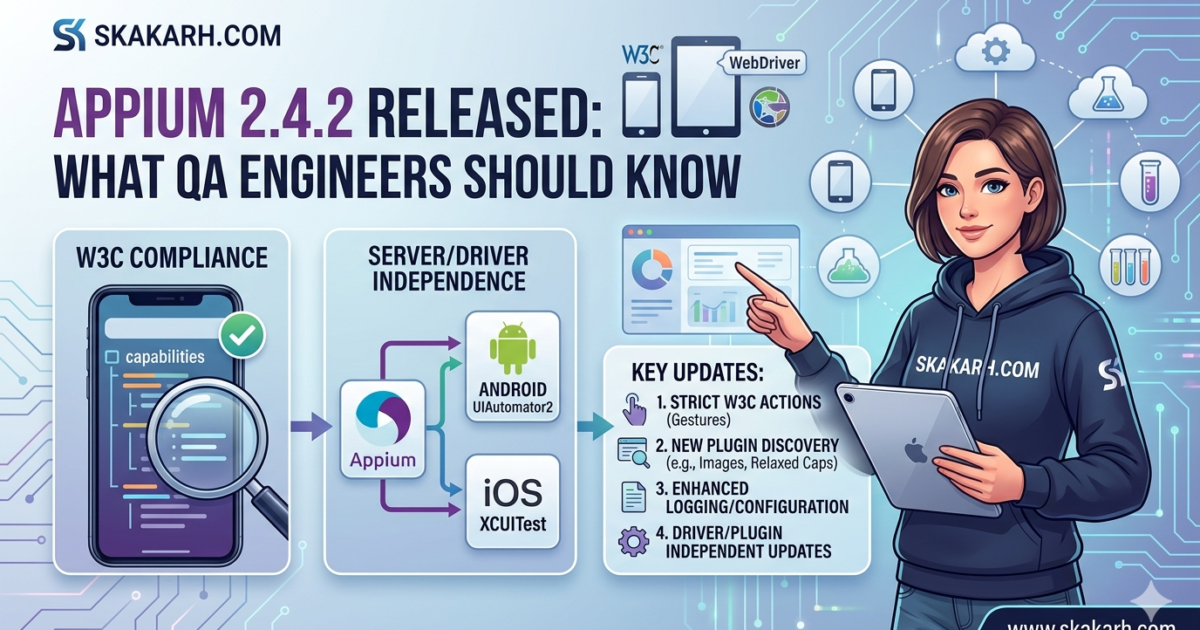
Appium version @appium/docutils@2.4.2 was officially released on May 07, 2026.
At first glance, the release notes look almost invisible:
“Version bump only for package @appium/docutils”
And most engineers will probably do this:
👉 Ignore it
👉 Skip reading
👉 Assume “nothing changed”
But experienced SDETs know something important:
Even small version bumps tell you something about ecosystem maturity, maintenance direction, and tooling stability.
So let’s break down what this release actually means for QA engineers and automation teams.
Official Release Notes
2.4.2 (2026-05-07)
Note: Version bump only for package @appium/docutils
Official release notes:
https://github.com/appium/appium/releases/tag/%40appium/docutils%402.4.2
What is @appium/docutils?
Many engineers immediately think:
“This isn’t Appium server itself… so why should I care?”
Fair question.
@appium/docutils is part of Appium’s internal tooling ecosystem used for:
- Documentation processing
- Utility generation
- Internal package consistency
- Developer tooling workflows
👉 So this release is NOT:
- New mobile automation features
- New locator strategies
- New gesture APIs
- New Android/iOS capabilities
Instead…
👉 It’s a maintenance + ecosystem stability release
And that matters more than many people realize.
Why Small Maintenance Releases Matter
Most automation engineers only notice:
- Big features
- Breaking changes
- New APIs
But mature engineering teams pay attention to:
👉 Ecosystem health
Because stable tooling ecosystems usually indicate:
- Active maintenance
- Consistent dependency management
- Reduced long-term technical debt
- Better compatibility handling
Healthy frameworks evolve continuously — even when changes look small.
What This Means for QA Engineers
1. No Immediate Breaking Changes Expected
Good news first.
This release does NOT indicate:
- Capability changes
- Driver changes
- API contract changes
So for most teams:
👉 Existing Appium test suites should remain unaffected.
2. Low-Risk Upgrade Window
Because this is primarily:
- Internal tooling maintenance
- Documentation utility version alignment
👉 This is considered a low-risk update.
That means:
- Safe for CI pipelines
- Minimal migration concerns
- No major framework rewrites needed
But Here’s the Bigger Insight
Most teams treat automation tools like this:
"If tests run today, don’t touch anything."
That mindset creates:
- Dependency drift
- Security issues
- Plugin incompatibility
- Painful future upgrades
Small controlled upgrades are healthier than massive emergency migrations later.
What Mature SDET Teams Actually Do
Instead of waiting 2 years to upgrade Appium…
They:
✅ Track release cadence
✅ Upgrade incrementally
✅ Validate continuously
✅ Monitor plugin compatibility
Because modern automation is no longer:
“Install once and forget”
It’s an evolving ecosystem.
Key Improvement #1 — Ecosystem Stability
Even though functionality didn’t visibly change…
Version alignment matters because it:
- Keeps internal packages synchronized
- Reduces dependency inconsistencies
- Improves maintainability across Appium tooling
For enterprise teams, this matters a LOT.
Because dependency fragmentation is one of the biggest hidden causes of:
- CI instability
- Plugin conflicts
- Build unpredictability
Key Improvement #2 — Better Long-Term Maintainability
Small utility package updates often indicate:
👉 Active repository hygiene
And active maintenance is critical for:
- Open-source reliability
- Faster issue resolution
- Better future compatibility
Dead ecosystems become dangerous ecosystems.
Active ecosystems survive.
Any Breaking Changes?
Based on official release notes:
✅ No direct breaking changes announced
✅ No migration notes required
✅ No automation API changes mentioned
However…
Experienced engineers should STILL:
- Run smoke suites
- Validate CI execution
- Check plugin compatibility
- Verify custom integrations
Because even indirect dependency shifts can occasionally affect:
- Lockfiles
- Build pipelines
- Internal tooling scripts
Should You Upgrade Immediately?
My Recommendation
✅ YES — for actively maintained projects
Why?
Because this appears to be:
- Stable
- Low-risk
- Maintenance-focused
⚠️ BUT…
Do NOT upgrade directly in production pipelines without:
- Smoke validation
- CI verification
- Driver compatibility checks
Professional automation teams don’t “hope upgrades work.”
They validate upgrades systematically.How to Upgrade
For Python Tools
pip install appium --upgrade
For Node.js Tools
npm install appium@latest
Bigger Industry Trend (Most Important Part)
This release highlights something bigger happening in automation:
The Shift From:
“Tool usage”
To:
“Tool ecosystem management”
Modern SDETs are no longer just writing scripts.
They’re managing:
- Dependency health
- CI reliability
- Toolchain stability
- Framework scalability
👉 That’s a completely different engineering mindset.
What Junior Engineers Miss
Junior engineers usually focus on:
- Writing tests
- Running automation
Senior SDETs focus on:
- Stability
- Maintainability
- Ecosystem evolution
- Upgrade strategies
The difference between average and elite engineers is often operational thinking.
My Recommendation for Teams
Best Practice Checklist
Before every automation upgrade:
✅ Run smoke suite
✅ Validate plugins
✅ Check CI logs
✅ Monitor flaky tests
✅ Review dependency tree
👉 Small discipline prevents massive outages later.
Let’s Talk
👉 Do you upgrade Appium regularly or avoid touching stable setups?
👉 What’s the worst automation upgrade issue you’ve faced?
Drop your thoughts below 👇
Final Line
Great SDETs don’t just automate tests.
They engineer stable ecosystems.