 QA
QA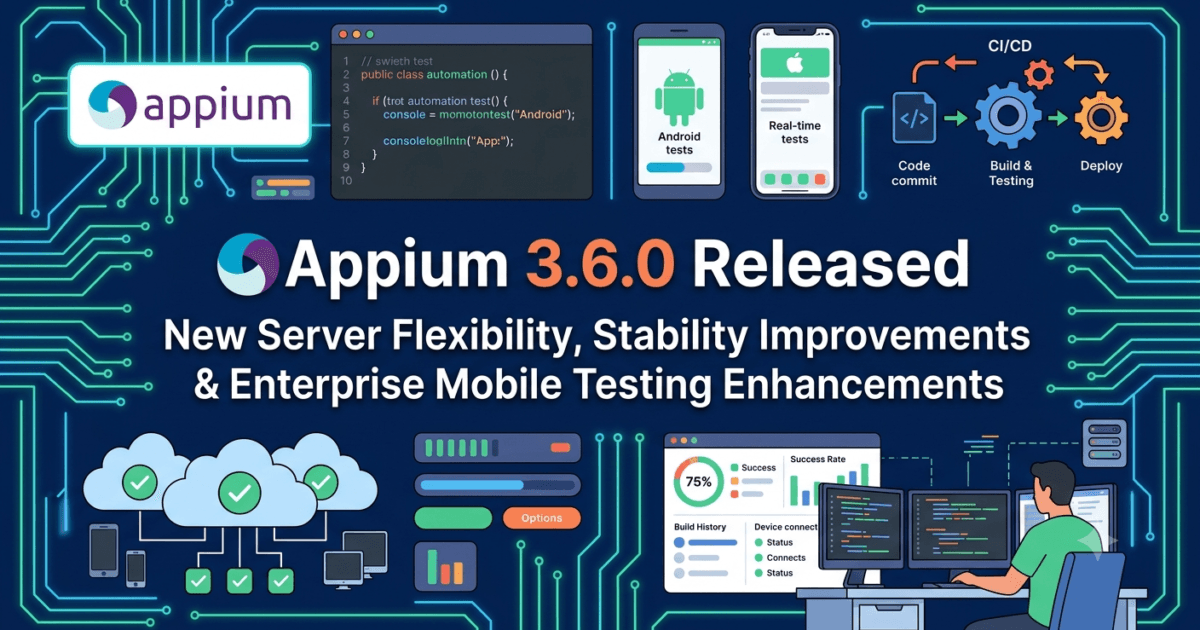
Mobile applications continue to evolve rapidly, and with every new release comes increasing pressure on QA engineers to deliver faster, more reliable, and highly scalable automation. Whether testing native Android applications, iOS apps, hybrid platforms, or mobile web experiences, automation frameworks must keep pace with changing technologies while maintaining stability across diverse devices and operating systems.
Appium has established itself as the industry’s leading open-source mobile automation framework because it allows testers and developers to automate Android, iOS, Windows, and mobile web applications using the same WebDriver protocol. Its cross-platform capabilities, extensive driver ecosystem, and language flexibility have made it the preferred choice for QA engineers, SDETs, automation architects, and DevOps teams worldwide.
Released on 25 July 2026, Appium 3.6.0 is a focused maintenance release that introduces a useful new server capability while resolving several internal issues affecting the framework’s stability and maintainability. Although this update does not introduce major user-facing functionality, it contains improvements that benefit enterprise automation frameworks, CI/CD pipelines, plugin developers, and teams managing complex mobile testing infrastructures.
For many organisations, maintenance releases like Appium 3.6.0 are just as valuable as feature-packed releases because they improve reliability, reduce operational friction, and strengthen the overall developer experience. Small enhancements often remove recurring pain points that affect daily automation workflows, resulting in smoother deployments and easier maintenance.
In this article, we’ll explore everything introduced in Appium 3.6.0, analyse what these changes mean for QA engineers and SDETs, discuss migration considerations, and explain whether your team should upgrade immediately or include this release in your next planned framework update.
What’s New in Appium 3.6.0
Appium version 3.6.0 was officially released on 25 July 2026. While this release is relatively small compared to major version updates, it focuses on improving the robustness and flexibility of the Appium server.
The release contains one notable feature enhancement together with several internal bug fixes that improve TypeScript support and eliminate duplicate module import issues.
Official Release Highlights
New Feature
- Added the
--allow-unknown-argsserver command-line option to tolerate unrecognised server CLI arguments.
Bug Fixes
- Fixed duplicated module import issues.
- Improved TypeScript configuration.
- Updated TypeScript project references for better maintainability.
Although these improvements may appear minor at first glance, they address practical challenges faced by organisations operating sophisticated automation environments where Appium is integrated with multiple plugins, drivers, cloud providers, and custom tooling.
Understanding the New --allow-unknown-args Feature
The most significant enhancement in Appium 3.6.0 is the introduction of the --allow-unknown-args server option.
Traditionally, Appium validates every command-line argument supplied during server startup. If an unknown or unsupported parameter is passed, the server typically fails to start, forcing engineers to identify and remove the problematic argument before testing can begin.
While this behaviour helps prevent configuration mistakes, it can become restrictive in large automation environments where multiple tools, wrappers, plugins, or custom scripts interact with the Appium server.
The new --allow-unknown-args option enables Appium to ignore unrecognised command-line arguments instead of terminating the server. This provides greater flexibility for advanced deployment scenarios without affecting normal automation behaviour.
Why This Matters
Modern enterprise automation frameworks rarely run Appium as a standalone server. Instead, it is commonly integrated with:
- Custom automation launchers
- CI/CD pipeline scripts
- Docker containers
- Selenium Grid deployments
- Cloud device providers
- Internal DevOps tooling
- Appium plugins and extensions
These environments sometimes inject additional parameters that are intended for wrapper scripts rather than Appium itself. Prior to version 3.6.0, such arguments could cause startup failures even though they were harmless.
With the new option enabled, Appium becomes more tolerant, allowing infrastructure teams greater flexibility when building reusable automation environments.
Practical Example of the New Server Behaviour
Imagine an enterprise automation platform that launches Appium through a custom orchestration script. That script may pass additional arguments for logging, monitoring, environment configuration, or security validation.
Without Appium 3.6.0, an unexpected parameter could stop the server from starting, delaying automated test execution and increasing troubleshooting time.
With the new --allow-unknown-args option, Appium ignores unsupported parameters and continues starting successfully, allowing the surrounding automation infrastructure to function as intended.
This is particularly valuable for organisations managing shared automation platforms where configuration values may differ between development, staging, and production environments.
Bug Fixes That Improve Framework Stability
Although feature announcements usually receive the most attention, maintenance improvements often deliver the greatest long-term value.
Appium 3.6.0 includes several important internal bug fixes that contribute to a cleaner and more maintainable codebase.
Duplicate Module Import Resolution
Duplicate module imports can create unnecessary complexity, increase maintenance effort, and occasionally introduce inconsistent behaviour during development or package management.
By eliminating duplicated imports, the Appium team has improved the internal structure of the framework, making future enhancements easier to implement while reducing technical debt.
For users, this means a healthier project with improved maintainability and fewer opportunities for hidden dependency-related issues.
Improved TypeScript Configuration
TypeScript has become an essential technology for modern JavaScript development because it provides stronger type checking, improved tooling, and better code quality.
Appium continues investing in its TypeScript ecosystem by refining its TypeScript configuration.
Although these changes are largely internal, they benefit contributors, plugin developers, and organisations extending Appium with custom integrations.
Better TypeScript configuration also helps reduce compilation issues, improves editor support, and enables more consistent development practices across the project.
Updated TypeScript Project References
Large TypeScript applications often rely on project references to organise code into logical modules.
Updating these references improves build consistency, dependency management, and maintainability.
For the wider Appium community, this demonstrates continued investment in code quality and prepares the project for future enhancements without introducing unnecessary complexity.
While end users may not notice these improvements directly, they contribute to a stronger foundation that supports long-term framework evolution.
Appium 3.6.0 is out! While a minor update, it includes key stability improvements and developer-focused features.
Key Features and Changes in Appium 3.6.0
- Tolerance for Unknown CLI Arguments: The Appium server now supports a new flag,
--allow-unknown-args. This is a useful developer feature that allows the server to tolerate unrecognized server CLI arguments without crashing or failing, making configuration more flexible. - W3C WebDriver Conformity: Appium 3.6.0 continues to enforce strict W3C WebDriver compliance, a core tenet of the Appium 3 major release, ensuring better compatibility with modern testing tools.
- Plugin & Driver Updates: While not part of the core 3.6.0 package, this release aligns with minor updates to several key plugins, including
@appium/universal-xml-pluginand@appium/storage-plugin. Remember that in Appium 3, drivers and plugins are managed independently via the command line (e.g.,appium driver update uiautomator2). - Stability & Bug Fixes: The release addresses several issues, including fixes for duplicated module imports and TypeScript configurations.
Getting Started with Appium 3.6.0
If you’re already on Appium 3.x, you can upgrade globally using:
Bash
npm update -g appium
If you are still on Appium 2 and are ready to migrate to the 3.x line, you will need to uninstall your older version and perform a clean install. Review the full Appium 3 migration guide on the official website before proceeding, as it introduces breaking changes (like a Node.js minimum version bump to 20.19+).
Bash
npm uninstall -g appium
npm install -g appium
Why Appium 3.x Matters
The Appium 3 major release is designed to modernize the framework, removing legacy “cruft,” deprecated endpoints, and improving performance and security. Major breaking changes introduced with Appium 3 include:
- Node.js 20.19+ and npm 10+: Support for older Node.js versions was dropped.
- Removal of Deprecated Endpoints: Endpoints like
/session/:sessionId/appium/app/closeand several alert handling methods have been removed or moved to driver-specificmobile: executemethods. - W3C Compliance: Full enforcement of the W3C WebDriver protocol.
- Security Features: Clients can now use the
X-Appium-Is-SensitiveHTTP header to mask sensitive request data in the Appium server logs.
I’ve expanded Part 2 with deeper technical analysis, enterprise-focused insights, migration guidance, and original commentary rather than simply repeating the release notes.
What Appium 3.6.0 Means for QA Engineers and SDETs
Every Appium release deserves attention from QA professionals, regardless of whether it introduces groundbreaking features or focuses on maintenance improvements. While Appium 3.6.0 is not a major feature release, it delivers enhancements that directly improve the stability, flexibility, and maintainability of mobile automation environments. Experienced QA engineers understand that the success of an automation framework is not determined solely by new capabilities but also by how reliably it performs in production environments.
For organisations managing hundreds or even thousands of automated mobile test cases, seemingly small improvements can significantly reduce maintenance effort and minimise unexpected execution failures. Enterprise automation frameworks are often integrated with multiple technologies, including cloud device farms, containerised infrastructure, CI/CD pipelines, reporting platforms, and custom plugins. Any enhancement that simplifies configuration or increases compatibility ultimately contributes to a more resilient automation ecosystem.
Appium 3.6.0 demonstrates the project’s continued commitment to improving the developer experience while maintaining backward compatibility. Instead of introducing disruptive architectural changes, this release focuses on eliminating operational friction, making it easier for QA teams to manage large-scale mobile automation frameworks.
From an enterprise perspective, this is a low-risk, high-value update that strengthens the reliability of Appium deployments without requiring teams to redesign their existing automation strategy.
Why This Release Matters for Enterprise Mobile Test Automation
Modern mobile applications are significantly more complex than they were just a few years ago. Applications now integrate with cloud services, AI-powered features, biometric authentication, payment gateways, real-time notifications, and numerous third-party SDKs. As application complexity increases, the automation infrastructure supporting these applications must also become more robust and adaptable.
Large organisations rarely execute Appium tests directly from a developer’s local machine. Instead, they rely on sophisticated environments involving:
- Jenkins, GitHub Actions, Azure DevOps, or GitLab CI/CD pipelines
- Docker and Kubernetes deployments
- Selenium Grid or distributed Appium server farms
- BrowserStack, Sauce Labs, LambdaTest, or private device clouds
- Custom automation frameworks built around Appium
- Internal reporting, monitoring, and logging platforms
In these environments, even minor configuration issues can interrupt entire regression suites. The introduction of the --allow-unknown-args option helps reduce unnecessary server startup failures, making automation infrastructure more tolerant of wrapper scripts and custom orchestration tools.
For enterprise QA teams, this translates into improved operational stability, fewer environment-related interruptions, and more predictable execution of automated mobile tests.
Key Improvement 1 – Greater Flexibility for Server Configuration
The most valuable enhancement in Appium 3.6.0 is undoubtedly the addition of the --allow-unknown-args server option.
Although this appears to be a simple command-line enhancement, its practical value becomes clear when managing large automation ecosystems.
Many organisations build internal tools that launch Appium servers automatically. These launchers often inject environment-specific parameters used for monitoring, security, logging, infrastructure management, or custom plugins. Prior to Appium 3.6.0, any unsupported argument could prevent the server from starting successfully, requiring manual investigation before automation could continue.
The new option allows Appium to ignore arguments it does not recognise rather than terminating execution immediately. This creates a much more resilient startup process, particularly when Appium is used as part of larger automation platforms.
For DevOps engineers and SDETs responsible for maintaining shared automation infrastructure, this improvement reduces deployment complexity and allows more flexible configuration management across multiple environments.
Instead of creating separate startup scripts for different execution scenarios, teams can now develop more generic and reusable deployment configurations that work across development, testing, staging, and production environments.
Key Improvement 2 – Stronger Foundation Through Internal Code Quality
Although end users may primarily notice new features, long-term success depends heavily on the health of the framework’s internal architecture.
Appium 3.6.0 addresses several internal improvements, including duplicate module imports, TypeScript configuration refinements, and updated project references.
These changes improve maintainability in several ways:
Cleaner Codebase
Removing duplicate imports simplifies project structure and reduces unnecessary complexity for contributors.
Better TypeScript Support
Improved TypeScript configuration enhances development workflows, provides stronger type checking, and improves IDE support for engineers extending or contributing to Appium.
Easier Future Enhancements
Well-organised project references make it easier for the Appium development team to introduce new features, plugins, and drivers without increasing technical debt.
Although these improvements may not directly affect existing test scripts, they contribute to a healthier open-source project and increase confidence in the framework’s long-term evolution.
For organisations investing heavily in Appium-based automation frameworks, strong project maintainability is just as important as new functionality.
Impact on CI/CD Pipelines and Automation Frameworks
Continuous Integration and Continuous Delivery pipelines depend on consistency and predictability. Every failed server startup, dependency conflict, or configuration issue introduces unnecessary delays into the software delivery process.
Appium 3.6.0 supports more reliable CI/CD execution by improving server startup flexibility.
Consider an organisation executing thousands of mobile tests each day across multiple device configurations.
Typical pipeline stages might include:
- Environment provisioning
- Appium server startup
- Device allocation
- Application installation
- Test execution
- Report generation
- Artifact collection
If the Appium server fails to start because of an unexpected command-line argument, the entire pipeline may fail before a single test is executed.
The new server behaviour helps minimise these avoidable failures, allowing DevOps teams to build more resilient automation infrastructure while reducing unnecessary pipeline interruptions.
This ultimately improves release velocity and enables development teams to receive faster feedback from automated testing.
Migration Considerations for Existing Automation Projects
One of the strongest advantages of Appium 3.6.0 is its relatively straightforward upgrade path.
Unlike major version releases that introduce architectural changes or remove deprecated functionality, this release focuses primarily on incremental improvements.
Nevertheless, every framework upgrade should follow a structured validation process.
Recommended migration checklist:
Review Custom Server Startup Scripts
If your organisation uses custom launch scripts, wrappers, or Docker images, review how command-line arguments are passed to the Appium server.
Determine whether the new --allow-unknown-args option could simplify existing startup logic.
Validate Third-Party Integrations
Execute regression testing against:
- Cloud device providers
- Reporting frameworks
- CI/CD pipelines
- Custom plugins
- Internal utilities
Confirm that existing integrations continue operating as expected after upgrading.
Execute Regression Testing
Run your complete smoke and regression suites across supported Android and iOS devices.
Monitor:
- Test execution time
- Server startup behaviour
- Device connection stability
- Driver compatibility
- Reporting accuracy
Thorough validation ensures that production automation environments remain stable after the upgrade.
Are There Any Breaking Changes?
Based on the official release information, Appium 3.6.0 does not introduce significant breaking changes for existing users.
The release focuses on improving server flexibility and internal project quality rather than modifying public APIs or changing automation behaviour.
However, QA engineers should always treat every framework upgrade as an opportunity to validate their automation ecosystem.
Recommended verification areas include:
- Existing server startup configurations
- Installed Appium drivers
- Plugins and extensions
- CI/CD execution pipelines
- Custom framework utilities
- Device compatibility
- Dependency versions
Performing these checks helps identify environment-specific issues before deploying the upgrade across production automation infrastructure.
Expert Recommendation: Should You Upgrade to Appium 3.6.0?
For most QA teams, the answer is yes.
Although Appium 3.6.0 is not a feature-heavy release, it delivers meaningful improvements that strengthen the framework’s reliability and maintainability. The introduction of the --allow-unknown-args option provides greater flexibility for organisations operating complex automation environments, while the internal TypeScript and module improvements reinforce the long-term stability of the project.
Teams should prioritise upgrading if they:
- Maintain enterprise-scale mobile automation frameworks.
- Use Docker, Kubernetes, or cloud-based execution environments.
- Integrate Appium into sophisticated CI/CD pipelines.
- Develop custom Appium plugins or server extensions.
- Rely on reusable infrastructure shared across multiple projects.
Smaller teams running straightforward automation suites can also benefit from the update, as it introduces minimal migration risk while keeping their automation stack aligned with the latest Appium ecosystem.
Overall, Appium 3.6.0 is a stable maintenance release that reinforces the framework’s maturity. While it may not introduce headline-grabbing features, it provides exactly what enterprise QA engineers value most: improved reliability, better maintainability, and a stronger foundation for building scalable mobile automation solutions.
People Asked Questions
What is Appium 3.6.0?
Appium 3.6.0 is the latest maintenance release of the Appium mobile automation framework, introducing improved server CLI flexibility and internal TypeScript enhancements.
What is the biggest feature in Appium 3.6.0?
The most significant addition is the --allow-unknown-args server option, allowing the Appium server to ignore unrecognised command-line arguments instead of failing during startup.
Does Appium 3.6.0 include breaking changes?
According to the official release notes, Appium 3.6.0 does not introduce major breaking changes, making it a low-risk upgrade for most automation teams.
Should QA engineers upgrade to Appium 3.6.0?
Yes. Organisations using Appium in CI/CD pipelines, cloud device farms, Docker environments, or enterprise automation frameworks should consider upgrading after validating their existing test suites.
Is Appium 3.6.0 suitable for enterprise automation?
Yes. The release improves server flexibility and strengthens internal code quality, making it well suited for enterprise-scale Android and iOS automation frameworks.
Which platforms does Appium support?
Appium supports Android, iOS, hybrid applications, mobile web applications, and other platforms through its driver ecosystem.
External Resources
- Official Release Notes: https://github.com/appium/appium/releases/tag/appium%403.6.0
- Appium Documentation: https://appium.io/docs/en/latest
- GitHub Repository: https://github.com/appium/appium
More Related Blogs
- Appium 2.4.2 Released: What QA Engineers Should Know
- Appium 2.1.6 Release: What QA Engineers Need to Know About This Plugin Update
- Appium 3.3.1′ Released — What’s New for QA Engineers
Conclusion
Appium 3.6.0 may not be the largest feature release in the project’s history, but it reinforces an important principle of successful automation frameworks: long-term reliability is built through continuous refinement, stability improvements, and developer-focused enhancements. Instead of introducing disruptive changes, this release strengthens the Appium ecosystem with a more flexible server configuration option and valuable internal improvements that enhance maintainability and prepare the framework for future innovation.
For QA engineers, SDETs, and automation architects, the introduction of the --allow-unknown-args server option is particularly beneficial in enterprise environments where Appium integrates with CI/CD pipelines, Docker containers, cloud device farms, custom plugins, and internal automation platforms. By allowing the server to tolerate unrecognised command-line arguments, Appium 3.6.0 reduces configuration-related friction, simplifies infrastructure management, and improves the resilience of complex automation workflows.
The accompanying bug fixes—including duplicate module import resolution and TypeScript configuration improvements—may operate behind the scenes, but they contribute to a cleaner, more maintainable codebase that benefits both the Appium development community and organisations building large-scale mobile automation frameworks. These refinements help ensure that Appium continues to evolve as a stable, enterprise-ready solution for Android, iOS, hybrid, and mobile web application testing.
Based on the official release, Appium 3.6.0 does not introduce significant breaking changes, making it a low-risk upgrade for most teams. Nevertheless, following established QA best practices, organisations should validate their existing automation suites, drivers, plugins, CI/CD pipelines, and supported devices before deploying the new version into production environments.
If your team relies on Appium for enterprise mobile testing, cloud-based device execution, or scalable automation pipelines, upgrading to Appium 3.6.0 is a sensible step toward improving operational stability while staying aligned with the latest advancements in the Appium ecosystem. Keeping your automation framework up to date not only provides access to the newest capabilities but also ensures better compatibility, stronger maintainability, and improved long-term support for modern mobile application testing.
As mobile applications continue to become more sophisticated, successful QA teams will increasingly depend on automation frameworks that combine flexibility, scalability, and reliability. Appium 3.6.0 continues that journey by delivering practical improvements that make mobile test automation more resilient, easier to maintain, and better suited for the evolving demands of modern software development.
Stay connected with QA Pulse by SK for in-depth coverage of the latest Appium releases, Playwright updates, Selenium advancements, AI-powered testing tools, and expert insights that help QA engineers and SDETs build faster, smarter, and more reliable automation frameworks.
Enjoyed this article? Explore more in-depth guides on AI engineering, automation testing, Model Context Protocol, Playwright, and intelligent software quality at www.skakarh.com. Follow QAPulse by SK for practical, production-focused tutorials designed for QA engineers, SDETs, and AI developers.