 QA
QA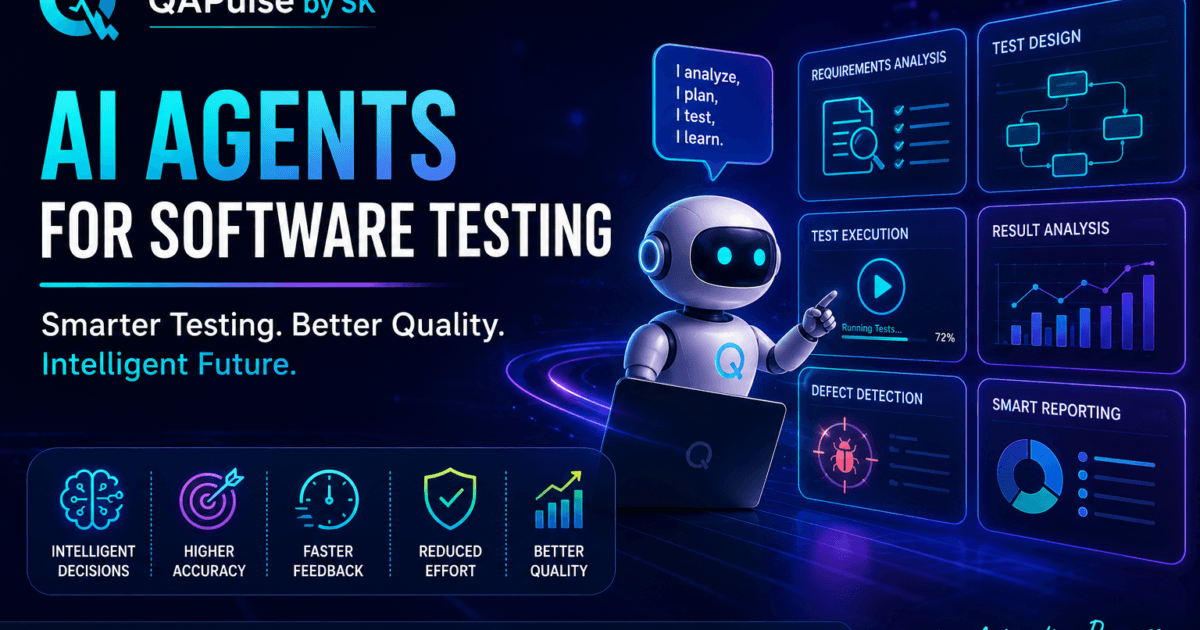
AI Agents for Software Testing Are No Longer a Future Concept
For years, software testing tools followed a predictable pattern.
You wrote tests.
The framework executed them.
Reports were generated.
Engineers investigated failures.
The process was largely manual.
Even modern automation frameworks such as Playwright, Selenium, Cypress, and Appium still rely heavily on human decision-making.
Humans decide:
- Which tests to create
- Which tests to execute
- How to investigate failures
- How to prioritize defects
- How to analyze risk
But something significant is changing.
A new generation of tools is emerging.
Tools that do not simply execute instructions.
Tools that can reason, plan, analyze, and take actions.
These systems are known as AI Agents for Software Testing.
And they are beginning to reshape how modern quality engineering teams operate.
The most important thing to understand is this:
AI agents are not simply another testing tool.
They represent a completely different way of thinking about software quality.
What Are AI Agents for Software Testing?
Quick Answer
AI Agents for Software Testing are intelligent software systems capable of:
- Understanding goals
- Making decisions
- Using tools
- Collecting information
- Performing testing activities
- Producing actionable outcomes
Unlike traditional automation scripts, AI agents can adapt their behavior based on changing conditions.
Traditional Automation vs AI Agents
| Capability | Traditional Automation | AI Agent |
|---|---|---|
| Execute Scripts | Yes | Yes |
| Follow Rules | Yes | Yes |
| Analyze Context | Limited | Strong |
| Make Decisions | No | Yes |
| Select Tools | No | Yes |
| Learn From Feedback | Limited | Emerging |
| Plan Tasks | No | Yes |
| Multi-Step Reasoning | No | Yes |
This is one of the biggest shifts happening in software testing today.
Why AI Agents Matter Now
Five years ago, many testing activities were difficult to automate intelligently.
Recent advancements in Large Language Models have changed that.
Modern AI systems can:
- Read requirements
- Analyze user stories
- Interpret defects
- Generate test ideas
- Execute workflows
- Summarize findings
These capabilities make AI agents uniquely valuable for testing.
The Difference Between AI Tools and AI Agents
Many people confuse AI tools with AI agents.
The difference is important.
AI Tool
Example:
Generate test cases from requirement
The AI performs a single task.
AI Agent
Example:
Read Jira Story
↓
Generate Test Cases
↓
Identify Risk Areas
↓
Execute Tests
↓
Analyze Results
↓
Create Defect
↓
Notify Team
The agent manages an entire workflow.
Why Traditional QA Workflows Are Struggling
Modern software systems are becoming increasingly complex.
Teams now manage:
- Microservices
- APIs
- Cloud infrastructure
- Mobile applications
- Web applications
- AI systems
This complexity creates challenges.
Common Problems
| Problem | Impact |
|---|---|
| Large regression suites | Slow feedback |
| Flaky tests | Low confidence |
| Manual triage | Lost productivity |
| Defect overload | Delayed releases |
| Tool fragmentation | Increased complexity |
AI agents are being adopted to reduce these inefficiencies.
9 Powerful Ways AI Agents Are Transforming Software Testing
1. Automated Test Case Generation
One of the most time-consuming QA activities is creating test cases.
AI agents can analyze:
- User stories
- Acceptance criteria
- Functional requirements
And generate:
- Positive scenarios
- Negative scenarios
- Boundary conditions
- Risk-based cases
Example Workflow
Requirement
↓
AI Analysis
↓
Test Scenarios
↓
Coverage Suggestions
This accelerates planning significantly.
2. Intelligent Defect Analysis
Many organizations spend hours investigating defects.
AI agents can help classify issues.
Traditional Approach
Failure
↓
Manual Investigation
↓
Root Cause Analysis
Agent-Based Approach
Failure
↓
Log Analysis
↓
Trace Analysis
↓
Root Cause Suggestion
This reduces investigation time dramatically.
3. Risk-Based Test Selection
Most teams still execute large regression suites.
This is expensive.
AI agents can evaluate:
- Recent code changes
- Impacted services
- Historical defects
- User behavior
And prioritize testing efforts.
Comparison
| Approach | Execution |
|---|---|
| Traditional | Run everything |
| AI Agent | Run highest-risk tests first |
This improves efficiency.
4. Intelligent Test Maintenance
Maintaining automation frameworks is expensive.
Locators change.
UI elements move.
APIs evolve.
AI agents can assist with:
- Locator updates
- Test repair suggestions
- Dependency analysis
This reduces maintenance effort.
5. Autonomous Regression Analysis
Imagine a regression suite containing:
5,000 Tests
Traditionally engineers review results manually.
AI agents can:
- Cluster failures
- Detect patterns
- Identify common causes
- Highlight high-priority issues
This creates faster feedback.
6. Requirements Validation
Many defects originate before development even begins.
AI agents can review:
- User stories
- Acceptance criteria
- Functional specifications
And identify:
- Missing scenarios
- Ambiguous language
- Potential risks
This improves quality earlier in the lifecycle.
7. API Testing Intelligence
Modern systems rely heavily on APIs.
AI agents can:
- Generate API tests
- Validate responses
- Detect anomalies
- Recommend additional coverage
Example
{
  "status": "success"
}
An agent might detect:
Missing validation:
- Performance
- Schema
- Security
This expands test coverage intelligently.
8. Continuous Quality Monitoring
AI agents can continuously monitor:
- Logs
- Metrics
- Traces
- User behavior
And identify emerging risks before customers are impacted.
This aligns closely with modern QA observability practices.
9. Multi-Agent Quality Engineering
One of the most exciting developments is the rise of multi-agent systems.
Imagine multiple specialized agents collaborating.
Example Architecture
Requirement Agent
        ↓
Test Design Agent
        ↓
Execution Agent
        ↓
Analysis Agent
        ↓
Reporting Agent
Each agent focuses on a specific responsibility.
Together they create an intelligent quality ecosystem.
AI Agent Architecture for Testing
A typical testing agent architecture includes:
| Component | Responsibility |
|---|---|
| LLM | Reasoning |
| Memory | Context |
| Tools | Actions |
| Planner | Workflow management |
| Evaluator | Validation |
This architecture enables autonomous workflows.
Real-World Example
Imagine a new Jira story arrives.
An AI testing agent could:
Read Story
↓
Generate Tests
↓
Identify Risks
↓
Execute API Tests
↓
Execute UI Tests
↓
Analyze Logs
↓
Create Bug
↓
Notify Team
This represents a major shift from traditional automation.
AI Agents and Playwright
Playwright is becoming one of the most popular execution layers for AI agents.
Why?
Because it provides:
- Reliable automation
- API testing
- Browser control
- Tracing
- Screenshots
Playwright Example
import { test, expect } from '@playwright/test';

test('checkout flow', async ({ page }) => {

  await page.goto('/checkout');

  await page.click('#pay-now');

  await expect(page.locator('.success'))
      .toBeVisible();

});
An AI agent could generate, execute, and analyze this test automatically.
Challenges of AI Agents in Testing
Despite the excitement, challenges remain.
Challenge Comparison
| Challenge | Impact |
|---|---|
| Hallucinations | Incorrect assumptions |
| Governance | Compliance concerns |
| Security | Data protection |
| Cost | Infrastructure spending |
| Explainability | Trust issues |
Organizations must address these risks carefully.
Will AI Agents Replace QA Engineers?
This question appears in nearly every discussion.
The short answer:
No.
At least not in the way many people imagine.
What Agents Replace
| Activity | Automation Potential |
|---|---|
| Repetitive analysis | High |
| Regression triage | High |
| Test generation | High |
| Report summarization | High |
What Humans Still Excel At
| Activity | Human Strength |
|---|---|
| Critical thinking | Strong |
| Product understanding | Strong |
| Risk assessment | Strong |
| Strategy | Strong |
| Customer empathy | Strong |
The future is collaboration, not replacement.
Skills QA Engineers Need in 2026
As AI adoption increases, successful engineers will focus on:
- Test strategy
- Quality engineering
- Observability
- Agent orchestration
- AI governance
- Risk management
These skills become more valuable as automation becomes smarter.
AI Agents vs Traditional Automation Frameworks
| Area | Traditional Automation | AI Agents |
|---|---|---|
| Script Execution | Strong | Strong |
| Context Awareness | Low | High |
| Decision Making | None | Strong |
| Adaptability | Limited | Strong |
| Workflow Automation | Moderate | Excellent |
| Business Reasoning | None | Emerging |
This is why many organizations are investing heavily in agentic systems.
The Future of Quality Engineering
The future of software testing will likely include:
- AI-assisted test design
- Autonomous execution
- Intelligent observability
- Multi-agent workflows
- Continuous quality monitoring
Teams that embrace these technologies early will gain significant advantages.
FAQ
What Are AI Agents for Software Testing?
AI Agents for Software Testing are intelligent systems capable of planning, executing, analyzing, and improving testing workflows.
Are AI Agents for Software Testing Replacing Test Automation?
No.
They extend automation capabilities rather than replacing existing frameworks.
Can AI Agents for Software Testing Work With Playwright?
Yes.
Playwright is frequently used as an execution layer within agentic testing architectures.
Are AI Agents for Software Testing Production Ready?
Some use cases are already being adopted, but governance and reliability remain important considerations.
Should QA Engineers Learn AI Agents for Software Testing?
Absolutely.
Understanding agentic systems will become increasingly important for modern quality engineers.
Final Thoughts
The software testing industry has experienced many transformations.
Manual testing.
Automation testing.
Continuous testing.
Quality engineering.
Now another shift is underway.
AI Agents for Software Testing are changing how teams design, execute, and analyze quality activities.
The most successful QA professionals in 2026 will not simply learn another tool.
They will learn how to collaborate with intelligent systems.
Because the future of testing is not humans versus AI.
The future is humans and AI working together to build better software.
More Relevant Articles
- How I Reduced Flaky Tests by 40% Using Self-Healing Locators + AI
- The Architecture Mistake 90% of Playwright Projects Make And How the Top 1% Quietly Avoid it
- Autonomous Load Pipelines: GitHub Actions + Grafana k6 + GPT5 Run Your Tests Before You Even Commit
- Python Lists, Tuples, Sets, and Dictionaries — Explained Visually
- Loops in Python: for vs while (And When to Use Each)
- If, Else, and Logic in Python: How Computers Actually Make Decisions
External Resources
- LangGraph Documentation
- OpenAI Platform Documentation
- Playwright Documentation
- OpenTelemetry Documentation
QAPulse by SK — For more QA, AI Testing, Playwright, and Quality Engineering content, visit www.skakarh.com.