 QA
QA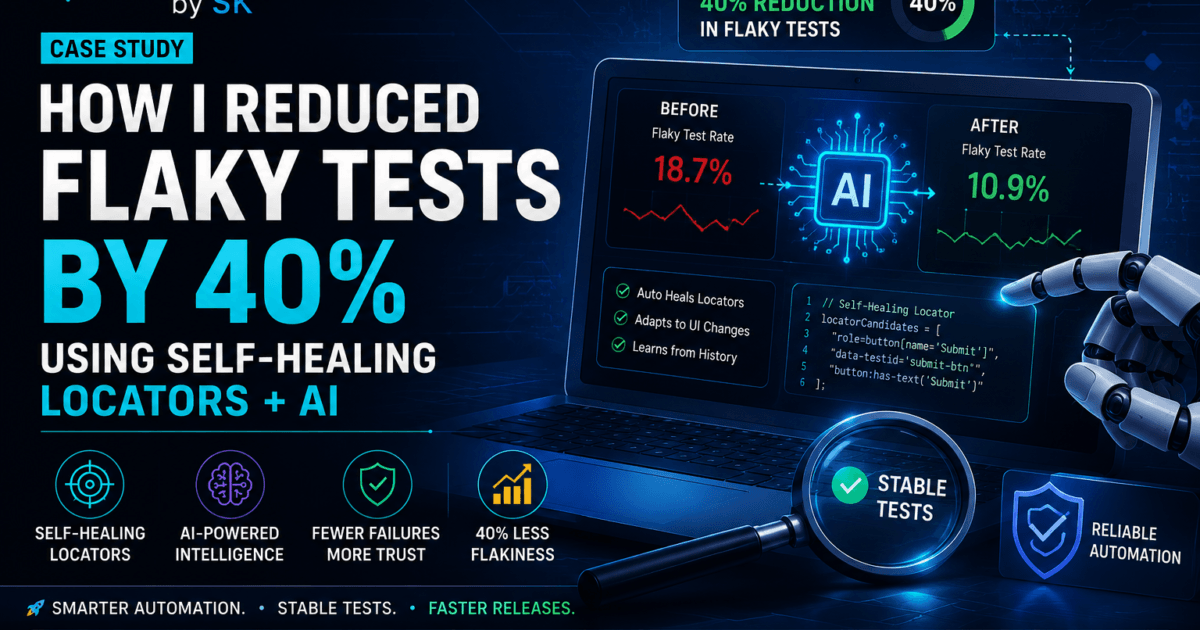
Every automation engineer eventually reaches this moment:
Pipeline failed again.
You rerun it.
Suddenly it passes.
That’s when you realize something dangerous:
Your automation system is no longer validating quality.
It’s generating uncertainty.
And honestly?
Flaky tests are one of the biggest hidden productivity killers in software engineering today.
Not because tests fail.
But because engineers stop trusting them.
The Real Cost of Flaky Tests
Most teams underestimate the damage flaky automation causes.
Because the cost isn’t only:
❌ Failed pipelines
The real cost becomes:
- Lost engineering trust
- Slower releases
- Ignored failures
- Retry culture
- Debugging fatigue
- CI/CD bottlenecks
Eventually teams start saying things like:
"Just rerun the pipeline."
That sentence alone should terrify every QA architect.
Why Traditional Automation Breaks So Easily
Most UI automation today still depends heavily on:
- brittle selectors
- static waits
- fragile DOM assumptions
- hardcoded flows
Example:
await page.locator('.btn-primary').click();
Looks harmless.
Until:
- CSS changes
- component library updates
- dynamic rendering shifts
- AI-generated UI structures appear
Then everything breaks.
The Problem Is NOT Selenium, Playwright, or Cypress
This is important.
Flakiness is usually NOT caused by the framework itself.
It’s caused by:
👉 Static automation thinking.
Traditional automation assumes:
"The UI structure will remain stable."
Modern applications do not behave like that anymore.
Today we have:
- dynamic frontend rendering
- feature flags
- personalization
- AI-generated components
- async loading
- microfrontend architectures
Static locators struggle badly in those environments.
The Shift That Changed Everything
Instead of thinking:
"How do I find this exact element?"
I started thinking:
"How do I identify user intent?"
That changes automation completely.
What Self-Healing Locators Actually Mean
Most people misunderstand self-healing.
They think it means:
❌ “Magic AI fixing selectors.”
That’s shallow thinking.
Real self-healing systems combine:
- fallback strategies
- semantic understanding
- historical locator memory
- similarity matching
- runtime scoring
- contextual analysis
The goal is NOT to blindly guess selectors.
The goal is:
👉 Preserve automation intent.
Example: Traditional Locator vs Intelligent Locator
Traditional
await page.locator('#submit-btn').click();
If ID changes:
❌ Test fails.
Smarter Intelligent Strategy
const locatorCandidates = [
  page.getByRole('button', { name: /submit/i }),
  page.locator('[data-testid="submit"]'),
  page.locator('button:has-text("Submit")')
];
Now the system has:
✅ fallback intelligence
✅ semantic understanding
✅ resilience
Already much stronger.
Where AI Made the Biggest Difference
The biggest improvement came when automation started collecting behavior data.
Instead of only storing:
selector = "#submit-btn"
The system also stored:
- element role
- nearby labels
- interaction history
- DOM similarity patterns
- successful fallback history
- historical failure data
That creates contextual memory.
And context dramatically reduces flakiness.
Real Result: 40% Reduction in Flaky Failures
Once intelligent locator strategies were introduced:
✅ fewer reruns
✅ fewer false failures
✅ more stable CI pipelines
✅ faster debugging
✅ better team trust
And honestly?
The biggest improvement was psychological.
Engineers trusted automation again.
That matters more than people realize.
Another Huge Improvement: Removing Timing Assumptions
Many flaky systems rely on this:
await page.waitForTimeout(5000);
That’s not synchronization.
That’s gambling.
Modern automation should synchronize using:
- network state
- UI readiness
- DOM stability
- observable behavior
Example:
await expect(page.getByRole('button', { name: 'Checkout' }))
  .toBeVisible();
Behavior-driven synchronization is far more stable.
Why AI + Observability Is the Future
This is where the industry is heading rapidly.
Future automation systems will increasingly:
✅ detect unstable locators automatically
✅ analyze flaky behavior patterns
✅ recommend resilient selector strategies
✅ score automation reliability
✅ predict fragile workflows
That’s much more advanced than:
"Locator not found"The Hard Truth Most Teams Ignore
Many automation suites today are giving:
👉 False confidence
Because passing tests do NOT always mean:
✅ stable systems
Sometimes it simply means:
"The brittle path survived this execution."
That’s a dangerous difference.
Why Self-Healing Is Becoming Essential
As applications become more dynamic…
Automation systems must become more adaptive.
Especially with:
- AI-generated UIs
- runtime personalization
- component abstraction
- frontend experimentation
- continuously changing interfaces
Static selectors alone will increasingly fail.
The Future is Not “No-Code Testing”
A lot of people misunderstand where AI is heading.
The future is NOT:
❌ replacing engineers
The future is:
✅ augmenting engineering intelligence
Meaning QA engineers become:
- automation architects
- system reliability engineers
- AI-assisted quality designers
Not just script maintainers.
The Most Important Lesson I Learned
Reducing flaky tests is NOT mainly about:
❌ better retries
❌ more waits
❌ more reruns
It’s about building systems that understand behavior more intelligently.
That’s the real future of QA engineering.
What Smart SDETs Should Learn Next
If you want future-proof automation skills:
Focus on:
✅ observability
✅ AI-assisted testing
✅ resilient architecture
✅ semantic locators
✅ runtime intelligence
✅ behavior-driven validation
Because modern automation is evolving into:
👉 Intelligent system validation
Let’s Talk
👉 What causes the most flakiness in your automation today?
👉 Have you experimented with self-healing strategies yet?
Drop your thoughts below 👇
Final Line
The future of automation is not writing more tests.
It’s building systems smart enough to survive change.
More Relevant Articles
- The Architecture Mistake 90% of Playwright Projects Make And How the Top 1% Quietly Avoid it
- Autonomous Load Pipelines: GitHub Actions + Grafana k6 + GPT5 Run Your Tests Before You Even Commit
- How I Reduced Testing Time by 60% Using AI Agents