QA
QA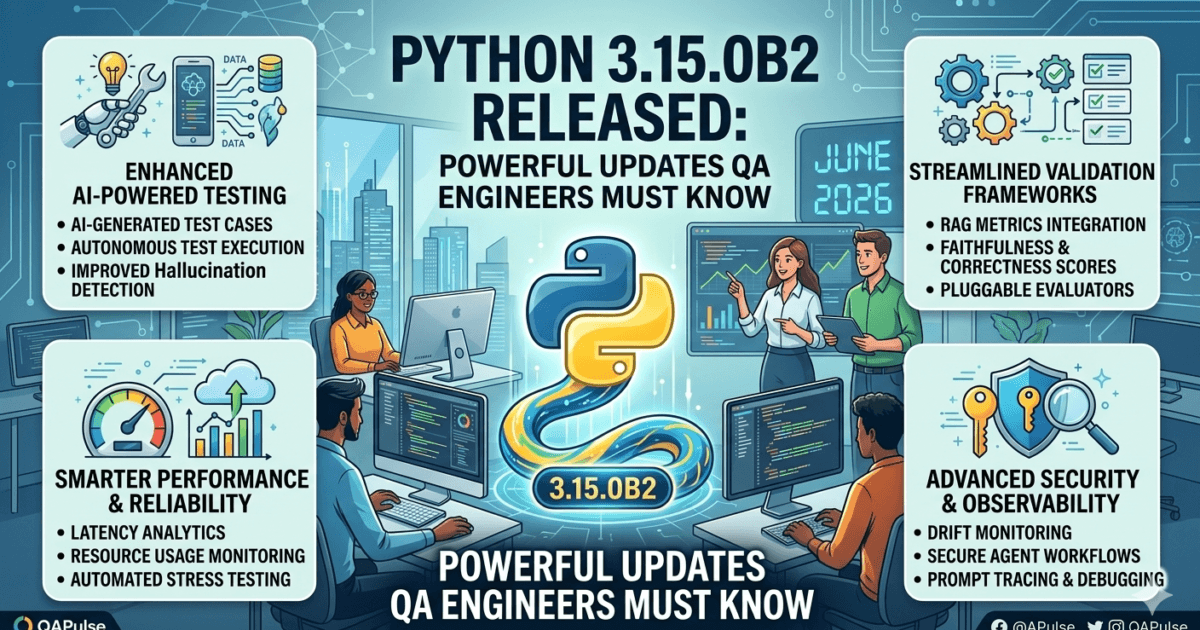
Python remains one of the most influential programming languages in software quality engineering.
From Selenium and Playwright automation frameworks to API testing,
AI testing, performance testing, and Agentic AI systems, Python powers a significant portion of modern QA workflows.
The Python core team recently released Python 3.15.0b2, the second beta release in the Python 3.15 development cycle. While this is not a production-ready version, it provides QA engineers, SDETs, and framework developers an opportunity to evaluate upcoming changes before the final release arrives.
In this article, we’ll examine what Python 3.15.0b2 means for test automation teams, migration planning, framework compatibility, and future-proofing automation infrastructure.
What is Python 3.15.0b2?
Python 3.15.0b2 is a beta release in the Python 3.15 development cycle.
Beta releases serve several purposes:
- Feature stabilization
- Compatibility validation
- Ecosystem testing
- Framework verification
- Community feedback
Unlike stable releases, beta versions should primarily be used in development, QA, and staging environments.
For QA teams, beta releases provide an early opportunity to identify issues before production adoption.
Why QA Engineers Should Care About Python 3.15.0b2
Many modern testing tools depend on Python.
Examples include:
- Selenium
- Playwright Python
- Pytest
- Robot Framework
- Behave
- Locust
- Requests
- FastAPI testing frameworks
- AI testing libraries
When a new Python version appears, compatibility testing becomes essential.
Ignoring language upgrades can create technical debt and future migration challenges.
Key Areas QA Teams Should Evaluate
1. Test Framework Compatibility
The first priority should be verifying automation framework support.
Validate:
- Pytest execution
- Selenium test suites
- Playwright automation
- Robot Framework projects
- Custom testing libraries
Framework maintainers often need time to certify support for new Python versions.
2. CI/CD Pipeline Stability
Modern QA pipelines depend heavily on Python runtimes.
Verify:
- GitHub Actions
- Jenkins jobs
- GitLab CI pipelines
- Azure DevOps workflows
A language upgrade can affect package installation, dependency resolution, and runtime behavior.
3. Dependency Management
One of the most common upgrade challenges involves dependencies.
Review:
- requirements.txt
- Poetry projects
- Pipenv configurations
- Internal packages
Beta releases often expose compatibility gaps within third-party libraries.
What This Means for Playwright Users
Many QA engineers now use Playwright with Python.
When evaluating Python 3.15.0b2:
- Run smoke tests
- Validate browser launches
- Verify tracing functionality
- Check reporting integrations
- Confirm CI pipeline execution
Any incompatibility discovered now can be addressed before the stable Python 3.15 release arrives.
What This Means for Selenium Users
Selenium remains a critical automation platform.
Recommended validation areas include:
- WebDriver initialization
- Browser compatibility
- Reporting frameworks
- Grid execution
- Parallel testing
Teams using large Selenium frameworks should perform comprehensive regression testing.
AI Testing and Agentic AI Considerations
Python is increasingly becoming the foundation of AI-powered testing solutions.
Many AI frameworks depend on Python, including:
- LangChain
- LlamaIndex
- OpenAI SDK
- AutoGen
- MCP integrations
Organizations building AI testing solutions should validate:
- Agent execution
- Prompt evaluation workflows
- RAG pipelines
- Model integrations
- Tool invocation systems
Early validation reduces future migration effort.
Potential Risks of Upgrading to Python 3.15.0b2
Although beta releases help identify issues early, they also introduce risks.
Common Risks
| Risk Area | Impact |
|---|---|
| Third-party libraries | Compatibility failures |
| CI/CD pipelines | Build instability |
| Automation frameworks | Runtime issues |
| Internal tooling | Unexpected regressions |
| AI frameworks | Dependency conflicts |
Because Python 3.15.0b2 is a beta release, these risks should be expected.
Recommended Upgrade Strategy
Step 1: Create a Dedicated Test Environment
Do not upgrade production systems immediately.
Instead:
- Create a staging environment
- Mirror production dependencies
- Execute validation tests
Step 2: Run Regression Suites
Execute:
- Functional tests
- API tests
- UI automation
- Integration tests
- AI testing scenarios
Step 3: Monitor Dependency Support
Track official announcements from:
- Pytest
- Selenium
- Playwright
- Robot Framework
- AI framework maintainers
Compatibility often improves significantly before final release.
Step 4: Document Findings
Capture:
- Failures
- Workarounds
- Dependency issues
- Performance observations
This documentation will help future migration planning.
Best Practices for Testing New Python Releases
Successful QA organizations treat language upgrades as engineering projects rather than routine package updates.
Recommended practices:
- Test early
- Validate frequently
- Maintain staging environments
- Monitor dependency ecosystems
- Automate compatibility testing
Teams that evaluate beta releases often discover issues before they become production blockers.
Should QA Teams Upgrade Immediately?
For production environments:
No.
Python 3.15.0b2 remains a beta release.
For testing and evaluation environments:
Yes.
This is exactly the stage where QA teams should begin compatibility testing.
Early adoption in controlled environments provides valuable feedback while minimizing operational risk.
Official Resources
Python Official Website:
https://www.python.org/
Python Documentation:
https://docs.python.org/3.15/
CPython Repository:
https://github.com/python/cpython
Python Release Schedule:
https://peps.python.org/pep-0790/
Frequently Asked Questions
What is Python 3.15.0b2?
Python 3.15.0b2 is the second beta release in the Python 3.15 development cycle and is intended for testing and validation before the final stable release.
Should QA engineers use Python 3.15.0b2 in production?
No. Beta releases should generally be evaluated in development, QA, or staging environments rather than production systems.
Why should QA teams test Python beta releases?
Testing beta releases helps identify framework compatibility issues, dependency conflicts, and automation regressions before stable release adoption.
Will Selenium and Playwright support Python 3.15?
Support will depend on each project’s release cycle. QA teams should monitor official announcements and validate compatibility in their own environments.
Is Python important for AI Testing?
Yes. Python powers many AI testing, automation, RAG, LLM, and Agentic AI frameworks used throughout the industry.
Relevant Articles
- AI Agents vs Agentic AI — Stop Confusing These Concepts (90% of Developers Get It Wrong)
- LLM Evaluation Framework: 9 Proven Ways to Measure AI Quality
External Authority Links
- Python Official Website: https://www.python.org/
- Python 3.15 Documentation: https://docs.python.org/3.15/
- CPython Repository: https://github.com/python/cpython
- Python Release Schedule: https://peps.python.org/pep-0790/
Final Thoughts
Python 3.15.0b2 provides QA engineers with an early opportunity to prepare for the next generation of Python development.
Although this beta release should not yet replace stable production environments, it is an excellent time to begin evaluating compatibility across automation frameworks, CI/CD pipelines, AI testing tools, and internal engineering platforms.
Teams that start testing today will be better prepared when the final Python 3.15 release arrives.