 QA
QA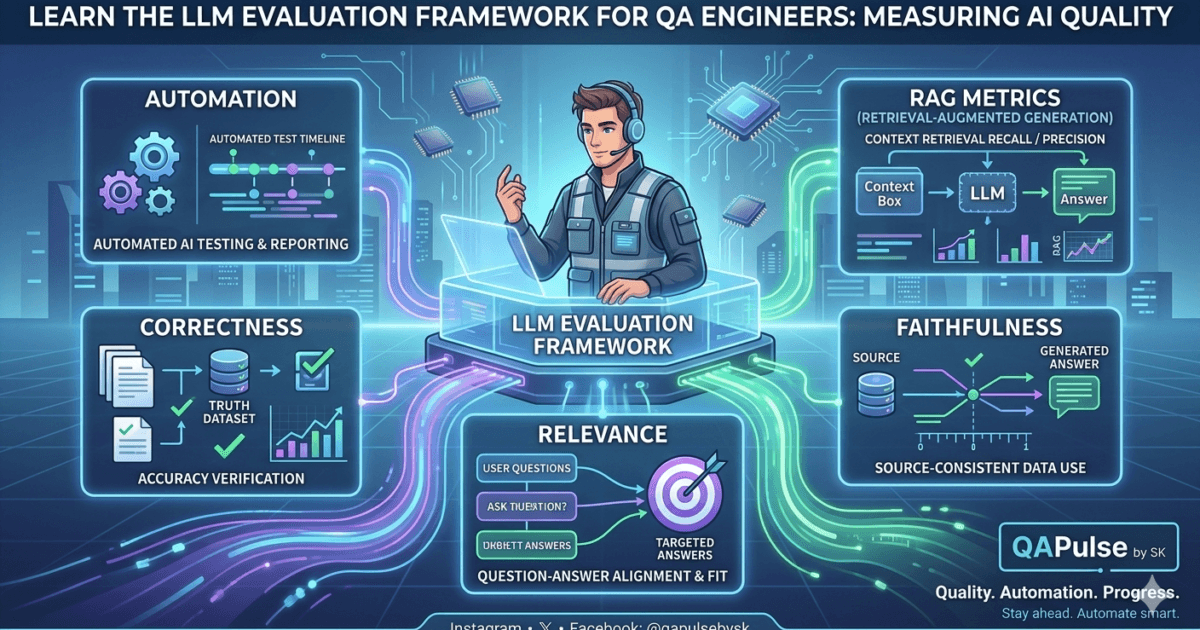
Why Every QA Engineer Needs an LLM Evaluation Framework
Traditional software testing has a simple goal:
Verify whether the application behaves correctly.
GenAI systems introduce a completely different challenge.
Ask an AI model the same question twice and you may receive two different answers.
Both answers might be correct.
Or neither might be.
This creates a problem that traditional testing cannot solve.
How do you measure quality when outputs are non-deterministic?
The answer is an LLM Evaluation Framework.
In 2026, organizations deploying AI products are investing heavily in evaluation because evaluation has become the new testing.
Before discussing tools and metrics, let’s understand why this shift matters.
What is an LLM Evaluation Framework?
Definition
An LLM Evaluation Framework is a structured process used to measure the quality, reliability, relevance, correctness, and safety of outputs generated by Large Language Models.
Instead of asking:
Did the test pass?
Evaluation asks:
Was the response useful, accurate, grounded, safe, and relevant?
Quick Summary
| Area | Traditional Testing | LLM Evaluation |
|---|---|---|
| Deterministic Output | Yes | No |
| Pass/Fail | Primary | Limited |
| Quality Scoring | Limited | Critical |
| Human Judgement | Rare | Common |
| Context Validation | Minimal | Essential |
| Hallucination Detection | Not Needed | Essential |
Why Traditional Automation Breaks for AI Systems
Imagine testing:
2 + 2
Expected:
4
Easy.
Now test:
Explain why software testing matters.
Possible response:
Software testing improves quality.
Another valid response:
Testing reduces risk and improves customer trust.
Both are correct.
This is why AI quality cannot rely exclusively on assertions.
Evaluation frameworks become necessary.
The Five Core Dimensions of AI Quality
Every modern LLM Evaluation Framework should measure at least five dimensions.
Evaluation Dimensions
| Metric | Purpose |
|---|---|
| Correctness | Factual accuracy |
| Relevance | User usefulness |
| Faithfulness | Grounded in source context |
| Safety | Risk assessment |
| Consistency | Stability across runs |
These metrics form the foundation of AI quality engineering.
Why Evaluation Is the New Testing
Historically QA teams validated:
- UI behavior
- API responses
- Database transactions
Modern AI systems require validation of:
- Reasoning quality
- Context usage
- Hallucination risk
- Retrieval effectiveness
- Agent behavior
This expands the QA role significantly.
Understanding Correctness
Correctness answers:
Is the response factually accurate?
Example
Question:
What is Playwright?
Correct Answer:
An open-source browser automation framework.
Incorrect Answer:
A mobile device testing platform.
Correctness evaluation helps identify factual errors.
Correctness Evaluation Table
| Response | Correct |
|---|---|
| Browser Automation Framework | ✅ |
| Mobile Device Framework | ❌ |
| Database Tool | ❌ |
Understanding Faithfulness
Faithfulness is one of the most important metrics in RAG systems.
It answers:
Does the answer come from the supplied context?
Example
Context:
Company leave policy allows 20 annual leave days.
Question:
How many annual leave days are allowed?
Faithful Answer:
20 days
Unfaithful Answer:
25 days
Even if the answer sounds reasonable, it is not grounded.
Faithfulness Evaluation Matrix
| Answer | Faithful |
|---|---|
| 20 Days | ✅ |
| 25 Days | ❌ |
| 22 Days | ❌ |
Understanding Relevance
Correct answers can still be poor answers.
Example:
Question:
How do I install Playwright?
Response:
Playwright was created by Microsoft.
Factually correct.
Completely irrelevant.
Relevance Scoring Example
| Score | Interpretation |
|---|---|
| 1 | Poor |
| 2 | Weak |
| 3 | Acceptable |
| 4 | Good |
| 5 | Excellent |
Understanding Context Recall
Context recall measures retrieval quality.
This is critical for RAG systems.
Formula
A simple interpretation:
\text{Recall} = \frac{\text{Relevant Retrieved Documents}}{\text{Total Relevant Documents}}
Higher recall usually improves answer quality.
Understanding Hallucination Rate
Hallucinations remain one of the biggest AI risks.
Hallucination Examples
| Statement | Supported |
|---|---|
| Retrieved from source | ✅ |
| Invented information | ❌ |
| Unsupported claim | ❌ |
Reducing hallucinations is one of the primary goals of evaluation.
9 Proven Components of an LLM Evaluation Framework
1. Ground Truth Testing
Use known correct answers.
Example:
{
  "question":"Capital of France",
  "answer":"Paris"
}
Compare generated output against expected output.
2. Reference-Free Evaluation
Sometimes ground truth doesn’t exist.
In those situations evaluate:
- Relevance
- Helpfulness
- Completeness
- Safety
3. Human Review
Human evaluation remains valuable.
Human Evaluation Criteria
| Area | Score |
|---|---|
| Accuracy | 1-5 |
| Relevance | 1-5 |
| Clarity | 1-5 |
| Helpfulness | 1-5 |
4. Automated Metrics
Automation enables scale.
Benefits include:
- Faster validation
- Continuous monitoring
- Regression detection
5. Dataset Evaluation
Instead of testing one prompt:
Test hundreds.
Example:
500 Questions
500 Responses
500 Evaluations
Patterns become visible.
6. RAG Evaluation
Modern AI systems rely heavily on retrieval.
RAG Metrics
| Metric | Importance |
|---|---|
| Recall | High |
| Precision | High |
| Faithfulness | Critical |
| Context Usage | Critical |
7. Agent Evaluation
AI agents require additional validation.
Agent Metrics
| Metric | Purpose |
|---|---|
| Goal Completion Rate | Success |
| Failure Recovery | Resilience |
| Tool Usage Accuracy | Reliability |
| Unsafe Action Rate | Risk |
8. Drift Detection
Models evolve over time.
Performance may decline gradually.
Example
| Month | Accuracy |
|---|---|
| January | 92% |
| February | 91% |
| March | 88% |
| April | 84% |
Evaluation helps identify this drift.
9. Production Monitoring
Evaluation should not stop after deployment.
Monitor:
- Latency
- Cost
- User feedback
- Quality trends
Continuously.
Best Tools for Building an LLM Evaluation Framework
Comparison Table
| Tool | Primary Use |
|---|---|
| RAGAS | RAG Evaluation |
| DeepEval | LLM Unit Testing |
| Braintrust | Dataset Evaluation |
| LangSmith | Tracing & Evaluation |
| Arize AI | Monitoring & Drift |
RAGAS Example
RAGAS has become one of the most popular frameworks for RAG testing.
What It Measures
| Metric | Supported |
|---|---|
| Faithfulness | ✅ |
| Context Recall | ✅ |
| Context Precision | ✅ |
| Relevance | ✅ |
DeepEval Example
DeepEval brings a pytest-like experience to AI testing.
Example:
from deepeval import assert_test
from deepeval.metrics import AnswerRelevancyMetric
This feels familiar to traditional QA engineers.
Braintrust Example
Braintrust focuses on:
- Dataset management
- Evaluation experiments
- Model comparisons
Excellent for enterprise-scale validation.
Common Evaluation Mistakes
Mistake 1
Evaluating only correctness.
Mistake 2
Ignoring hallucinations.
Mistake 3
No production monitoring.
Mistake 4
Testing only happy paths.
Mistake 5
Skipping human reviews.
LLM Evaluation Framework Architecture
User Prompt
      ↓
LLM
      ↓
Generated Response
      ↓
Evaluation Layer
      ↓
Metrics Dashboard
      ↓
Quality Decision
This architecture is becoming standard across AI-first organizations.
Future of AI Quality Engineering
The next generation of QA engineers will not spend all day writing UI tests.
They will increasingly focus on:
- AI evaluation
- Agent validation
- RAG quality
- Observability
- Production monitoring
Testing is evolving.
Evaluation is becoming a core skill.
FAQ
What Is an LLM Evaluation Framework?
An LLM Evaluation Framework is a structured approach used to measure AI quality using metrics such as correctness, relevance, faithfulness, safety, and consistency.
Why Is an LLM Evaluation Framework Important?
It helps organizations quantify AI quality and detect hallucinations, retrieval failures, and model drift.
Which Tool Is Best for RAG Evaluation?
RAGAS is currently one of the most widely adopted frameworks for evaluating retrieval-augmented generation systems.
Can QA Engineers Learn LLM Evaluation?
Absolutely.
Many concepts map naturally from traditional testing into AI quality engineering.
Is Evaluation More Important Than Testing?
Evaluation does not replace testing.
It complements testing by measuring aspects that traditional assertions cannot capture.
Final Thoughts
Organizations investing in AI are learning a hard lesson:
Building AI is easy. Measuring AI quality is difficult.
That is why every serious GenAI initiative eventually develops an LLM Evaluation Framework.
Whether you are testing chatbots, AI copilots, RAG systems, or autonomous agents, evaluation provides the visibility needed to understand quality.
In the coming years, evaluation frameworks will become as important to AI teams as Selenium and Playwright became to traditional automation teams.
Related Reading
Relevant Articles
- Learn MCP – Zero to Hero
- Learn AI Agents for QA – Zero to Hero
- Playwright Automation – Zero to Hero
- TencentDB Agent Memory: Complete Zero to Hero
- LangGraph: Complete Zero to Hero
- Learn Python – Zero to Hero
- OpenAI Codex: Complete Zero to Hero
- Cursor AI: Complete Zero to Hero
- Claude Code Tutorial: Complete Zero to Hero
- AutoGen: Complete Zero to Hero Guide
- Free QA Resources Built From Real Experience
- QA Glossary: Test Automation Terms Every Engineer Should Know
- AI Agents vs Agentic AI — Stop Confusing These Concepts (90% of Developers Get It Wrong)
External Resources
QAPulse by SK — For more QA, AI Testing, GenAI QA, Playwright, and Quality Engineering content, visit www.skakarh.com.