 QA
QA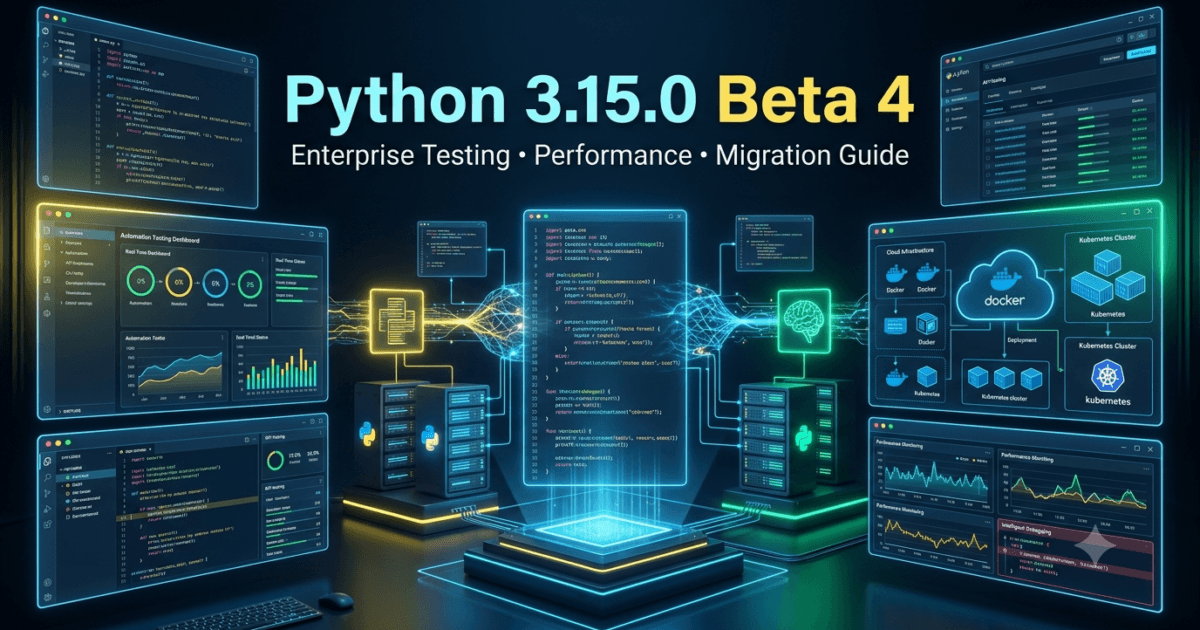
Python 3.15.0 Beta 4 is the latest milestone in the development cycle of the next major Python release. Although beta releases are primarily intended for testing, feedback, and ecosystem validation rather than production deployment, they provide software engineers, QA professionals, framework maintainers, and open-source contributors with an early opportunity to evaluate upcoming language improvements before the official stable release.
Unlike many open-source projects, CPython does not publish detailed GitHub release notes for every beta version. Instead, beta releases are tracked through Git tags and the official Python development changelog. As a result, Python 3.15.0b4 focuses on stabilization, bug fixes, performance refinements, and compatibility improvements rather than introducing major new language features.
For QA Engineers, SDETs, Automation Engineers, Python Developers, Backend Engineers, DevOps Teams, AI Engineers, and Test Framework Maintainers, beta releases play a crucial role in preparing existing applications, automation frameworks, libraries, and CI/CD pipelines for the upcoming stable version of Python.
Testing against beta releases enables engineering teams to identify compatibility issues months before the final release, significantly reducing migration risks and ensuring production readiness.
Official Release Information
The Python Software Foundation does not publish GitHub release notes for CPython beta releases. Instead, development progress is documented through the official CPython repository and Python changelog.
For Python 3.15.0 Beta 4, the emphasis remains on:
- Stabilizing the runtime
- Resolving bugs discovered during previous beta testing
- Improving interpreter reliability
- Preparing the ecosystem for Release Candidate builds
- Helping package maintainers validate compatibility
- Collecting community feedback before the final release
While there are no headline language features attached specifically to Beta 4, every beta release contributes to making the upcoming Python version more reliable and production-ready.
Python 3.15.0 Beta 4 Release Overview
| Category | Details |
|---|---|
| Version | Python 3.15.0 Beta 4 |
| Release Stage | Beta |
| Stability | Pre-release |
| Production Ready | No |
| Intended Audience | Developers & Testers |
| Focus | Bug Fixes, Stabilization, Compatibility |
| Breaking API Changes | Possible During Beta Cycle |
| Recommended Usage | Testing & Validation |
Why Beta Releases Matter
Many engineering teams ignore beta releases until the stable version arrives. However, organizations that maintain production software understand that beta testing is one of the most valuable phases of the software lifecycle.
Early testing allows organizations to:
- Detect compatibility issues
- Validate third-party libraries
- Update automation frameworks
- Modernize CI/CD pipelines
- Benchmark application performance
- Prepare migration documentation
- Train engineering teams
- Identify deprecated APIs
- Reduce production upgrade risk
For teams maintaining enterprise applications, waiting until the final release often results in compressed testing schedules and increased migration effort.
What This Means for QA Engineers
For QA Engineers and SDETs, Python beta releases provide an opportunity to proactively evaluate automation frameworks before the wider ecosystem adopts the new version.
Areas that should be validated include:
- Selenium frameworks
- Playwright automation
- Pytest test suites
- Robot Framework projects
- API automation
- Performance testing tools
- AI testing pipelines
- Data validation scripts
- Custom Python utilities
- Internal automation libraries
Running regression tests on Python 3.15.0b4 helps identify interpreter-related issues early, allowing teams to report bugs upstream or prepare compatibility fixes before the stable release becomes generally available.
Organizations that maintain large automation codebases can significantly reduce migration effort by incorporating beta testing into their release strategy.
Benefits for Python Developers
Backend developers and Python engineers should also use this beta release to validate production code against the upcoming runtime.
Recommended validation areas include:
- Type hints
- Async programming
- Exception handling
- Dataclass behavior
- Pattern matching
- Standard library compatibility
- Dependency management
- Package installation
- Virtual environments
- Performance benchmarks
Although Beta 4 is not intended for production systems, it provides valuable insight into how existing applications will behave under Python 3.15.
Impact on Test Automation Frameworks
Many popular testing tools rely directly on CPython behavior.
Examples include:
- Pytest
- Selenium
- Playwright Python
- Behave
- Robot Framework
- Requests
- HTTPX
- FastAPI
- Django
- Flask
Framework maintainers typically begin validating compatibility during beta releases.
QA teams should do the same by executing full regression suites using Python 3.15.0b4 in isolated development environments.
Preparing Enterprise Applications
Enterprise organizations often operate hundreds of Python services across multiple business domains.
Testing Beta 4 enables teams to identify issues affecting:
- REST APIs
- Microservices
- AI applications
- Machine Learning pipelines
- Data Engineering workflows
- Automation servers
- Internal developer tools
- Cloud-native services
- Kubernetes workloads
- Enterprise integrations
Early validation dramatically reduces deployment risks when Python 3.15 reaches General Availability.
How to Upgrade
Install Beta Version
python -m pip install --upgrade --pre
Verify Installed Version
python --version
Create an Isolated Virtual Environment
python -m venv py315-beta
Upgrade Existing Packages
pip install --upgrade -r requirements.txt
Running beta releases inside isolated virtual environments is strongly recommended to prevent conflicts with production development environments.
Comparison with Python 3.14
| Feature | Python 3.14 | Python 3.15.0 Beta 4 |
|---|---|---|
| Stability | Stable | Beta |
| Production Use | Recommended | Testing Only |
| Language Changes | Finalized | Stabilizing |
| Bug Fixes | Maintenance | Active Development |
| Package Compatibility | Mature | Under Validation |
| Community Feedback | Complete | Ongoing |
Upgrade Recommendation
Organizations should not deploy Python 3.15.0 Beta 4 into production systems.
Instead, this release should be used for:
- Compatibility testing
- Regression testing
- Framework validation
- Package verification
- CI/CD preparation
- Performance benchmarking
- Open-source contribution
- Migration planning
Engineering teams maintaining automation frameworks, enterprise APIs, AI applications, and Python libraries should begin testing now so that the eventual migration to Python 3.15 stable is smooth and predictable.
Who Should Evaluate Python 3.15.0 Beta 4?
This release is particularly valuable for:
- QA Engineers
- SDETs
- Python Developers
- Backend Engineers
- DevOps Engineers
- Platform Engineers
- AI Engineers
- Data Engineers
- Framework Maintainers
- Open Source Contributors
The earlier these teams validate compatibility, the lower their migration effort will be once Python 3.15 becomes generally available.
Enterprise Migration Strategy for Python 3.15.0 Beta 4
Although Python 3.15.0 Beta 4 is not intended for production deployment, it represents one of the most important phases in the Python release lifecycle. Beta releases provide software engineering teams with sufficient time to validate applications, identify compatibility issues, and prepare production systems before the final stable version becomes generally available.
For organizations operating hundreds of Python services, automation frameworks, AI applications, APIs, cloud-native microservices, and internal developer platforms, waiting until the official release often results in rushed migrations and unexpected production issues. Adopting a proactive testing strategy during the beta phase allows engineering teams to discover problems months in advance while there is still time for both the Python core developers and third-party library maintainers to address them.
A recommended enterprise migration strategy includes:
- Install Python 3.15.0 Beta 4 in an isolated development environment.
- Upgrade critical third-party dependencies to their latest compatible versions.
- Execute complete regression suites across all automation projects.
- Validate CI/CD pipelines using the beta runtime.
- Benchmark application startup time, memory consumption, and execution performance.
- Verify compatibility with containers, Docker images, Kubernetes deployments, and cloud infrastructure.
- Test internal libraries and reusable automation utilities.
- Report any discovered compatibility issues to framework maintainers.
- Continue testing future Release Candidate (RC) versions before final production rollout.
- Prepare internal migration documentation for engineering teams.
Organizations following this phased approach significantly reduce upgrade risks while ensuring that production deployments remain stable when Python 3.15 reaches General Availability (GA).
QA Regression Testing Checklist
Regression testing is one of the most critical activities during any major Python upgrade. Even though Python maintains excellent backward compatibility, subtle interpreter changes, dependency updates, or library behaviors can affect enterprise applications.
The following regression checklist helps ensure comprehensive validation after upgrading to Python 3.15.0 Beta 4.
| Test Area | Validation Required |
|---|---|
| Unit Tests | Verify all business logic passes existing test suites |
| API Testing | Validate REST, GraphQL, SOAP, and WebSocket APIs |
| Selenium Frameworks | Execute complete browser automation suites |
| Playwright Projects | Validate Chromium, Firefox, and WebKit execution |
| Pytest Plugins | Ensure plugins remain compatible |
| Robot Framework | Validate keyword execution and reports |
| AI Applications | Test LangChain, CrewAI, LlamaIndex, MCP, and AI workflows |
| Async Code | Validate asyncio tasks, event loops, and concurrency |
| Database Operations | Verify ORM behavior, migrations, and transactions |
| Package Installation | Confirm pip resolves dependencies correctly |
| Virtual Environments | Validate venv creation and package isolation |
| Docker Images | Build and execute Python 3.15 containers |
| CI/CD Pipelines | Run GitHub Actions, GitLab CI, Jenkins, Azure DevOps pipelines |
| Logging | Validate structured logging and monitoring integrations |
| Performance | Compare execution time against Python 3.14 |
| Security | Execute dependency vulnerability scans |
Completing this checklist before the stable release dramatically reduces migration risks for enterprise software.
Performance Validation Recommendations
Although Beta 4 primarily focuses on stabilization, performance validation remains an important activity for engineering teams.
Organizations should benchmark:
- Application startup time
- API response latency
- Memory utilization
- CPU consumption
- Background task execution
- Async processing performance
- Database query throughput
- Batch processing workloads
- File I/O operations
- Large-scale data processing jobs
Comparing these metrics against Python 3.14 helps determine whether any regressions or unexpected improvements exist before production adoption.
For AI workloads involving LangChain, CrewAI, OpenAI SDK, MCP Servers, FastAPI, and LlamaIndex, performance benchmarking is especially valuable because even small runtime improvements can have a measurable impact on token processing, API latency, and workflow execution.
Dependency Compatibility Planning
One of the most common challenges during Python upgrades is third-party package compatibility.
Before adopting Python 3.15.0 Beta 4, teams should verify support for critical libraries such as:
- FastAPI
- Django
- Flask
- Pytest
- Selenium
- Playwright
- Requests
- HTTPX
- SQLAlchemy
- Pandas
- NumPy
- LangChain
- CrewAI
- LlamaIndex
- OpenAI SDK
- Pydantic
- Uvicorn
- Celery
- Redis clients
- Async frameworks
If a dependency does not yet officially support Python 3.15 Beta, continue monitoring the maintainer’s roadmap rather than forcing production upgrades.
CI/CD Pipeline Readiness
Modern Python applications rely heavily on automated deployment pipelines.
Engineering teams should validate:
Build Pipelines
Ensure source code compiles correctly using Python 3.15.
Automated Testing
Execute complete regression suites during pull requests.
Docker Builds
Verify container images build successfully with the updated runtime.
Deployment Automation
Confirm deployment scripts continue functioning across staging environments.
Artifact Generation
Validate wheels, distributions, packages, and compiled assets.
Security Scanning
Ensure vulnerability scanners and dependency audit tools remain compatible.
Updating CI/CD infrastructure early prevents deployment bottlenecks once Python 3.15 becomes the default runtime.
Best Practices Before Production Adoption
To maximize stability, engineering teams should follow several best practices while evaluating Python 3.15.0 Beta 4.
Keep Production on Stable Releases
Beta versions should never replace stable runtimes in mission-critical environments.
Test in Isolation
Use virtual environments, Docker containers, or dedicated staging servers to prevent interference with existing development environments.
Monitor Framework Compatibility
Follow release announcements from major Python framework maintainers to determine when official Python 3.15 support becomes available.
Report Bugs
If compatibility issues are discovered, report them through the CPython issue tracker or the relevant package repository. Early community feedback contributes directly to a more stable final release.
Update Internal Documentation
Prepare migration guides, coding standards, dependency matrices, and onboarding documentation so engineering teams can transition smoothly after the stable release.
Should You Upgrade?
The answer depends on your environment.
Development Teams
Yes. Begin evaluating Python 3.15.0 Beta 4 immediately within development and testing environments. Early adoption provides valuable insight into compatibility and allows teams to prepare for the stable release.
Open Source Maintainers
Absolutely. Testing against beta releases ensures libraries are compatible before Python 3.15 reaches General Availability, benefiting the broader ecosystem.
Enterprise Organizations
Adopt the beta in non-production environments only. Use it for compatibility testing, regression validation, performance benchmarking, and CI/CD readiness while keeping production workloads on the latest stable Python version.
Production Systems
No. Production environments should continue running a stable Python release until Python 3.15 officially reaches General Availability and your critical dependencies declare full support.
Relevant Articles
- AI Agents vs Agentic AI — Stop Confusing These Concepts (90% of Developers Get It Wrong)
- LLM Evaluation Framework: 9 Proven Ways to Measure AI Quality
External Authority Links
- Python Official Website: https://www.python.org/
- Python 3.15 Documentation: https://docs.python.org/3.15/
- CPython Repository: https://github.com/python/cpython
- Python Release Schedule: https://peps.python.org/pep-0790/
Frequently Asked Questions
Is Python 3.15.0 Beta 4 production-ready?
No. It is a pre-release beta version intended for testing, validation, and ecosystem feedback. Production deployments should continue using the latest stable Python release.
Does Python 3.15.0 Beta 4 introduce breaking changes?
Major language features are generally finalized by the beta stage, but compatibility adjustments may still occur before the final release. Thorough regression testing is recommended.
Should QA Engineers test against beta releases?
Yes. Running automation frameworks, API tests, and regression suites against beta versions helps identify compatibility issues early and minimizes migration effort later.
Which teams benefit most from this release?
Python Developers, QA Engineers, SDETs, AI Engineers, DevOps Engineers, Backend Developers, Platform Engineers, Open Source Maintainers, and organizations building Python-based enterprise applications.
When should production systems upgrade?
Upgrade only after the official stable release becomes available and after validating all dependencies, automation frameworks, CI/CD pipelines, and business-critical applications.
Continue Learning with QAPulse by SK
At QAPulse by SK, we continuously analyze the latest releases across the Python ecosystem, including Python, FastAPI, Playwright, Selenium, Pytest, LangChain, CrewAI, Model Context Protocol (MCP), n8n, Docker, Node.js, and many other technologies shaping modern software engineering.
Our goal is to help QA Engineers, SDETs, Python Developers, AI Engineers, and DevOps teams stay ahead with enterprise-grade migration guides, release analyses, automation tutorials, performance optimization strategies, and practical best practices. Whether you’re building scalable APIs, AI-powered applications, automation frameworks, or cloud-native platforms, QAPulse by SK provides the technical insights needed to build reliable, secure, and future-ready software systems.