 QA
QA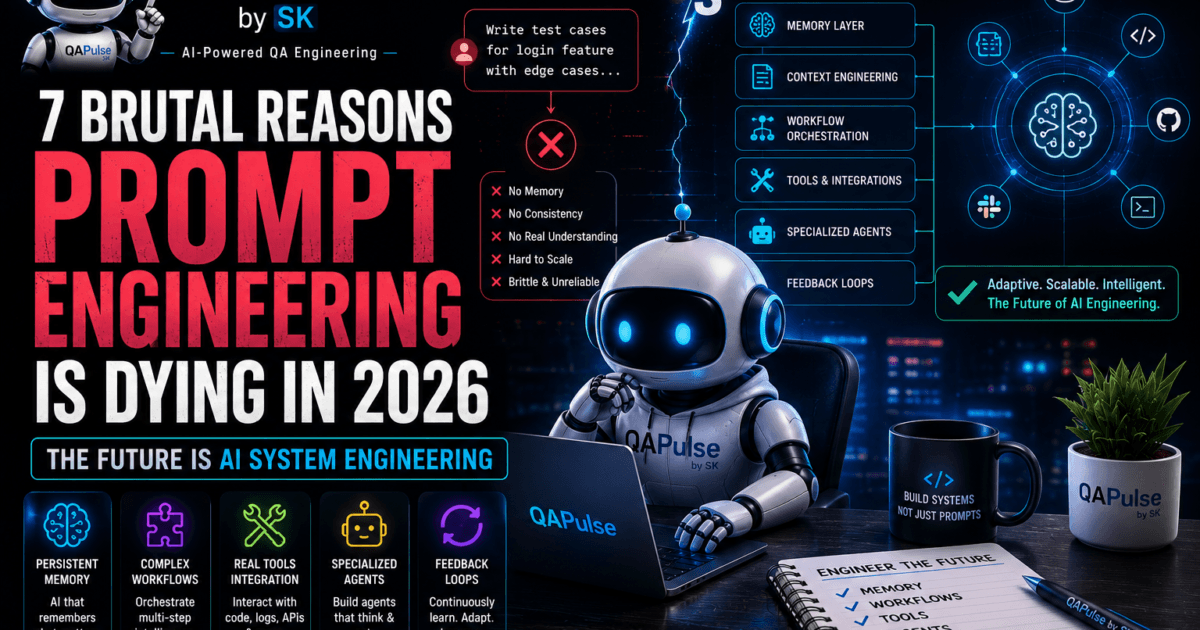
Prompt Engineering Is Dying Faster Than Most Engineers Realize
For the last few years, the AI industry became obsessed with:
prompt engineering
People treated prompts like magic spells.
Everyone was sharing:
- mega prompts
- jailbreak prompts
- chain-of-thought tricks
- “ultimate ChatGPT prompts”
- copy-paste AI templates
And honestly?
That phase is already fading.
Fast.
Because modern AI systems are evolving toward something much bigger:
✅ memory
✅ workflows
✅ tools
✅ orchestration
✅ agents
✅ context systems
✅ autonomous execution
The future is no longer:
❌ “better prompts”
The future is:
✅ better AI systems
Why Prompt Engineering Became Overhyped
At first, prompts felt revolutionary.
A single prompt could:
- generate code
- write tests
- summarize logs
- create APIs
- debug errors
That created the illusion that:
prompts = intelligence
But over time engineers discovered a huge limitation:
LLMs without systems:
❌ forget context
❌ lose consistency
❌ hallucinate
❌ lack memory
❌ cannot adapt reliably
That changes everything.
Prompt Engineering Problem #1 — No Persistent Memory
This is one of the biggest weaknesses of standalone prompt engineering.
Every session often starts from:
zero context
The AI forgets:
- project architecture
- testing rules
- framework standards
- coding conventions
- historical failures
That creates repetitive workflows.
And repetitive workflows destroy scalability.
This is why modern AI systems increasingly use:
- vector databases
- memory layers
- contextual retrieval
- persistent workspace knowledge
Memory is becoming more important than prompts.
Prompt Engineering Problem #2 — Prompts Cannot Scale Complexity
Simple tasks?
Prompts work fine.
But large engineering systems involve:
- dependencies
- architecture decisions
- CI/CD workflows
- runtime state
- multiple repositories
- observability signals
A giant prompt cannot manage all that reliably.
Modern AI engineering increasingly requires:
✅ orchestration
✅ tool chaining
✅ dynamic context
✅ execution pipelines
Not:
one massive promptPrompt Engineering Problem #3 — Tools Are Becoming More Powerful
This is a major shift happening right now.
Modern AI agents increasingly interact with:
- GitHub
- CI/CD pipelines
- browsers
- databases
- APIs
- logs
- telemetry systems
The AI is no longer just:
text generation
It’s becoming:
system interactionThat means the real engineering challenge is increasingly:
👉 tool orchestration
Not prompt wording.
Prompt Engineering Problem #4 — Workflows Matter More Than Instructions
This is where many people misunderstand AI engineering.
The winning systems are no longer:
❌ prompt collections
They are:
✅ workflow architectures
Example modern AI workflow:
User Request
    ↓
Memory Retrieval
    ↓
Tool Selection
    ↓
Code Analysis
    ↓
Execution Engine
    ↓
Validation Layer
    ↓
Feedback Loop
That entire pipeline matters more than:
"Write me a good test script"Because intelligent systems require:
👉 process design
Prompt Engineering Problem #5 — AI Agents Need Specialization
One massive general-purpose prompt is becoming inefficient.
Modern AI systems increasingly use:
- architect agents
- coding agents
- reviewer agents
- debugger agents
- researcher agents
Each agent can have:
✅ dedicated context
✅ dedicated memory
✅ dedicated behavior rules
✅ dedicated capabilities
That’s much more scalable than:
universal mega promptsPrompt Engineering Problem #6 — Context Engineering Is Replacing It
This is one of the biggest shifts in AI right now.
The real challenge is increasingly:
👉 context engineering
Meaning:
- what information the AI receives
- when it receives it
- how memory is structured
- how retrieval works
- how workflows adapt dynamically
Because even the best prompt fails if:
❌ the context is poor
Meanwhile:
strong context systems dramatically improve:
✅ consistency
✅ accuracy
✅ reasoning
✅ reliability
Context engineering is becoming the real superpower.
Prompt Engineering Problem #7 — Feedback Loops Beat Static Prompts
Static prompts do not improve automatically.
But modern AI systems increasingly learn through:
- feedback loops
- runtime corrections
- memory updates
- behavior adaptation
- workflow optimization
This creates:
continuous intelligence evolution
Instead of:
fixed prompt behaviorThat’s a MASSIVE difference.
Why This Matters for SDETs and QA Engineers
Because QA engineering is becoming deeply connected with:
- AI systems
- intelligent automation
- autonomous workflows
- adaptive testing
- observability
- runtime analysis
The future SDET will increasingly behave like:
✅ AI system designer
Not just:
❌ automation script writer
That transition is already happening.
Prompt Engineering Alone Will Not Be Enough in 2026
Engineers relying only on prompts will eventually struggle with:
- scaling
- consistency
- reliability
- maintainability
- system intelligence
Meanwhile engineers learning:
✅ workflows
✅ memory systems
✅ orchestration
✅ tool integration
✅ context engineering
will move much faster.
What Smart Engineers Are Building Instead
The strongest AI engineering systems now combine:
- memory layers
- retrieval pipelines
- observability
- specialized agents
- execution engines
- validation systems
- runtime feedback loops
That’s not:
prompt engineering
That’s:
AI systems engineering
Huge evolution.
The Industry Shift Most People Still Don’t See
Right now many people are still competing on:
better prompts
But the real future is shifting toward:
better systemsAnd honestly?
That shift may become one of the biggest engineering transformations of this decade.
Why Prompt Engineering Is Evolving Into System Engineering
Modern prompt engineering is evolving beyond standalone prompts into AI system engineering involving memory layers, context retrieval, workflow orchestration, specialized agents, and adaptive feedback loops. As AI systems become more integrated into software engineering, modern prompt engineering increasingly depends on observability, tool integration, runtime intelligence, and context engineering rather than isolated prompt optimization techniques alone in 2026.
Internal Links
- Build a Memory System for Your AI Testing Agent
- SKILLS.md Is Just the Beginning — Here’s What Your AI Agent Still Can’t Do
- Stop Writing Test Cases — Start Designing Test Intelligence Systems
External Resources
Let’s Talk
👉 Do you think prompt engineering is overrated now?
👉 What matters more in 2026: prompts or systems?
Drop your thoughts below 👇
Final Line
The future belongs to engineers who design intelligent systems — not just clever prompts.
More Relevant Articles
- The Most Dangerous QA Engineer in 2026 Is the Comfortable One
- Why Most Test Automation Frameworks Collapse at Scale
- Most QA Engineers Are Learning the Wrong Skills in 2026