 QA
QA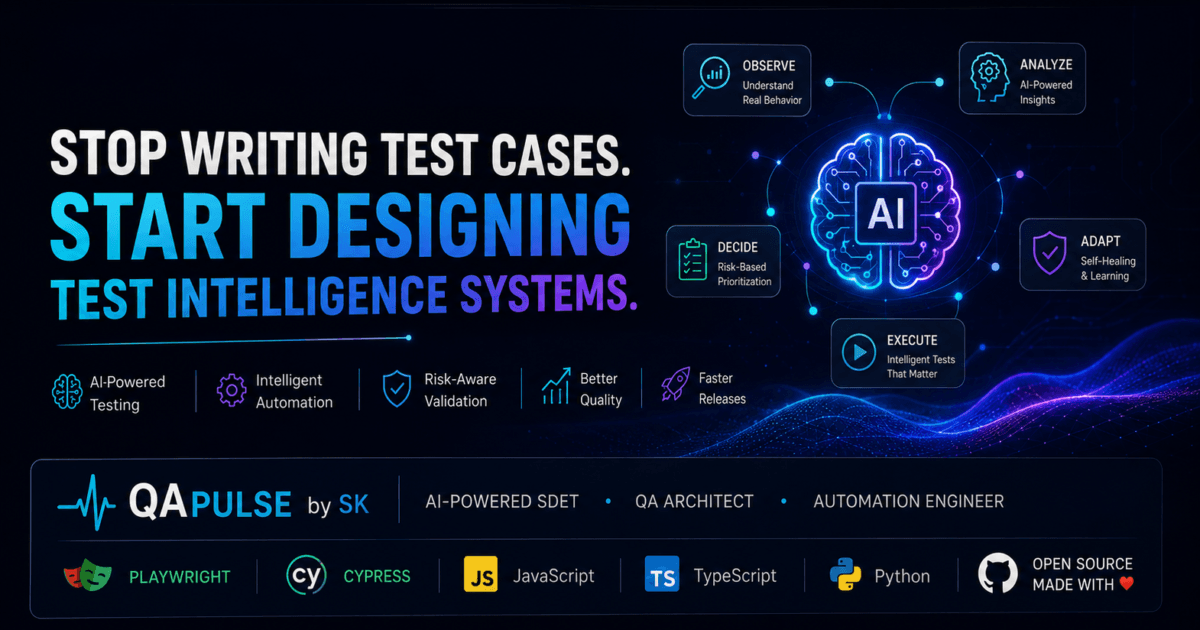
We need Test Intelligence Systems. For years, QA engineers were taught following mindset:
Write test cases.
Execute test cases.
Automate test cases.
But honestly?
That entire model is starting to break.
Not because testing is dying.
But because software complexity exploded.
Modern systems now include:
- AI-generated UIs
- Dynamic APIs
- Real-time rendering
- Distributed microservices
- Agentic workflows
- Self-changing interfaces
And static test cases simply cannot keep up anymore.
The Biggest Lie QA Engineers Still Believe
Most teams still think:
More test cases = better quality.
That’s outdated thinking.
Because eventually every growing automation suite hits the same wall:
❌ Thousands of brittle tests
❌ Endless maintenance
❌ Duplicate coverage
❌ False confidence
❌ Flaky pipelines
❌ Slower releases
And suddenly the “quality system” becomes:
👉 An operational burden
Instead of an engineering advantage.
The Real Future of QA Is NOT More Scripts
The future is:
👉 Test Intelligence Systems
Meaning systems that can:
- Understand application behavior
- Detect risk dynamically
- Prioritize validation automatically
- Adapt to UI changes
- Observe production patterns
- Generate smarter coverage
- Learn from failures
That’s fundamentally different from:
if button exists → clickWhat is a Test Intelligence System?
A Test Intelligence System is NOT just:
❌ A framework
❌ A reporting dashboard
❌ AI-generated scripts
It’s an engineering ecosystem that combines:
- Automation
- Context
- Observability
- Runtime signals
- AI reasoning
- Historical behavior
- Risk analysis
Instead of blindly executing fixed scripts…
The system becomes capable of making testing decisions.
Example: Old QA vs Modern QA
Traditional Automation Thinking
test('login', async () => {
  await page.fill('#email', 'user@test.com');
  await page.fill('#password', '123');
  await page.click('#login');
  await expect(page.locator('.dashboard')).toBeVisible();
});
This validates ONE static flow.
Now compare that with intelligent testing.
Modern Test Intelligence Thinking
The system asks:
👉 Which flows changed recently?
👉 Which APIs became unstable?
👉 Which components fail most often?
👉 Which user journeys generate revenue?
👉 Which tests historically detect production bugs?
👉 Which areas deserve deeper validation today?
That’s a completely different engineering mindset.
Why Static Test Cases Are Becoming Dangerous
Here’s the uncomfortable truth:
Many teams today have:
✅ Thousands of passing tests
And STILL ship:
❌ Critical production bugs
Why?
Because static automation often validates:
👉 Expected behavior
But modern systems fail through:
- Timing issues
- Data inconsistencies
- Async race conditions
- Environment complexity
- User unpredictability
- AI-generated behavior
Static test cases struggle to detect those realities.
Test Coverage Is Not Intelligence
One of the biggest misconceptions in QA:
More coverage = safer systemNot true.
Because modern quality engineering is increasingly about:
👉 Risk awareness
Not just coverage numbers.
A smart system with:
- 200 intelligent validations
Can outperform:
- 10,000 shallow automated tests
AI Changes Everything Here
This is where AI becomes transformative.
Not because AI writes scripts faster.
That’s the least interesting part.
The real power is this:
👉 AI can reason about behavior patterns.
Imagine systems that automatically detect:
- unstable locators
- risky deployments
- suspicious response patterns
- historical flaky areas
- unusual UI behavior
- performance regressions
That’s where testing is heading.
The Best QA Engineers Already Work Like This
Elite SDETs today increasingly think like:
- Systems engineers
- Reliability engineers
- Observability architects
- AI workflow designers
Not just:
Automation script writersBecause modern software systems became too complex for static thinking.
The Rise of Test Intelligence Architecture
In the next few years, automation systems will increasingly include:
✅ Self-healing locators
✅ Runtime risk scoring
✅ AI-assisted debugging
✅ Memory-driven agents
✅ Dynamic coverage analysis
✅ Production-aware testing
✅ Autonomous validation systems
And honestly?
Most teams are not prepared for this shift yet.
Why Most Automation Frameworks Still Fail
Because many frameworks still optimize for:
- Writing tests faster
- Generating reports
- Running pipelines
But the future optimization is different:
👉 Reducing uncertainty
That requires:
- Context
- Memory
- Runtime intelligence
- Observability
- AI reasoning
Not just more assertions.
A New Mental Model for QA Engineers
Stop asking:
"How many test cases do we have?"
Start asking:
"How intelligently does our system understand risk?"That question changes everything.
The Engineers Who Will Win in 2026
The next generation of high-value SDETs will not be the people who:
❌ Memorize framework syntax
It will be engineers who can design:
✅ Intelligent testing ecosystems
✅ AI-enhanced validation systems
✅ Adaptive automation architectures
✅ Observability-driven QA platforms
Because testing is evolving into:
👉 System intelligence engineering
What You Should Learn Next
If you want to stay relevant in the next era of QA:
Focus less on:
- Tutorial-driven scripting
- Tool worship
- Framework tribalism
And focus more on:
- AI systems
- Architecture
- Observability
- Runtime behavior
- Context engineering
- Automation intelligence
That’s where the industry is moving.
Fast.
Let’s Talk
👉 Are traditional test cases becoming obsolete?
👉 What would a truly intelligent QA system look like to you?
Drop your thoughts below 👇
Final Line
The future QA engineer will not be measured by how many tests they wrote.
They will be measured by how intelligently their systems understand software behavior.
More Relevant Articles
- The Most Dangerous QA Engineer in 2026 Is the Comfortable One
- Why Most Test Automation Frameworks Collapse at Scale
- Most QA Engineers Are Learning the Wrong Skills in 2026