QA
QA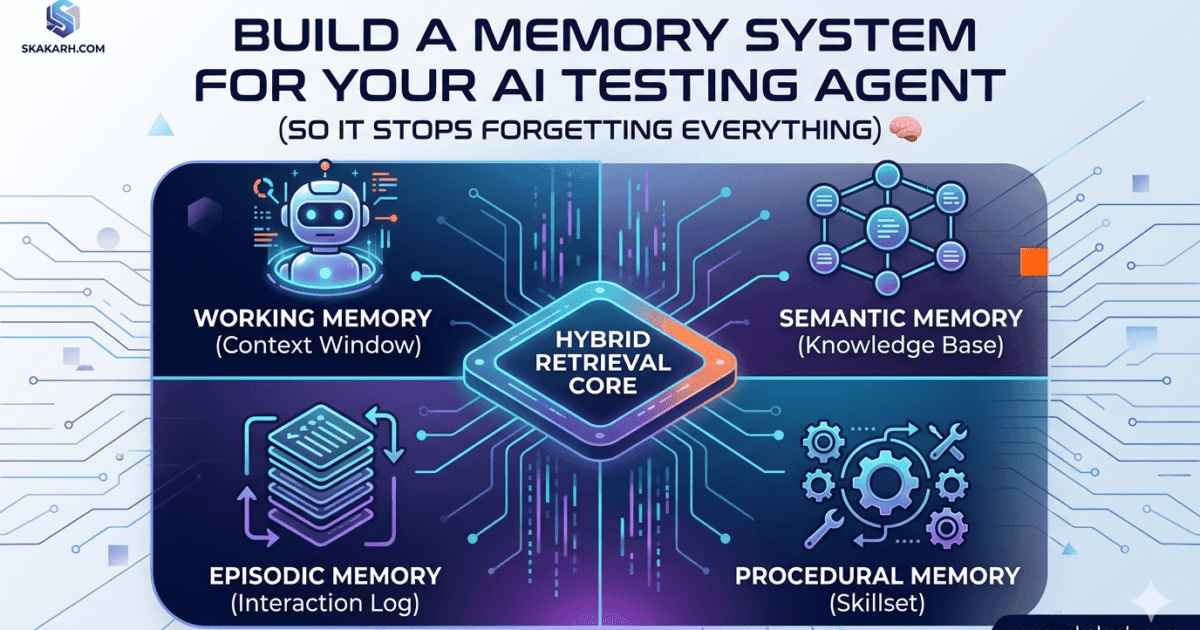
“Your AI Testing agent isn’t dumb…
It just forgets everything.”
That’s the real problem.
You gave it:
- Skills ✅
- Instructions ✅
- Tools ✅
But not the one thing that actually creates intelligence:
👉 Memory
The Problem You’re Ignoring 🤯
Your AI agent today:
- Generates test cases
- Executes them
- Fails
- Suggests a fix
…and then?
👉 Next run = same mistake again
Stateless AI = infinite repetition
What “Memory” Actually Means (Not Buzzword)
Memory is NOT:
❌ Just chat history
❌ Just logs
👉 Real memory means:
- Remembering failures
- Remembering fixes
- Remembering context
- Using past decisions
Memory = Experience for AI
Before vs After (This Will Click Instantly)
❌ WITHOUT Memory
Run 1 → Test fails (locator issue)
Run 2 → Same test fails again
Run 3 → Same mistake again
👉 Agent learns nothing
✅ WITH Memory
Run 1 → Test fails (locator issue)
→ Store failure

Run 2 → Agent detects similar pattern
→ Uses alternative locator
→ Passes
👉 Agent evolves
Architecture (Simple but Powerful)
Input → Memory Check → Decision → Execution → Store Result
👉 Memory is used BEFORE and AFTER execution
Step 1: Define Memory Structure
Start simple (don’t overengineer)
memory = {
    "failures": [],
    "fixes": [],
    "patterns": []
}
Step 2: Store Failures
def store_failure(test_name, error):
    memory["failures"].append({
        "test": test_name,
        "error": error
    })
Step 3: Store Fixes
def store_fix(test_name, fix):
    memory["fixes"].append({
        "test": test_name,
        "solution": fix
    })
Step 4: Retrieve Relevant Memory
def get_similar_failure(error):
    for item in memory["failures"]:
        if error in item["error"]:
            return item
    return None
👉 This is basic… but powerful.
Step 5: Use Memory Before Execution
def decide_strategy(error):
    past = get_similar_failure(error)

    if past:
        return "use_alternative_locator"

    return "default_execution"
👉 Now your agent is not blind anymore
Step 6: Integrate with AI (Next Level)
Instead of simple matching…
👉 Let AI reason over memory
def analyze_with_memory(error, memory):
    prompt = f"""
    Given past failures:
    {memory}

    Analyze this error:
    {error}

    Suggest best fix.
    """

    return planner.generate_reply(
        messages=[{"role": "user", "content": prompt}]
    )
👉 Now you have:
👉 Reasoning + Memory = Intelligence
Step 7: Persist Memory (Don’t Lose It!)
If memory resets every run…
👉 You’re back to zero
Simple JSON Storage
import json

def save_memory():
    with open("memory.json", "w") as f:
        json.dump(memory, f)

def load_memory():
    global memory
    with open("memory.json", "r") as f:
        memory = json.load(f)
👉 Now your agent improves over time
Advanced Upgrade (For Real Engineers)
🔥 Add Pattern Recognition
def detect_pattern(error):
    if "element not found" in error:
        return "locator_issue"
    return "unknown"
👉 Now memory becomes structured intelligence
Add Memory Types
- Short-term → Current run
- Long-term → Historical patterns
- Context memory → Project-specific
👉 This is how real AI systems are built
The Mistake Everyone Makes
They build:
👉 AI agent
👉 Cool prompts
👉 Fancy tools
But ignore:
👉 Memory layer
Without memory, your AI is just repeating itself faster.
What You Should Build TODAY
Don’t overcomplicate.
Start with:
🔥 Step 1:
Store failures
🔥 Step 2:
Store fixes
🔥 Step 3:
Reuse them
👉 That alone changes everything
Real Insight
Intelligence is not about knowing more…
It’s about remembering and applying.
Let’s Talk
👉 Does your AI agent repeat mistakes?
👉 Are you storing failures anywhere?
Drop your thoughts 👇
Final Line
Without memory, AI is just automation.
With memory, AI becomes a system.
Now ask yourself:
👉 Is your agent remembering… or forgetting?
More Relevant Articles
- How I Reduced Flaky Tests by 40% Using Self-Healing Locators + AI
- The Architecture Mistake 90% of Playwright Projects Make And How the Top 1% Quietly Avoid it
- Autonomous Load Pipelines: GitHub Actions + Grafana k6 + GPT5 Run Your Tests Before You Even Commit