 QA
QA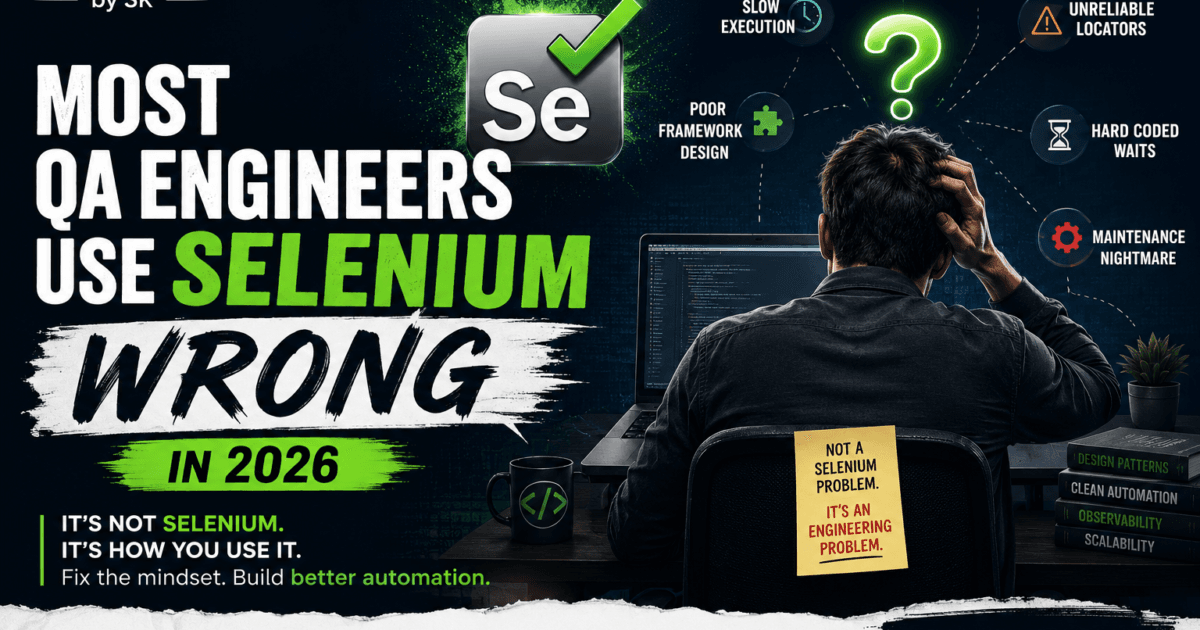
Selenium Is Not the Problem Most QA Engineers Think It Is
For years, people have repeatedly claimed:
“Selenium is dead.”
But somehow…
Selenium continues surviving every single wave of:
- new frameworks
- AI hype
- modern tooling
- frontend trends
- browser automation revolutions
That should tell engineers something important.
The truth is:
Selenium itself is not the biggest problem.
The bigger problem is:
how most teams actually use Selenium
And honestly?
A huge percentage of automation failures blamed on Selenium are actually:
- architecture failures
- framework design failures
- scaling failures
- observability failures
- engineering maturity failures
Not tooling failures.
Why Selenium Still Dominates Enterprise QA
People online often underestimate how massive Selenium still is.
Modern enterprise organizations continue relying on Selenium because:
- ecosystems are mature
- integrations are stable
- language support is huge
- enterprise tooling exists everywhere
- large teams already invested heavily
Even in 2026, Selenium remains deeply embedded inside:
- banks
- telecom companies
- enterprise SaaS platforms
- insurance systems
- government infrastructure
- legacy modernization projects
That scale does not disappear overnight.
Many companies cannot simply:
rewrite years of automation infrastructure instantly
That’s why Selenium continues surviving despite constant “replacement” narratives.
The Biggest Selenium Misconception in 2026
The biggest misconception is this:
“Selenium automatically creates flaky automation.”
That is rarely true.
Most flaky Selenium frameworks fail because teams:
- design poor locators
- ignore synchronization
- overload UI testing
- create weak architecture
- lack observability
- mix responsibilities everywhere
The framework becomes the scapegoat.
But the real issue is usually:
👉 engineering quality
not:
👉 Selenium itself
Why Most Selenium Frameworks Collapse at Scale
This is where things get brutally honest.
Most Selenium projects start like this:
- quick proof of concept
- small regression suite
- fast initial success
Then gradually:
- more tests get added
- execution time grows
- flakiness increases
- debugging becomes painful
- CI pipelines slow down
And eventually teams conclude:
“Selenium doesn’t scale.”
But scaling failure often comes from:
- poor framework architecture
- weak parallelization strategy
- unstable environments
- zero telemetry visibility
- no intelligent retry handling
Many automation systems collapse because teams treat automation like:
test scripts
instead of:
engineering systemsSelenium is Often Used Like a Scripting Tool
This is one of the biggest long-term mistakes.
Many teams still approach Selenium using:
- giant utility classes
- hardcoded waits
- unstable XPath chains
- duplicated workflows
- tightly coupled page objects
That creates fragile automation ecosystems.
Modern QA engineering requires:
- modular architecture
- observability
- distributed execution
- telemetry systems
- workflow intelligence
- adaptive synchronization
Selenium can absolutely support scalable systems.
But only if teams engineer it correctly.
Why Flaky Automation Is Usually an Engineering Problem
Flaky automation rarely comes from only:
browser automation tools
Most instability actually comes from:
- environment inconsistency
- poor synchronization strategy
- unreliable test data
- API instability
- async timing issues
- infrastructure bottlenecks
Yet many teams blame Selenium for everything.
That creates a dangerous mindset.
Because switching frameworks without fixing:
- architecture
- pipelines
- engineering discipline
usually reproduces the same failures later.
This is why many migrations from Selenium to newer tools still end up facing:
- flaky suites
- scaling bottlenecks
- debugging pain
just with:
different syntaxModern Selenium Requires Better Architecture
Selenium in 2026 works best when paired with:
- intelligent waits
- observability systems
- modular frameworks
- scalable execution pipelines
- distributed infrastructure
- adaptive retry systems
Modern Selenium teams increasingly combine:
- Selenium Grid
- Docker
- Kubernetes
- telemetry platforms
- cloud execution systems
- AI-assisted debugging
This changes Selenium from:
browser scripting
into:
automation infrastructure engineeringThat distinction matters massively.
Why Observability Matters More Than Framework Choice
This is one of the biggest industry shifts happening quietly.
Most teams still obsess over:
- Playwright vs Selenium
- Cypress vs Selenium
- WebDriverIO vs Selenium
But modern high-performing teams increasingly focus on:
automation observability
instead.
Because debugging quality matters more than framework marketing.
Without observability:
every framework eventually becomes difficult at scale.
Modern automation ecosystems increasingly require:
- traces
- execution telemetry
- intelligent logging
- runtime diagnostics
- distributed visibility
That is becoming more important than:
👉 framework popularity debates
Selenium vs Modern Expectations in 2026
Modern engineering expectations changed dramatically.
Teams now expect:
- parallel execution
- cloud-native scaling
- CI/CD orchestration
- AI-assisted debugging
- resilient automation
- intelligent retries
Older Selenium frameworks often struggle because they were designed for:
2015-era automation thinking
not:
modern distributed engineering systemsBut Selenium itself evolved significantly.
Modern Selenium supports:
- W3C WebDriver standards
- better browser interoperability
- cloud execution
- distributed scaling
- ecosystem integrations
The issue is many teams never modernized their architecture around it.
What Smart QA Teams Do Differently With Selenium
Strong engineering teams increasingly treat Selenium like:
a scalable platform component
not:
a scripting libraryModern high-performing teams typically invest heavily in:
- observability
- telemetry
- adaptive retries
- execution orchestration
- stable test data systems
- containerized environments
They also reduce unnecessary UI automation aggressively.
That is important.
Because many teams attempt solving instability by:
adding more UI tests
which often creates:
- slower pipelines
- more flakiness
- higher maintenance cost
instead of better quality.
Should Engineers Still Learn Selenium in 2026?
Absolutely.
But engineers should learn Selenium differently.
Not as:
a record-and-playback browser tool
Instead learn it as part of:
- automation architecture
- distributed systems
- observability engineering
- scalable QA ecosystems
- intelligent execution pipelines
Because Selenium still teaches critical concepts:
- browser automation principles
- synchronization
- execution orchestration
- locator strategies
- distributed testing
And those concepts remain valuable across:
- Playwright
- Cypress
- WebDriverIO
- AI-native automation systems
Why Most QA Engineers Use Selenium Wrong
Selenium remains one of the most important browser automation technologies in modern enterprise QA, but many engineering teams still use it with outdated automation practices. In 2026, scalable Selenium ecosystems increasingly require observability, distributed execution, modular architecture, intelligent retries, telemetry systems, and cloud-native orchestration. Teams that modernize their Selenium engineering strategy often build highly scalable automation systems, while teams treating Selenium as simple browser scripting frequently struggle with flakiness, maintenance overhead, and unreliable CI/CD execution pipelines.
More Related Blogs
- Playwright vs Cypress in 2026: Which Tool Actually Wins?
- Why Most Test Automation Frameworks Collapse at Scale
- The Future of QA Is Smaller Teams With Smarter Systems
External Resources
Final Thoughts
The future of Selenium is not about:
whether the tool survives
It will survive.
The bigger question is:
whether engineering teams evolve how they use it
Because modern QA success increasingly depends less on:
- framework hype
- trendy tooling
- marketing narratives
and more on:
- engineering maturity
- architecture quality
- observability
- intelligent execution systems
Most QA engineers don’t fail because of Selenium.
They fail because they try scaling modern automation using outdated engineering thinking.