 QA
QA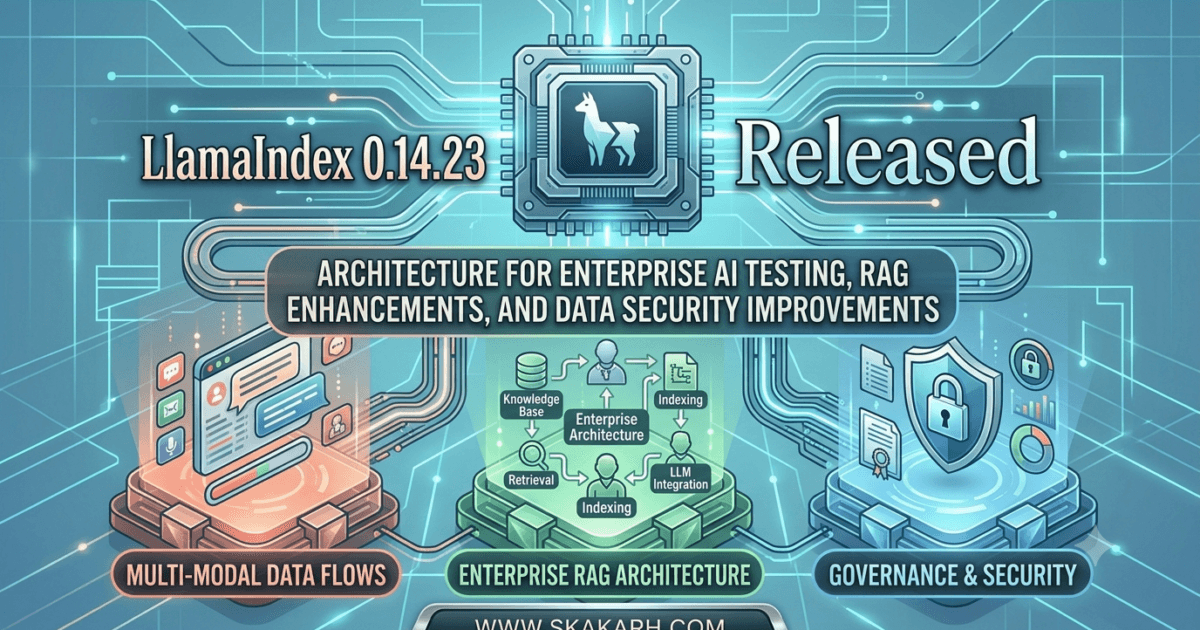
LlamaIndex 0.14.23 Released: Why This Update Matters
Large Language Models are only as useful as the data they can access. That is precisely where LlamaIndex has established itself as one of the most important frameworks in today’s AI ecosystem.
Whether you’re building Retrieval-Augmented Generation (RAG) applications, AI copilots, enterprise search engines, autonomous agents, or document intelligence platforms, LlamaIndex often serves as the layer responsible for connecting language models with external knowledge sources.
Although LlamaIndex 0.14.23 is not a feature-heavy release, dismissing it as “just another maintenance update” would be a mistake.
For engineering organizations running production AI systems, dependency management, package compatibility, and ecosystem stability directly influence platform reliability. Small infrastructure updates often prevent future integration issues, improve security posture, and ensure compatibility across hundreds of optional integrations.
For QA engineers, SDETs, AI platform teams, and DevOps engineers, this release is less about new capabilities and more about maintaining a healthy AI software supply chain.
What’s New in LlamaIndex 0.14.23?
Unlike previous feature-focused releases, version 0.14.23 primarily concentrates on ecosystem maintenance.
The release includes:
- Dependency upgrades across dozens of packages
- UV package management updates
- Pip dependency refreshes
- Improvements to LlamaIndex integrations
- Updates across callback modules
- Internal package consistency improvements
On paper, these changes may appear routine.
In production AI environments, however, dependency updates frequently determine whether enterprise systems remain secure, compatible, and maintainable over the long term.
Key Highlights at a Glance
| Area | Update | QA Impact |
|---|---|---|
| Dependency Management | Large-scale package upgrades | Improves long-term framework stability |
| UV Package Updates | Multiple dependency refreshes | Better reproducible development environments |
| Pip Updates | Library maintenance | Reduced compatibility issues |
| Callback Integrations | Argilla callback updates | Improved evaluation workflows |
| Ecosystem Maintenance | Package synchronization | Lower technical debt |
| Enterprise Readiness | Infrastructure improvements | More reliable production deployments |
Why Dependency Releases Matter More Than Most Teams Realize
Many developers instinctively overlook maintenance releases because they do not introduce exciting new APIs.
Enterprise engineering teams think differently.
Modern AI applications depend on enormous dependency graphs.
A typical RAG application today may include:
- LlamaIndex
- LangChain
- OpenAI SDK
- Anthropic SDK
- Pydantic
- FastAPI
- SQLAlchemy
- Vector database clients
- MCP integrations
- Embedding libraries
- Evaluation frameworks
A compatibility issue in any one of these libraries can trigger failures across the entire application stack.
That is why dependency maintenance releases deserve serious attention.
LlamaIndex 0.14.23 reduces ecosystem drift by keeping supporting packages aligned with the broader Python AI landscape.
UV Dependency Updates Improve Development Consistency
One recurring theme throughout this release is the extensive use of UV dependency updates.
The Python ecosystem is increasingly adopting uv as a modern alternative for package installation and dependency management.
Compared to traditional package management approaches, UV offers:
- faster dependency resolution
- reproducible builds
- improved installation speed
- cleaner lockfile management
- better developer experience
For QA teams managing AI automation frameworks, consistent dependency resolution reduces one of the most common sources of “works on my machine” failures.
If different developers install slightly different dependency versions, reproducing AI bugs becomes significantly more difficult.
By continuously updating dependency definitions, the LlamaIndex team helps maintain consistency across supported environments.
Better Package Maintenance Improves Enterprise Stability
The release notes contain numerous package updates across dozens of directories.
While repetitive at first glance, these updates indicate healthy project maintenance.
Well-maintained frameworks typically:
- update dependencies regularly
- remove outdated packages
- patch vulnerabilities quickly
- keep integrations synchronized
- reduce technical debt
This matters because AI frameworks evolve at an exceptionally fast pace.
OpenAI, Anthropic, Google, Cohere, Azure AI, vector databases, and embedding providers all release updates frequently.
Frameworks that fail to maintain dependency compatibility eventually become difficult to upgrade.
LlamaIndex continues demonstrating an active maintenance strategy, which is reassuring for enterprise adoption.
Argilla Callback Updates Strengthen AI Evaluation
One noteworthy component updated in this release is llama-index-callbacks-argilla.
Argilla has become an increasingly popular platform for:
- LLM evaluation
- Human feedback collection
- Prompt validation
- Dataset annotation
- AI quality monitoring
Organizations building production RAG systems often combine LlamaIndex with Argilla to continuously evaluate response quality.
Keeping callback integrations current helps ensure that evaluation pipelines remain compatible with the latest framework versions.
For QA engineers responsible for AI quality assurance, stable evaluation tooling is just as important as stable inference pipelines.
What LlamaIndex 0.14.23 Means for QA Engineers
For traditional software teams, this release may appear to be a routine maintenance update. However, for organizations building AI-powered applications, releases like LlamaIndex 0.14.23 often have a much greater impact than new feature releases.
Modern AI systems are built on a complex ecosystem of interconnected libraries. A single Retrieval-Augmented Generation (RAG) application may combine LlamaIndex with FastAPI, LangChain, OpenAI SDKs, embedding providers, vector databases, observability platforms, and cloud-native deployment tools. Even a small dependency mismatch can introduce subtle bugs that are difficult to reproduce and diagnose.
LlamaIndex 0.14.23 focuses on maintaining ecosystem health by synchronizing dependencies, refreshing packages, and improving compatibility across its growing collection of integrations. Although end users may never notice these changes directly, engineering teams benefit from more predictable upgrades, fewer compatibility issues, and improved long-term maintainability.
For QA engineers and SDETs, this translates into more stable test environments, reduced troubleshooting time, and greater confidence when validating AI applications before production deployment.
Regression Testing Checklist Before Upgrading
Although this release does not introduce significant new functionality, every framework upgrade should be validated using a structured regression testing strategy.
Before deploying LlamaIndex 0.14.23 into production, verify that your existing AI workflows continue behaving as expected.
Recommended validation areas include:
- Document ingestion pipelines successfully process new data.
- Embedding generation remains consistent with previous releases.
- Vector database indexing continues without errors.
- Retrieval quality has not changed unexpectedly.
- Prompt execution produces reliable responses.
- Callback handlers and evaluation pipelines function correctly.
- Third-party integrations continue working with supported LLM providers.
- CI/CD pipelines execute successfully after dependency updates.
- Existing automated AI regression tests pass without modification.
These validation steps help detect hidden compatibility issues long before they affect production systems.
Should You Upgrade to LlamaIndex 0.14.23?
For most organizations, the answer is yes.
This release focuses on maintenance rather than introducing breaking architectural changes, making it a relatively low-risk upgrade. Teams already running production RAG systems should include this version in their next planned maintenance cycle after completing standard regression testing.
Organizations with heavily customized AI workflows should still validate integrations in a staging environment before rolling the update into production. While dependency updates are generally safe, enterprise environments often contain unique combinations of packages that deserve careful verification.
How to Upgrade
Python
pip install --upgrade llama-index
After upgrading, recreate your virtual environment if required and rerun your automated regression suite to validate document indexing, retrieval accuracy, embeddings, vector database connectivity, callback integrations, and overall application behaviour.
Official Resources
Official Release Notes: https://github.com/run-llama/llama_index/releases/tag/v0.14.23
Official Documentation: https://docs.llamaindex.ai
Internal Links
- How Postman’s AI Evolution Is Turning API Collections into Autonomous Testing Systems
- Pytest AI in 2026: The Rise of Autonomous, Self-Healing Test Runners
- How I Used GPT-5 to Auto-Generate Pytest API Tests from a Swagger File
Final Verdict
LlamaIndex 0.14.23 demonstrates that successful AI platforms depend on more than innovative features—they require a healthy, actively maintained ecosystem.
Regular dependency updates help reduce technical debt, improve compatibility across AI frameworks, and simplify future upgrades. While this release may not introduce headline features, it strengthens the underlying foundation that production AI applications rely on every day.
For QA engineers, SDETs, and AI platform teams, the recommendation is straightforward: schedule the upgrade, execute a comprehensive regression test suite, validate your Retrieval-Augmented Generation workflows, and continue keeping your AI stack aligned with the rapidly evolving Python ecosystem.
Maintenance releases like this rarely generate excitement, but they often prevent tomorrow’s production incidents.
Frequently Asked Questions
Is LlamaIndex 0.14.23 a major feature release?
No. It is primarily a maintenance release focused on dependency updates, package synchronization, and improving overall ecosystem stability.
Does LlamaIndex 0.14.23 introduce breaking changes?
No breaking API changes have been announced. Nevertheless, production teams should always perform regression testing before upgrading.
Should QA engineers upgrade immediately?
Most organizations can confidently plan the upgrade after validating their AI workflows in a staging environment.
What should be tested after upgrading?
Focus on document ingestion, embeddings, retrieval quality, vector database integrations, callback handlers, evaluation pipelines, and end-to-end RAG workflows to ensure no regressions have been introduced.
Continue Learning
Explore more practical guides on AI Testing, Agentic AI, MCP, Playwright, Selenium, LangChain, CrewAI, LlamaIndex, FastAPI, and Test Automation at www.skakarh.com.
At QAPulse by SK, every release article goes beyond release notes to explain the real-world impact, testing strategy, migration considerations, and engineering insights that help QA professionals build more reliable software.