 QA
QA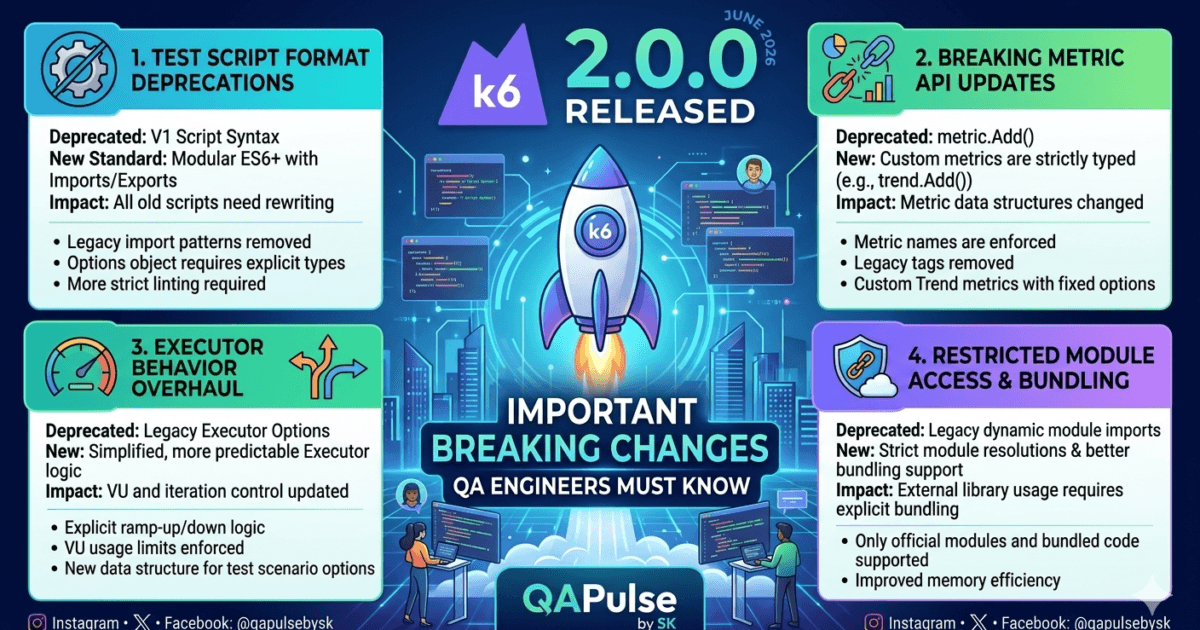
Performance testing is no longer a luxury.
Modern applications must handle increasing user traffic, API workloads, microservices communication, and cloud-native deployments.
As a result, tools like k6 have become essential for QA Engineers, SDETs, and Performance Testing teams.
On May 11, 2026, Grafana officially released k6 2.0.0, marking the completion of the major version transition that began during the release candidate phase.
Unlike many maintenance releases, k6 2.0.0 introduces several breaking changes, removes long-deprecated functionality, updates cloud workflows, and changes extension compatibility requirements.
If your organization relies on k6 for performance testing, this release deserves careful attention before upgrading production pipelines.
What is k6?
k6 is an open-source performance testing tool designed for:
- Load testing
- Stress testing
- Spike testing
- API performance validation
- Continuous performance testing
- CI/CD integration
Written in Go and using JavaScript for scripting, k6 has become one of the most popular modern alternatives to traditional performance testing tools.
QA teams frequently use k6 to validate:
- API performance
- Microservices scalability
- Cloud-native applications
- Web application responsiveness
- Production readiness
What’s New in k6 2.0.0?
The primary focus of k6 2.0.0 is cleanup and modernization.
The release removes deprecated APIs, obsolete commands, outdated configuration options, and unsupported workflows that have accumulated over previous versions.
While this improves maintainability, it also introduces migration challenges for existing users.
Major Breaking Change: Go Module Path Updated
One of the most important changes is:
go.k6.io/k6/v2
The Go module path has changed.
Why This Matters
Teams building:
- Custom extensions
- Internal plugins
- Organization-specific integrations
must update import paths to maintain compatibility.
Failure to update extension code may result in:
- Build failures
- Runtime issues
- CI pipeline failures
Organizations using custom k6 extensions should prioritize migration testing.
Deprecated Commands Have Been Removed
Several deprecated CLI commands have been permanently removed.
Examples include:
- k6 login
- k6 pause
- k6 resume
- k6 scale
- k6 status
- –no-summary
- –upload-only
QA Impact
Automation pipelines relying on these commands will stop functioning after upgrading.
Before deployment, teams should:
- Audit scripts
- Review Jenkins jobs
- Validate GitHub Actions workflows
- Test Azure DevOps pipelines
This is one of the highest-risk migration areas.
Externally Controlled Executor Removed
Another significant change:
executor: "externally-controlled"
has been removed.
Why This Is Important
Any performance test scripts using externally controlled execution will fail under k6 2.0.0.
QA teams should identify affected scripts immediately and evaluate alternative execution models supported by the new release.
This is likely the most impactful breaking change for advanced performance testing environments.
Cloud Execution Changes
Several cloud-related workflows have changed.
Exit Code Behavior Updated
Cloud runs that terminate due to:
- User cancellation
- Timeouts
- System interruptions
now return:
97
instead of:
0
Testing Implications
If CI/CD pipelines evaluate exit codes, they may require updates.
Incorrect assumptions about successful execution could produce misleading reporting results.
Cloud Configuration Changes
The following configuration is no longer supported:
options.ext.loadimpact
Teams should migrate to:
options.cloud
Migration Recommendation
Search existing repositories for:
loadimpact
and update all configurations before upgrading.
Redis Module Removed
The following module has been removed:
k6/experimental/redis
Impact on Existing Projects
Scripts depending on Redis integrations may fail after migration.
Organizations should:
- Review test repositories
- Validate Redis-based workflows
- Explore replacement approaches
This change may require code refactoring in some environments.
Web Vitals Updated
The bundled web-vitals library has been updated to version 5.1.0.
As part of this update:
FID (First Input Delay)
has been removed.
Why QA Teams Should Care
Performance dashboards and reports using FID should be reviewed.
Organizations may need to update:
- Reporting systems
- KPI dashboards
- Performance baselines
to align with newer web performance metrics.
What QA Engineers Should Test After Upgrading
Before upgrading to k6 2.0.0, run a structured validation plan.
1. Script Compatibility Testing
Validate:
- Existing test scripts
- Shared libraries
- Internal extensions
2. CI/CD Validation
Execute:
- Jenkins pipelines
- GitHub Actions workflows
- GitLab CI jobs
- Azure DevOps pipelines
3. Cloud Testing Workflows
Verify:
- Cloud execution
- Exit code handling
- Reporting systems
- Alerting integrations
4. Extension Compatibility
Review:
- Custom plugins
- Internal modules
- Go extensions
Should QA Teams Upgrade Immediately?
The answer depends on your current usage.
Upgrade Immediately If:
- You use standard k6 functionality.
- You do not rely on removed commands.
- You do not maintain custom extensions.
Delay Upgrade If:
- You use custom Go extensions.
- You depend on externally controlled executors.
- You have extensive cloud automation workflows.
- You rely on Redis integrations.
For larger organizations, a staged rollout is recommended.
Migration Checklist for k6 2.0.0
| Task | Priority |
|---|---|
| Review CLI commands | High |
| Update Go module paths | High |
| Validate CI/CD pipelines | High |
| Review cloud configurations | High |
| Test custom extensions | High |
| Verify Redis dependencies | Medium |
| Update performance dashboards | Medium |
Official Resources
Official Release Notes:
https://github.com/grafana/k6/releases/tag/v2.0.0
Official Documentation:
https://grafana.com/docs/k6/latest/
Migration Guide:
https://grafana.com/docs/k6/latest/set-up/migrate-to-k6-v2/
Grafana k6:
https://grafana.com/k6/
Frequently Asked Questions
What is k6 2.0.0?
k6 2.0.0 is the latest major release of the Grafana k6 performance testing platform and includes breaking changes, removed deprecated features, and cloud workflow updates.
Is k6 2.0.0 backward compatible?
No. Several deprecated APIs, commands, and execution modes have been removed, making migration testing essential.
What is the biggest breaking change in k6 2.0.0?
The removal of the externally-controlled executor and updates required for Go extension compatibility are among the most impactful changes.
Should QA engineers upgrade immediately?
Organizations should first validate script compatibility, cloud workflows, CI/CD integrations, and custom extensions before upgrading production environments.
Final Thoughts
The release of k6 2.0.0 represents a significant milestone for the performance testing community.
While the release improves maintainability and modernizes the platform, it also introduces breaking changes that require careful migration planning.
For QA Engineers, SDETs, and Performance Test Architects, the safest approach is clear:
- Review existing scripts
- Validate CI/CD workflows
- Test extensions
- Verify cloud configurations
- Execute a complete regression cycle
Teams that prepare properly can benefit from the improvements in k6 2.0.0 while avoiding unexpected disruptions in their performance testing pipelines.
Related Reading
Relevant Articles
- RAG Powered Performance Testing: Real-Time API Behavior Feeds Your k6 Tests
- How Vector DB Latency Impacts AI-Driven Test Optimization in the Agentic QA Stack
- Level Up Your Claude Code with CLAUDE.md
- AI Agents vs Agentic AI — Stop Confusing These Concepts (90% of Developers Get It Wrong)
- LLM Evaluation Framework: 9 Proven Ways to Measure AI Quality
Official Resources
- Official Release Notes:
https://github.com/grafana/k6/releases/tag/v2.0.0 - Official Migration Guide:
https://grafana.com/docs/k6/latest/set-up/migrate-to-k6-v2/ - Official Documentation:
https://grafana.com/docs/k6/latest/ - Grafana k6 Website:
https://grafana.com/k6/