 QA
QA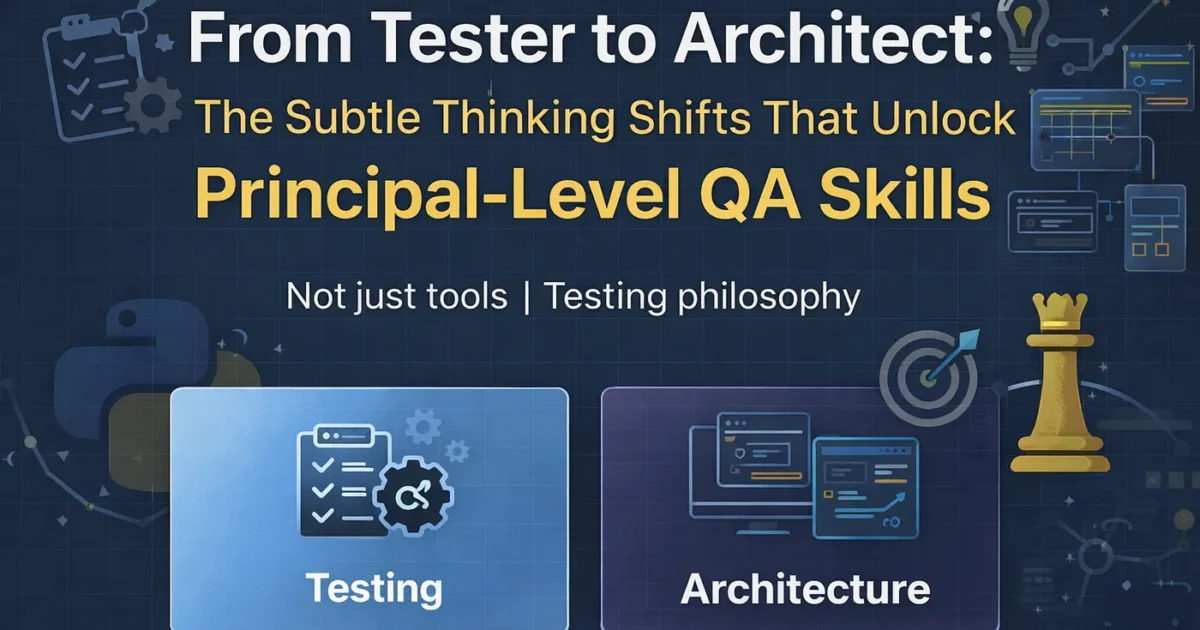
At some point in every strong Software Tester career, something strange happens.
You’re no longer asking:
“Did we test this?”
You’re asking:
“Why does this system fail this way?”
That moment is the line between tester and architect.
Not a title change.
A thinking shift.
Let’s talk about the invisible transitions that separate mid-level QA from principal-level QA engineers.
Shift #1: From “Test Cases” → “Failure Modes”
Testers think in:
- scenarios
- steps
- expected results
Architects think in:
- failure patterns
- blast radius
- systemic weakness
Instead of:
“Did we test login?”
They ask:
“How can authentication fail over time, scale, geography, and abuse?”
That’s architecture thinking.
Shift #2: From Coverage % → Risk Distribution
Mid-level QA chases:
- line coverage
- scenario count
- automation numbers
Principal QA asks:
“Where does failure hurt the business most?”
They map:
- revenue paths
- data sensitivity
- customer trust points
- legal & compliance risks
Coverage becomes strategic, not cosmetic.
Shift #3: From Framework Builder → System Designer
A tester asks:
“How do I automate this flow?”
An architect asks:
“How does this test system evolve over 3 years?”
They design for:
- change tolerance
- self-healing
- observability
- signal > noise
They don’t just build frameworks.
They build testing ecosystems.
Shift #4: From Execution → Feedback Loops
Junior mindset:
“Tests run after code.”
Principal mindset:
“Tests influence design before code exists.”
They inject QA into:
- PR discussions
- architecture reviews
- API contracts
- product discovery
QA becomes a design input, not a validation step.
Shift #5: From Bug Finder → Sense-Maker
Anyone can find bugs.
Principal QA explains:
- why it happened
- why now
- why again if unchanged
- why other teams will hit it next
They translate chaos into clarity.
That’s why leadership listens to them.
Shift #6: From Static Rules → Adaptive Intelligence
Traditional QA writes:
- hardcoded assertions
- fixed waits
- brittle checks
Architect-level QA builds:
- AI-assisted validation
- adaptive waits
- probabilistic reasoning
- learning systems
They accept one truth:
Software changes. Testing must learn.
Shift #7: From Ownership of Tests → Ownership of Outcomes
This is the biggest leap.
Testers own:
- scripts
- cases
- reports
Architects own:
- release confidence
- production stability
- quality culture
- long-term trust
When something breaks, they don’t ask:
“Who tested this?”
They ask:
“Why did our system allow this to escape?”
What Principal QA Looks Like in Practice
They:
- challenge architecture early
- kill low-value tests ruthlessly
- invest in observability
- design for unknown failures
- think in years, not sprints
- document less but think deeper
They are calm in chaos — because they’ve seen the pattern before.
The Hard Truth
You don’t become a principal QA by:
- more tools
- more automation
- more buzzwords
You become one by changing how you think about systems, risk, and responsibility.
Titles are given.
Architecture thinking is earned.
Final Question
Be honest with yourself 👇
Are you still validating features…
or are you designing confidence at scale?
That answer tells you exactly where you are on the journey 🚀
More Relevant Articles
- The Most Dangerous QA Engineer in 2026 Is the Comfortable One
- Why Most Test Automation Frameworks Collapse at Scale
- Most QA Engineers Are Learning the Wrong Skills in 2026