15 Best Postman Alternatives in 2026 for API Testing and Automation
Looking for Postman alternatives in 2026? Compare Bruno, Hoppscotch, Insomnia, Apidog, Hurl, Playwright, REST Assured, Karate, Schemathesis, and more based on API testing, automation, Git, CI/CD, and developer workflows.
SK
Shahnawaz Khan
· Updated
35 min read
What You Will Learn
Why Are Developers Looking for Postman Alternatives in 2026?
Postman is Not the Problem
What Should a Postman Alternative Actually Replace?
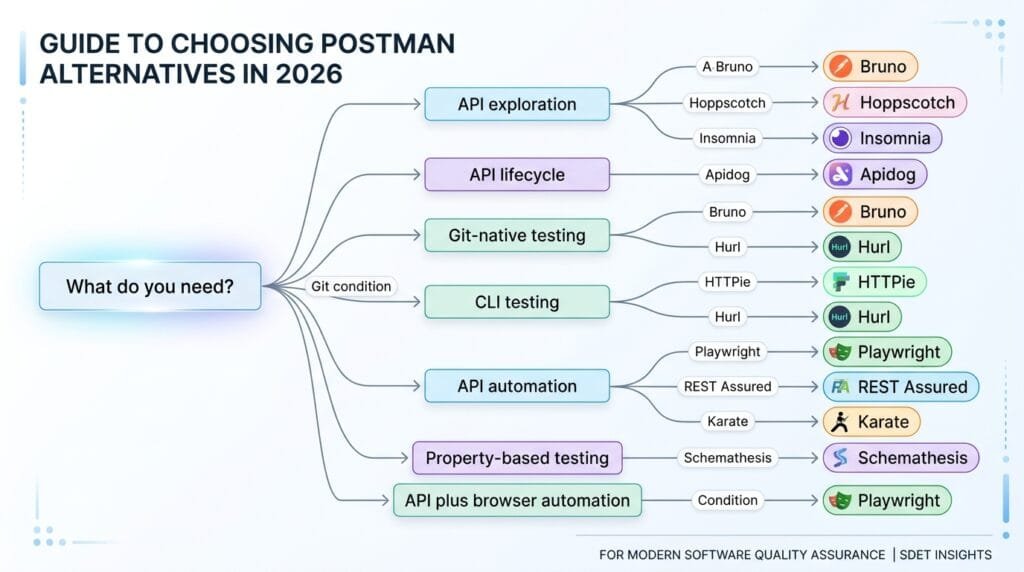
The Five Categories of Postman Alternatives
⚡ Quick Answer
QA engineers and SDETs are seeking Postman alternatives in 2026 because evolving API testing needs specialized tools that deeply integrate with Git-based workflows and CI/CD pipelines. This article helps you choose the best alternative by analyzing specific tool categories to match your advanced automation, design, and performance testing requirements.
Postman alternatives have become a serious consideration for developers, QA engineers, SDETs, and API teams in 2026. The reason is not simply that there are more API clients than before. The bigger change is that API work has split into several different jobs: exploratory request testing, API design, documentation, automated regression, CI/CD validation, contract testing, performance testing, and increasingly AI-assisted API testing.
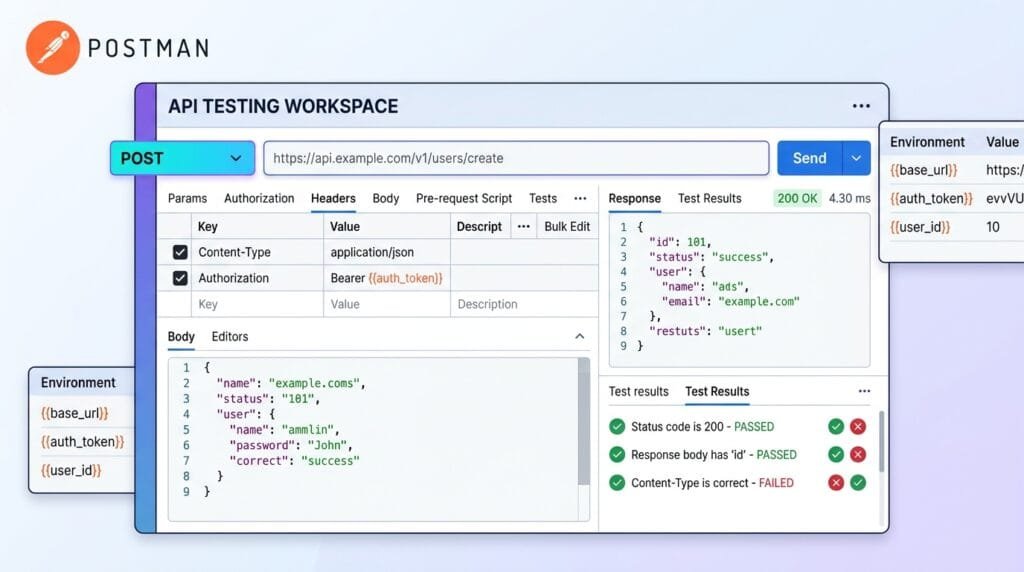
Postman: API Testing Workspace
That means replacing Postman is no longer a simple question of finding another application with a similar Send button.
The better question is:
Which Postman alternative fits the way you actually develop, test, automate, version, and operate APIs?
The answer can be very different for a backend developer, manual QA engineer, SDET, platform engineer, or enterprise API team.
Postman remains a broad API platform, and its own comparison page positions it against tools including Bruno, SmartBear, SoapUI, Stoplight, Apidog, Hoppscotch, cURL, Insomnia, and Kong. (Postman) But the growing alternative ecosystem shows that API testing teams increasingly have different priorities: some want Git-native collections, some want local-first workflows, some want browser-based tooling, some want API lifecycle management, and others want to move their regression testing into code and CI/CD.
This article takes a practical SDET-oriented approach.
Instead of simply ranking tools by popularity, we will examine what each category actually solves, where Postman remains strong, where alternatives have an advantage, and when an API client should be replaced by a proper automation framework.
The goal is not to convince you to abandon Postman.
The goal is to help you make a technically defensible decision.
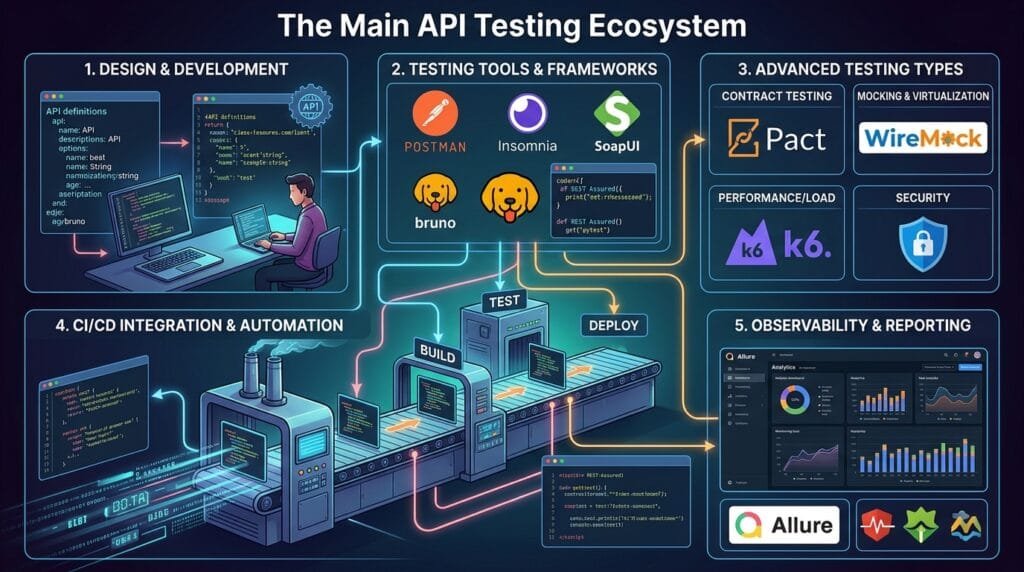
Main API Testing Ecosystem
Why Are Developers Looking for Postman Alternatives in 2026?
The API testing market has changed significantly.
A few years ago, the common workflow looked like this:
Developer
   |
   v
Postman
   |
   +---- Send request
   +---- Inspect response
   +---- Add assertion
   +---- Save collection
   +---- Share collection
That workflow is still valid.
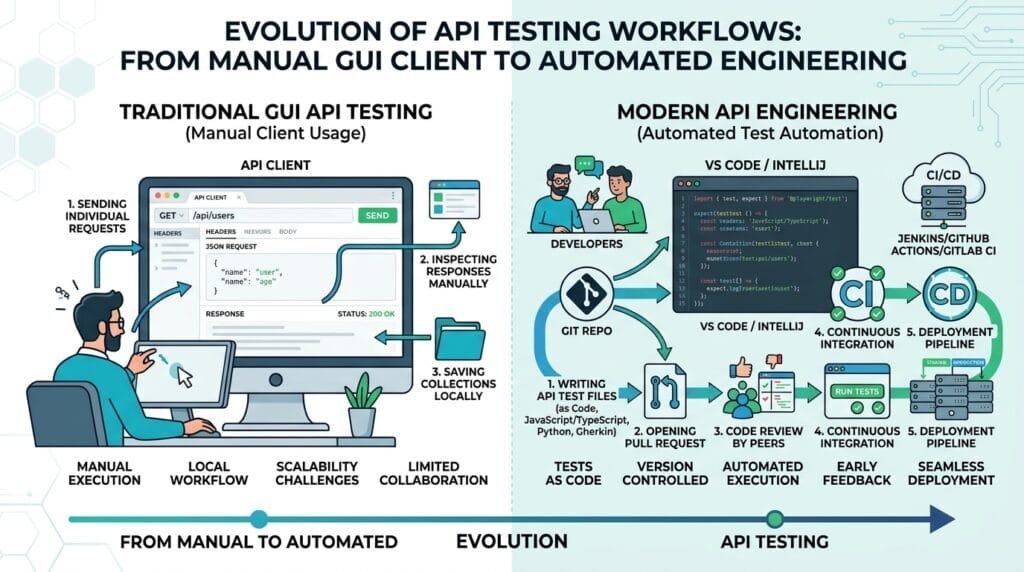
But modern engineering teams increasingly want their API definitions and tests to fit into existing engineering workflows:
Developer
   |
   v
Git Repository
   |
   +---- API definitions
   +---- Test scenarios
   +---- Environment configuration
   +---- Assertions
   |
   v
CI/CD
   |
   v
Release Gate
That is a fundamentally different philosophy.
API client versus Git based automated API testing workflow
A recent 2026 comparison of Postman alternatives highlights the growing demand for tools that are lightweight, offline-capable, Git-friendly, open source, or better aligned with modern developer workflows. (Buanacoding)
Another current comparison identifies Bruno, Hoppscotch, Insomnia, Yaak, and Apidog as major alternatives while also highlighting security and supply-chain considerations as increasingly relevant evaluation criteria. (apidog)
But there is an even more important reason to rethink the category:
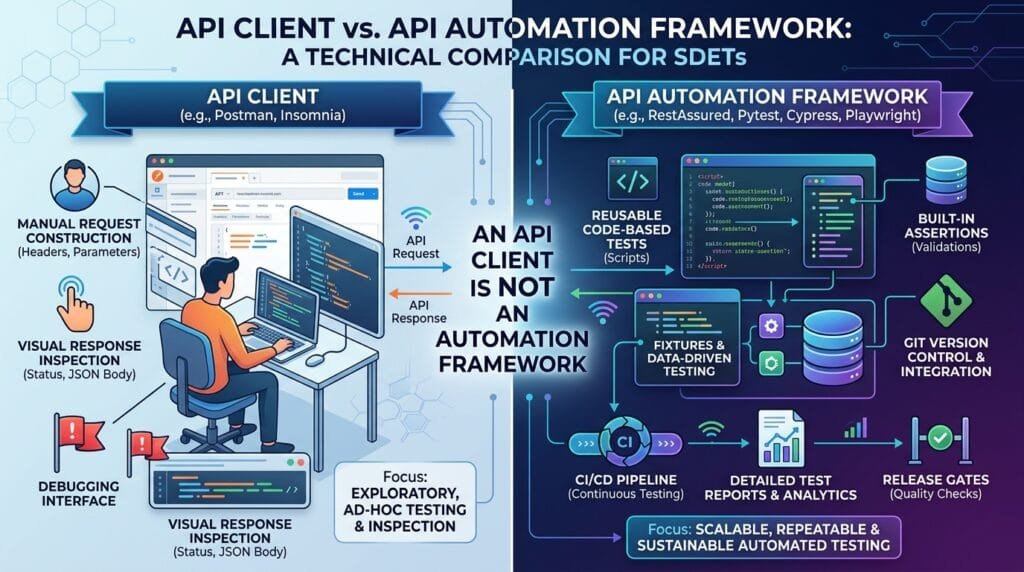
API client ≠ API automation framework.
That distinction can save an SDET team from choosing the wrong tool.
API client versus API automation framework for SDET teams
Postman is Not the Problem
Before discussing alternatives, let us make something clear.
Postman is not automatically a bad choice.
It remains a mature platform with broad API capabilities, collaboration features, mocking, monitoring, documentation, testing, and enterprise functionality. Postman itself emphasizes its broader API lifecycle and enterprise capabilities when comparing itself with alternatives. (Postman)
The problem starts when teams use a single tool for jobs that actually require different engineering approaches.
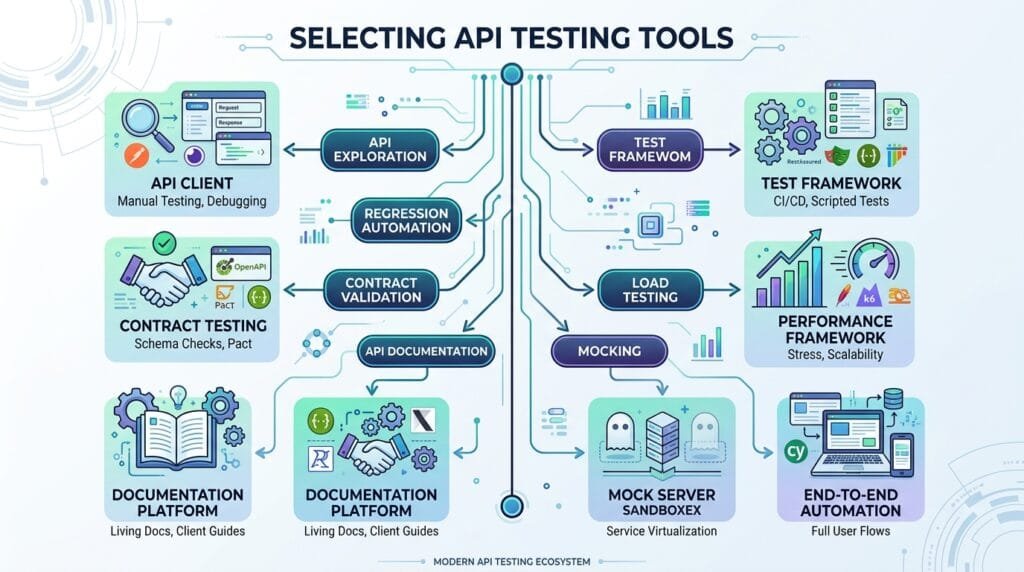
For example:
Exploratory API debugging
        ↓
API client

Regression automation
        ↓
Code + test framework + CI/CD

Contract validation
        ↓
Contract testing tooling

Load testing
        ↓
Performance testing framework

API documentation
        ↓
OpenAPI/documentation platform

End-to-end user journey
        ↓
Browser automation
Trying to force all of those responsibilities into one GUI can create unnecessary complexity.
A better strategy is to choose the right tool for each layer.
What Should a Postman Alternative Actually Replace?
Before choosing a replacement, identify what Postman currently does for your team.
Ask yourself:
Question
If your answer is “Yes”
Do you manually send API requests?
You need an API client
Do you store collections?
You need versionable API definitions
Do you write API assertions?
You need test execution support
Do you run tests in CI?
You need a CLI/automation strategy
Do you maintain OpenAPI specifications?
You need API lifecycle support
Do you mock unavailable services?
You need mocking
Do you test GraphQL?
Check GraphQL support
Do you test gRPC?
Check gRPC support
Do you test WebSockets?
Check WebSocket support
Do you need Git-based reviews?
Prioritize file-based tools
Do you need enterprise collaboration?
Evaluate governance and team features
Do you need AI-generated tests?
Evaluate AI capabilities
Do you validate complete user flows?
Consider E2E automation
API testing requirements mapped to different testing tools
This is the first strategic lesson:
Do not choose a Postman alternative until you know which Postman capability you are actually replacing.
A developer who needs a lightweight HTTP client should not necessarily choose an enterprise API lifecycle platform.
An SDET who needs thousands of automated regression tests should not necessarily choose another GUI API client.
The Five Categories of Postman Alternatives
The current ecosystem can be divided into five useful categories.
1. Lightweight API clients
Examples:
Bruno
Hoppscotch
Insomnia
Yaak
Thunder Client
These are closest to the traditional Postman experience.
2. API lifecycle platforms
Examples:
Apidog
Postman itself
Stoplight-oriented workflows
These combine several API development activities.
3. CLI and developer-native tools
Examples:
HTTPie
cURL
Hurl
These fit naturally into terminals, scripts, repositories, and CI/CD.
4. API automation frameworks
Examples:
Playwright API testing
REST Assured
Karate
These are more appropriate when API testing becomes a software engineering discipline rather than manual request inspection.
5. Specialized API testing approaches
Examples:
Schemathesis
contract testing
property-based API testing
AI-assisted test generation
These solve deeper testing problems that an API client alone cannot fully address.
This categorization is more useful than a simple “best alternatives” ranking.
Quick Comparison: The 2026 API Testing Landscape
Tool
Best For
Open Source
Git-Friendly
API Automation
CI/CD
Best Differentiator
Bruno
Git-native API work
Yes
Excellent
Good
Yes
File-based collections
Hoppscotch
Browser-based API testing
Yes
Moderate
Limited
Possible
Lightweight web workflow
Insomnia
Desktop API development
Yes/partial depending on component
Moderate
Good
Yes
Broad protocol support
Apidog
API lifecycle
No
Good
Strong
Yes
Design + mock + test + docs
Yaak
Local-first API work
Yes
Strong
Moderate
Limited
Modern lightweight workflow
Thunder Client
VS Code users
No
Good
Good
Yes
IDE integration
HTTPie
CLI/API requests
Yes
Excellent
Strong via scripts
Excellent
Developer-friendly CLI
Hurl
HTTP test automation
Yes
Excellent
Excellent
Excellent
Text-based HTTP assertions
REST Assured
Java API automation
Yes
Excellent
Excellent
Excellent
Java test ecosystem
Playwright
API + E2E automation
Yes
Excellent
Excellent
Excellent
Unified browser/API testing
Karate
API automation
Yes
Excellent
Excellent
Excellent
DSL + API automation
Schemathesis
Property-based API testing
Yes
Excellent
Excellent
Excellent
OpenAPI-driven testing
This table reveals something important.
There is no single “best” tool.
There is a best tool for a particular testing problem.
1. Bruno: The Git-Native Postman Alternative
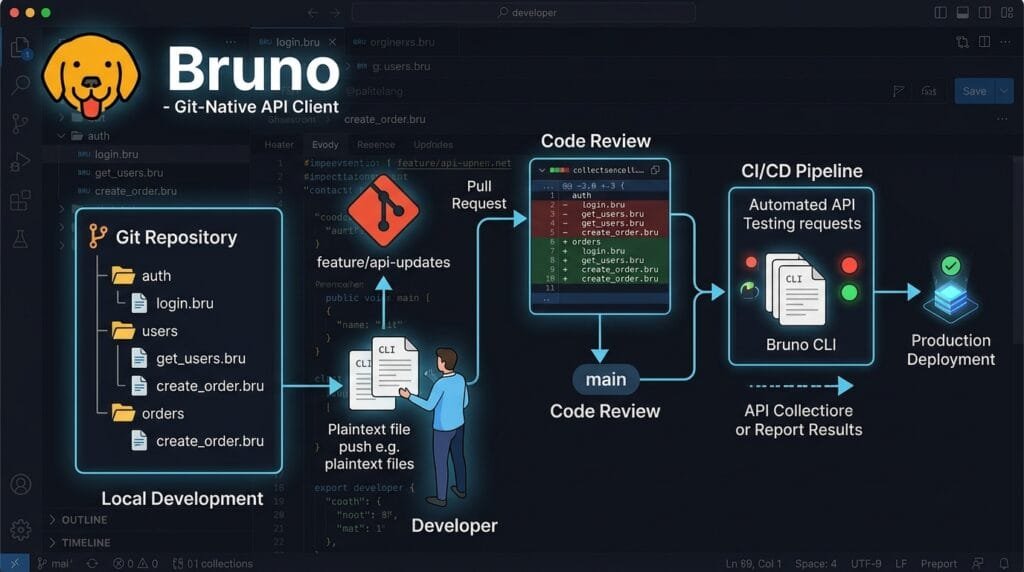
Bruno has become one of the most interesting choices for developers who want API collections to behave more like source code.
Its major architectural difference is the file-based approach.
Instead of thinking:
Cloud Workspace
    |
    v
Collection
the workflow becomes:
Git Repository
    |
    +---- users/
    +---- auth/
    +---- payments/
    +---- orders/
    |
    v
API Requests
That changes collaboration.
Bruno Git native API testing collections and CI workflow
A developer can make a request change and submit it through a pull request.
A reviewer can inspect the change.
A branch can contain API test modifications.
A commit can represent a meaningful API testing change.
This is attractive to engineering teams that already treat infrastructure, application code, and test automation as version-controlled assets.
Current 2026 comparisons consistently identify Bruno’s Git-native and offline/local-first workflow as one of its defining advantages. (apidog)
Now your API testing artifacts live beside the code.
That supports:
Developer
   |
   v
Feature Branch
   |
   +---- Code
   +---- API tests
   +---- API definitions
   |
   v
Pull Request
   |
   v
CI
This is a strong engineering model.
Where Bruno may not be the best choice
If your organization needs:
extensive enterprise collaboration,
sophisticated API lifecycle management,
visual API design,
large-scale mocking,
centralized API governance,
you may need a broader platform.
Bruno’s strength is not “doing everything.”
Its strength is keeping API work close to the developer and Git workflow.
2. Hoppscotch: The Browser-First Alternative
Hoppscotch takes a different approach.
Instead of installing a heavyweight desktop client, the basic experience is browser-oriented.
That makes the workflow extremely simple:
Open Browser
     |
     v
Hoppscotch
     |
     v
Send Request
     |
     v
Inspect Response
The project is open source, and current comparisons highlight its browser-first, lightweight, and self-hosting characteristics. (apidog)
For developers who simply want:
URL
Method
Headers
Body
Send
Response
this can be attractive.
When Hoppscotch makes sense
Choose it when:
you want minimal setup,
browser access matters,
you need quick API exploration,
you prefer open-source tooling,
self-hosting is important,
you do not want API work tied to a heavyweight desktop application.
Where it becomes weaker
The more your API testing becomes:
Complex test suite
        +
Assertions
        +
Data dependencies
        +
CI execution
        +
Reporting
        +
Long-term regression management
the more likely you are to need a dedicated automation framework.
This is not a failure of Hoppscotch.
It is simply a different architectural role.
3. Insomnia: A Strong Desktop API Client
Insomnia remains relevant because many developers want something that feels like a focused API development environment without adopting an entire API lifecycle platform.
It is particularly interesting when protocol support matters.
Current 2026 comparisons commonly position Insomnia as a strong option for REST, GraphQL, and gRPC workflows. (apidog)
This makes it useful for teams working with heterogeneous backend systems.
Insomnia vs Bruno
This is a particularly useful comparison.
Requirement
Bruno
Insomnia
Git-native workflow
Excellent
Good
Local-first philosophy
Excellent
Good
REST
Yes
Yes
GraphQL
Yes
Yes
gRPC
More limited
Strong
Lightweight workflow
Strong
Strong
Postman-like experience
Moderate
Strong
Developer-focused
Excellent
Excellent
If your highest priority is:
“I want my API collections to live naturally in Git.”
Bruno deserves serious consideration.
If your priority is:
“I want broad protocol support in a polished desktop client.”
Insomnia may be more attractive.
That is a much better decision rule than simply asking which has more features.
4. Apidog: The API Lifecycle Alternative
Apidog belongs to a different category.
It is not simply trying to be another lightweight API request client.
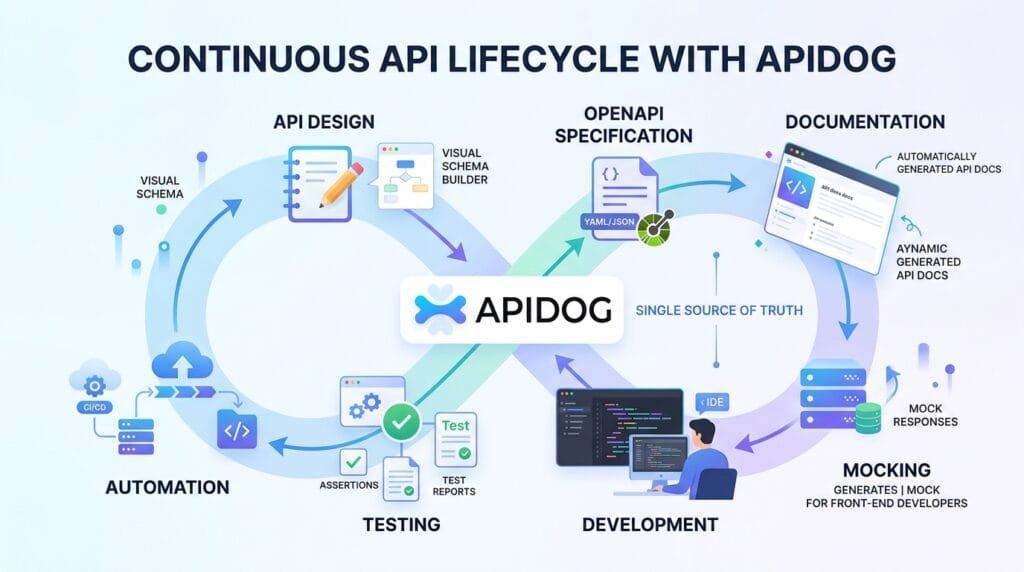
It positions itself around API design, documentation, mocking, testing, and broader API development workflows. Current 2026 comparisons describe it as a unified API lifecycle platform with capabilities spanning design, testing, mocking, and documentation. (apidog)
Think:
API Design
     |
     v
Documentation
     |
     v
Mocking
     |
     v
Testing
     |
     v
Automation
This is attractive when multiple teams need to collaborate around an API contract.
The organization can use that specification as the basis for:
Design
  |
Mock
  |
Develop
  |
Test
  |
Document
This is fundamentally different from:
Send HTTP request
Apidog API design documentation mocking and testing lifecycle
Who should consider Apidog?
It can make sense for:
API-first teams,
backend development organizations,
product teams,
API documentation workflows,
teams needing visual API design,
teams wanting mocking and testing in one environment.
The trade-off
The broader the platform becomes, the less likely it is to feel like a minimal developer tool.
So ask:
Do I want an API client or an API lifecycle platform?
That question alone can narrow your decision considerably.
5. Yaak: The Local-First Modern Client
Yaak represents another direction in the API client ecosystem: modern, lightweight, developer-centric API work with strong local-first characteristics.
Current 2026 comparisons identify Yaak as a newer desktop client emphasizing speed, local storage, Git synchronization, and modern protocol support. (apidog)
The important trend here is not merely Yaak itself.
It is the broader movement toward:
Local files
   +
Git
   +
Developer tooling
   +
API testing
That architecture appeals to engineers who want their API work to follow the same principles as source code.
6. Thunder Client: API Testing Inside VS Code
If your team spends most of the day inside VS Code, a separate API client can feel unnecessary.
Thunder Client brings API requests directly into the editor.
The conceptual workflow becomes:
VS Code
 |
 +---- Source Code
 +---- Tests
 +---- Git
 +---- API Requests
That can reduce context switching.
For example:
src/
tests/
api/
.env
can all live in one development environment.
This is particularly attractive for:
frontend developers,
Node.js teams,
full-stack developers,
developers who already live inside VS Code.
But again, the question is whether you need a client or an automation framework.
For serious API regression, you may eventually move toward code-first tests.
API Client vs API Automation: The Most Important Decision
This is where many “best Postman alternatives” articles stop too early.
Suppose your team has 1,000 API requests.
Are they all actually tests?
No.
A request becomes a meaningful automated test when you define what should happen.
For example:
pm.test("Status code is 200", function () {
    pm.response.to.have.status(200);
});
is better than simply sending:
GET /users/123
But even that may not be enough.
A strong API test might validate:
HTTP status
Response schema
Business rule
Required fields
Authorization
Boundary conditions
Error handling
Data relationships
This is where SDETs should start thinking beyond Postman alternatives.
When You Should Stop Looking for Another API Client
If your requirement is:
“We need to send requests manually and inspect responses.”
Choose an API client.
If your requirement is:
“We need 5,000 API tests running on every pull request.”
Stop searching for another GUI.
You need an automation architecture.
That might look like:
Git
 |
 v
API Tests
 |
 +---- Playwright
 +---- REST Assured
 +---- Karate
 +---- Hurl
 |
 v
CI/CD
 |
 v
Reports
The client becomes a developer debugging tool rather than the central test execution platform.
This distinction is one of the most important strategic lessons for SDETs.
Playwright as a Postman Alternative for API Automation
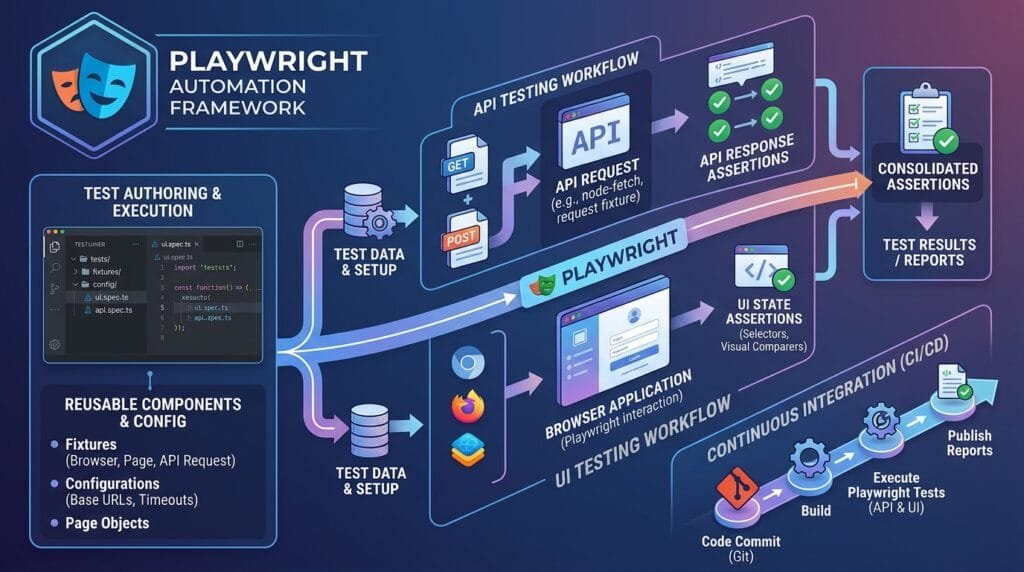
Playwright is primarily known for browser automation, but its API testing capabilities make it relevant when teams want one automation framework for browser and API workflows.
A simplified example:
import { test, expect } from '@playwright/test';

test('create user through API', async ({ request }) => {
  const response = await request.post('/users', {
    data: {
      name: 'John',
      email: 'john@example.com'
    }
  });

  expect(response.ok()).toBeTruthy();

  const body = await response.json();

  expect(body.name).toBe('John');
});
Playwright API and browser automation testing workflow
If your API regression suite already belongs in a Java testing ecosystem, moving from Postman collections to REST Assured can be a major architectural improvement.
But it also requires engineering investment.
You now own:
test code,
fixtures,
configuration,
reporting,
CI execution,
maintenance.
That is not necessarily a disadvantage.
For an SDET organization, it can be exactly what you want.
Karate: API Testing With a Dedicated DSL
Karate takes another approach by providing a dedicated syntax for API automation.
Conceptually:
Given url baseUrl
And path 'users'
When method post
Then status 201
This can make API tests readable to developers and testers while still supporting automation.
Karate becomes particularly interesting when you want:
And API clients sit alongside the pyramid as developer tools:
                E2E
                 /\
                /  \
          API automation
             /      \
       Contract tests
          /          \
    Service/unit tests

API CLIENT
     |
Exploration / Debugging
That distinction is essential.
A tool like Bruno may be excellent for exploratory API work and Git-based collections.
A framework like Playwright or REST Assured may be better for release-gate automation.
A tool like Schemathesis may be better for specification-driven property-based API testing.
There is no contradiction in using all three.
What About AI-Powered API Testing?
This is where the 2026 ecosystem becomes particularly interesting.
AI is moving API testing beyond:
“Generate a GET request for me.”
The harder problem is understanding dependencies between API operations.
Imagine:
POST /users
      |
      v
user_id
      |
      v
POST /orders
      |
      v
order_id
      |
      v
GET /orders/{order_id}
      |
      v
DELETE /orders/{order_id}
The test generator must understand that:
user_id
is produced by one operation and consumed by another.
Recent 2026 research on LLM-assisted REST API testing specifically addresses this problem. APIPilot uses LLM reasoning to infer candidate dependencies from OpenAPI specifications, then validates those dependencies through actual API execution before constructing workflows. Its reported evaluation covered 16 real-world REST API services and reported 92.3% operation coverage and an 88.1% workflow execution success rate. (arXiv)
That is a significant conceptual shift.
The future is not simply:
AI -> Generate request
It is moving toward:
OpenAPI
   |
   v
AI reasoning
   |
   v
Dependency graph
   |
   v
Executable workflow
   |
   v
Runtime validation
   |
   v
Improved test generation
That is much closer to intelligent API engineering.
AI Can Also Help With Assertions
Generating requests is only half the problem.
The harder question is:
What should the response prove?
A test that only checks:
HTTP 200
can still pass while the application returns incorrect business data.
Recent research into automated REST API test-oracle generation has explored using AI to identify meaningful response fields and generate assertions rather than validating only generic status codes. One 2026 study evaluated more than 2,300 API traces across 246 services and reported improved identification of semantically meaningful response fields. (arXiv)
That points toward a more advanced testing model:
Request
   |
   v
Response
   |
   +---- Status assertion
   +---- Schema assertion
   +---- Semantic assertion
   +---- Business assertion
   |
   v
Test verdict
This is where AI-assisted API testing becomes genuinely interesting for SDETs.
So What Should You Actually Replace?
Do not replace Postman simply because another tool is trending.
Instead classify your existing work.
If you mainly explore APIs
Consider:
Bruno
Hoppscotch
Insomnia
Yaak
Thunder Client
If you need API lifecycle management
Consider:
Apidog
Postman
If you want Git-native API artifacts
Consider:
Bruno
Hurl
HTTPie
Yaak
If you need serious automated regression
Consider:
Playwright
REST Assured
Karate
Hurl
If you need specification-driven API testing
Consider:
Schemathesis
If you need API + browser workflows
Consider:
Playwright
That is the decision framework an engineering team can actually use.
The Most Important 2026 Trend: API Testing Is Becoming Code
The biggest change is not that Bruno is competing with Postman.
It is that API testing is gradually becoming more integrated with the software engineering lifecycle.
The old model:
Open Postman
    |
Send request
    |
Check response
    |
Save collection
is becoming:
Write test
    |
Commit to Git
    |
Review Pull Request
    |
Run CI
    |
Generate report
    |
Block release if necessary
This is why tools such as Hurl, REST Assured, Karate, Playwright, and specification-driven testing frameworks deserve to be evaluated alongside conventional API clients.
The GUI is still valuable.
But the GUI should not automatically be your entire API quality strategy.
A Practical SDET Workflow
Here is a workflow I would recommend for a modern API-focused QA team:
                    API Development
                           |
                           v
                     OpenAPI Spec
                           |
             +-------------+-------------+
             |                           |
             v                           v
       API Exploration              API Design
             |                           |
       Bruno / Insomnia              Apidog
             |                           |
             +-------------+-------------+
                           |
                           v
                    Automated Tests
                           |
             +-------------+-------------+
             |             |             |
             v             v             v
         Playwright    REST Assured    Karate
             |             |             |
             +-------------+-------------+
                           |
                           v
                         Git
                           |
                           v
                         CI/CD
                           |
                           v
                   Release Decision
This is much stronger than trying to make one API client perform every testing responsibility.
The First Half of the Decision
At this point, the most important conclusion is already becoming clear:
The best Postman alternative depends on what “API testing” means inside your organization.
For a developer, API testing might mean:
“I need to inspect an endpoint.”
For a manual QA engineer:
“I need to validate requests and responses.”
For an SDET:
“I need repeatable assertions running in CI.”
For an API architect:
“I need contract, design, documentation, and governance.”
For an AI engineering team:
“I need machine-discoverable API capabilities and automatically generated workflows.”
Those are different problems.
And they should not necessarily have the same solution.
The strongest 2026 API strategy is therefore not “find the Postman clone with the most features.”
It is:
Identify the API problem
        |
        v
Choose the appropriate layer
        |
        v
Choose the appropriate tool
        |
        v
Automate what must be repeatable
        |
        v
Version everything important
        |
        v
Run critical tests in CI/CD
That mindset produces a much healthier API testing ecosystem than simply migrating collections from one GUI to another.
11. Schemathesis: When Your API Specification Becomes a Testing Engine
One of the biggest mistakes in API testing is assuming that manually written happy-path tests are enough.
GET /users/0
GET /users/-1
GET /users/999999999
GET /users/abc
What happens when optional fields are omitted?
What happens when arrays contain unexpected values?
What happens when combinations of valid-looking parameters expose an unexpected server-side state?
This is where specification-driven testing becomes powerful.
Schemathesis can use an API schema to generate test cases automatically and exercise edge cases that a manually maintained collection may never contain.
The conceptual model is:
OpenAPI Specification
        |
        v
Schema Analysis
        |
        v
Generated Inputs
        |
        v
API Execution
        |
        v
Response Validation
        |
        v
Failure Discovery
That is fundamentally different from an API client.
The client helps you send the request you thought of.
A property-based API testing framework helps discover requests you did not think of.
For an SDET team, that difference matters.
12. Hurl vs API Clients: Why Text Files Can Win
There is a growing engineering preference for tools that represent tests as plain text.
Compare that with a large exported GUI collection where the important difference may be buried inside generated metadata.
This is why Git-native API testing is becoming a meaningful architectural criterion rather than merely a developer preference.
API Client vs Code-Based Testing: A Practical Comparison
Capability
GUI API Client
Code-Based API Testing
Specification-Based Testing
Manual exploration
Excellent
Moderate
Low
Quick debugging
Excellent
Good
Moderate
Git diff
Variable
Excellent
Excellent
Pull-request review
Moderate
Excellent
Excellent
CI/CD
Good
Excellent
Excellent
Large regression suites
Moderate
Excellent
Excellent
Edge-case generation
Limited
Good
Excellent
Business assertions
Good
Excellent
Good
Developer integration
Moderate
Excellent
Excellent
Non-functional testing
Limited
Good
Specialized tools
API contract validation
Good
Good
Excellent
This table exposes the central architectural point:
These tools are complementary more often than they are direct competitors.
13. Postman Alternative for CI/CD: Think Beyond the GUI
Suppose your organization currently has:
1,500 API requests
250 environments
300 assertions
20 collections
The question should not be:
Which application can import all of this?
The better question is:
Which tests actually need to execute automatically?
Divide them into categories.
Exploratory requests
Keep these in an API client.
Regression tests
Move critical scenarios into a maintainable automation framework.
Contract checks
Use contract or schema validation.
Performance tests
Use dedicated performance tooling.
Security checks
Integrate security testing into the pipeline.
Smoke tests
Keep them fast enough to run on every deployment.
This gives you a layered architecture:
                     API Quality
                         |
       +-----------------+-----------------+
       |                 |                 |
       v                 v                 v
 Exploratory         Automated         Specialized
   Testing            Regression         Testing
       |                 |                 |
       v                 v                 v
Bruno/Insomnia     Playwright/RA       Contract
Hoppscotch         Karate/Hurl         Performance
                                     Security
                                     Property-based
That is a much stronger approach than treating a single API client as the complete testing platform.
14. Postman Alternatives for Different Team Sizes
The best choice can also change with organizational maturity.
Small development team
A lightweight combination may be enough:
Bruno
+
Git
+
Hurl
+
CI/CD
The team gets API exploration plus automated checks without introducing a large platform.
Growing QA/SDET team
A stronger setup could be:
Bruno
+
Playwright
+
OpenAPI
+
CI/CD
The API client supports exploration while Playwright handles automation.
Build
  |
  v
Deploy/Test Environment
  |
  v
API Smoke Tests
  |
  v
Regression Tests
  |
  v
Report
Step 6: Add specialized testing
Once basic automation is stable:
Contract Testing
Property-Based Testing
Performance
Security
AI-Assisted Test Generation
This is far more sustainable than trying to perform a “big bang” migration.
What Makes a Good API Testing Tool in 2026?
Feature count should not be your primary metric.
Evaluate these dimensions instead.
Developer experience
Can engineers understand the tool quickly?
Test maintainability
Can you still understand your tests six months later?
Version control
Can a meaningful change be reviewed through Git?
Automation
Can tests execute without a human sitting in front of a screen?
CI/CD
Can failures block an unsafe deployment?
Protocol support
Does the tool support the protocols your architecture actually uses?
Security
How are credentials, environment variables, secrets, and sensitive API data handled?
Scalability
Will the approach survive when your test suite grows from 50 tests to 5,000?
Reporting
Can engineers quickly identify what failed and why?
Extensibility
Can the tool integrate with your existing language, framework, CI system, and observability stack?
AI capabilities
Does AI actually improve test creation, maintenance, reasoning, or coverage?
That last question deserves special attention.
An “AI-powered” badge does not automatically make a tool better.
Ask:
What testing problem does the AI solve?
If the answer is only “generate a request,” the value may be limited.
If it can reason about dependencies, infer meaningful assertions, detect schema inconsistencies, generate edge cases, or maintain tests based on API changes, the value becomes much more significant.
The Future Is Not One Postman Replacement
The most interesting conclusion from the 2026 API tooling landscape is that the market is becoming more specialized.
Instead of one tool controlling every API activity, teams are increasingly building toolchains.
Consider this:
                  OpenAPI
                     |
       +-------------+-------------+
       |             |             |
       v             v             v
     Design       Testing       Documentation
       |             |             |
       v             v             v
    Apidog       Playwright      API Docs
                     |
              +------+------+
              |             |
              v             v
        Contract Tests   Property Tests
              |             |
              +------+------+
                     |
                     v
                    CI/CD
Meanwhile, developers may still use:
Bruno
Insomnia
Hoppscotch
HTTPie
for everyday API exploration.
This is not fragmentation for the sake of fragmentation.
It is specialization.
The same principle already exists elsewhere in software engineering.
You do not use your unit-test framework for load testing.
You do not use your browser automation framework as your database.
You do not use your code editor as your entire CI/CD platform.
API testing should be treated the same way.
MCP Changes the Conversation Around API Tools
There is another emerging architectural consideration for AI-heavy engineering teams: Model Context Protocol (MCP).
Traditional API tooling assumes:
Human
   |
   v
API Client
   |
   v
HTTP API
An AI-native workflow increasingly looks like:
AI Agent
   |
   v
Tool Interface
   |
   v
API
This changes how API capabilities can be exposed to intelligent agents.
Instead of an engineer manually opening a client and constructing every request, an agent can potentially reason over available tools, invoke appropriate operations, inspect results, and build multi-step workflows.
That does not mean MCP replaces REST APIs.
It does not.
REST is an API communication style.
MCP provides a standardized way for AI applications to interact with tools and contextual capabilities.
They solve different problems.
A future engineering stack may therefore contain:
Human Developer
       |
       v
API Client
       |
       v
REST API


AI Agent
       |
       v
MCP Tool
       |
       v
REST/API Service
For QA engineers, this creates a new testing question:
How do we test APIs that are consumed not only by applications and humans, but also by AI agents?
That is an emerging quality engineering problem worth watching.
The Strategic Difference Between a Tool and a Testing Strategy
This entire comparison ultimately leads to one important principle.
A tool is not a testing strategy.
You can have the most sophisticated API client available and still have poor API quality.
You can also have a relatively simple toolchain and achieve excellent API coverage if your engineering strategy is sound.
A strong strategy answers:
What should we test?
        |
        v
At what layer?
        |
        v
With what data?
        |
        v
With what assertions?
        |
        v
How often?
        |
        v
Where should it execute?
        |
        v
What failure blocks release?
Only after answering those questions should you select tools.
That is the difference between tool adoption and engineering design.
Final Conclusion: Which Postman Alternative Should You Choose?
There is no universal winner among the Postman alternatives in 2026.
And that is actually good news.
The ecosystem now offers tools optimized for different engineering problems.
If you want a Git-native API workflow, Bruno is one of the strongest candidates.
If you want fast browser-based API exploration, Hoppscotch is compelling.
If you want a desktop API client with broad protocol support, Insomnia deserves consideration.
If you need API design, documentation, mocking, and testing together, Apidog belongs on the shortlist.
If you want a lightweight modern local client, Yaak is worth evaluating.
If you want API requests directly inside your development environment, Thunder Client can reduce context switching.
If you want terminal-first HTTP testing, HTTPie and Hurl are strong developer-oriented choices.
If your real requirement is automated API regression, the conversation should move toward Playwright, REST Assured, Karate, or similar code-first frameworks.
If you want schema-driven and property-based API testing, Schemathesis addresses a different class of testing problem entirely.
And if your organization is moving toward AI-native engineering, the bigger opportunity is not merely replacing one API client with another. It is building an API quality architecture that combines specifications, automation, contract validation, intelligent test generation, CI/CD, and eventually AI-agent-aware testing.
The most important decision is therefore not:
“What is the best Postman alternative?”
It is:
“What API engineering problem am I actually trying to solve?”
Once you answer that question, the tool choice becomes much easier.
Key Differences at a Glance
Tool / Approach
Core Purpose
Best Fit
Biggest Strength
Main Limitation
Bruno
API client/testing
Git-first teams
Local, file-based workflow
Not an all-in-one API lifecycle platform
Hoppscotch
API client
Quick exploration
Browser-first simplicity
Less suited to deep automation
Insomnia
API client
Developers using multiple protocols
Strong desktop/API workflow
Not primarily a complete automation framework
Apidog
API lifecycle
API-first organizations
Design + mock + docs + testing
Broader platform than a simple client
Yaak
API client
Local-first developers
Lightweight modern workflow
Smaller ecosystem
Thunder Client
API client
VS Code users
IDE integration
More focused than full API platforms
HTTPie
CLI
Developers/automation
Friendly terminal workflow
Less visual
Hurl
HTTP test automation
CI/CD teams
Text-based executable tests
Requires a code/CLI mindset
Playwright
Automation framework
SDETs
API + UI in one framework
More engineering effort than a GUI client
REST Assured
API automation
Java teams
Mature Java integration
Java-centric
Karate
API automation DSL
QA/API teams
Readable API automation
Different learning model
Schemathesis
Property-based testing
API quality engineers
Automatic edge-case generation
Requires API schema maturity
People Asked Questions
1. What are the best Postman alternatives in 2026?
Some of the strongest options include Bruno, Hoppscotch, Insomnia, Apidog, Yaak, Hurl, HTTPie, Playwright, REST Assured, Karate, and Schemathesis. The right choice depends on whether you need API exploration, automation, API lifecycle management, or specialized testing.
2. Is Bruno better than Postman?
Bruno can be a better choice for teams that prioritize local-first, file-based, and Git-native API workflows. Postman remains stronger when teams need broader collaboration and API lifecycle capabilities.
3. What is the best Postman alternative for API automation?
For serious automated API regression, tools such as Playwright, REST Assured, Karate, and Hurl can be more appropriate than simply switching to another GUI API client.
4. Is Hoppscotch a good alternative to Postman?
Hoppscotch is a strong option for lightweight, browser-based API exploration and development. Teams with large automated regression suites may still need a dedicated API automation framework.
5. Is Insomnia better than Postman?
Insomnia can be attractive for developers who want a focused desktop API client and broad protocol support. Whether it is better depends on the team’s collaboration, automation, and API lifecycle requirements.
6. What is the best Git-friendly Postman alternative?
Bruno is particularly well suited to Git-native API workflows because API collections can be represented as files and managed alongside source code.
7. Can Playwright replace Postman?
Playwright can replace some Postman API testing workflows when the requirement is automated API testing, especially for teams that also need browser automation. It is not simply a one-to-one GUI replacement for every Postman feature.
8. What is the best Postman alternative for SDETs?
There is no single answer. SDETs may combine an API client such as Bruno or Insomnia with automation frameworks such as Playwright, REST Assured, or Karate and specialized tools such as Schemathesis.
9. Is Hurl good for API testing?
Hurl is useful for text-based HTTP testing, particularly when API tests need to live in Git and run naturally through CI/CD pipelines.
10. What is the difference between an API client and an API automation framework?
An API client is primarily designed for sending requests, exploring APIs, debugging responses, and interacting with endpoints. An automation framework is designed for reusable tests, assertions, fixtures, CI/CD execution, reporting, and regression testing.
11. Can AI replace API testers?
AI can assist with API test generation, dependency discovery, assertion generation, edge-case discovery, and test maintenance, but it does not eliminate the need for engineering judgment, test strategy, validation, and risk analysis.
12. Does MCP replace REST APIs?
No. REST APIs and MCP solve different problems. REST provides an API communication architecture, while MCP provides a standardized mechanism for AI applications to interact with tools and contextual capabilities.
AI Overview Optimization
The best Postman alternative depends on the API testing problem. Bruno is a strong choice for Git-native API collections, Hoppscotch for lightweight browser-based testing, Insomnia for desktop API development, Apidog for API lifecycle management, Hurl for text-based CI testing, and Playwright, REST Assured, or Karate for automated API regression. Schemathesis is better suited to specification-driven property-based testing.
Comparison
Need
Recommended Tool
Git-native API testing
Bruno
Browser API testing
Hoppscotch
Desktop API development
Insomnia
API lifecycle
Apidog
Lightweight API client
Yaak
VS Code API testing
Thunder Client
CLI API requests
HTTPie
Text-based HTTP testing
Hurl
API + UI automation
Playwright
Java API automation
REST Assured
API automation DSL
Karate
Property-based API testing
Schemathesis
AEO Optimization
What is the best alternative to Postman in 2026?
There is no universal best Postman replacement. Bruno is a strong choice for Git-native API testing, while Insomnia and Hoppscotch work well for API exploration. For automated regression, Playwright, REST Assured, and Karate are better suited than another GUI API client.
What can I use instead of Postman for API testing?
You can use Bruno, Hoppscotch, Insomnia, Apidog, Hurl, HTTPie, Playwright, REST Assured, Karate, or Schemathesis depending on whether you need API exploration, automation, lifecycle management, CLI testing, or schema-driven testing.
Is Bruno better than Postman?
Bruno can be better for teams that want local, file-based, Git-native API collections. Postman can remain preferable for teams that need broader collaboration and API lifecycle capabilities.
Can Playwright replace Postman?
Playwright can replace Postman for many automated API testing scenarios, especially when API and browser tests need to share one framework. It is not a complete one-to-one replacement for every Postman feature.
What is the best Postman alternative for SDET?
SDETs should choose based on the testing layer. Bruno or Insomnia can handle API exploration, while Playwright, REST Assured, or Karate can handle automated regression, and Schemathesis can add specification-driven testing.
Do not replace Postman just because another tool is popular. First identify what your team actually needs.
Bruno is particularly compelling for Git-native API workflows, where collections and API tests should behave like source-controlled engineering assets.
Hoppscotch and Insomnia are primarily API-client choices, making them useful for exploration and development rather than automatically replacing a complete automation strategy.
Apidog belongs in a different category because API design, documentation, mocking, and testing are treated as parts of a broader lifecycle.
Hurl changes the model from GUI interaction to executable HTTP files, making it especially interesting for Git and CI/CD.
Playwright, REST Assured, and Karate should be considered when API testing becomes automated software engineering, not merely request exploration.
Schemathesis demonstrates why specification-driven testing matters: automated testing can explore combinations and edge cases humans may never manually create.
API clients and automation frameworks are complementary. A mature QA organization may legitimately use Bruno for exploration and Playwright or REST Assured for regression.
AI-powered API testing is moving toward workflow reasoning, dependency discovery, and meaningful assertions, rather than simply generating HTTP requests.
MCP does not replace REST APIs or API clients. It introduces another interaction layer for AI applications and agents, creating new opportunities—and new testing challenges—for AI-native systems.
The best API testing architecture is layered: exploratory testing, automated regression, contract/schema validation, performance, security, and specialized testing should each have an appropriate role.
The real 2026 question is not “Which tool replaces Postman?” The better question is “Which combination of tools gives my team reliable API quality from development through CI/CD?”
For an SDET team, that shift in thinking is more valuable than any individual API client.
The strongest engineering organizations will not win because they chose the “perfect Postman alternative.”
They will win because they know where API testing belongs, what should be automated, what should remain exploratory, and which tool should own each responsibility.
Continue Learning
Explore more expert articles on Mobile Testing, Backend & API, AI & Agentic, AI Tools, n8n, LangChain, CrewAI, MCP Servers, AI Agents, LlamaIndex, Docker, FastAPI, Playwright, Cypress, Test Automation, DevOps, and Software Engineering at www.skakarh.com.
QAPulse by SK delivers expert release analysis, AI engineering insights, enterprise automation strategies, migration guidance, DevOps best practices, and practical testing knowledge to help software professionals build scalable, intelligent, and production-ready software systems.
Frequently Asked Questions
Why are Postman alternatives a serious consideration for QA engineers in 2026?
Postman alternatives have become a serious consideration for QA engineers because API work has diversified significantly. This includes specialized areas such as automated regression, CI/CD validation, contract testing, performance testing, and AI-assisted API testing. These distinct needs mean that finding another application with just a similar Send button is no longer sufficient.
What is the key philosophical difference driving the shift from traditional API testing workflows to alternatives?
The key difference is the desire for API definitions and tests to fit into existing engineering workflows, moving beyond a sole Postman-centric approach. Modern teams increasingly want to manage API definitions, test scenarios, and environment configurations within a Git Repository. This enables integration into CI/CD pipelines and release gates, representing a fundamentally different philosophy.
What characteristics are QA teams and engineers looking for in Postman alternatives?
QA teams are increasingly looking for tools that offer Git-native collections, local-first workflows, or browser-based tooling. They also seek lightweight, offline-capable, Git-friendly, and open-source solutions. These characteristics align better with modern developer workflows and the goal of moving regression testing into code and CI/CD.
10+ years in software development and QA, with the last 5 years focused on test automation. Building production-grade frameworks with Playwright, Cypress, Selenium and PyTest for clients worldwide. PhD candidate. Founder of QA Pulse.
 QA
QA