 QA
QA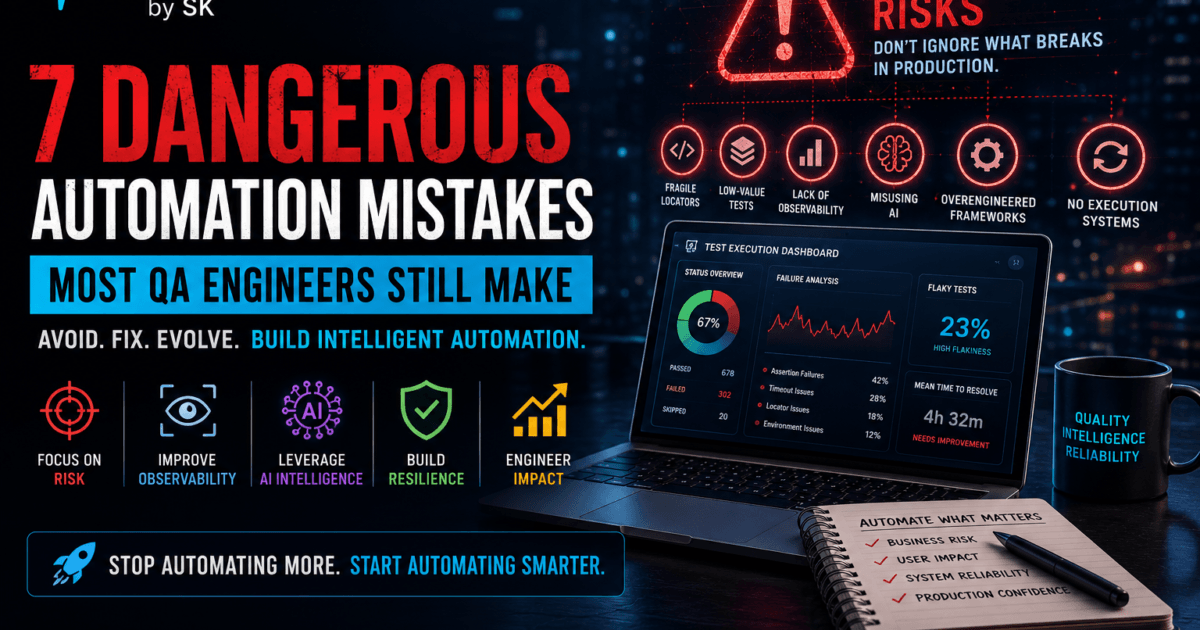
Why Modern Automation Mistakes Are Increasing?
Most automation suites do not fail because engineers are bad.
They are increasing because teams optimize for:
❌ writing more tests
instead of:
✅ building smarter systems
And honestly?
That difference is destroying many QA pipelines silently.
Modern automation is no longer just:
- Selenium scripts
- Playwright assertions
- Cypress commands
Today’s systems are:
- AI-assisted
- distributed
- dynamic
- event-driven
- continuously changing
But many QA teams still automate software like it’s 2017.
That creates dangerous automation mistakes.
Automation Mistake #1 — Automating Everything
This is probably the most common automation mistake.
Teams think:
More automation = better quality
Not true.
Automating low-value flows creates:
- maintenance chaos
- flaky pipelines
- slower execution
- debugging fatigue
Meanwhile:
high-risk workflows remain poorly validated.
Modern automation should prioritize:
✅ business-critical paths
✅ revenue-impacting systems
✅ risky integrations
✅ production-sensitive flows
Smart SDETs automate:
👉 risk
Not just screens.
Automation Mistake #2 — Obsessing Over Coverage Numbers
One of the most misleading metrics in QA:
85% test coverage
Looks impressive.
But coverage without intelligence means very little.
Many teams achieve:
✅ huge coverage
While still shipping:
❌ major production incidents
Why?
Because modern failures often happen between:
- services
- async systems
- data states
- dependencies
- runtime conditions
Coverage metrics rarely capture that complexity.
Automation Mistake #3 — Building Fragile Locator Systems
This is where countless automation suites collapse.
Example:
await page.locator('.btn-primary').click();
Looks simple.
Until:
- CSS changes
- component libraries evolve
- UI rendering shifts
- AI-generated interfaces appear
Now everything breaks.
Modern locator systems should increasingly use:
- semantic selectors
- accessibility roles
- fallback strategies
- contextual matching
- intelligent locator patterns
Static selectors are becoming dangerous.
Automation Mistake #4 — Ignoring Observability
Most QA frameworks know:
✅ test passed
✅ test failed
But they cannot explain:
👉 WHY
That’s a huge problem.
Modern QA systems increasingly require:
- logs
- traces
- network visibility
- runtime telemetry
- performance signals
- failure clustering
Without observability:
Debugging becomes:
guessworkAnd honestly?
Many automation teams waste HOURS debugging preventable failures because they lack proper visibility.
Automation Mistake #5 — Treating AI Like a Shortcut
This is exploding right now.
Many engineers think AI means:
Generate test scripts automatically
That’s shallow thinking.
The real power of AI is:
✅ reasoning
✅ risk analysis
✅ workflow intelligence
✅ failure understanding
✅ memory systems
✅ adaptive validation
The future is NOT:
❌ “AI replacing testers”
The future is:
✅ AI augmenting engineering systems
Huge difference.
Automation Mistake #6 — Overengineering Frameworks
This one hurts many teams badly.
Frameworks become:
- gigantic
- impossible to maintain
- overloaded with abstractions
- dependent on one engineer
Eventually:
Nobody wants to touch the framework anymore.
That’s dangerous.
A strong automation architecture should be:
✅ scalable
✅ readable
✅ observable
✅ maintainable
✅ adaptable
Not:
architecturally impressive but operationally painfulAutomation Mistake #7 — Ignoring Execution Systems
Most engineers focus only on:
- tools
- frameworks
- tutorials
But ignore:
👉 execution systems
That’s why many engineers:
- learn constantly
- consume endlessly
- still struggle to build consistently
Strong SDETs build:
✅ repeatable systems
✅ learning workflows
✅ AI-assisted pipelines
✅ compounding habits
Execution systems outperform random motivation every time.
Why These Automation Mistakes Matter More in 2026
Because software complexity exploded.
Modern systems now include:
- AI agents
- distributed architectures
- real-time rendering
- adaptive interfaces
- dynamic APIs
- autonomous workflows
Traditional automation thinking cannot scale effectively anymore.
This is why modern QA engineering is evolving toward:
✅ intelligent automation
✅ runtime awareness
✅ observability-driven validation
✅ AI-assisted systems
✅ adaptive architectures
The role itself is changing.
Fast.
What Smart SDETs Are Doing Differently
The best automation engineers today increasingly think like:
- systems engineers
- reliability architects
- AI workflow designers
- observability engineers
Not just:
script writersBecause the future belongs to engineers who understand:
👉 system behavior
Not only framework syntax.
Automation Mistakes Modern QA Teams Must Avoid
Modern automation mistakes are no longer just technical problems — they become operational bottlenecks affecting CI/CD speed, release confidence, team trust, and engineering productivity. Avoiding these automation mistakes requires smarter architecture, observability, AI-assisted workflows, resilient locator strategies, and intelligent automation systems designed for modern software complexity in 2026.
External Resources
Let’s Talk
👉 Which automation mistake hurts most teams today?
👉 What’s the biggest weakness in modern automation frameworks?
Drop your thoughts below 👇
Final Line
The biggest automation risk in 2026 is not lack of tooling.
It’s outdated thinking.
More Relevant Articles
- The Most Dangerous QA Engineer in 2026 Is the Comfortable One
- Why Most Test Automation Frameworks Collapse at Scale
- Most QA Engineers Are Learning the Wrong Skills in 2026