 QA
QA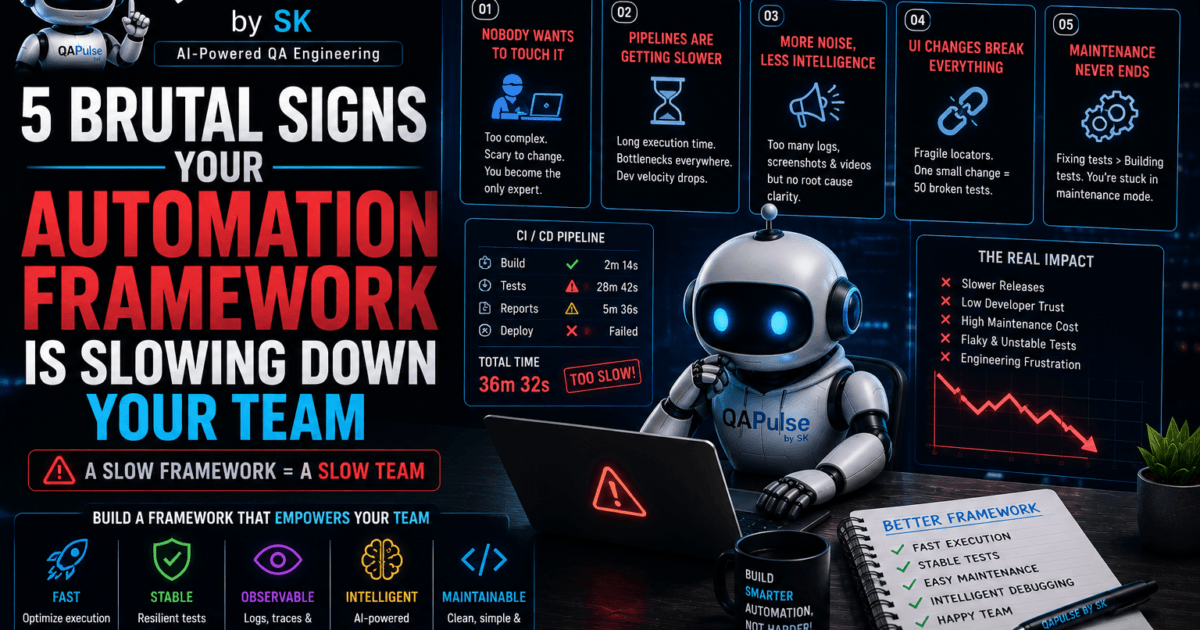
Your Automation Framework Might Be the Biggest Bottleneck in Your Team
Most QA engineers assume their biggest problem is:
- flaky tests
- unstable environments
- CI/CD failures
- browser instability
But honestly?
Many teams are being slowed down by something much deeper:
their own automation frameworkThat’s a dangerous reality most teams never discuss openly.
Because once an automation framework becomes:
- too complex
- too rigid
- too dependent on one engineer
- overloaded with abstractions
…it slowly starts hurting productivity instead of improving it.
And the scary part?
This usually happens silently.
Why Modern Automation Framework Problems Are Increasing
Software systems changed dramatically.
Modern applications now involve:
- microservices
- AI workflows
- distributed systems
- dynamic frontends
- real-time rendering
- observability pipelines
But many automation frameworks are still designed like:
2018 UI testing systems
That gap creates operational pain.
Fast.
Automation Framework Sign #1 — Nobody Wants to Touch It
This is one of the biggest warning signs.
You open the framework and see:
- deeply nested abstractions
- unclear naming
- magical utilities
- excessive inheritance
- hidden execution flows
Now engineers become afraid to modify anything.
That creates:
❌ bottlenecks
❌ dependency on one “framework expert”
❌ slow onboarding
❌ reduced innovation
A healthy automation framework should feel:
✅ understandable
✅ scalable
✅ predictable
Not:
architectural archaeologyAutomation Framework Sign #2 — CI/CD Pipelines Keep Getting Slower
This problem destroys engineering velocity.
Overengineered frameworks often introduce:
- unnecessary waits
- duplicated setup
- heavy execution layers
- excessive retries
- bloated fixtures
- slow initialization
At small scale:
everything seems fine
At enterprise scale:
pipeline chaos beginsAnd honestly?
Many teams normalize terrible execution times.
A modern automation framework should optimize:
✅ speed
✅ isolation
✅ parallelization
✅ observability
Because slow pipelines reduce:
- developer trust
- release confidence
- deployment speed
Automation Framework Sign #3 — The Framework Produces More Noise Than Intelligence
Many frameworks generate:
- massive logs
- screenshots
- videos
- traces
But still cannot explain:
👉 WHY failures happen
That’s a critical weakness.
Modern automation increasingly requires:
✅ observability
✅ runtime telemetry
✅ intelligent debugging
✅ failure clustering
✅ AI-assisted analysis
Without intelligence:
automation becomes:
noise generation
Instead of:
engineering insightAutomation Framework Sign #4 — Every Small UI Change Breaks Everything
This usually means the framework relies on:
- brittle locators
- fragile selectors
- weak abstraction design
- poor resilience patterns
Example:
await page.locator('.submit-btn').click();
Looks harmless.
Until:
- CSS changes
- component libraries evolve
- frontend rendering shifts
Now:
40 tests fail instantlyA scalable automation framework increasingly requires:
✅ semantic locators
✅ accessibility-first selectors
✅ fallback strategies
✅ intelligent retry logic
✅ adaptive validation
Because UI systems are becoming more dynamic every year.
Automation Framework Sign #5 — Engineers Spend More Time Maintaining Tests Than Building Systems
This is the most dangerous stage.
Eventually teams become trapped in:
maintenance mode
Instead of:
innovation modeNow engineers spend most of their time:
- fixing locators
- updating utilities
- debugging flaky tests
- stabilizing pipelines
- rewriting fragile abstractions
That kills:
❌ momentum
❌ creativity
❌ engineering growth
The best automation systems increasingly focus on:
✅ maintainability
✅ observability
✅ adaptability
✅ system intelligence
Not endless patchwork.
Why Traditional Automation Framework Thinking Is Breaking
Old-school automation thinking focused heavily on:
- framework structure
- page objects
- reusable methods
- assertion libraries
Those things still matter.
But modern systems now require much more:
- AI-assisted debugging
- runtime awareness
- observability
- adaptive workflows
- intelligent validation
- execution intelligence
The role of automation frameworks is evolving rapidly.
What Smart SDETs Are Building Instead
Modern SDETs increasingly think like:
- systems engineers
- platform engineers
- reliability architects
- AI workflow designers
The strongest automation systems now prioritize:
✅ developer experience
✅ debugging visibility
✅ execution speed
✅ runtime intelligence
✅ maintainability
✅ scalable architecture
Not just:
more abstractionsThe Future Automation Framework Will Behave Differently
Future automation systems will increasingly include:
- AI failure analyzers
- self-healing locators
- telemetry-driven debugging
- adaptive execution
- intelligent retries
- workflow orchestration
Meaning the future automation framework becomes:
an intelligent testing platform
Not:
a collection of scriptsHuge difference.
The Hard Truth Most Teams Avoid
Many teams believe:
more framework complexity = engineering maturity
But often:
complexity hides inefficiencyThe best systems usually feel:
✅ simpler
✅ faster
✅ clearer
✅ more observable
Not:
impressively complicatedWhy Modern Automation Framework Architecture Matters in 2026
Modern automation framework architecture directly impacts CI/CD speed, debugging efficiency, developer productivity, and engineering scalability. As applications become more AI-driven and distributed, modern automation framework systems increasingly require observability, intelligent debugging, adaptive locators, runtime telemetry, and maintainable execution pipelines. Teams that continue relying on fragile or overengineered automation frameworks may struggle with scalability, flaky tests, and slow delivery cycles in 2026.
External Resources
Let’s Talk
👉 What’s the biggest weakness in modern automation frameworks today?
👉 Have you ever inherited a framework nobody wanted to maintain?
Drop your thoughts below 👇
Final Line
The best automation framework in 2026 will not be the most complex one.
It will be the one engineers actually enjoy using.
More Relevant Articles
- The Most Dangerous QA Engineer in 2026 Is the Comfortable One
- Why Most Test Automation Frameworks Collapse at Scale
- Most QA Engineers Are Learning the Wrong Skills in 2026