 QA
QA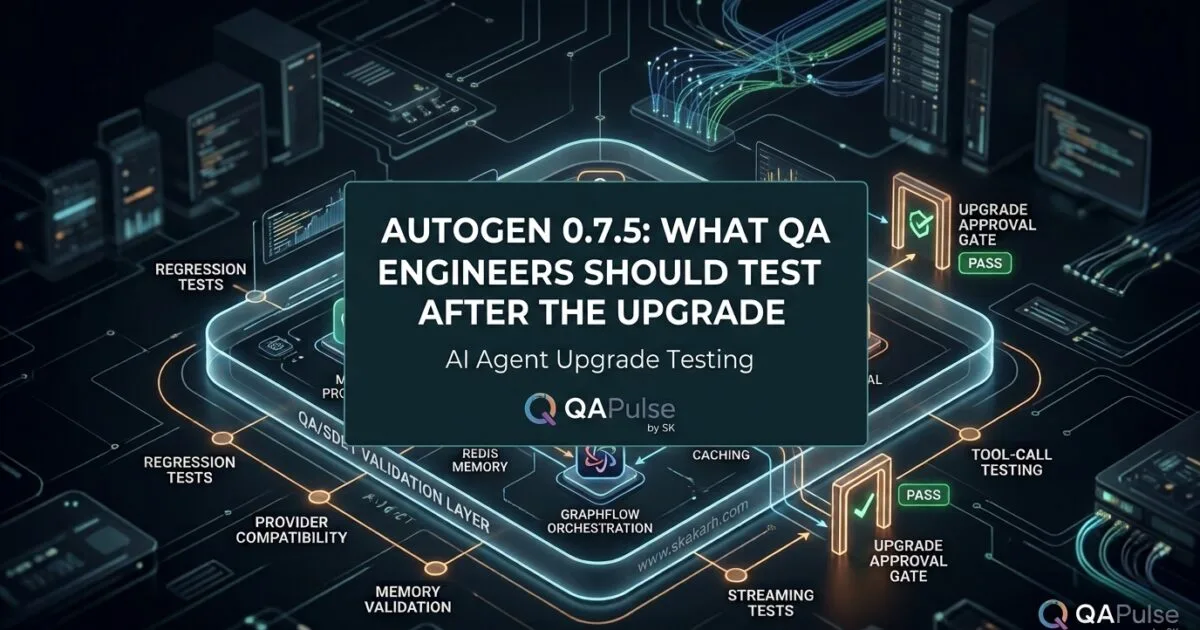
AutoGen 0.7.5 is not simply another dependency update for teams building AI agents. The September 30, 2025 release includes fixes and improvements involving streaming responses, Redis memory, message correlation, thinking-mode configuration, GraphFlow cycle detection, caching, and several model-provider integrations. AutoGen 0.7.5 official release notes
For QA engineers and SDETs, that creates a more important question than “Does the new version install successfully?”
Does the AI agent system still behave correctly after the upgrade?
That distinction is critical.
A conventional dependency upgrade may be validated with installation checks and unit tests:
pip install --upgrade <package>

pytest
That can be enough for a simple library.
An AI-agent framework has a much larger execution surface:
User Request
     ↓
Agent
     ↓
Model Client
     ↓
Streaming
     ↓
Tool Calling
     ↓
Memory
     ↓
Agent Orchestration
     ↓
External Systems
     ↓
Final Response
A regression at any point can change the final behavior even when the application starts normally and the existing unit-test suite remains green.
This is why AutoGen 0.7.5 deserves targeted upgrade testing rather than a simple “upgrade and deploy” workflow.
What Changed in AutoGen 0.7.5?
The official release contains a collection of fixes and improvements rather than one large feature that changes the entire framework. Several changes are nevertheless directly relevant to teams running production agent workflows. AutoGen 0.7.5 release notes
Among the notable areas are:
- Redis linear memory support
- Streaming Bedrock response handling
- Streaming message-ID correlation
- Thinking-mode support for the Anthropic client
- Fixes related to disabling thinking through extra arguments
- GraphFlow cycle-detection behavior
- Redis caching behavior
- Ollama client component loading
- Azure AI client streaming behavior
- Streaming output handling involving empty reasoning content
The important QA lesson is that these changes map directly to runtime behavior.
| Release Area | QA Concern | Recommended Test |
|---|---|---|
| Streaming | Lost or malformed events | Streaming regression |
| Message IDs | Incorrect event correlation | Correlation test |
| Redis Memory | Incorrect agent context | Persistence test |
| Redis Cache | Incorrect cached values | Cache regression |
| Thinking Mode | Configuration ignored | Configuration test |
| GraphFlow | Infinite/incorrect recursion | Cycle test |
| Ollama | Client initialization | Provider test |
| Azure AI | Streaming behavior | Provider regression |
| Anthropic | Thinking configuration | Provider matrix |
Instead of asking only whether the release contains breaking changes, QA engineers should ask:
Which execution paths changed, and what production behavior depends on them?


Why an AI Framework Upgrade Needs More Than Unit Tests
Consider a traditional application library.
You might have:
def test_calculate_total():
    assert calculate_total(100, 20) == 120
The behavior is deterministic.
AI-agent systems are different.
A seemingly simple request can trigger:
User
 ↓
Agent
 ↓
LLM
 ↓
Tool Selection
 ↓
Tool Arguments
 ↓
External API
 ↓
Tool Response
 ↓
Memory Update
 ↓
Agent Reasoning
 ↓
Streaming
 ↓
Final Response
There are multiple boundaries where a framework change can affect behavior.
For example, your application may pass this test:
async def test_agent_returns_response():
    response = await agent.run("What is my order status?")
    assert response is not None
But that test doesn’t prove that:
- the correct tool was called
- the correct arguments were generated
- the tool response reached the agent
- memory was updated
- streaming chunks were correlated correctly
- the correct model provider was used
- retries behaved correctly
- the workflow terminated correctly
That is the fundamental difference between testing an AI agent framework and testing a normal Python dependency.
AutoGen 0.7.5 Testing vs a Traditional Dependency Upgrade
A conventional upgrade pipeline might look like this:
Install
  ↓
Import
  ↓
Unit Tests
  ↓
Deploy
For an AI-agent application, a stronger strategy looks like this:
Install
  ↓
Unit Tests
  ↓
Integration Tests
  ↓
Provider Compatibility
  ↓
Streaming Tests
  ↓
Memory Tests
  ↓
Tool Tests
  ↓
GraphFlow Tests
  ↓
Failure Tests
  ↓
End-to-End Agent Tests
  ↓
Performance Comparison
  ↓
Production Gate
The additional layers aren’t there because AI testing needs more tests for the sake of having more tests.
They exist because the framework controls more runtime behavior.
| Traditional Upgrade | AI Agent Upgrade |
|---|---|
| Package import | Agent initialization |
| Function output | Agent workflow |
| API response | Tool/model interaction |
| Unit tests | Unit + integration tests |
| One runtime dependency | Multiple providers and tools |
| Deterministic execution | Partially nondeterministic behavior |
| Error checking | Recovery behavior |
| Final result | Complete execution trace |
This distinction should influence your regression strategy before installing the new version.
Streaming Is One of the First Areas to Test
One of the most relevant areas in AutoGen 0.7.5 is streaming.
The release includes a fix for loading streaming Bedrock responses when tool usage has empty arguments. It also includes a fix involving message IDs used to correlate streaming chunks with final messages and addresses spurious tags associated with empty reasoning content in streaming. AutoGen 0.7.5 release notes
These are exactly the kinds of changes that should immediately become regression scenarios.
A weak test checks only the final result:
response = await run_agent("Summarize this document")

assert response is not None
A stronger streaming test observes the execution itself:
chunks = []

async for chunk in agent.run_stream(
    task="Summarize this document"
):
    chunks.append(chunk)

assert chunks
Then validate the final state:
assert final_message is not None
assert final_message.id is not None
assert final_message.content
The precise API available to your application will depend on the AutoGen components you use, but the testing principle is the same:
Don’t test only the final answer. Test the stream that produced the answer.
Streaming Regression Matrix
| Scenario | Expected Result |
|---|---|
| Normal streaming | All expected chunks received |
| Multiple chunks | Correct ordering |
| Empty reasoning content | No malformed output |
| Tool call during stream | Correct tool invocation |
| Empty tool arguments | Controlled handling |
| Final message | Correctly generated |
| Message correlation | Correct ID relationship |
| Interrupted stream | Controlled failure |
| Retry | No unintended duplication |
This is especially important for user-facing applications where partial responses are displayed in real time.
Test Message Correlation Explicitly
Message IDs can look like implementation details until your application starts processing multiple concurrent streams.
Imagine two agents running simultaneously:
Agent A
  ↓
Message A
  ↓
Chunk A1
Chunk A2
Chunk A3

Agent B
  ↓
Message B
  ↓
Chunk B1
Chunk B2
If correlation breaks, chunks can theoretically be associated with the wrong logical message.
Your QA strategy should therefore verify identity as well as content.
Conceptually:
expected_id = final_message.id

for chunk in chunks:
    assert chunk.message_id == expected_id
The exact properties exposed by your implementation may differ, but the assertion principle should remain.
Content Validation vs Correlation Validation
| Test Type | What It Detects |
|---|---|
| Content validation | Incorrect response |
| Ordering validation | Misordered stream |
| ID validation | Incorrect correlation |
| Completion validation | Incomplete stream |
| Duplicate detection | Repeated events |
| Timeout validation | Hanging stream |
A green final-response assertion can miss several of these failures.
Redis Memory Requires State-Based Testing
Another significant area in AutoGen 0.7.5 is Redis memory. The release adds support for linear memory in RedisMemory and also fixes Redis caching behavior involving string values. AutoGen 0.7.5 release notes
Memory is different from ordinary output testing.
Suppose an agent learns:
Customer prefers email communication.
The critical question isn’t simply:
assert memory is not None
You need to verify the state transition:
Agent
 ↓
Write Memory
 ↓
Session Ends
 ↓
New Session
 ↓
Read Memory
 ↓
Agent Uses Memory
A conceptual test could look like:
await memory.add(
    "customer prefers email communication"
)

new_session = create_agent_session(memory)

context = await new_session.get_context()

assert "prefers email" in context
Again, adapt the code to the specific AutoGen memory API used by your application.
Memory Test Scenarios
| Scenario | What to Verify |
|---|---|
| Write | State is stored |
| Read | Expected state returned |
| New session | State remains available |
| Multiple memories | Correct retrieval |
| Empty memory | Safe behavior |
| Redis unavailable | Controlled failure |
| Cache hit | Correct cached value |
| Cache miss | Correct fresh value |
| Repeated read | Consistent result |
This matters because incorrect memory can produce a response that looks correct but is based on incorrect context.
That is a much more dangerous failure mode than a visible exception.
Test Redis Failure, Not Only Redis Success
A production-grade QA strategy should deliberately break dependencies.
For example:
Agent
 ↓
Redis
 ✕
 ↓
Failure
 ↓
Recovery / Fallback
Test scenarios could include:
def test_agent_handles_memory_backend_failure():
    disable_redis()

    result = run_agent(
        "Continue our previous conversation."
    )

    assert expected_failure_behavior(result)
The important question isn’t necessarily whether the agent can continue without memory.
The question is:
Does it fail in a predictable and safe way when memory is unavailable?
That distinction should drive your assertion.
Thinking Mode Needs Configuration Testing
The release also adds thinking-mode support to the Anthropic client and includes a fix related to extra arguments used to disable thinking. AutoGen 0.7.5 release notes
Configuration changes are frequently under-tested.
A developer may verify:
client = create_client(thinking=True)
and assume the configuration works.
QA should test multiple states:
Default
   ↓
Thinking Enabled
   ↓
Thinking Disabled
   ↓
Explicit Override
   ↓
Invalid Configuration
A useful matrix:
| Configuration | Expected Behavior |
|---|---|
| Default | Framework default applied |
| Enabled | Thinking configuration enabled |
| Disabled | Thinking configuration disabled |
| Explicit override | Override takes effect |
| Invalid value | Predictable validation |
| Provider unsupported | Clear behavior |
The key is to validate behavior, not merely configuration acceptance.
GraphFlow Cycle Detection Needs Negative Testing
Graph orchestration is another area where happy-path testing is insufficient.
The release fixes GraphFlow cycle detection so recursion state is cleaned up correctly. AutoGen 0.7.5 release notes
Consider this workflow:
Agent A
   ↓
Agent B
   ↓
Agent C
   ↓
Agent A
A normal test might never create such a graph.
A good SDET deliberately creates it.
def test_graphflow_detects_cycle():
    graph = create_cyclic_graph()

    result = execute_graph(graph)

    assert expected_cycle_behavior(result)
Depending on your application, the expected behavior could be a controlled exception, termination state, or another documented response.
GraphFlow Test Matrix
| Scenario | Test Objective |
|---|---|
| Linear graph | Normal execution |
| Branching graph | Conditional routing |
| Single cycle | Cycle detection |
| Nested cycle | Recursion protection |
| Invalid graph | Validation |
| Large graph | Stability |
| Repeated execution | State cleanup |
This is a classic example of how a release-note item can become an actual QA test design.
Provider Compatibility Should Be a Matrix
The release includes fixes touching provider integrations such as Ollama and Azure AI, while also adding Anthropic thinking-mode support. AutoGen 0.7.5 release notes
If your application supports multiple providers, don’t validate only one.
Build a support matrix.
| Provider | Initialization | Streaming | Tools | Memory | E2E |
|---|---|---|---|---|---|
| Anthropic | ✓ | ✓ | ✓ | ✓ | ✓ |
| Azure AI | ✓ | ✓ | ✓ | ✓ | ✓ |
| Ollama | ✓ | ✓ | ✓ | ✓ | ✓ |
| Bedrock | ✓ | ✓ | ✓ | ✓ | ✓ |
Only include providers and capabilities your product actually supports.
The purpose isn’t to test every possible provider combination.
The purpose is to establish a clear compatibility contract:
These are the providers and capabilities our application officially supports, and these are the regression tests proving that support.
Tool Calling Is a Critical Upgrade Boundary
Agent systems often look like:
User
 ↓
Agent
 ↓
Model
 ↓
Tool Decision
 ↓
Tool Arguments
 ↓
External API
 ↓
Tool Result
 ↓
Agent
 ↓
Final Answer
An upgrade can affect tool-call generation, argument handling, streaming, or result processing.
Therefore, don’t stop with:
assert response is not None
Verify the tool itself:
result = await run_agent(
    "Check order 123"
)

assert tool_called("get_order_status")
assert tool_argument("order_id") == "123"
Then add negative scenarios:
Valid arguments
Invalid arguments
Empty arguments
Missing arguments
Tool timeout
Tool unavailable
Tool returns error
Tool returns malformed data
This is where AI-agent testing becomes much closer to distributed-system testing than traditional unit testing.


Don’t Test Only the Happy Path
One of the biggest mistakes in AI-agent testing is concentrating almost entirely on successful prompts.
The happy path looks like:
Prompt
 ↓
Agent
 ↓
Correct Tool
 ↓
Correct Result
Production looks more like:
Prompt
 ↓
Agent
 ↓
Model
 ├── Provider Timeout
 ├── Malformed Output
 ├── Tool Failure
 ├── Empty Arguments
 ├── Stream Interruption
 ├── Memory Failure
 └── Invalid Workflow
Build tests around these failure modes.
| Failure | Expected QA Behavior |
|---|---|
| Provider timeout | Controlled retry/failure |
| Tool timeout | Recovery or safe response |
| Empty arguments | Validation/controlled handling |
| Redis unavailable | Safe memory behavior |
| Broken stream | No corrupted final result |
| Cycle | Controlled termination |
| Invalid configuration | Clear error |
| Provider initialization failure | Actionable error |
The goal is not to make the application survive every imaginable failure.
The goal is to ensure that known failure modes have predictable behavior.
Build an AutoGen Upgrade Regression Pyramid
A practical test architecture for AutoGen 0.7.5 should not put everything into slow end-to-end tests.
Use layers:
                 E2E Agent Tests
                       ▲
                 Workflow Tests
                       ▲
              Provider Tests
                       ▲
             Tool + Memory Tests
                       ▲
             Integration Tests
                       ▲
                  Unit Tests
Each layer should answer a different question.
| Layer | Question |
|---|---|
| Unit | Does this component work? |
| Integration | Do components interact correctly? |
| Provider | Does the model client work? |
| Tool | Does the agent invoke tools correctly? |
| Memory | Does context persist correctly? |
| Workflow | Does orchestration behave correctly? |
| E2E | Does the complete agent accomplish the task? |
This approach gives you broad coverage without making every test slow and expensive.
Compare the Baseline Before Approving the Upgrade
Passing tests are not the only signal.
For an AI-agent application, compare the old and new versions.
Current Version
      ↓
Baseline
      ↓
Upgrade
      ↓
Same Test Suite
      ↓
Compare
      ↓
Approve / Investigate / Reject
Track metrics such as:
- workflow completion rate
- tool-call success rate
- response latency
- streaming completion
- memory retrieval accuracy
- provider errors
- retry frequency
- token consumption
- unexpected exceptions
For example:
| Metric | Before | After | Decision |
|---|---|---|---|
| Workflow success | 98.5% | 98.7% | ✓ |
| Tool success | 99.1% | 99.0% | ✓ |
| Median latency | 2.1s | 2.2s | Monitor |
| Stream completion | 99.8% | 99.8% | ✓ |
| Memory retrieval | 99.5% | 99.6% | ✓ |
This is far stronger evidence than simply saying:
“All tests passed.”
Create an Upgrade Gate
Before allowing AutoGen 0.7.5 into production, define explicit gates.
✓ Package installation
✓ Unit tests
✓ Integration tests
✓ Provider initialization
✓ Streaming regression
✓ Message correlation
✓ Tool calling
✓ Empty-argument scenarios
✓ Redis memory
✓ Cache behavior
✓ Thinking configuration
✓ GraphFlow cycles
✓ Failure scenarios
✓ E2E workflows
✓ Performance comparison
✓ Production approval
The gate should be automated wherever possible.
For example:
pytest tests/unit
pytest tests/integration
pytest tests/providers
pytest tests/streaming
pytest tests/memory
pytest tests/tools
pytest tests/graphflow
pytest tests/e2e
Then make the production deployment dependent on the result.
The Strategic QA Question
The most useful way to evaluate AutoGen 0.7.5 isn’t:
“Did the upgrade break anything?”
Instead ask:
“Which agent behaviors depend on the framework components changed by this release?”
That question leads directly to better test coverage.
If the application depends on streaming, test streaming.
If it depends on Redis memory, test persistence and failure.
If it uses GraphFlow, test cycles.
If it supports multiple providers, test the provider matrix.
If agents call external APIs, test tool failures.
If users see streaming responses, test message correlation.
That is how release notes become an actionable SDET regression strategy rather than a list of changes to read and forget.
Practical Upgrade Workflow
A disciplined upgrade process can be simple:
1. Read release notes
        ↓
2. Identify changed execution paths
        ↓
3. Map paths to production dependencies
        ↓
4. Add focused regression tests
        ↓
5. Upgrade in CI
        ↓
6. Run full regression
        ↓
7. Compare baseline metrics
        ↓
8. Validate staging
        ↓
9. Canary deployment
        ↓
10. Monitor before full rollout
This approach changes the role of QA from “verify the new package” to “prove that the production behavior remains trustworthy.”
And that is the real value of upgrade testing for AI-agent systems.
AutoGen 0.7.5: What Changed and What QA Engineers Should Test
AutoGen 0.7.5 is more interesting from a QA and SDET perspective than its patch-version number might suggest. The September 30, 2025 release includes fixes and improvements around streaming responses, Redis memory, thinking-mode controls, GraphFlow cycle detection, provider integrations, caching, and message correlation. AutoGen 0.7.5 release notes
For teams building multi-agent systems, these changes matter because an agent framework is not just another application dependency. It sits directly in the execution path between models, tools, memory, providers, streams, and agent orchestration.
That means a small framework change can produce failures that ordinary unit tests may not catch.
The strategic QA question should therefore be:
Don’t just verify that AutoGen 0.7.5 installs. Verify that agents still reason, communicate, stream, remember, call tools, and recover correctly after the upgrade.
Why AutoGen 0.7.5 Matters to QA Engineers
Traditional library upgrades often follow a simple validation model:
pip install --upgrade <package>
pytest
For an AI agent framework, that approach is incomplete.
A more realistic dependency chain looks like this:
AutoGen
   ↓
Agent
   ↓
Model Client
   ↓
Streaming
   ↓
Tool Calls
   ↓
Memory
   ↓
Orchestration
   ↓
External Systems
A change at any layer can affect the final agent behavior.
For example, an agent may still return a response while silently losing:
- message correlation
- streaming chunks
- memory state
- tool arguments
- provider-specific behavior
- cycle detection
- reasoning configuration
This makes AutoGen 0.7.5 a useful example of why AI-agent testing needs to validate behavior rather than simply package installation.
Traditional Library Testing vs Agent Framework Testing
| Traditional Dependency Test | AI Agent Framework Test |
|---|---|
| Package installs | Package integrates with the agent |
| Unit tests pass | Agent workflow completes |
| API returns data | Correct tool/model interaction occurs |
| Function returns result | Multi-agent conversation remains coherent |
| No exception | Correct behavior under streaming |
| Cache works | Cached state doesn’t corrupt agent behavior |
| Dependency imports | Providers remain compatible |
The difference is important.
A green pytest run does not automatically prove that an agent system remains reliable after a framework upgrade.


The Streaming Changes Deserve Focused Testing
One of the notable areas in AutoGen 0.7.5 is streaming-related behavior.
The release includes a fix for loading streaming Bedrock responses when tool usage contains empty arguments. It also includes a fix related to message IDs used for correlation between streaming chunks and final messages, along with a fix for spurious tags caused by empty reasoning content in streaming. AutoGen 0.7.5 release notes
These are exactly the kinds of changes QA engineers should translate into regression tests.
Don’t test only:
response = await agent.run(task)

assert response is not None
Test the entire stream.
Conceptually:
chunks = []

async for chunk in agent.run_stream(task):
    chunks.append(chunk)

assert chunks
assert all(chunk is not None for chunk in chunks)
Then validate the final result:
assert final_message.id is not None
assert final_message.content
More importantly, validate the relationship between the chunks and the final message.
Streaming Request
       ↓
Chunk 1
       ↓
Chunk 2
       ↓
Chunk 3
       ↓
Final Message
       ↓
Correlation Validation
What Should QA Validate?
| Streaming Scenario | Expected Result |
|---|---|
| Normal response | All chunks received |
| Empty reasoning content | No malformed output |
| Tool call during stream | Correct tool invocation |
| Empty tool arguments | Request handled correctly |
| Multiple chunks | Correct correlation |
| Final response | Correct final message |
| Provider interruption | Controlled failure |
| Retry | No duplicated logical result |
This is a stronger approach than checking only the final text.
Test Message Correlation, Not Just Message Content
Message IDs may appear insignificant during normal testing.
They become critical when the system processes streaming events, retries, multiple agents, or asynchronous responses.
Imagine:
Agent A
  ↓
Message ID 101
  ↓
Streaming Chunk 1
  ↓
Streaming Chunk 2
  ↓
Streaming Chunk 3
  ↓
Final Message ID 101
Your test should verify that the stream belongs to the expected logical message.
For example:
assert final_message.id == expected_message_id
And if your implementation exposes chunk identifiers:
for chunk in chunks:
    assert chunk.message_id == expected_message_id
The exact API depends on the AutoGen version and client implementation, but the testing principle remains stable:
Test event identity as well as event content.
This becomes particularly important for production systems where concurrent agents may generate multiple streams.
Redis Memory Changes Need State-Based Testing
Another significant change in AutoGen 0.7.5 is support for linear memory in RedisMemory. The release also includes a fix for Redis caching behavior that could return False because of unhandled string values. AutoGen 0.7.5 release notes
For QA, memory should never be tested simply with:
assert memory is not None
Instead, test state persistence.
Agent
 ↓
Write Memory
 ↓
End Session
 ↓
Start Session
 ↓
Read Memory
 ↓
Validate State
A simple conceptual test:
await memory.add("customer prefers email")

new_session = create_agent_session(memory)

context = await new_session.get_context()

assert "customer prefers email" in context
The exact API will vary according to the AutoGen memory implementation, so treat this as a testing pattern rather than a drop-in API guarantee.
Memory Test Matrix
| Scenario | Expected Result |
|---|---|
| Write memory | State persisted |
| Read memory | Correct state returned |
| New session | Expected memory available |
| Multiple entries | Correct ordering/behavior |
| Empty memory | No unexpected exception |
| Redis unavailable | Controlled failure |
| Cache hit | Correct result |
| Cache miss | Correct result |
| Repeated retrieval | Consistent state |
AI memory testing is especially important because a system can produce plausible responses while using incorrect context.
That makes memory corruption harder to detect than a traditional application exception.
Thinking Mode Requires Behavioral Testing
The release also includes support for thinking mode in the Anthropic client and fixes related to extra arguments used to disable thinking. AutoGen 0.7.5 release notes
This creates an important configuration-testing problem.
A configuration option should not be tested only by checking that it is accepted.
Test its behavior.
Thinking Enabled
       ↓
Expected Provider Configuration
       ↓
Agent Execution
       ↓
Expected Output Behavior
Then test the opposite:
Thinking Disabled
       ↓
Configuration Applied
       ↓
Agent Execution
       ↓
Expected Non-Thinking Behavior
A useful matrix is:
| Configuration | Test |
|---|---|
| Thinking enabled | Agent executes correctly |
| Thinking disabled | Agent executes correctly |
| Default configuration | Expected behavior |
| Explicit configuration | Overrides default |
| Unsupported configuration | Clear failure |
| Provider-specific configuration | Correct provider behavior |
This is a classic example of configuration regression testing becoming more important in AI systems.
GraphFlow Cycle Detection Should Be Tested With Intentional Cycles
The release fixes GraphFlow cycle detection so that recursion state is cleaned up correctly. AutoGen 0.7.5 release notes
This is particularly interesting for SDETs because orchestration logic is difficult to validate through happy-path tests alone.
Create a deliberately cyclic workflow:
Agent A
   ↓
Agent B
   ↓
Agent C
   ↓
Agent A
The system should detect the cycle according to its configured behavior rather than continuing indefinitely.
A test should establish:
result = run_cyclic_graph()

assert result.status == "handled"
or, depending on the expected API behavior:
with pytest.raises(ExpectedCycleError):
    run_cyclic_graph()
The important thing is to test the failure mode intentionally.
Happy Path vs Failure Path
| Test | Purpose |
|---|---|
| Linear graph | Normal orchestration |
| Branching graph | Conditional routing |
| Single cycle | Cycle detection |
| Nested cycle | Recursion protection |
| Long graph | Stability |
| Invalid graph | Validation |
| Repeated execution | State cleanup |
A framework fix around cycle detection should immediately trigger these regression scenarios in your test suite.
Provider Compatibility Needs a Matrix
The release also contains changes affecting provider clients, including Ollama and Azure AI client behavior. AutoGen 0.7.5 release notes
This highlights another important principle.
Don’t test an AI framework against only one model provider.
If your product supports multiple providers, create a compatibility matrix.
| Provider | Model Client | Streaming | Tools | Memory | Expected |
|---|---|---|---|---|---|
| Provider A | Client A | ✓ | ✓ | ✓ | PASS |
| Provider B | Client B | ✓ | ✓ | ✓ | PASS |
| Ollama | Ollama client | ✓ | ✓ | ✓ | PASS |
| Azure AI | Azure client | ✓ | ✓ | ✓ | PASS |
| Anthropic | Anthropic client | ✓ | ✓ | ✓ | PASS |
Not every feature needs identical behavior across providers.
The purpose is to establish what your application promises to support.
That distinction prevents an enormous amount of unnecessary testing.
Tool Calling Is a Critical Regression Boundary
Agent systems become difficult to test when model output triggers external actions.
Consider:
User
 ↓
Agent
 ↓
Model
 ↓
Tool Decision
 ↓
Tool Arguments
 ↓
External API
 ↓
Tool Result
 ↓
Agent
 ↓
Final Response
A framework upgrade can potentially affect any point in this chain.
Therefore, create explicit tool-call tests.
result = await run_agent(
    "Find the current order status for order 123"
)

assert tool_called("get_order_status")
assert tool_argument("order_id") == "123"
assert result.contains("123")
Also test invalid arguments:
result = await run_agent(
    "Find the order status for an invalid order ID"
)

assert expected_validation_behavior(result)
And failure behavior:
Tool Available
    ↓
Tool Timeout
    ↓
Agent Recovery
    ↓
Controlled Response
A robust agent shouldn’t collapse simply because an external tool fails.
AutoGen 0.7.5 Upgrade Testing Should Include Negative Scenarios
One of the biggest mistakes in AI testing is over-investing in happy paths.
A typical test might say:
Prompt → Agent → Correct Answer
Production is more complicated:
Prompt
 ↓
Model
 ↓
Tool
 ↓
Network
 ↓
Memory
 ↓
Provider
 ↓
Streaming
 ↓
Orchestration
Every boundary can fail.
Therefore, add tests for:
- empty tool arguments
- malformed model output
- provider timeout
- tool timeout
- Redis unavailable
- incomplete stream
- duplicate stream event
- invalid graph
- cycle
- missing configuration
- unsupported provider capability
- retry
- partial response
This is where QA engineers can provide substantially more value than simply checking generated answers.
Build an AI Agent Regression Pyramid
A useful testing strategy for AutoGen 0.7.5 can be structured like this:
                 E2E Agent Tests
                       ▲
                Multi-Agent Tests
                       ▲
             Tool + Memory Tests
                       ▲
          Provider Compatibility Tests
                       ▲
          Streaming Regression Tests
                       ▲
          Framework Integration Tests
                       ▲
                Unit Tests
Unit tests should remain numerous and fast.
But the higher layers are essential because AI-agent failures frequently emerge from interactions between components.
Test Distribution
| Layer | Speed | Coverage | Example |
|---|---|---|---|
| Unit | Very Fast | Component | Message parser |
| Integration | Fast | Subsystem | Redis memory |
| Provider | Medium | Client | Anthropic/Azure/Ollama |
| Workflow | Medium | Agent graph | GraphFlow |
| E2E | Slow | Full system | Agent + tools + memory |
| Resilience | Slow | Failure behavior | Provider timeout |
The goal isn’t to put every scenario into an expensive end-to-end test.
Instead, put each test at the cheapest layer capable of detecting the failure.
Automate AutoGen 0.7.5 Upgrade Validation
A CI pipeline can turn the release validation into a repeatable engineering process.
For example:
python -m pip install --upgrade autogen-agentchat

pytest tests/unit
pytest tests/integration
pytest tests/providers
pytest tests/streaming
pytest tests/memory
pytest tests/graphflow
pytest tests/e2e
Before upgrading production, capture a baseline:
Current Version
      ↓
Baseline Tests
      ↓
Upgrade Dependency
      ↓
Full Regression
      ↓
Compare Results
      ↓
Production Decision
Don’t compare only pass/fail.
Track:
- latency
- token usage
- tool-call success rate
- streaming completion
- memory retrieval accuracy
- provider failures
- workflow completion
- retries
- error rate
For AI systems, these metrics can expose regressions that ordinary functional assertions miss.
How AutoGen 0.7.5 Compares With a Normal Patch Upgrade
A normal patch upgrade might focus on:
Install
 ↓
Import
 ↓
Unit Tests
 ↓
Deploy
An agent framework upgrade should look more like:
Install
 ↓
Import
 ↓
Unit Tests
 ↓
Provider Matrix
 ↓
Streaming Tests
 ↓
Tool Tests
 ↓
Memory Tests
 ↓
GraphFlow Tests
 ↓
Failure Tests
 ↓
E2E Agent Tests
 ↓
Performance Comparison
 ↓
Production Gate
This is the strategic difference.
The version number may suggest a small change.
The execution surface can still be large.
A Practical QA Gate for AutoGen 0.7.5
Before approving the upgrade, define explicit gates:
✓ Package installation succeeds
✓ Existing tests pass
✓ Supported providers initialize
✓ Streaming responses complete correctly
✓ Message correlation remains correct
✓ Tool calls work
✓ Empty tool arguments are handled
✓ Redis memory persists expected state
✓ Cache behavior is correct
✓ Thinking configuration behaves correctly
✓ GraphFlow detects cycles correctly
✓ Provider-specific integrations pass
✓ Failure scenarios are controlled
✓ E2E agent workflows pass
✓ Performance remains within agreed thresholds
This makes the upgrade decision evidence-based.
A Practical Experiment for SDETs
Take one production-like multi-agent workflow and map its dependencies:
                    Agent Workflow
                         │
       ┌─────────────────┼─────────────────┐
       ↓                 ↓                 ↓
    Provider           Memory            Tools
       ↓                 ↓                 ↓
   Streaming           Redis          External API
       │                 │                 │
       └─────────────────┼─────────────────┘
                         ↓
                    Final Result
Now ask:
What would fail if each dependency became unavailable?
Then create a test.
Provider failure      → Recovery test
Redis failure         → Memory resilience test
Tool failure          → Tool recovery test
Stream interruption   → Streaming test
Cycle                 → GraphFlow test
Invalid arguments     → Validation test
This turns an abstract AI-agent architecture into an executable QA strategy.
Upgrade Recommendation for QA Teams
For teams currently using AutoGen, AutoGen 0.7.5 should be evaluated through targeted regression testing rather than treated as a blind package update.
The release contains several fixes and improvements in areas that directly affect agent execution: streaming, provider integrations, Redis memory and caching, thinking configuration, and GraphFlow orchestration. AutoGen 0.7.5 release notes
For a non-production development environment:
Upgrade
 ↓
Run focused regression
 ↓
Run provider matrix
 ↓
Run E2E workflows
 ↓
Compare baseline
For production:
Upgrade Candidate
       ↓
CI Regression
       ↓
Staging
       ↓
Production-like Agent Tests
       ↓
Canary
       ↓
Monitor
       ↓
Full Rollout
The recommendation is therefore test first, then upgrade progressively, particularly if your system relies heavily on streaming, memory, GraphFlow, tool calling, or multiple model providers.
Internal Links
- Learn MCP – Zero to Hero
- Learn AI Agents for QA – Zero to Hero
- Playwright Automation – Zero to Hero
- TencentDB Agent Memory: Complete Zero to Hero
- LangGraph: Complete Zero to Hero
- Learn Python – Zero to Hero
- OpenAI Codex: Complete Zero to Hero
- Cursor AI: Complete Zero to Hero
- Claude Code Tutorial: Complete Zero to Hero
- AutoGen: Complete Zero to Hero Guide
- Free QA Resources Built From Real Experience
- QA Glossary: Test Automation Terms Every Engineer Should Know
External Links
- AutoGen 0.7.5 Release Notes
- Microsoft AutoGen GitHub Repository
- AutoGen Documentation
- AutoGen AgentChat Documentation
- AutoGen Core Documentation
- Redis Documentation
- Anthropic API Documentation
- Microsoft Azure AI Documentation
- Amazon Bedrock Documentation
- Ollama Documentation
People Asked Questions
What is AutoGen 0.7.5?
AutoGen 0.7.5 is a release of Microsoft’s AutoGen framework containing fixes and improvements involving streaming, Redis memory, caching, GraphFlow, provider integrations, and AI-agent execution behavior.
What changed in AutoGen 0.7.5?
Notable changes include Redis linear memory support, streaming-related fixes, message correlation improvements, Anthropic thinking-mode support, GraphFlow cycle-detection fixes, Redis caching fixes, and provider-specific fixes. Official AutoGen 0.7.5 release notes
Should QA engineers test AutoGen 0.7.5 before upgrading?
Yes. Teams using streaming, memory, GraphFlow, tools, or multiple model providers should run targeted regression tests before deploying the upgraded framework to production.
How should AutoGen 0.7.5 streaming be tested?
Test individual streaming chunks, message correlation, final-message generation, tool calls during streaming, empty arguments, interrupted streams, retries, and duplicate events.
How should Redis memory be tested in AutoGen?
Test memory writes, retrieval, persistence across sessions, cache behavior, multiple memory entries, and Redis failure scenarios.
What should I test in GraphFlow after upgrading?
Test linear workflows, branching workflows, intentional cycles, invalid graphs, nested cycles, repeated execution, and expected termination behavior.
Should AutoGen be tested with multiple model providers?
If your application officially supports multiple providers, yes. Build a provider compatibility matrix covering initialization, streaming, tool calling, configuration, memory, and representative end-to-end workflows.
What is the most important AutoGen upgrade test?
There isn’t one universal test. The highest-value tests are those covering the framework features your application actually depends on, especially streaming, tool calling, memory, provider integrations, and orchestration.
Is passing unit tests enough after an AutoGen upgrade?
No. Unit tests can miss integration problems involving model providers, streaming, memory, tools, orchestration, and external services.
How can SDETs automate AutoGen upgrade testing?
Create layered CI tests covering unit, integration, provider, streaming, memory, tool, GraphFlow, resilience, and end-to-end scenarios, then compare important baseline metrics before approving the upgrade.
AI Overview Optimization
AutoGen 0.7.5 includes fixes and improvements affecting streaming responses, Redis memory and caching, GraphFlow cycle detection, thinking-mode configuration, and several model-provider integrations. QA engineers should test streaming, message correlation, memory persistence, tool calling, provider compatibility, orchestration, failure handling, and end-to-end agent workflows before upgrading production systems. AutoGen 0.7.5 release notes
AI-Answer-Friendly Summary
| Area | What QA Should Validate |
|---|---|
| Streaming | Chunks, completion and correlation |
| Redis Memory | Persistence and retrieval |
| Caching | Correct cached values |
| Thinking Mode | Configuration behavior |
| GraphFlow | Cycle detection |
| Providers | Compatibility |
| Tools | Arguments and failures |
| E2E Agents | Complete workflows |
| Resilience | Recovery behavior |
Key AI Overview Statement
An AutoGen upgrade should be validated at the agent-workflow level, not only at the package level.
Conclusion
AutoGen 0.7.5 demonstrates why AI-agent framework upgrades require a different QA mindset.
A package can install successfully while the real system has problems with streaming, message correlation, memory, caching, tool calls, provider integrations, thinking configuration, or graph orchestration.
The most effective strategy is to test the behavior that matters to users and to the agent system itself.
Don’t stop at:
pytest → PASS
Instead validate:
Agent
 ↓
Provider
 ↓
Streaming
 ↓
Tools
 ↓
Memory
 ↓
Graph
 ↓
External Systems
 ↓
Business Outcome
For SDETs, this creates a much stronger upgrade strategy: combine unit tests with provider compatibility, streaming regression, memory validation, tool-call testing, workflow testing, resilience scenarios, and end-to-end agent validation.
The most important lesson is simple:
An AI framework upgrade is successful only when the agent workflows depending on it remain reliable—not merely when the package installs without errors.
Final Key Takeaways
- AutoGen 0.7.5 contains changes that deserve focused regression testing.
- Streaming behavior should be tested at both chunk and final-message levels.
- Message correlation should be explicitly validated.
- Redis memory requires state-persistence and retrieval testing.
- Cache behavior should be tested with both valid and unexpected values.
- Thinking-mode configuration needs behavioral tests.
- GraphFlow should be tested with intentional cycles and failure scenarios.
- Provider compatibility should be tested through a defined support matrix.
- Tool calling requires positive, negative, timeout, and malformed-input scenarios.
- AI-agent testing should include resilience and failure-path testing.
- E2E tests should validate complete agent workflows rather than only generated text.
- Baseline-versus-upgraded comparisons can expose subtle regressions.
- Production upgrades should use staged validation and, where practical, canary deployment.
- The QA goal is not merely “Does AutoGen 0.7.5 work?”
- The better question is “Do our AI agents still behave correctly after moving to AutoGen 0.7.5?”
Continue Learning
Explore more expert articles on Mobile Testing, Backend & API, AI & Agentic, AI Tools, n8n, LangChain, CrewAI, MCP Servers, AI Agents, LlamaIndex, Docker, FastAPI, Playwright, Cypress, Test Automation, DevOps, and Software Engineering at www.skakarh.com.
QAPulse by SK delivers expert release analysis, AI engineering insights, enterprise automation strategies, migration guidance, DevOps best practices, and practical testing knowledge to help software professionals build scalable, intelligent, and production-ready software systems.