 QA
QA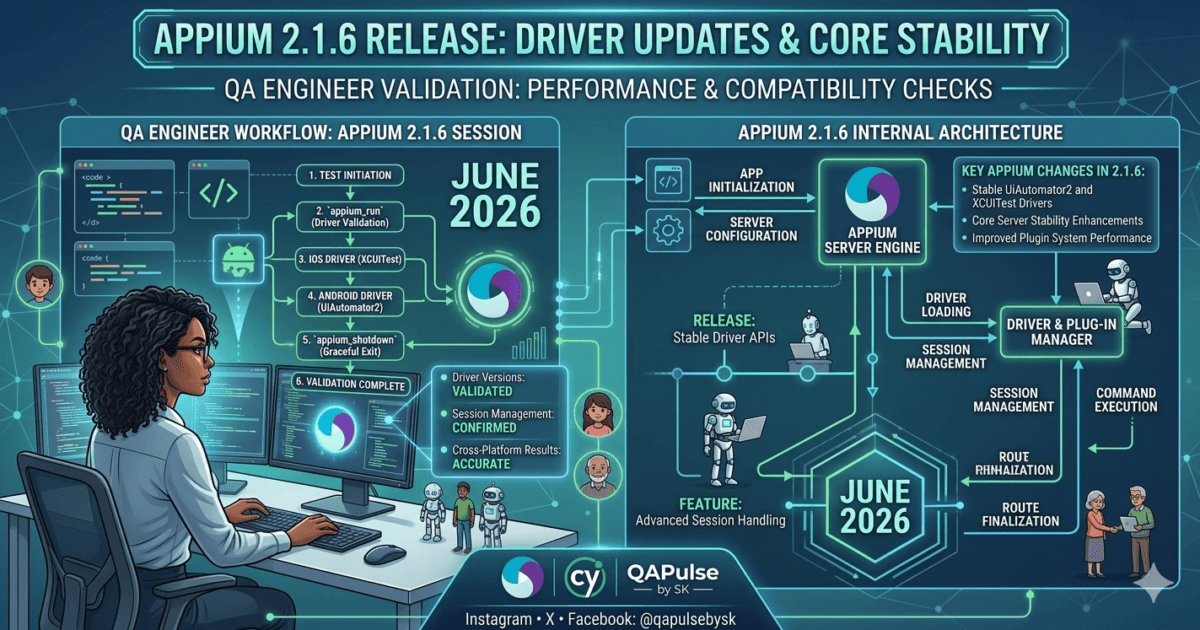
Appium 2.1.6 Release is a maintenance update for the universal XML plugin. Learn the impact, upgrade guidance, and QA recommendations.
- Appium 2.1.6 Release, published on June 18, 2026.
- Appium 2.1.6 Release is one of the smallest releases Appium users have seen this year.
- Unlike major Appium updates that introduce new capabilities, bug fixes, or platform support enhancements, this release is primarily a version bump for a single Appium component.
- This release updates the Appium 2.1.6 Release – Universal XML plugin, a component responsible for handling XML representations of mobile application UI hierarchies.
At first glance, many QA engineers might dismiss such a release as insignificant. However, experienced automation engineers understand that even small dependency updates can influence test infrastructure stability, plugin compatibility, and future upgrade paths.
The official release notes for the Appium 2.1.6 Release contain only one statement:
Version bump only for package @appium/universal-xml-plugin
While this may appear trivial, it’s worth understanding what the Universal XML Plugin does, who should care about this update, and whether mobile automation teams should upgrade immediately.
In this article, we’ll break down:
- What changed in Appium 2.1.6
- Understanding the Universal XML Plugin
- Impact on QA teams
- Migration considerations
- Upgrade recommendations
- Testing checklist for Appium users
What is Appium?
Appium is one of the most widely adopted open-source frameworks for mobile test automation.
It enables automation of:
- Android applications
- iOS applications
- Hybrid mobile apps
- Mobile web applications
Appium supports multiple programming languages including:
- Java
- Python
- JavaScript
- TypeScript
- C#
- Ruby
Modern QA teams rely on Appium for:
- Functional testing
- Regression testing
- Cross-platform validation
- CI/CD automation
- Mobile device cloud execution
Because of its plugin-based architecture introduced in Appium 2.x, even small plugin updates deserve review before production adoption.
What’s New in Appium 2.1.6?
According to the official release notes:
Release Summary
| Category | Change |
|---|---|
| Core Appium Server | No Changes |
| Drivers | No Changes |
| APIs | No Changes |
| Features | No Changes |
| Bug Fixes | No Changes |
| Plugins | Universal XML Plugin Version Bump |
Official note:
Version bump only for package @appium/universal-xml-plugin
This means there are no reported enhancements to Appium core functionality.
What is the Universal XML Plugin?
Many Appium users may not be familiar with the Universal XML Plugin because it operates behind the scenes.
The plugin helps standardize XML representations generated from mobile UI hierarchies.
These XML structures are used for:
- Element inspection
- Locator identification
- UI hierarchy analysis
- Test debugging
- Accessibility validation
The plugin can provide a more consistent XML view across different automation environments.
Why Does the Universal XML Plugin Matter?
When Appium interacts with a mobile application, it retrieves UI information from the device.
That information often includes:
<element>
   <button>
   <textfield>
   <image>
</element>
Automation frameworks rely heavily on these structures for:
- XPath locators
- Accessibility IDs
- Dynamic element discovery
- Page Object Models
Any improvements to XML processing can potentially influence:
- Locator stability
- Element discovery reliability
- Debugging experience
What Does the Appium 2.1.6 Release Mean for QA Engineers?
The practical impact depends on how your team uses Appium.
For Most Teams
The impact is extremely low.
If your automation framework uses:
- Standard Appium drivers
- Native locators
- Accessibility IDs
- Existing test suites
you are unlikely to notice any immediate difference.
For Advanced Framework Teams
Teams that heavily customize:
- XML parsing
- Element tree analysis
- Dynamic locator generation
- Accessibility tooling
should review plugin-related dependencies.
Although no functional changes were announced, plugin version updates can occasionally affect edge-case integrations.
Key Improvement #1: Ecosystem Maintenance
While the release does not introduce visible functionality, it demonstrates ongoing maintenance of the Appium ecosystem.
Healthy open-source projects regularly:
- Update dependencies
- Maintain plugins
- Improve compatibility
- Prepare infrastructure for future releases
This helps reduce technical debt over time.
QA Perspective
Stable ecosystems generally lead to:
- Fewer upgrade surprises
- Better plugin compatibility
- More predictable release cycles
Key Improvement #2: Future-Proofing Plugin Infrastructure
The Appium 2.1.6 Release appears to be a maintenance-oriented update focused on plugin management.
Such releases often:
- Align package versions
- Prepare upcoming releases
- Resolve internal dependency mismatches
- Improve package publishing workflows
Although invisible to end users, these updates contribute to long-term project stability.
QA Perspective
Teams building custom Appium plugins should remain aligned with current package versions to avoid future compatibility issues.
Are There Any Breaking Changes?
Official Assessment
No breaking changes have been reported.
The release notes contain:
- No API changes
- No driver updates
- No command modifications
- No deprecations
- No migration warnings
Risk Assessment
| Area | Risk |
|---|---|
| Existing Test Suites | Very Low |
| Mobile Automation Frameworks | Very Low |
| Appium Drivers | Very Low |
| CI/CD Pipelines | Very Low |
| Custom Plugins | Low |
For most organizations, the upgrade should be straightforward.
Migration Guidance
Because this is a plugin-related maintenance release, migration complexity is minimal.
Recommended Validation Steps
Before production rollout:
Verify Appium Server Startup
appium
Ensure:
- Server launches correctly
- Plugins load successfully
- Driver registration succeeds
Verify Existing Automation Suites
Run:
- Smoke tests
- Regression tests
- Device compatibility tests
QA Testing Checklist After Upgrade
High Priority
- Launch application
- Find elements
- Execute clicks
- Validate text fields
- Verify gestures
Medium Priority
- XPath locators
- Accessibility IDs
- Dynamic element searches
- Page Object validations
Infrastructure Validation
- CI/CD pipelines
- Device farm integrations
- Cloud execution environments
- Parallel execution
Impact Analysis for Different Teams
| Team Type | Impact |
|---|---|
| Mobile QA Team | Low |
| SDET Team | Low |
| Appium Plugin Developers | Medium |
| Device Farm Operators | Low |
| Enterprise QA Teams | Low |
The vast majority of Appium users will experience little to no behavioral change.
Should You Upgrade Immediately?
Recommendation: Yes
Unlike security-critical releases that demand urgency, the Appium 2.1.6 Release is a low-risk maintenance update.
Upgrade Recommendation Matrix
| Organization Type | Recommendation |
|---|---|
| Small QA Teams | Upgrade Now |
| Enterprise Teams | Upgrade During Normal Sprint |
| Mobile Automation Teams | Upgrade Now |
| Appium Plugin Developers | Validate First |
| Highly Regulated Systems | Staging Validation |
Because no breaking changes are reported, most teams can upgrade during their regular maintenance cycle.
How to Upgrade Appium
Using NPM
npm install -g appium@latest
Verify installation:
appium --version
Expected output:
2.1.6
Project Dependency Upgrade
npm update appium
Important Note
Appium is a Node.js-based framework.
The commonly shared command:
pip install appium --upgrade
upgrades the Python Appium client library, not the Appium server itself.
If you’re using Python-based automation, you may upgrade the client separately:
pip install --upgrade Appium-Python-ClientAppium 2.1.6 Release Verdict
The Appium 2.1.6 Release is a maintenance-focused update that introduces no new user-facing functionality and no reported bug fixes.
Its primary purpose is updating the @appium/universal-xml-plugin package.
For most QA engineers, this release will have minimal day-to-day impact. Existing mobile automation suites should continue functioning normally without modification.
However, organizations that rely on custom Appium plugins or advanced XML processing workflows should perform routine validation before deployment.
Overall Rating:
| Category | Rating |
|---|---|
| Stability | 10/10 |
| Upgrade Risk | 10/10 |
| QA Impact | 5/10 |
| Enterprise Readiness | 9/10 |
| Recommended Upgrade | Yes |
Frequently Asked Questions
What changed in Appium 2.1.6?
The release only updates the @appium/universal-xml-plugin package.
Are there any new features?
No. No new user-facing features were announced.
Are there any breaking changes?
No breaking changes have been reported.
Should mobile QA teams upgrade immediately?
Yes. The release appears low-risk and suitable for routine maintenance upgrades.
Do existing Appium test suites require modifications?
In most cases, no changes are required.
Who should pay the most attention to this release?
Teams building:
- Custom Appium plugins
- XML processing tools
- Advanced mobile automation frameworks
What QA Engineers Should Watch Next
Although this release is small, it may indicate preparation for future Appium enhancements.
Teams should monitor upcoming releases for:
- Plugin architecture updates
- Driver improvements
- Android automation enhancements
- iOS automation improvements
- Appium ecosystem changes
Small maintenance releases often lay the groundwork for larger updates later.
External Resources
Official Release Notes: https://github.com/appium/appium/releases/tag/%40appium/universal-xml-plugin%402.1.6
Appium Documentation: https://appium.io/docs/en/latest
GitHub Repository: https://github.com/appium/appium
More Related Blogs
- Cypress 15.17.0 Released: Valuable Stability Improvements QA Engineers Should Know
- FastAPI 0.137.1 Released: Important API Routing Fixes QA Engineers Should Upgrade For
- PyTest 9.1.0 Released: Critical Fixture Changes QA Engineers Must Understand
- Playwright 1.61.0 Released: Powerful Authentication Testing Features QA Engineers Must Know
- LangChain 1.4.6 Released: Valuable AI Agent Observability Improvements QA Engineers Must Know
Final Thoughts
The Appium 2.1.6 Release is a textbook example of a maintenance release that prioritizes ecosystem health over new functionality.
While there are no headline-grabbing features, keeping dependencies and plugins aligned remains an important part of maintaining stable automation frameworks.
For most QA engineers, the upgrade should be uneventful, requiring only routine validation. For teams extending Appium through custom plugins, it’s a good opportunity to ensure compatibility with the latest plugin ecosystem.