 QA
QA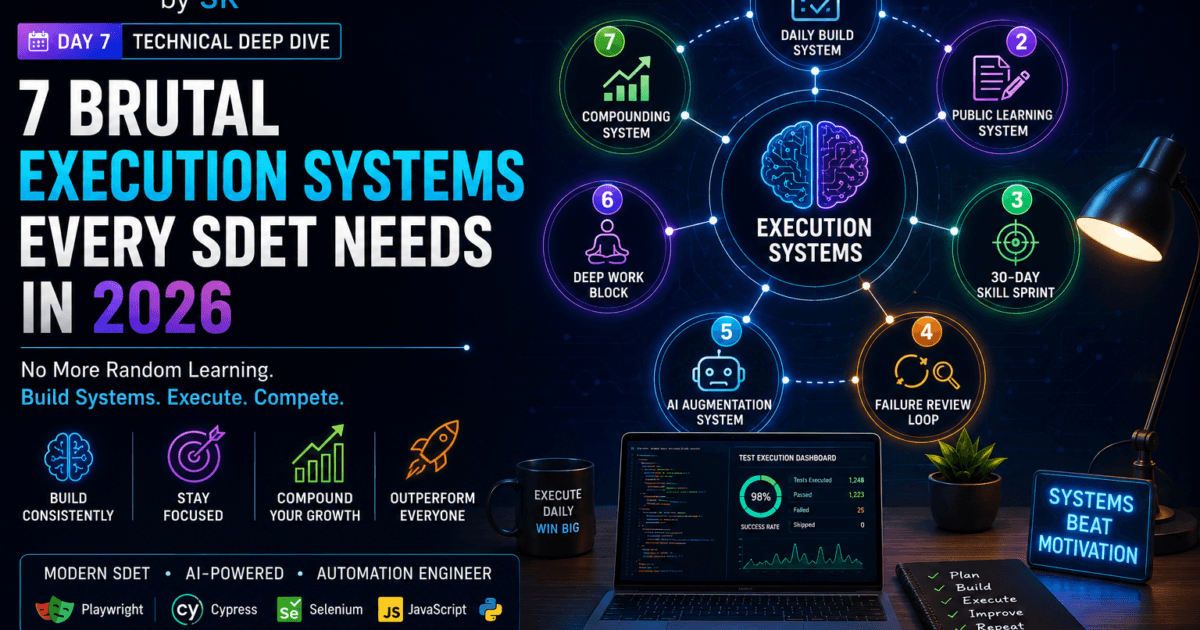
Most QA engineers think they need:
❌ another course
❌ another certification
❌ another tutorial playlist
But honestly?
That’s rarely the real problem.
The real problem is this:
Most engineers have information… but no execution system.
And without execution systems:
- motivation disappears
- learning becomes random
- consistency dies
- growth becomes slow
- overwhelm increases
That’s why many engineers stay stuck for YEARS.
Despite watching:
- YouTube videos
- Udemy courses
- LinkedIn tutorials
- AI webinars
- framework guides
Knowledge is everywhere now.
Execution is rare.
What Are Execution Systems?
Execution systems are repeatable operating structures that remove dependence on:
❌ motivation
❌ mood
❌ inspiration spikes
Instead of asking:
"What should I learn today?"
You already know:
- what to build
- when to build
- how to improve
- how to iterate
That changes everything.
Execution Systems vs Motivation
This is one of the biggest mindset shifts engineers need.
Motivation is unstable.
Systems scale.
Motivation says:
"I feel inspired today."
Execution systems say:
"I execute whether inspired or not."
That’s why high-level engineers improve faster.
Not because they know more.
Because they execute more consistently.
Execution System #1 — The Daily Build System
Most engineers consume endlessly.
Very few build consistently.
That’s the gap.
Instead of:
- watching tutorials daily
- bookmarking threads
- saving AI tools endlessly
Start building something every day.
Even small things:
- assertion utilities
- Playwright helpers
- AI testing experiments
- reporting improvements
- CI/CD scripts
Because building creates:
✅ real understanding
✅ engineering intuition
✅ portfolio proof
✅ confidence
This single system changes careers.
Execution System #2 — The Public Learning System
One of the fastest growth accelerators:
👉 Learn publicly.
Write:
- Medium blogs
- LinkedIn posts
- GitHub projects
- architecture breakdowns
- testing experiments
Why this works psychologically:
Teaching forces clarity.
And clarity creates expertise.
Most engineers:
❌ consume privately
Strong engineers:
✅ document publicly
That creates:
- visibility
- opportunities
- authority
- network effects
Execution System #3 — The 30-Day Skill Sprint
Most people fail because learning goals are too vague.
Example:
"Learn Playwright"
That’s not actionable.
Instead:
Build 1 advanced Playwright concept daily for 30 days.
Now execution becomes measurable.
Examples:
- Day 1 → locator strategy
- Day 2 → network interception
- Day 3 → trace viewer
- Day 4 → flaky test detection
- Day 5 → AI-assisted debugging
Small daily compounding beats random intensity.
Every time.
Execution System #4 — The Failure Review Loop
This system changed my thinking massively.
Most engineers experience failure like this:
Pipeline failed → frustration → rerun
High-level engineers ask:
Why did this fail?
What pattern exists?
How do we prevent it permanently?
That creates:
✅ system thinking
✅ architecture maturity
✅ debugging intelligence
Modern SDETs must increasingly think like:
👉 reliability engineers
Not just automation writers.
Execution System #5 — The AI Augmentation System
This is critical in 2026.
Engineers who ignore AI workflows will struggle badly.
But there’s a difference between:
❌ asking ChatGPT random questions
And:
✅ building AI-assisted engineering workflows
Modern execution systems increasingly include:
- AI research pipelines
- memory systems
- reusable prompts
- workflow automation
- coding copilots
- intelligent debugging
The goal is not:
Replace engineers
The goal is:
Increase engineering leverage
Huge difference.
Execution System #6 — The Deep Work Block
Most engineers are trapped in:
- notifications
- Slack
- random scrolling
- context switching
- tutorial hopping
Deep engineering requires uninterrupted focus.
One focused 90-minute block can outperform:
- 8 distracted hours
This is where:
- frameworks get built
- architecture improves
- real learning happens
The internet rewards distraction.
Engineering rewards depth.
Execution System #7 — The Compounding System
This is the most powerful one.
Most engineers start from zero repeatedly.
Smart engineers build compounding systems.
Example:
- one blog → becomes LinkedIn post
- one GitHub repo → becomes portfolio
- one framework → becomes reusable product
- one experiment → becomes authority
That’s how personal brands scale.
That’s how careers accelerate.
Why Most Courses Don’t Change Careers
Courses give information.
But execution systems create transformation.
Without systems:
- knowledge fades
- motivation disappears
- consistency breaks
That’s why some engineers watch:
- 50 courses
And still cannot build:
- one scalable framework
Execution matters more than consumption.
The Future Belongs to Engineers Who Execute Fast
The industry is changing rapidly:
- AI
- automation
- agentic workflows
- intelligent systems
- AI-assisted coding
The winning engineers will not be:
❌ the people with the most certificates
They will be:
✅ the people with the strongest execution systems
Because execution compounds faster than knowledge alone.
The Hard Truth
You do NOT need:
- another roadmap
- another course
- another productivity hack
You need:
✅ consistency
✅ systems
✅ compounding
✅ deep execution
That’s what separates:
- consumers
from: - builders
External Resources
Let’s Talk
👉 Which execution system changed your engineering growth the most?
👉 What’s stopping most QA engineers from executing consistently?
Drop your thoughts below 👇
Final Line
The future belongs to engineers who execute consistently while everyone else keeps consuming endlessly.
More Relevant Articles
- The Most Dangerous QA Engineer in 2026 Is the Comfortable One
- Why Most Test Automation Frameworks Collapse at Scale
- Most QA Engineers Are Learning the Wrong Skills in 2026