 QA
QA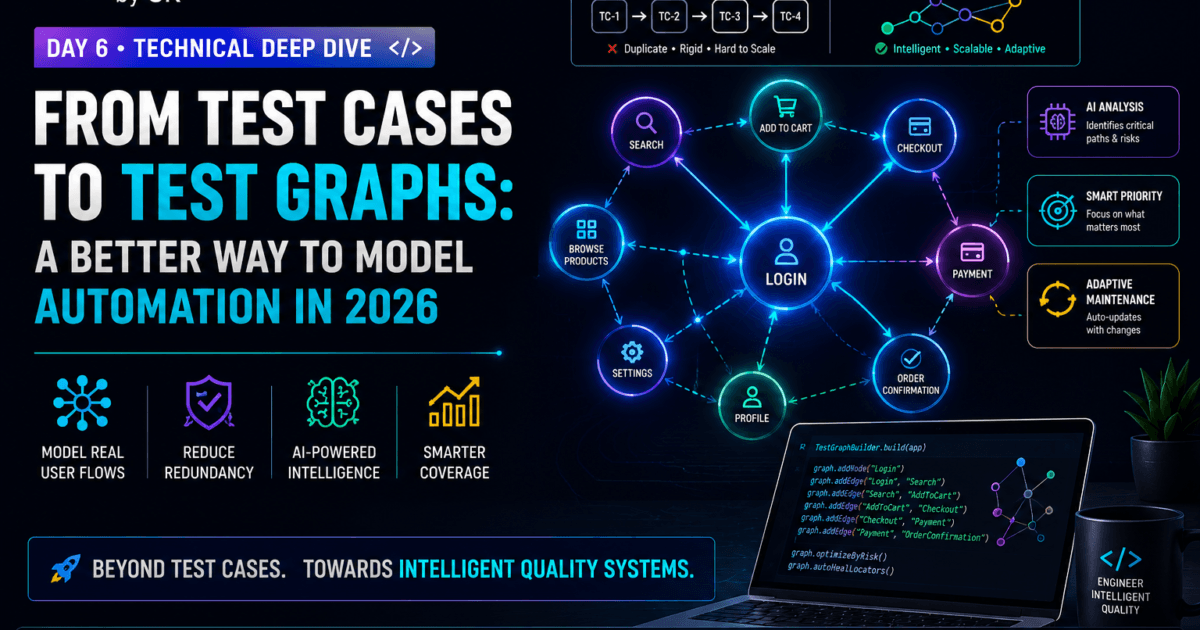
For years, automation frameworks were built around one core idea and there was no concept of Test Graphs:
Write isolated test cases.
One login test.
One checkout test.
One profile update test.
One payment test.
That worked when applications were smaller.
But modern systems are no longer simple linear flows.
Today’s applications are:
- distributed
- event-driven
- AI-assisted
- microservice-heavy
- highly dynamic
- continuously changing
And honestly?
Traditional test-case thinking is starting to collapse under that complexity.
The Real Problem With Traditional Automation
Most automation frameworks today still think in straight lines:
Open page → click button → validate result
But modern systems behave more like:
Connected ecosystems of states, behaviors, APIs, permissions, data flows, and events.
That difference matters massively.
The Hidden Limitation Nobody Talks About
Traditional test cases are:
❌ isolated
❌ repetitive
❌ context-blind
❌ difficult to scale
❌ hard to maintain
❌ weak at modeling behavior relationships
Which creates a huge problem.
Because software bugs rarely happen in isolation anymore.
They happen because of:
- state transitions
- dependency chains
- async timing
- permission interactions
- cross-service communication
- shared data relationships
Static test cases struggle badly with these realities.
What Are Test Graphs?
A Test Graph is a connected behavioral model of your application.
Instead of thinking:
"Run checkout test"
You think:
"How do all system behaviors connect together?"In a Test Graph:
- nodes represent behaviors or states
- edges represent transitions or dependencies
- risk flows become visible
- relationship failures become detectable
This changes automation completely.
Simple Example
Traditional automation thinks like this:
Login Test
Checkout Test
Profile Test
Payment Test
Everything disconnected.
Test Graph thinking looks more like this:
User Authentication
    ↓
Session Generation
    ↓
Cart State
    ↓
Payment Authorization
    ↓
Order Processing
    ↓
Email Notification
Now the system understands relationships.
That’s powerful.
Why This Matters in 2026
Because modern bugs increasingly happen between systems.
Not inside isolated screens.
Example:
A payment succeeds.
But:
❌ inventory is not updated
❌ notification queue fails
❌ user session expires
❌ analytics event never triggers
Traditional UI tests may still pass.
But the business workflow failed.
Test Graphs help model entire behavior ecosystems.
AI Makes Test Graphs Even More Powerful
This is where things become really interesting.
AI systems are extremely good at:
- relationship analysis
- pattern detection
- dependency mapping
- behavioral reasoning
Meaning AI can increasingly help:
✅ detect risky graph paths
✅ identify weak coverage areas
✅ suggest missing validations
✅ analyze failure propagation
✅ optimize execution priority
That’s much more advanced than:
expect(status).toBe(200)Why Most Automation Suites Become Unmaintainable
Because test count grows faster than system understanding.
Eventually teams have:
✅ 15,000 test scripts
But still cannot answer:
👉 Which business flows are actually risky?
👉 Which dependencies fail most often?
👉 Which user journeys matter most?
👉 Which failures cascade into production incidents?
That’s not intelligent testing.
That’s automated noise.
Test Coverage vs Behavioral Coverage
This is one of the most important mindset shifts.
Traditional coverage asks:
"Did we test this page?"
Modern intelligent coverage asks:
"Did we validate this behavioral relationship?"
Huge difference.
Because modern applications are increasingly:
👉 systems of interactions
Not isolated pages.
Example Architecture
Imagine an e-commerce platform.
Instead of writing:
- 50 login tests
- 40 cart tests
- 80 payment tests
A graph-driven system models:
- authentication dependencies
- session persistence
- inventory state
- pricing logic
- payment transitions
- order lifecycle
Now failures become easier to trace.
The automation system starts understanding:
👉 impact propagation
That’s next-level QA engineering.
Why This Changes CI/CD Too
One massive advantage of Test Graphs:
You no longer need to run everything blindly.
Instead:
The graph can prioritize execution based on:
- changed services
- dependency risk
- production incidents
- historical failures
- user impact
- AI risk scoring
That dramatically improves:
✅ pipeline speed
✅ signal quality
✅ release confidence
This Is Where QA Meets Systems Engineering
And honestly?
This is why modern SDETs are evolving beyond:
Test script writers
Toward:
- systems thinkers
- reliability engineers
- AI-assisted architects
- observability-focused engineers
Because software complexity exploded.
Static thinking cannot scale anymore.
What Smart QA Engineers Should Learn Now
If you want to stay ahead in 2026:
Focus less on:
❌ memorizing framework APIs
❌ writing repetitive scripts
❌ tool tribalism
And focus more on:
✅ behavioral modeling
✅ system relationships
✅ observability
✅ AI-assisted testing
✅ dependency intelligence
✅ architecture thinking
That’s where the industry is heading.
Fast.
Important Reality Check
Most companies are still operating with:
2018 automation strategies
While software systems already evolved into:
2026 complexity
That gap is exactly why so many teams struggle with:
- flaky tests
- unstable pipelines
- false confidence
- slow releases
- maintenance chaos
Test Graph thinking helps close that gap.
Why This Topic Will Matter More Every Year
As AI-generated software increases…
Applications will become:
- more dynamic
- more interconnected
- more unpredictable
Meaning testing must evolve from:
Validating pages
Toward:
Understanding behavior ecosystems
That’s the future.
Let’s Talk
👉 Are traditional test cases becoming outdated?
👉 Could Test Graphs become the future architecture of QA?
Drop your thoughts below 👇
Final Line
The future of QA will not belong to engineers who write the most tests.
It will belong to engineers who understand system behavior the best.
More Relevant Articles
- The Most Dangerous QA Engineer in 2026 Is the Comfortable One
- Why Most Test Automation Frameworks Collapse at Scale
- Most QA Engineers Are Learning the Wrong Skills in 2026