 QA
QA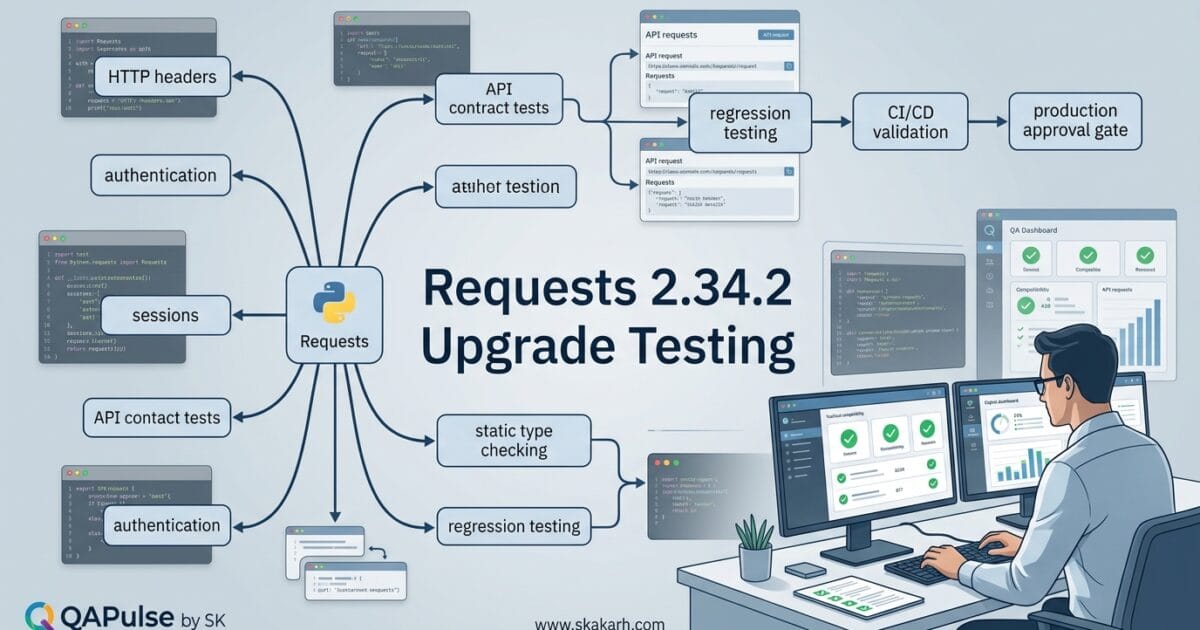
Requests 2.34.2 looks like a small release, but small dependency releases can still expose problems in typed Python codebases and API test suites. Released on May 14, 2026, Requests 2.34.2 changes the headers input type back to Mapping to address invariance issues involving MutableMapping and inferred dictionary types. The maintainers specifically note that users calling Request.headers.update() may need to narrow their typing. (GitHub)
For QA engineers and SDETs, the important question is therefore not simply, “Does Requests 2.34.2 install?” The better question is: “Does our HTTP automation, API integration, type checking, authentication, headers, sessions, and negative-test behavior remain stable after the upgrade?”
Official Requests 2.34.2 release
Why Requests 2.34.2 Matters to QA Engineers
At first glance, Requests 2.34.2 contains only one documented change. But that change sits directly around the Request.headers API, which is commonly used by API clients, test frameworks, fixtures, authentication helpers, and custom HTTP utilities.
The release changed the type annotation from MutableMapping back to Mapping. The runtime behavior of ordinary header dictionaries is not suddenly a completely different HTTP protocol, but static type checking can behave differently, especially in projects using mypy, Pyright, or strict CI type validation. (GitHub)
That distinction is important for SDETs.
A test suite can be:
- functionally green,
- API calls can succeed,
- HTTP responses can be correct,
and yet the pipeline can fail because the upgraded dependency exposes a typing incompatibility.
That means dependency testing needs to cover both runtime behavior and development-time contracts.
The strategic QA question
Before upgrading, ask:
Which parts of our test infrastructure depend on Requests’ public API, and which of those dependencies are checked only at runtime versus statically?
That question produces a much stronger upgrade strategy than simply running the existing regression suite.
What Actually Changed in Requests 2.34.2?
The key change is:
# Requests 2.34.2 conceptually exposes headers as Mapping
headers: Mapping[str, str]
The previous 2.34.1 release had changed the headers input type to MutableMapping, while 2.34.2 moved it back to Mapping because of invariance issues involving MutableMapping and inferred dictionary types. (GitHub)
This is particularly relevant if your test framework contains code like:
from requests import Request

request = Request(
    "GET",
    "https://example.com",
    headers={
        "Authorization": "Bearer token",
        "Accept": "application/json",
    },
)
For ordinary API automation, this remains a familiar usage pattern.
The risk appears when your code performs mutation through Request.headers.update() or has strongly typed abstractions around headers.
For example:
request = Request(
    "GET",
    "https://example.com",
    headers={"Accept": "application/json"},
)

request.headers.update({
    "Authorization": "Bearer token"
})
The important point is not that this suddenly becomes invalid Python. Rather, your static typing assumptions may need adjustment, particularly in strict typed projects.
Runtime Testing vs Type Testing
This release provides a useful lesson for QA teams: runtime tests alone cannot detect every dependency upgrade problem.
Consider these two validation layers:
| Validation | What it catches | Requests 2.34.2 relevance |
|---|---|---|
| Unit tests | Application behavior | High |
| API tests | HTTP behavior | High |
| Integration tests | Service interaction | High |
| Static type checking | Type-contract problems | Very high |
| Linting | Code-quality issues | Medium |
| Dependency installation | Packaging problems | High |
| Regression suite | Existing behavior | Very high |
A traditional API regression suite might execute:
response = requests.get(
    "https://api.example.com/users",
    headers={"Authorization": "Bearer token"},
)

assert response.status_code == 200
That can pass while your type-checking pipeline fails elsewhere.
For example:
mypy src tests
or:
pyright
This is why a mature SDET pipeline should treat dependency upgrades as multi-layer validation events rather than simply running functional tests.


The Hidden Risk: Mutable Headers in Test Infrastructure
The most interesting QA impact is around code that treats headers as mutable objects.
A common test utility might look like this:
def add_auth_header(request, token: str):
    request.headers.update({
        "Authorization": f"Bearer {token}"
    })
This looks harmless.
But in a typed codebase, the type expected by request.headers and the type accepted by update() become relevant to the checker.
The Requests maintainers explicitly called out users of Request.headers.update() in the 2.34.2 release notes. (GitHub)
That means QA engineers should search their automation repositories for patterns such as:
grep -R "headers.update" tests/
and:
grep -R "Request(" tests/
For larger repositories, use your IDE or code-search tooling to identify:
Request.headers.headers.update()- custom header wrappers
- typed HTTP clients
- fixtures that modify headers
- authentication helpers
- request factories
- API test base classes
This is a simple but effective upgrade-impact inventory.
A Better Upgrade Test: Build a Header Contract Test
Instead of relying entirely on broad regression tests, create a focused contract test.
from requests import Request


def test_request_headers_accept_standard_mapping():
    headers = {
        "Accept": "application/json",
        "X-Test-Client": "qa-automation",
    }

    request = Request(
        method="GET",
        url="https://example.com",
        headers=headers,
    )

    assert request.headers["Accept"] == "application/json"
    assert request.headers["X-Test-Client"] == "qa-automation"
This test verifies the behavior your automation actually depends upon.
If your framework modifies headers dynamically, add a dedicated test:
def test_request_headers_can_be_updated():
    request = Request(
        "GET",
        "https://example.com",
        headers={"Accept": "application/json"},
    )

    request.headers.update({
        "Authorization": "Bearer test-token"
    })

    assert request.headers["Authorization"] == "Bearer test-token"
The value of this test is not the complexity of the code.
The value is that it establishes a known contract for your test infrastructure.
Requests 2.34.2 vs a Major Version Upgrade
Not every dependency upgrade deserves the same testing strategy.
Compare a patch release with a major-version migration:
| Area | Requests 2.34.2 | Major HTTP-client upgrade |
|---|---|---|
| Installation validation | Required | Required |
| Existing API tests | Required | Required |
| Type checking | Important | Critical |
| Authentication | Recommended | Critical |
| Headers | High priority | Critical |
| Sessions | Recommended | Critical |
| Proxy behavior | Targeted | Critical |
| TLS/SSL | Targeted | Critical |
| Full regression | Recommended | Mandatory |
| Source-code migration | Usually limited | Often required |
Requests 2.34.2 is not a major API migration. Therefore, QA teams don’t need to treat it like a completely new HTTP client.
But that does not mean “no testing required.”
The correct strategy is risk-proportional testing.
Don’t Confuse a Small Changelog With Zero Risk
This is one of the most common mistakes in dependency management.
A release containing one visible change can still affect thousands of lines of automation code.
Imagine this architecture:
                    API Tests
                       |
                Request Factory
                       |
              Authentication Layer
                       |
                Header Utility
                       |
                  Requests
                       |
                 urllib3 / TLS
                       |
                 Target API
A change at the Requests layer can propagate through multiple abstractions.
Your test suite might never directly instantiate Request.
Instead:
client.get("/users")
could internally become:
APIClient
   ↓
SessionManager
   ↓
AuthProvider
   ↓
HeaderBuilder
   ↓
requests.Session
That is why dependency-impact analysis should follow usage paths, not just direct imports.
How SDETs Should Test the Upgrade
A practical validation sequence looks like this:
Install
   ↓
Static Type Check
   ↓
Focused Unit Tests
   ↓
HTTP Contract Tests
   ↓
Authentication Tests
   ↓
API Regression
   ↓
Integration Tests
   ↓
Full CI Validation
Start with the cheapest signals.
There is little value in spending 45 minutes running thousands of tests if the upgraded dependency immediately fails your type-checking stage.
A fast validation pipeline might therefore look like:
python -m pip install --upgrade requests

python -m pytest tests/unit

mypy src tests

python -m pytest tests/api

python -m pytest tests/integration
Then execute the complete regression suite.
Pin the Version During Validation
Do not upgrade your production dependency and your test environment simultaneously without knowing which version actually passed validation.
Use an explicit version during the evaluation:
requests==2.34.2
Then verify:
python -c "import requests; print(requests.__version__)"
Expected:
2.34.2
This makes the test result reproducible.
A green test suite without knowing the exact dependency version is much less valuable.
Compare Before and After
A particularly effective strategy is to run the same test suite against the current and target versions.
For example:
Baseline
Requests 2.34.1
      ↓
Run regression
      ↓
Record results
      ↓
Upgrade
Requests 2.34.2
      ↓
Run same regression
      ↓
Compare
You are looking for differences in:
- failures
- warnings
- type-checking errors
- test duration
- HTTP status codes
- response payloads
- headers
- authentication
- retries
- redirects
- exceptions
This is far more useful than asking only:
“Did the tests pass?”
The better question is:
“Did the behavior change between the baseline and upgraded environments?”
Requests 2.34.2 and Your API Automation Stack
Requests rarely exists in isolation inside a mature QA environment.
It may sit underneath:
- API test frameworks
- custom Python clients
- authentication utilities
- service virtualization
- test fixtures
- CI scripts
- data setup utilities
- integration tests
- contract-testing helpers
That means the upgrade should be tested at multiple levels.
| Layer | Example test |
|---|---|
| Library | Import and basic request |
| Utility | Header manipulation |
| Authentication | Token injection |
| Client | GET/POST/PUT/DELETE |
| API contract | Status + schema |
| Integration | Service-to-service request |
| End-to-end | Complete business workflow |
| CI | Full automation pipeline |
This is where experienced SDETs differentiate themselves from simply maintaining test scripts.
You are not testing the library in isolation. You are testing the dependency’s impact on your automation ecosystem.
What About Node.js?
There is an important correction to the common upgrade snippet that often appears in release-news templates.
Requests is a Python HTTP library, so this is the relevant upgrade command:
python -m pip install --upgrade requests
or, when deliberately pinning the release:
python -m pip install requests==2.34.2
The following is not the appropriate way to install Python Requests:
npm install requests@latest
This distinction matters for a QA-focused article because your upgrade instructions should reflect the actual package ecosystem rather than applying a generic Python/Node.js template to every tool.
Requests officially supports Python 3.10+ according to its current project information. (GitHub)
Upgrade Recommendation for QA Teams
For most projects already running Requests 2.x, Requests 2.34.2 should be approached as a low-risk, targeted upgrade rather than a major migration.
However, teams with strict static typing should give special attention to header-related code because the release specifically changes the typing of headers and calls out Request.headers.update() usage. (GitHub)
My recommended approach is:
| Environment | Recommendation |
|---|---|
| Personal automation | Upgrade and run focused tests |
| Small API suite | Upgrade after regression |
| Typed Python project | Run mypy/Pyright before approval |
| Large SDET framework | Validate in CI/staging first |
| Shared internal HTTP library | Add targeted header contract tests |
| Production API platform | Baseline → upgrade → regression → deploy |
The important lesson is simple:
Do not decide upgrade safety from the changelog size. Decide it from dependency usage and test coverage.
Make This Upgrade Interactive: Your QA Checklist
Before approving Requests 2.34.2, ask your team:
Question 1: Do we call Request.headers.update() anywhere?
grep -R "headers.update" .
Question 2: Do we run static type checking?
mypy .
Question 3: Do our API fixtures inject headers dynamically?
Question 4: Do authentication utilities mutate request headers?
Question 5: Does our HTTP client wrap Requests behind another abstraction?
Question 6: Have we compared baseline and upgraded test results?
If you cannot answer these questions, the upgrade is not fully assessed yet.


The Bigger Lesson for SDETs
Requests 2.34.2 is a useful reminder that software dependencies have multiple contracts.
There is the runtime contract:
Does the request work?
There is the API contract:
Does our application receive the expected response?
There is the type contract:
Does our source code still satisfy the dependency's type definitions?
And there is the automation contract:
Does our entire test framework still behave correctly?
A mature SDET strategy validates all four.
That is particularly important now that Python projects increasingly use static analysis as part of CI/CD. Requests 2.34.0 introduced inline types, and the subsequent 2.34.1 and 2.34.2 releases adjusted typing around headers and other interfaces. (Requests)
So the most valuable lesson from this release isn’t a new HTTP feature.
It is this:
A dependency upgrade can change your development contract even when your runtime behavior appears unchanged.
That is exactly why QA engineers should test both.
Official Reference
The authoritative Requests release history confirms that 2.34.2 was released on May 14, 2026, with the header typing change as its documented release change. (GitHub)
This article should therefore position Requests 2.34.2 as a targeted upgrade-testing story, not another generic “What’s New” release summary.
How to Validate Requests 2.34.2 Before Production
The safest way to handle a Requests 2.34.2 upgrade is to treat it as a compatibility exercise rather than a routine package update. The release is small, but its change to the typing of Request.headers can matter in strongly typed Python automation frameworks, particularly where headers are updated or wrapped by custom utilities.
For QA engineers and SDETs, the real acceptance criterion should be:
Requests 2.34.2 is ready when the application and its automation ecosystem behave the same—or better—under the upgraded dependency.
That means validating more than whether pip install succeeds.
Build a Requests 2.34.2 Upgrade Test Matrix
A useful upgrade strategy begins by mapping the dependency to the behavior that matters.
| Test layer | What to validate | Priority |
|---|---|---|
| Installation | Correct package/version | High |
| Imports | Existing imports still work | High |
| Headers | Creation, reading, and mutation | Critical |
| Authentication | Authorization headers and token injection | Critical |
| Sessions | Session-level headers and cookies | High |
| HTTP methods | GET, POST, PUT, PATCH, DELETE | High |
| Error handling | Exceptions and failure responses | High |
| Type checking | mypy/Pyright compatibility | Critical for typed projects |
| API contracts | Status codes and response schemas | High |
| Integration | Real service communication | High |
| Regression | Existing automation behavior | Critical |
This matrix prevents a common mistake: running one huge regression suite without knowing what the dependency change could actually affect.
Test the Header Contract First
Because the 2.34.2 release specifically moves the headers input type back to Mapping, header behavior deserves focused coverage.
Start with a simple test:
from requests import Request


def test_request_accepts_mapping_headers():
    headers = {
        "Accept": "application/json",
        "X-Test-Client": "qapulse",
    }

    request = Request(
        method="GET",
        url="https://example.com",
        headers=headers,
    )

    assert request.headers["Accept"] == "application/json"
    assert request.headers["X-Test-Client"] == "qapulse"
Then test the mutation pattern that may be relevant to existing code:
def test_request_headers_update():
    request = Request(
        "GET",
        "https://example.com",
        headers={
            "Accept": "application/json"
        },
    )

    request.headers.update({
        "Authorization": "Bearer test-token"
    })

    assert request.headers["Authorization"] == "Bearer test-token"
The objective isn’t to prove that Requests itself works. Your objective is to prove that your application’s use of Requests still matches the contract you depend on.
Test Authentication Separately
Headers often become more important when authentication is involved.
A typical API framework might have:
def build_headers(token: str) -> dict[str, str]:
    return {
        "Authorization": f"Bearer {token}",
        "Accept": "application/json",
    }
Then:
response = requests.get(
    "https://api.example.com/profile",
    headers=build_headers(token),
)

assert response.status_code == 200
Your regression suite should explicitly verify:
- Authorization header injection
- expired-token handling
- missing-token behavior
- custom headers
- content negotiation
- correlation IDs
- tenant headers
- tracing headers
For example:
def test_authenticated_request():
    headers = {
        "Authorization": "Bearer test-token",
        "Accept": "application/json",
    }

    response = requests.get(
        "https://api.example.com/profile",
        headers=headers,
    )

    assert response.status_code == 200
For a real test environment, replace the example token and endpoint with controlled test credentials and infrastructure.
Don’t Test Only requests.get()
A weak dependency regression test might cover only:
requests.get(url)
A stronger SDET test matrix covers the HTTP behaviors your system actually uses.
| Request behavior | Example |
|---|---|
| GET | Retrieve resource |
| POST | Create resource |
| PUT | Replace resource |
| PATCH | Partial update |
| DELETE | Remove resource |
| Headers | Authentication and metadata |
| Query parameters | Filtering and pagination |
| JSON body | API payloads |
| Timeouts | Failure handling |
| Redirects | Navigation behavior |
| Sessions | Connection and shared state |
| Exceptions | Negative scenarios |
For example:
def test_api_client_handles_timeout():
    with pytest.raises(requests.exceptions.Timeout):
        requests.get(
            "https://api.example.com/slow",
            timeout=0.001,
        )
The exact timeout should be appropriate for your test environment; the important part is verifying that your application’s exception handling remains intact.
Requests 2.34.2 and Static Type Checking
This is where the upgrade becomes particularly interesting for modern SDETs.
Functional tests answer:
Does the program execute correctly?
Static type checking answers:
Does the source code still satisfy the dependency’s declared interface?
Those are different questions.
Run the same type-checking pipeline you use in CI:
python -m mypy src tests
or:
pyright
If your repository doesn’t currently use static typing, this release is still a good reminder that dependency changes can affect developer tooling even when runtime tests remain green.
A useful CI sequence
python -m pip install requests==2.34.2

python -m pytest tests/unit

python -m mypy src tests

python -m pytest tests/api

python -m pytest tests/integration
The order is deliberate.
Fail fast on cheap signals before spending CI resources on expensive integration tests.
Compare Requests 2.34.1 With 2.34.2
One of the most reliable upgrade-testing techniques is baseline comparison.
Run the same suite against the current version first.
Requests 2.34.1
      ↓
Baseline tests
      ↓
Record results
      ↓
Requests 2.34.2
      ↓
Same tests
      ↓
Compare results
Don’t compare only pass/fail.
Track:
- test failures
- type-checking errors
- warnings
- response status changes
- response-body differences
- exception changes
- execution time
- authentication failures
- header differences
A simple CI comparison can reveal a subtle regression that a binary “all tests passed” report hides.
Test Your HTTP Abstraction Layer
Many mature QA frameworks don’t call Requests directly.
Instead, they might have:
Test
 ↓
API Fixture
 ↓
Custom API Client
 ↓
Authentication Manager
 ↓
HTTP Utility
 ↓
Requests
For example:
class ApiClient:

    def __init__(self, token: str):
        self.session = requests.Session()
        self.session.headers.update({
            "Authorization": f"Bearer {token}",
            "Accept": "application/json",
        })

    def get(self, url: str):
        return self.session.get(url)
Your tests should therefore validate the public behavior of ApiClient, not just the underlying Requests package.
def test_api_client_adds_authentication():
    client = ApiClient("test-token")

    assert client.session.headers["Authorization"] == (
        "Bearer test-token"
    )
This is a critical distinction.
If your abstraction works correctly, you don’t need hundreds of tests asserting implementation details of Requests. You need enough focused contract tests to detect whether the dependency breaks your abstraction.


Test Sessions, Not Just Individual Requests
If your framework uses requests.Session, explicitly test session behavior.
def test_session_headers():
    session = requests.Session()

    session.headers.update({
        "Accept": "application/json",
        "X-Test-Client": "qapulse",
    })

    response = session.get(
        "https://api.example.com/users"
    )

    assert response.status_code == 200
Session-level behavior can be particularly important in test frameworks because sessions may carry:
- authentication
- cookies
- default headers
- connection reuse
- proxies
- configuration
A test that passes with:
requests.get(...)
doesn’t automatically prove that your Session abstraction behaves correctly.
Validate Negative API Scenarios
Dependency upgrades shouldn’t be validated only through successful requests.
Test failures too.
def test_missing_authentication():
    response = requests.get(
        "https://api.example.com/private"
    )

    assert response.status_code in {401, 403}
Also consider:
401 Unauthorized
403 Forbidden
404 Not Found
409 Conflict
429 Too Many Requests
500 Server Error
Timeout
Connection Error
SSL Error
The exact scenarios depend on your application.
The strategic principle is:
Upgrade testing should validate how the application fails, not only how it succeeds.
That is especially important for SDETs because error handling is often part of the automation framework itself.
Test Headers as Data, Not Just Strings
Headers can contain more than authentication.
Your API automation may depend on:
headers = {
    "Authorization": "Bearer token",
    "Accept": "application/json",
    "Content-Type": "application/json",
    "X-Correlation-ID": "test-123",
    "X-Tenant-ID": "tenant-a",
}
Test important properties:
assert "Authorization" in headers
assert headers["Accept"] == "application/json"
assert headers["X-Correlation-ID"]
This becomes particularly valuable when your test infrastructure generates headers dynamically.
For example:
def build_headers(token: str, correlation_id: str):
    return {
        "Authorization": f"Bearer {token}",
        "Accept": "application/json",
        "X-Correlation-ID": correlation_id,
    }
Test the builder independently:
def test_build_headers():
    headers = build_headers(
        "test-token",
        "run-123",
    )

    assert headers["Authorization"] == "Bearer test-token"
    assert headers["X-Correlation-ID"] == "run-123"
Now a Requests upgrade can be validated without coupling every test to the implementation details of the HTTP library.
Compare Requests With Other HTTP Clients
This release also highlights an important architectural question: should your test framework depend directly on Requests?
| Capability | Requests | HTTPX | aiohttp |
|---|---|---|---|
| Synchronous HTTP | Excellent | Yes | Yes |
| Async-first design | No | Yes | Yes |
| Mature ecosystem | Very strong | Strong | Strong |
| Simple API testing | Excellent | Excellent | Moderate |
| HTTP/2 support | Limited | Yes | Yes |
| Existing Requests compatibility | Best | Different API | Different API |
| Migration cost | Low if already adopted | Moderate | Moderate |
| Best fit | Traditional Python HTTP | Sync + async | Async-heavy systems |
The lesson isn’t that QA teams should replace Requests.
A dependency upgrade is an opportunity to ask whether the current HTTP abstraction still makes sense for the application.
For a mature Requests-based test framework, the lower-risk approach is usually:
upgrade → validate → observe → adopt
rather than:
upgrade → rewrite the HTTP layer → discover unrelated regressions.
Use Contract Tests to Reduce Upgrade Risk
If dozens of test suites depend on the same HTTP client abstraction, create a small contract suite.
For example:
class TestApiClientContract:

    def test_get_request(self):
        ...

    def test_authentication(self):
        ...

    def test_headers(self):
        ...

    def test_timeout(self):
        ...

    def test_error_response(self):
        ...

    def test_session_behavior(self):
        ...
Run these tests against the new Requests version first.
If the contract suite passes, continue with broader regression.
This gives your team a fast compatibility gate.
A Practical CI Upgrade Gate
You can turn the strategy into a pipeline:
              Requests 2.34.2
                     |
              Dependency Check
                     |
              Import Validation
                     |
             Type Check Validation
                     |
             Header Contract Tests
                     |
             API Contract Tests
                     |
            Integration Regression
                     |
             Full Test Automation
                     |
                QA Approval
                     |
               Production
For example:
steps:
  - name: Install dependency
    run: python -m pip install requests==2.34.2

  - name: Type check
    run: python -m mypy src tests

  - name: Unit tests
    run: python -m pytest tests/unit

  - name: API tests
    run: python -m pytest tests/api

  - name: Integration tests
    run: python -m pytest tests/integration
The exact CI syntax depends on GitHub Actions, GitLab CI, Jenkins, Azure DevOps, or your internal platform.
The architecture remains the same:
fast checks first, expensive checks later.
What Should Actually Block Production?
Not every warning should block a dependency upgrade.
Create explicit gates.
| Finding | Production decision |
|---|---|
| Package installation failure | Block |
| Import failure | Block |
| Header regression | Block |
| Authentication regression | Block |
| API contract failure | Block |
| Type-checking failure in strict CI | Block |
| Minor unrelated lint warning | Investigate |
| Small test-duration increase | Monitor |
| Documentation warning | Usually non-blocking |
This turns upgrade testing into an engineering decision rather than a subjective discussion.
A Simple Requests 2.34.2 Upgrade Checklist
Before merging the dependency update, verify:
[ ] Requests 2.34.2 installed explicitly
[ ] Version verified in CI
[ ] Existing imports pass
[ ] Header creation tested
[ ] Header mutation tested
[ ] Authentication tested
[ ] Session behavior tested
[ ] API contract tests pass
[ ] Negative scenarios pass
[ ] mypy/Pyright passes
[ ] Integration tests pass
[ ] Full regression passes
[ ] Baseline comparison completed
[ ] Production dependency lock updated
This checklist is intentionally small.
The goal isn’t to create hundreds of new tests for every patch release.
The goal is to make the risk introduced by the dependency change observable.
The Bigger Lesson From Requests 2.34.2
The most valuable lesson from Requests 2.34.2 isn’t that one type annotation changed.
It is that modern dependency testing has multiple dimensions.
A dependency can affect:
Runtime behavior
      +
Type contracts
      +
Automation infrastructure
      +
CI/CD
      +
Application integrations
A traditional QA strategy might focus primarily on runtime behavior.
A modern SDET strategy asks a broader question:
What contracts does this dependency participate in?
For Requests, those contracts can include HTTP behavior, headers, sessions, authentication, exceptions, type definitions, and custom API-client abstractions.
That is why a small release can still deserve strategic testing.
Upgrade Recommendation
For teams already using Requests 2.x, Requests 2.34.2 should generally be treated as a targeted, low-complexity upgrade rather than a major migration.
However, don’t translate “small release” into “no testing.”
Prioritize:
- Header-related code
Request.headers.update()usage- Static type checking
- Authentication utilities
- Session behavior
- API contract tests
- Existing regression coverage
If those areas remain healthy, the upgrade becomes much easier to approve with confidence.
The strongest upgrade strategy is therefore not:
“The release only contains one change, so we don’t need to test it.”
It is:
“The release contains one relevant change. Let’s identify every place our system depends on that contract and validate those paths.”
Internal Links
- Learn MCP – Zero to Hero
- Learn AI Agents for QA – Zero to Hero
- Playwright Automation – Zero to Hero
- TencentDB Agent Memory: Complete Zero to Hero
- LangGraph: Complete Zero to Hero
- Learn Python – Zero to Hero
- OpenAI Codex: Complete Zero to Hero
- Cursor AI: Complete Zero to Hero
- Claude Code Tutorial: Complete Zero to Hero
- AutoGen: Complete Zero to Hero Guide
- Free QA Resources Built From Real Experience
- QA Glossary: Test Automation Terms Every Engineer Should Know
External Links
- Requests 2.34.2 Release on GitHub
- Requests Changelog
- Requests Documentation
- Requests API Documentation
- Python Documentation
- Python typing Documentation
AI Overview Optimization
Requests 2.34.2 upgrade testing should focus on header behavior,
Request.headers.update()usage, static type checking, authentication, sessions, API contracts, and regression testing. The release changes the typing of request headers, so strongly typed Python automation frameworks should validate both runtime behavior and type-checking results before production deployment.
A Requests 2.34.2 upgrade is successful when the application’s HTTP behavior and Python type contracts remain compatible—not merely when the package installs successfully.
Another Strong Answer
QA engineers should test Requests 2.34.2 with focused header tests, authentication tests, session tests, static type checking, API contract tests, and full regression testing.
People Asked Questions
What changed in Requests 2.34.2?
Requests 2.34.2 moves the Request.headers input type back to Mapping to address invariance issues involving MutableMapping and inferred dictionary types. Users calling Request.headers.update() may need to review their typing.
Should I upgrade to Requests 2.34.2?
For most existing Requests 2.x applications, the upgrade can be approached as a targeted dependency update. QA teams should nevertheless test header usage, authentication, sessions, static typing, and API regression before production deployment.
Is Requests 2.34.2 a breaking change?
It is not a major-version API migration, but the header typing adjustment can expose compatibility issues in strongly typed Python code, particularly around code that updates request headers.
What should QA engineers test after upgrading Requests?
Test imports, headers, authentication, sessions, HTTP methods, exceptions, timeouts, API contracts, static type checking, integration behavior, and the full regression suite.
How do I test Requests headers?
Create focused tests that verify header creation, retrieval, mutation, authentication headers, custom headers, and session-level headers.
Why is type checking important for Requests 2.34.2?
The release changes the typing around request headers. Runtime API tests may continue passing while mypy or Pyright detects incompatibilities in application or test-framework code.
How do I test Request.headers.update()?
Create a focused test that constructs a Request with headers, updates the headers, and verifies the expected values. In typed projects, also run the project’s static type checker.
How should I validate a Python dependency upgrade?
Establish a baseline, install the target version, run focused compatibility tests, execute static analysis, run API and integration tests, and compare the results against the baseline.
Should Requests 2.34.2 be tested against API authentication?
Yes. Authentication commonly relies on HTTP headers, so bearer tokens, API keys, custom authentication headers, and session-level authentication should be included in regression testing.
Should I compare Requests 2.34.1 and 2.34.2?
Yes. Running the same test suite against the baseline and upgraded versions helps identify behavioral, typing, performance, or exception differences introduced by the dependency change.
Conclusion
Requests 2.34.2 demonstrates why experienced QA engineers should look beyond release-note counts when evaluating dependencies. A single typing change can affect a strongly typed API automation framework even when ordinary HTTP requests continue working normally.
The right approach is risk-based: establish a baseline, inspect header usage, test authentication and sessions, run static type checking, execute focused API contracts, and then complete the broader regression suite.
Most importantly, don’t make package installation your definition of upgrade success.
Upgrade success means the entire automation ecosystem still behaves according to its expected contracts.
Final Key Takeaways
- Requests 2.34.2 is a small release, but its header typing change deserves targeted validation.
Request.headers.update()deserves special attention in typed Python projects.- Runtime tests and static type checks validate different contracts.
- API authentication, sessions, headers, exceptions, and negative scenarios should be included in upgrade testing.
- Baseline-versus-upgraded testing provides stronger evidence than a single regression run.
- Contract tests can provide a fast compatibility gate before expensive full regression.
- The correct upgrade strategy is risk-based, not changelog-size-based.
- For QA engineers, dependency testing should validate the impact on the entire automation ecosystem—not just the dependency itself.
Continue Learning
Explore more expert articles on Mobile Testing, Backend & API, AI & Agentic, AI Tools, n8n, LangChain, CrewAI, MCP Servers, AI Agents, LlamaIndex, Docker, FastAPI, Playwright, Cypress, Test Automation, DevOps, and Software Engineering at www.skakarh.com.
QAPulse by SK delivers expert release analysis, AI engineering insights, enterprise automation strategies, migration guidance, DevOps best practices, and practical testing knowledge to help software professionals build scalable, intelligent, and production-ready software systems.