QA
QA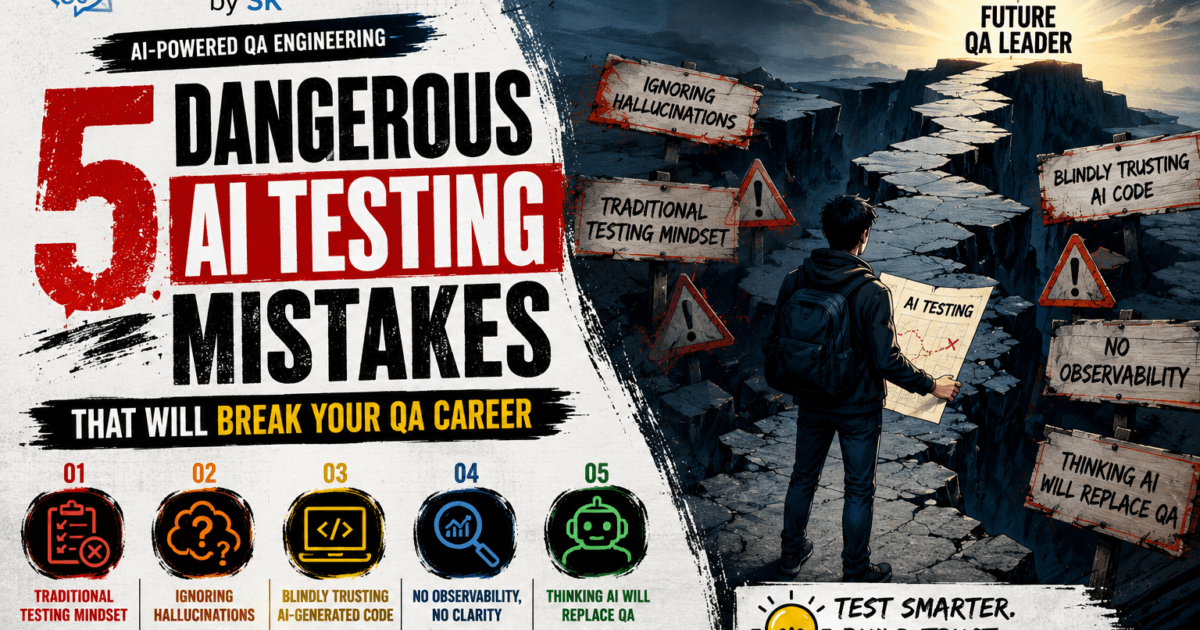
AI Testing Mistakes are Growing Fast — But Most Engineers Are Approaching It Completely Wrong
Right now the software industry is flooded with:
- AI testing tools
- autonomous agents
- AI-generated automation
- self-healing frameworks
- intelligent debugging systems
And honestly?
Many QA engineers are rushing into AI testing without understanding:
👉 how dangerous bad AI testing practices can become.
Because AI systems behave differently from traditional software.
They are:
- probabilistic
- adaptive
- context-sensitive
- non-deterministic
- continuously evolving
That means traditional QA thinking alone is no longer enough.
And the engineers who fail to adapt may struggle badly in the coming years.
AI Testing Mistake #1 — Treating AI Like Traditional Automation
This is currently one of the biggest AI testing mistakes in the industry.
Many teams still test AI systems using:
- fixed assertions
- static validations
- deterministic expectations
Example:
assert response == "Expected Answer"
Looks normal.
But AI systems may generate:
- semantically correct variations
- adaptive responses
- context-aware outputs
Now strict assertions start creating:
❌ false failures
❌ unstable pipelines
❌ misleading test results
Modern AI testing increasingly requires:
✅ semantic validation
✅ probabilistic evaluation
✅ contextual reasoning
✅ adaptive assertions
That’s a huge shift for QA engineering.x
AI Testing Mistake #2 — Ignoring Hallucination Risk
One of the most dangerous realities of AI systems:
AI can sound correct while being completely wrong.
That changes everything.
Traditional systems usually fail visibly.
AI systems can fail:
❌ confidently
This creates serious risks in:
- healthcare systems
- financial applications
- legal platforms
- enterprise workflows
- autonomous agents
Strong AI testing strategies increasingly include:
- hallucination detection
- fact validation
- retrieval verification
- confidence scoring
- output grounding
Because testing AI is not just about:
Does it run?
It’s increasingly about:
Can it be trusted?AI Testing Mistake #3 — Blindly Trusting AI-Generated Test Scripts
This trend is exploding right now.
Many engineers are copy-pasting:
- ChatGPT-generated tests
- AI-generated locators
- auto-generated assertions
Without reviewing:
- architecture quality
- maintainability
- resilience
- execution logic
That creates dangerous automation debt.
Fast.
AI-generated code may:
- duplicate logic
- create brittle locators
- misuse waits
- introduce flaky patterns
- ignore scalability
Modern SDETs must increasingly behave like:
✅ AI reviewers
not:
❌ AI copy-paste operators
Because intelligent engineering still requires:
👉 human judgment
AI Testing Mistake #4 — Ignoring Observability in AI Systems
Many AI workflows fail silently.
This is critical.
Without observability, teams often cannot understand:
- why an AI responded incorrectly
- what context was retrieved
- which tool failed
- how memory influenced output
- where reasoning broke
Modern AI testing increasingly depends on:
✅ traces
✅ logs
✅ prompt tracking
✅ memory visibility
✅ execution telemetry
✅ retrieval analytics
Without observability:
AI debugging becomes:
guessworkAnd honestly?
Many teams are dramatically underestimating this challenge.
AI Testing Mistake #5 — Thinking AI Will Replace QA Engineers
This may be the most dangerous mindset of all.
Many engineers now fear:
AI will replace testers
But the real shift is different.
AI is increasingly replacing:
❌ repetitive workflows
Not:
✅ intelligent engineering thinking
The strongest future QA engineers will increasingly focus on:
- system intelligence
- observability
- risk modeling
- AI orchestration
- adaptive automation
- workflow design
The role is evolving.
Not disappearing.
Why AI Testing Mistakes Are Becoming More Dangerous in 2026
Modern software systems increasingly include:
- AI copilots
- autonomous workflows
- agent systems
- memory architectures
- retrieval pipelines
- adaptive decision engines
That creates:
✅ incredible power
But also:
🚨 unpredictable complexity
Traditional testing strategies alone cannot fully handle that complexity anymore.
What Smart SDETs Are Learning Instead
The best QA engineers now increasingly study:
- AI workflows
- vector databases
- memory systems
- observability
- semantic validation
- runtime telemetry
- agent orchestration
Because future QA engineering increasingly becomes:
AI systems engineering
Not only:
automation scriptingHuge difference.
The Future of AI Testing Will Require New Thinking
Future AI testing systems will increasingly involve:
- adaptive validation
- semantic assertions
- hallucination detection
- AI risk scoring
- intelligent observability
- runtime behavior analysis
Meaning future SDETs must understand:
👉 system behavior
Not just:
👉 test execution
That shift is already happening.
Fast.
Why Avoiding AI Testing Mistakes Matters for Modern QA Engineers
Modern AI testing mistakes can create unreliable automation, hidden hallucination risks, unstable validation systems, and poor observability in intelligent applications. As AI-powered software becomes more common, avoiding dangerous AI testing mistakes is becoming essential for scalable QA engineering, adaptive automation, semantic validation, and trustworthy AI workflows. Future SDETs will increasingly need AI system thinking, intelligent debugging, and runtime observability skills to succeed in modern software engineering environments in 2026.
External Resources (DoFollow)
Let’s Talk
👉 What is the biggest AI testing challenge right now?
👉 Would you trust fully autonomous AI-generated test automation?
Drop your thoughts below 👇
Final Line
The future of QA belongs to engineers who understand AI behavior — not just automation syntax.
More Relevant Articles
- The Most Dangerous QA Engineer in 2026 Is the Comfortable One
- Why Most Test Automation Frameworks Collapse at Scale
- Most QA Engineers Are Learning the Wrong Skills in 2026